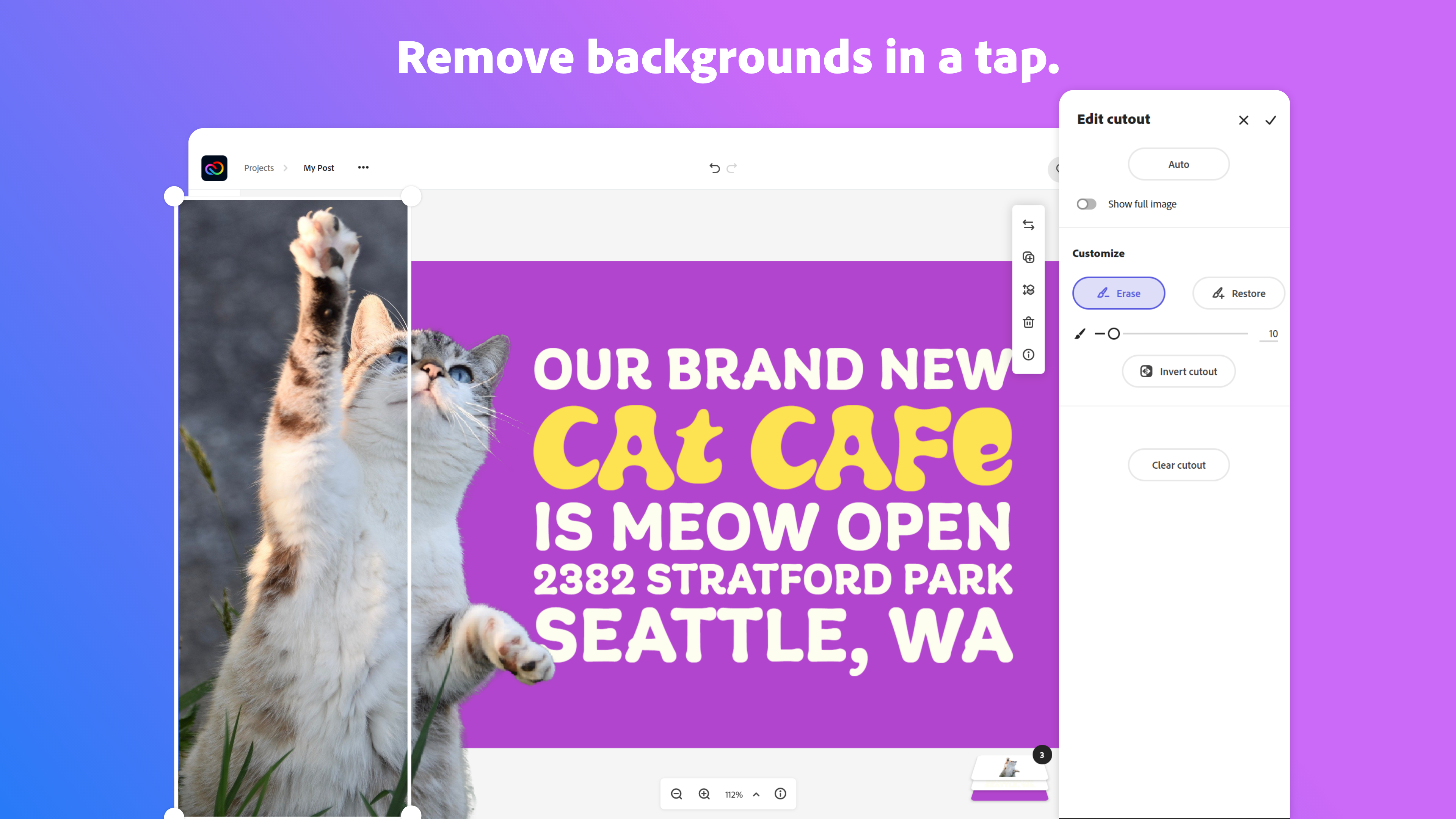
Adobe Creative Cloud Express (formerly Adobe Spark) is a task-based, web and mobile product used to create and share rich multimedia content – from social media posts and stories to invitations to marketing materials like logos, flyers and banners.
$0
Adobe Stock
Score 8.9 out of 10
N/A
Adobe Stock consists of curated asset collections that allow users to explore diverse collections of high-resolution, royalty-free, stock assets for use in digital projects.
$29
per month
Pricing
Adobe Express
Adobe Stock
Editions & Modules
Free
$0.00
Premium
$9.99 / $99.99
per month
Teams
$9.99
per month per user
Individuals
Starting at $29
per month
Teams
Starting at $29.99
per month
Offerings
Pricing Offerings
Adobe Express
Adobe Stock
Free Trial
Yes
No
Free/Freemium Version
Yes
No
Premium Consulting/Integration Services
No
No
Entry-level Setup Fee
No setup fee
No setup fee
Additional Details
Contact Adobe directly for Enterprise pricing plan details.
Well, they were using Canvas and I just knocked it out. We use After Effects too, but again, if you go into After Effects or Premier, you have to do a lot of addition. It's a lot more complex and Adobe Express for doing simple things. And I don't mean simple by diminishing …
I started on Adobe Spark / Adobe Express before ever trying Figma nad Canva. I tried them after being told how great the were by colleagues and honestly felt like they were cheesy and less adult. The final product didn't feel as polished and the user experience was lackluster. …
Express and Canva are very similar but backed by the power of Adobe; Express is the better option. Its feature set is greater, and the recent addition of Firefly is a game changer, making it leaps and bounds better than Canva. Certain features in Express that Canva doesn't have …
Adobe Express has stronger branding features. For example, it's much easier to save custom logos and styles and I feel like the end-products are more polished.
I used Canva for a long time, but since we already had the Adobe Creative Suite and Adobe Creative Cloud Express was included, I went ahead and started using Adobe Creative Cloud Express, as it was more cost-effective. Unfortunately, Adobe Creative Cloud Express doesn't offer …
Adobe Creative Cloud Express uses layers which is closer to the very widely used Adobe PhotoShop. Its integration with Adobe PhotoShop made it more familiar to use. But overall [in my opinion], Canva has more options of elements and effects.
I prefer Adobe Creative Cloud Express to Canva for the back-end interface. To me, Adobe Creative Cloud Express is more user-friendly and provides greater options. You really do get what you pay for. I was also able to learn how to use Adobe Creative Cloud Express with little to …
Adobe Creative Cloud Express offers greater versatility in creating, including video, images, and pages. Access to Adobe content will take your creativity to new levels and this alone makes Adobe Creative Cloud Express stand out and above the rest. Finally, the apps are …
I think the main benefit of Adobe Creative Cloud Express over PicMonkey is simply the ease of use for the App. PicMonkey did have a better web interface, but it's also meant for users who have experience with graphics, whereas Adobe Creative Cloud Express is the most …
I have not used any other products like Adobe Creative Cloud Express. Adobe Creative Cloud Express has been the best thing for me and my work. I have no need to use any other products that are remotely close to Adobe Creative Cloud Express. I will probably not look for any …
They both have great ease of use. More recently, Adobe changed something in its interface that created a small but consistently aggravating inconvenience, so Canva may be better in that aspect. The platform for Canva has great UX in my opinion. Adobe Creative Cloud Express …
While I think Adobe Creative Cloud Express and Canva are actually pretty similar, I find that kids tend to see Adobe Creative Cloud Express as a little more manageable and less overwhelming. Graphic design can be a little scary, and I think Adobe Creative Cloud Express does a …
Adobe Creative Cloud Express was chosen for us by somebody else in the organization, but I still really like it. Though I do like Canva, I'm so used to Adobe Creative Cloud Express now I'd never go back. We used to use Animoto (free version) and I do miss some of the …
Adobe Creative Cloud Express is easier to use than almost every other graphics program I’ve used. Those that are as simple, or simpler, do not produce creations with as professional and creative looks as Adobe Creative Cloud Express does.
We use Adobe Creative Cloud Express in addition to all of the above, depending on the project. It stacks up extremely well against all other products, except Premiere Pro on the video side (obviously). In the area that we use it most - for the on the fly social media - it is …
Canva has more free templates than Adobe Creative Cloud Express. The content planner option in Canva makes it different from Adobe Creative Cloud Express. Canva has a more easy-to-understand interface. We can use Canva on any device but Adobe Creative Cloud Express Post is only …
I think across the board, Adobe Stock is in line with all of these. It does seem to have better (and more) options than tools like Pixabay, but there are instances where we find something niche and specific on Pixabay that we did not find on Adobe Stock. I think Getty and Canva …
the main thing about Adobe Stock is first its integration with creative cloud you wont see this feature in any platform. the library is rich with high quality assets from vector to videos their offering is really good. their pricing structure is fair to everyone. the trust …
In my opinion, Adobe Stock is better value for money than the Shutterstock plan, and the free assets available on Adobe Stock are of higher quality than what can be found on Pexles or Unsplash.
The quality and number of images available make Adobe Stock stand out from other options. It's clear artists and creatives trust Adobe Stock with their portfolio - which is apparent in the variety of results provided from a search. The filtering options are more robust than …
Adobe Stock has a better selection than most. It also has a free trial to help you decide if the price is worth it. The other companies are free but you may not find the right image or it will take longer to find a unique picture for your needs. Adobe Stock adds new photos …
Adobe Stock stacks well against Getty, Depositphotos, Wix, and Unsplash. Although I sometimes find their stock imagery options to be less robust than Getty, I do like how purchased assets integrate nicely into CC libraries.
While adobe stock is similar to these products it is also very different. Photo stock sites and uses credits. This means sometimes you have to figure out how much credit is worth. Annoyingly this can get confusing for credit values. Adobe Stock is very straight toward and the …
We selected Stock as we have the entire suite of Adobe products and this pairs nicely as well as with its ability to easily integrate into PPT presentations and the Microsoft suite of products.
Adobe Stock is heads and shoulders better than Shutterstock. I found myself frustrated that Shutter stock didn't have what I needed or was too confusing to navigate to the original image due to so many low-quality fakes and duplicates. I soon learned that Adobe stock didn't …
Adobe Stock has the best automation for creating big data business creation for many users and is powerful in setting business security and managing larger data analytics and is best in integrating other tools and has best marketing aspects than other features in the field and …
Adobe Stock is less expensive and has a wider variety than other paid stock imagery offerings. They are far better than any unpaid image outlets as well.
Generally, Adobe Stock is cheaper than its big competitors but still has many of the same or similar images, though not quite the breadth of photography/illustrations either. However, it has significantly more options than its cheaper (or free) alternatives as well. The …
Adobe Stock is very user friendly. It’s the only one with full integration into other Adobe products. It’s also much more affordable than others like Getty. While it’s lacking some editorial content, there is a wide selection of images to choose from that stand out against the …
In comparison to other options, Adobe Stock is far more user-friendly. Adobe Stock has helped me find quality photos. One-stop licensing's convenience and variety were important. Instead of buying photos per image, we usually find something similar at Adobe and license it under …
both Adobe Stock and shutter stock fulfill the same function, I believe that both can satisfy their customers, however, the position that adobe has against shutter stock is immense, making there more confidence in adobe, in prices and what it offers each one according to the …
I have found that compared to Getty Images, Adobe stock is much more user-friendly. Adobe Stock has easy-to-use filters that make finding the perfect image much easier. I also believe that Adobe Stock has a wider variety of photos compared to Getty.
I've always had an easier time finding quality photos I needed on Adobe Stock. Other services like Shutterstock work fine, it's a personal preference for the catalogue of resources that Adobe curated vs other services.
Adobe Stock was given to us as initially an inexpensive add-on to our Creative Cloud subscription. Once the trial pricing expired, we found it so convenient, that we continued subscribing. The convenience of one-stop licensing and its wide variety was key. You do find some …
We use iStock and Adobe equally because we have subscriptions. They are pretty equal altho sometimes I think it's easier to find candid shots on iStock.
Pexels offered some great free stuff, but Adobe Stock has been the site of choice for graphic designers due to the size and quality of the images and videos that exist on the site. Budgetary choices were made by our company to use both, but the preference overall went to Adobe.
For on-demand buying, Adobe Stock wins in flexibility and per-image rates. Shutterstock offers the simpler buying method, though. Shutterstock has a larger collection of stock images, lower prices, and cheaper extended licenses if you buy them in bulk. Adobe Stock is better …
I needed to create quarterly safety training posters. In the past, I have used Canva. But in Canva's free version, your options are limited. So off to AE I went. I was able to find four templates to help me create my four posters. I found templates that looked like a movie poster, and the results were so professional looking. It was easy to add my own pictures from my computer to further personalize the posters. I loved them so much I made them into movie poster size printouts, sprayed some liquid glue on a styroboard, and hung them up around our offices. Our employees loved them too, and it drummed up more people to attend my sessions.
Well suited for background images and graphics where you want to channel an idea or theme that is known to the general population, e.g., a football field for a social media post related to a company fantasy league or a child holding crayons to promote a donation drive for local schools in need. Where it is less appropriate are images involving people and it's not necessarily Adobe's fault but it's very hard when you consider "your people" unique and want to reflect them in a way that feels genuine when you're creating graphics to represent your company. Many of the best shot set-ups and styles for pictures involving people that Adobe creates have people in them who just don't look like "our people."
Canva has a better interface, in my opinion... I like that this one is friendly to Adobe users, but I would likely recommend Canva to someone who's never used design software for a complete beginner.
Removing the background from images doesn't always work well. I almost always need to switch to Photoshop for this.
The touch screen interface could be better; graphics on mobile apps are tough in general but specifically, the iPad interface could use some improvement.
It does much more than images however for somebody that doesn't have experience using video or fonts it can be too much.
Cost can be a barrier for images that are not free. Your adobe membership does not transfer over to adobe stock unfortunately.
I have noticed certain images being used by others, some of their more popular images are often used and duplicated throughout my industry. This isn't a fault of them, but ideally, they would update their images more often.
I use it daily for almost all my marketing needs. So far it is the program that has the most and best to offer for what I need and is the easiest to use
Because it is easy to use, has a robust database of all kinds of photos, has industry photos that we serve clients in, is quick and easy to download the licensed images, easy to find similar images, cost effective, acts as a source of quality images we can use on high resolution art.
The overall usability of the software was strong. The application, especially relative to other Adobe services like Photoshop that can demand a lot of knowledge and skill, was highly easy to use. At the same time, that also speaks to the somewhat limited amount of customization opportunities that allow content designers to truly create content that is dynamic, engaging, and different than the standard stuff that floods our vision every day.
the user interface is very basic their filter function is difficult for beginners to use although after sometime of use you wont find any problem in that, their library is good but again. they still have to work on their library volume with current quality standards. apart from interface which is a personal perspective everything is amazing in this platform.
Because adobe is so widespread the community support is amazing. I have never actually used adobe support short of their website, but I go to youtube a lot to get my questions answered. You can google any problem you have and not have any issues finding an answer. In my opinion, community support is much more meaningful and helpful than support directly from the company
For users already in the Adobe ecosystem, Adobe Express is a great tool to consider for it's modern, professional templates, impressive stock image library and the easy drag-and-drop tools. I mostly do most of my work on desktop, but I know Canva is generally better for mobile usability and its got more third-party integrations that may be important to some users.
In comparison to other options, Adobe Stock is far more user-friendly. Adobe Stock has helped me find quality photos. One-stop licensing's convenience and variety were important. Instead of buying photos per image, we usually find something similar at Adobe and license it under our subscription. I prefer Adobe's curated resources over other services. Adobe Stock's filters make finding the right image easy.
It has allowed us to complete more demos and projects in less time by being so flexible.
It has positively impacted our efficiency in delivering creatives such as YouTube thumbnails, event poster designs, Instagram story posts, etc to clients in a timely manner no matter where work takes us.
I would say the ROI has been seeing more projects completed and invoiced per month. I would estimate overall a 20% increase in volume on deliverables.
I used stock photos for my blog posting on medium and website creation. I found adobe stock a very amazing site for high-quality images.
It has resolved the issue where I would spend countless hours looking for a photo on Google or other stock-image websites, no other stock photos website is perfect and stunning like Adobe Stock. Overall, it's a fantastic time-saver.
Overall, I found images impact more than words while blog posting on medium and other social media, so I can say that Adobe Stock helps me in growing my startup…