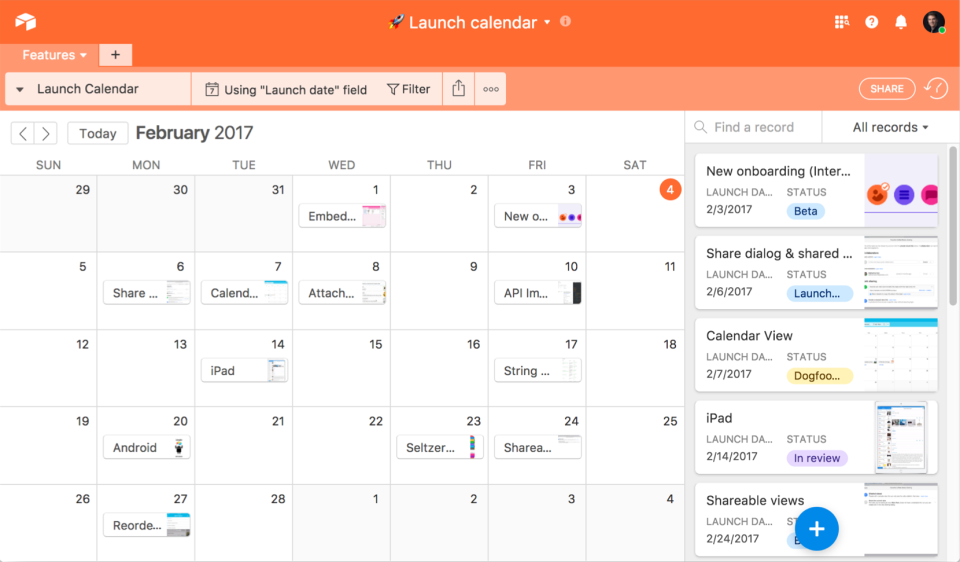
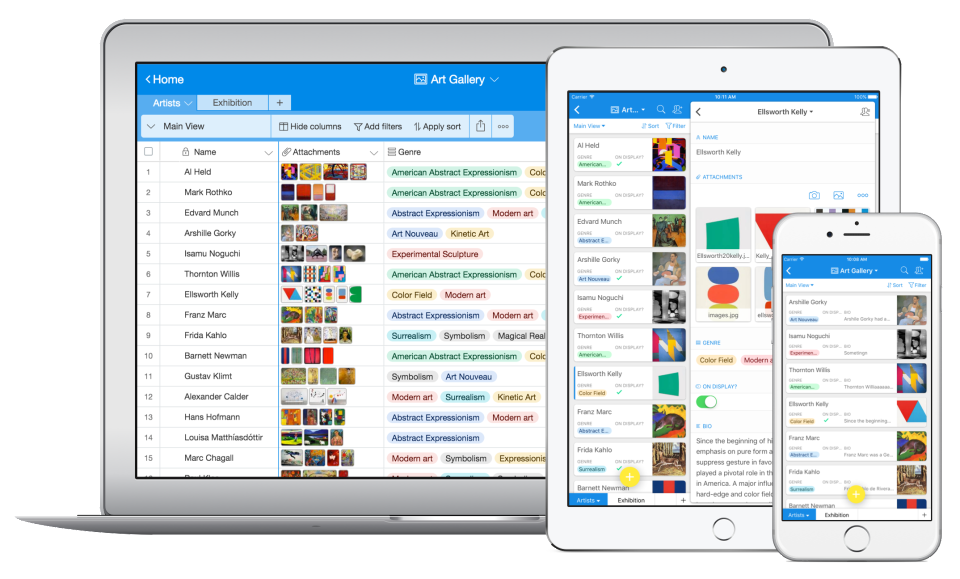
Airtable is a project management and collaboration platform designed to enable content pipelines, product management, events planning, user research, and more. It combines spreadsheet,database, calendar, and kanban functionality within one platform.
$24
per month per user
Zeplin
Score 6.8 out of 10
N/A
Zeplin, from the company of the same name, is a platform supporting collaboration in application development by engineers and designers by providing an API with popular collaboration, development and prototyping tools and creating a space where productions can be shared and reviewed.
Airtable is the best for structuring, automating and interacting with data, but only for internal use. For public-facing needs, other apps are required for their support of custom domains and styling.
Airtable is far more sophisticated than Sheets or Excel in terms of its functions. The interface is also much easier on the eyes. People are less familiar with it and there is a bit of a learning curve, but overall, Airtable empowers us to do more and to better understand our …
Airtable is the most user-friendly and adaptive. It's UX/UI is the most aesthetically pleasing (which matters a lot if its what you're staring at every day), and the customizability of having different views and perspectives of the same record is extremely helpful.
It is not comparable because we use it as a bridge those tools and our platform. So, in our use case, Airtable works more as a connector between the different tools we use and as a complement to eliminate repeated tasks trough automation. We are also exploring the possibility …
AirTable does a great job at Project Management. You can easily create tasks and set up reminders, including automated reminder emails, when deadlines draw near. You can group the tasks and can also group tasks in a variety of ways (not started, pending, completed or …
Airtable was a really good fit for this specific use case as it provided a huge number of collaboration features in an intuitive and pleasant-to-use interface. The free tier worked initially with our work, and the upgrade pathway was fair and made sense for us.
There's a saying that spreadsheets were never meant to be databases, and Airtable provides the missing piece for nontechnical users who need to hear that saying. It's more performant and provides more custom view options, for example, than Excel or Google Sheets.
Airtable is as powerful, if not more than these competitors. It has a simple interface like Asana or Trello but has robust data functions and tracking of Jira or ShotGrid (now called Flow). While I haven't found it as profoundly integrated as Jira, Airtable feels much more …
While a very capable tool, Smartsheet ultimately didn't provide the ease of use we required for our scenario. Monday was a great tool that felt very similar to Airtable, except its mobile app actually lead to some mismatched information and difficult use in time-sensitive …
I have tried Trello, Monday.com, Meister Task, and even Google Sheets. They are all great and solid applications. Some even have really nice user interfaces. However, none of them have met my primary need of being able to view my current projects and associated deadlines at a …
Airtable exceeds all competitors I’ve seen. The feature set is full and only growing. The UI is intuitive for non-tech employees. Any competitors that match Airtable are really operating in a different space. Airtable is the industry leader in this category. Period.
Asana is a great piece of software but it ultimately had too many features and offerings. Our main focus was having a 'smartsheet' that easily allowed for collaboration at a very affordable price. Airtable was the best fit for what we were looking for at the time. If we ever …
We have tried to use smart-sheet before but it is nowhere as good as Airtable. The user interface with Airtable is much better and it also has much more functionality.
The only similar thing that I have used is Google Sheets, and Airtable is much better than this as it provides way more abilities and creation of automation.
Zeplin is used for us purely as a handoff tool. It keeps it clean and clear for devs and product managers what is completed. It has some good labels and other organizing features. The different levels of access are also super helpful to give the correct people the view they …
As our project is large and there are many modules and they should be consistent. So, Zeplin's style guide can be shared globally across different projects and we can easily ensure consistency across all modules. Zeplin automatically exports assets in multiple file formats like …
Actually, we didn't select Zeplin. After a long time of internal discussions, the majority of the team decided that we want to move to Figma. We still use Zeplin as a legacy, but we don't use it for new features. In my opinion, it's less flexible than Figma, which allows …
We went without a tool like Zeplin for a long time, but as we grew we needed to get a better handle on the design process and handoff to engineering. We went straight to Zeplin off of numerous recommendations and didn't look back. We have had a great experience with Zeplin.
Zeplin is more focused on the handoff than in the creation itself. The other alternatives can do both, but Zeplin is an awesome tool for the handoff part. It depends in how big is your team and how the workflow is organized to understand whats the best tool for your team.
It was a business need from different departments. From an IT point of view, we have been a part of purchasing and setting up. However, the decision to go with Zeplin was not ours.
Out of all of the products that I have used to support design-to-development handoffs, Zeplin is my favorite. It’s pretty lightweight and easy to use (once you get the hang of it). Zeplin also has a smooth interface and is, generally, clearer to use than other tools, such as …
These other tools are really helpful products for creating and sharing wireframes / prototypes. However, Zeplin is the best tool for the actual hand off between the design and development teams once the design is actually ready to share. Zeplin fills this gap and improves the …
Zeplin is simpler. Zeplin lacks prototyping on par with Invision. Zeplin doesn't give a direct code for Android and iOS like Figma does. Zeplin doesn't have a lot of advanced features like Invision, for example, whiteboard. But Zeplin is good for at its job which is to share …
Zeplin is a really nice lightweight app, that is easier to use than Invision for sharing purposes. Invision does primarily handle prototyping, which Zeplin does not do. Abstract is my product of choice but is also a slightly different tool — almost a Github for design. It …
We chose Zeplin because it allowed our product and design teams to collaborate more effectively, while providing the rest of the organization an easily accessible location to access up-to-date assets. While InVision's interface can be more intuitive, we prefer Zeplin because it …
Marvel is a pretty expensive application for what it gives you, it is a pretty good tool but I think the handoff is not as good as Zeplin's. I think the style of Zeplin is more oriented to developers and Marvel is more oriented to the designers. I like the way Zeplin is …
Zeplin is great to inspect and share user interfaces, specifications and assets, perfect for developers. Tools like Invision and Marvel are much better to create prototypes for both developers, coworkers and even stakeholders, but they don't have this kind of feature …
For my company needs, Zeplin comes as the best tool in its category. Zeplin's competitors are great tools but they either offer way too many features or are priced above Zeplin with the same features.
Zeplin is in the right spot for both pricing and features.
I know there are other products out there but Zeplin has been so effective that I haven't even bothered to look elsewhere. The whole experience of Zeplin has been excellent. However, once Adobe XD is more built out Zeplin will finally have a formidable competitor as it will be …
Zeplin is much better when it comes to seeing the properties and CSS code of the design elements. Our developers love it when they get all that info from the Zeplin file.
Zeplin is the only solution tailored for this common use case. Previously we just shared files in dropbox but that was messy and didn't allow for specific comments, etc.
Airtable is well suited for cross-functional teams who all have an interest in data site - it's democratizing who owns data. Especially if there will be a need to add input on a cell-level basis view comment functionality with the expectation of @mentioned parties respond. Airtable is less suited for teams who need to run functions, jobs, and macros across a data set; they're best suited for Excel.
I still have some issues, especially with color integration between the style guide and also project. When we update the colors, it's not automatically sync to every project. Aside from that, zeplin solves my problem for hand-off design from design to developer. I set zeplin is source of truth design file
Airtable has capabilities commonly found in spreadsheet applications, but also has some of the features found in databases.
The ability to filter fields. I set up a filter on the status field, so when a project is marked, complete, on hold, or canceled, that record is hidden from my current projects table view. If it is marked complete, the record is moved to the completed projects table view. In this way I can easily access a record of past projects
Being able to duplicate tables and create alternate views
Collapse and expand records. When I collapse the rows, I can easily scan current projects, next steps, project status, and due dates. When I expand the row, or field, I can see more detailed information about that field or record very easily. I can also expand or open the entire record. This is is helpful, when I am entering a lot of information to multiple fields in that record.
Airtable does not integrate with collaboration services with which it is possible to review live changes within each spreadsheet (in the case of keeping them closed).
Does not automate analysis traffic.
It does not include any section where it is possible to communicate with the other editors.
We love Airtable for how we use it and we know there are probably tons of other ways we can implement it for other departments. We just haven't gotten there yet (due to bandwith) Customer Support is also super helpful and overall ease of use is fantastic
Airtable is a simple and intuitive tool. However, when you first set it up, you need someone who is curious and able to design a system that works for your organisation's use case. This takes some time, but it can be intuitive once it's set up.
Zeplin's component management and style guide help us to be consistent across whole product and it so easy to use for non-technical person. It is now easy to collaboration for designes between different teams like stackholders, product owner, UI/UX, developers and testers. Now there is only one point of reference is Zeplin so it is so easy to get details without asking designer or developer again and again.
I have rarely experience downtime, compared to other tools, and given how much time we spend on the tool. Even if there were to be, their updates on it are very timely, and our support team are able to provide any questions regarding
I never had any issues with load time, even with the integrations that we use today (google sheets) However, I'm curious if adding additional layers of integrations would slow down performance. We do carry quite a bit of data in Airtable, but, again, no impact on overall performance
Airtable has great support. They have a variety of support features to answer any questions. They have great self teaching instructions for templates and product tours. They also have support for teams and project management. They also have a fantastic customer help line. They are able and willing to answer customer questions and never have customers waiting long
Zeplin has classic support with a chat from the website. It's working fine, and we're also getting the support needed when needed. However, Zeplin is very good at closing the incidents and moving on. It was a while ago we had a case with their support so that it might have improved since then.
Recorded trainings were provided by the Airtable team. Great as an evergreen resources to new team members and for anyone that wants to refresh their Airtable knowledge
Training all users was an important part of the implementation, which did take considerable time and effort. At first glance without training, the content calendar can be overwhelming because of the amount of data. The features within Airtable seem to be endless but our team was able to identify the most important to be successful.
Airtable is the most user-friendly and adaptive. It's UX/UI is the most aesthetically pleasing (which matters a lot if its what you're staring at every day), and the customizability of having different views and perspectives of the same record is extremely helpful. It's also a great cloud-based storage place for marketing materials, as it goes beyond simple storage - you can group together, make notes, connect, and comment on assets.
Out of all of the products that I have used to support design-to-development handoffs, Zeplin is my favorite. It’s pretty lightweight and easy to use (once you get the hang of it). Zeplin also has a smooth interface and is, generally, clearer to use than other tools, such as InVision. Plus, all of the plug-ins that you can use with Zeplin have supported the design-development relationship and workflows in which I’ve been involved in more efficient, clear, and effective ways than I’ve seen with any other product.
There are TONS of opportunity to scale, but I think it's a matter if you have the time and resources to do so because the initial setup can be fairly time consuming and prioritized dedication
Through this platform, I always have the idea bout which of my team member is working on which particular part of the project, I can easily track their progress, and also I can easily correct them where it is required by adding sticky notes, by sending the attachments and URLs.
We're using the free plan, so it fits in our needs, although we're limited to create only one project at a time
Sketch has some plugins that offers exactly what Zeplin does, for free
The integration with design apps (Sketch, Photoshop, XD) and collaboration (Slack and Trello) helps our team to better communicate and be notified on every update