Akamai Cloud Computing vs. Mirantis Kubernetes Engine

Overview
ProductRatingMost Used ByProduct SummaryStarting Price
Akamai Cloud Computing
Score 7.9 out of 10
N/A
Akamai Cloud Computing (formerly Linode) include scalable and accessible Linux cloud solutions and services. These products and services support developers and enterprises as they build, deploy, secure, and scale applications.N/A
Mirantis Kubernetes Engine
Score 9.4 out of 10
N/A
The Mirantis Kubernetes Engine (formerly Docker Enterprise, acquired by Mirantis in November 2019)aims to let users ship code faster. Mirantis Kubernetes Engine gives users one set of APIs and tools to deploy, manage, and observe secure-by-default, certified, batteries-included Kubernetes clusters on any infrastructure: public cloud, private cloud, or bare metal.
$0
per year
Pricing
Akamai Cloud ComputingMirantis Kubernetes Engine
Editions & Modules
No answers on this topic
Free
$0.00
per year
Basic
$500.00
per year
Offerings
Pricing Offerings
Akamai Cloud ComputingMirantis Kubernetes Engine
Free Trial
YesYes
Free/Freemium Version
NoYes
Premium Consulting/Integration Services
NoNo
Entry-level Setup FeeOptionalNo setup fee
Additional DetailsCPU, transfer, storage, and RAM are bundled into one price. Storage capacity can be increased with additional Block Storage or S3-compatible Object Storage. Instant Backups can be added with complete independence to the stack. Linode NodeBalancers ensure applications are available.These pricing options are compatible with Linux or Windows Server and are per year, per node. The basic version requires maximum online purchase not to exceed 50 nodes. Support/professional services are not included.
More Pricing Information
Community Pulse
Akamai Cloud ComputingMirantis Kubernetes Engine
Considered Both Products
Akamai Cloud Computing
Chose Akamai Cloud Computing
Better efficiency, better cost savings, improved Return on Investments. Overall the Akamai Connected Cloud (Linode) cloud solutions are a step above the competition in regards to all categories. We prefer it for several reasons but the one that stands out is the cost and …
Chose Akamai Cloud Computing
It is more user-friendly than the big three cloud providers like AWS and GCP. The interface blows them out of the water; pricing is so much more competitive—no egregious bandwidth fees like AWS. As a small startup, cutting out the overhead of ultra-complex UI and pricing …
Chose Akamai Cloud Computing
The Linode interface is just vastly better, easier, more responsive. Pricing overall is similar, but Linode is better for short term testing.

Chose Akamai Cloud Computing
Compared to AWS EC2, Linode has an easier creation of services and lots of options to pre-select and get a ready VM installed in minutes.
Chose Akamai Cloud Computing
The thing that caught my eye was the price to start with. I move to Digital Ocean because they had better options for virtual network isolation, but I came back as soon as Linode fixed the issue. There support is great and things just work.
Chose Akamai Cloud Computing
RackSpace had priced themselves out of the market, when compared to Linode
Chose Akamai Cloud Computing
We have used both DigitalOcean and EC2 in the past, and a client is currently using EC2.

DigitalOcean certainly has some attractive offerings, particularly price-wise, but it did not seem to suit our needs at the time.
Chose Akamai Cloud Computing
We switched to Linode from NameCheap due to poor uptime, and never had any issues with stability ever again after switching. We also cut our costs in half by switching. We compared Linode to DigitalOcean and Vultr, with the primary factor that caused us to go with Linode …
Chose Akamai Cloud Computing
I could not talk to anyone at all with digital ocean. I still cant turn off their billing. I hate those guys. They are good for techies - terrible for small co. owner like me that does not have techie staff on hand every day
Chose Akamai Cloud Computing
We evaluated DigitalOcean vs. Elastic Beanstalk before Linode, which was pretty cost intensive for deploying basic machines in the cloud for experimentation purposes. So, we had to switch to Linode for cost-effectiveness and default security mechanisms built inside Linode.
Chose Akamai Cloud Computing
Compared to the big cloud players like Amazon Web Services, Google Cloud Platform, MS Azure, Oracle Cloud, and co., Linode's product is simpler and cheaper. For quick and straightforward client engagements, the power and flexibility afforded by the previously mentioned vendors …
Chose Akamai Cloud Computing
Amazon Lightsail, Amazon Elastic Compute Cloud (EC2), Amazon Relational Database Service (RDS) and DigitalOcean Droplets
Chose Akamai Cloud Computing
We've used larger solutions, including AWS, Azure, Google Cloud, and Oracle Cloud. In each case, the pricing was confusing and, with all of the add-ons needed for even a simple infrastructure, ended up being several times the cost of a similar Linode solution. On the flip side, …
Chose Akamai Cloud Computing
Linode's offering is almost identical to DigitalOcean's, but I find Linode's customer service better AWS, Azure and Google Cloud provide all services Linode does, but provides a much large set of other features and customizations.
Chose Akamai Cloud Computing
I personally feel that Linode platform is more stable and faster than other platforms. While other are great Linode has never let me down. I've hosted with other providers for clients because that's who they were using and they definitely go down more than Linode has.
Chose Akamai Cloud Computing
AWS Instance, AWS S3 Bucket, and other AWS Services. Linode is more cost-efficient, easier to deploy servers.
Chose Akamai Cloud Computing
Linode delivers higher performance cloud servers, within an easier web interface, simpler API, and better cost-benefit. Amazon has a complex interface that many times make the customers spend much more time in order to finish simple tasks and use "AWS-terms" so even if you need …
Chose Akamai Cloud Computing
Linode has a much better range of data center locations than DigitalOcean. DigitalOcean has slightly better pricing and included backups( not extra backup fees like with Linode)
Chose Akamai Cloud Computing
Linode offers the most applicable services to the users through Cloud deployment and easy data management capabilities, and even easy project cost management. The features adaptation is easy and quality services from the migration of data and demand monitoring and the project …
Chose Akamai Cloud Computing
I've had performance issues with other providers, and when running workloads where CPU performance is vitally important, my experience with Linode has been excellent. The cloud landscape is crowded, and I think it's important to know why one vendor might stand out amongst …
Chose Akamai Cloud Computing
I chose Linode instead of AWS and Google Compute for two reasons: 1. Cost: With Linode, I can deploy a Linux VPS as cheap as 5 a month that meets my website requirements. 2. User Interface: I admit that AWS EC2 and Google Compute are too complicated for me, but Linode is easy …
Mirantis Kubernetes Engine
Chose Mirantis Kubernetes Engine
I didn’t select Mirantis Cloud Native Suite (Docker Enterprise) when I joined this organisation it was already being used here. The one thing I can say about Mirantis Cloud Native Suite (Docker Enterprise) is easy to use and creates a good impact in the businesses. So, I …
Chose Mirantis Kubernetes Engine
So far I haven't used any other containerized product except Docker Enterprise because in terms of community support and tutorial videos, Docker has a better reach than other tools.
Docker can be easily set up from local to the cloud without worrying about the flavor of OS …
Chose Mirantis Kubernetes Engine
I have not used any other software as a container management solution. Its containerized apps allow the usage of less memory, thus they start and shut down very fast. This tool is helping the enterprise software to work quickly against the changing conditions thus offers great
Chose Mirantis Kubernetes Engine
I have heard about others, but all my professional life I have been using Docker as my primary container and the thing is you just don't need anything else right now. Because Kubernetes supports Docker and Docker is open-source and just very simple to get started with. 10 …
Chose Mirantis Kubernetes Engine
I have used Vagrant for consistent development environments as well. It is a more "heavyweight" solution since it's a complete virtual machine that requires a host like VirtualBox in order to run. With Docker, the container is much more lightweight and just requires the docker …
Chose Mirantis Kubernetes Engine
FreeNAS, I don't wish to bad mouth any product but it appeared that iXsystems just did not want to help their users or attempt to resolve issues. It looks good on paper and it worked well for me for about 4 years until I needed more support and a more complex and bigger …
Chose Mirantis Kubernetes Engine
Docker has become the defacto service, as far as I have seen, to run Linux or other tools on any OS and architecture and get the same output. I have used vagrant in the past, but it was much more complicated to use. Docker is very common among developers, so documentation and …
Chose Mirantis Kubernetes Engine
Dockers isn't a replacement for VMWare or VirtualBox in all cases. It's fundamentally a different way to solve the development problem. We use Docker when we need a lightweight, fast development scaffold. We use other virtualization solutions if we need GUI access or need a …
Chose Mirantis Kubernetes Engine
I would also compare to BSD Jails, LXC, and Solaris Zones, but they weren't listed. One of the first reasons we decided to use Docker over other container applications is because Docker is the default everyone recommends and is easily the most popular. We found Docker to be …
Chose Mirantis Kubernetes Engine
Docker provides less lock in and more portability than Heroku. You can also easily self host or choose a Docker hosting service. Additionally, there is a wide availability of Docker containers where Heroku build packs are somewhat more limited. Heroku offers a more turnkey …
Chose Mirantis Kubernetes Engine
We've used XAMPP, PHPmyAdmin and similar local environments (our app is on PHP).

Because of how easy you can change the configuration of libraries on PHP and versions (which is SO painful on XAMPP or other friendly LAMP local servers) we are using Docker right now. Also, being …
Chose Mirantis Kubernetes Engine
Docker isn’t a buzz word. It has promising return on investment and a bright future ahead backed up by the open source community.
Chose Mirantis Kubernetes Engine
Prior to docker, we had a custom build and deployment system. For local development, we use VirtualBox to host our VMs, while our custom VMs resided directly on the servers. We chose Docker primarily to allow us to get rid of our custom deployment system, both simplifying build …
Chose Mirantis Kubernetes Engine
Docker is great because of how the Docker Runtime works and how it eliminates the need to have the full operating system overhead that you'd find in a virtual machine (VM), keeping things lightweight and compatible regardless of where you go. Having an isolated, full Linux …
Chose Mirantis Kubernetes Engine
For light weight frontends, the Docker Swarm is the easiest to manage. One person can then mange the production environment and at the same time develop new software.
Chose Mirantis Kubernetes Engine
While Ansible and Docker focus on solving two different problems, we were previously using Ansible to ensure that all dependencies were automatically setup on new servers and that proper configuration was applied when new nodes were brought up. With docker, most of these …
Chose Mirantis Kubernetes Engine
While we still use virtual machines [for our Docker servers], we prefer Docker containers for our deployments. It really allows for a simpler infrastructure footprint to manage. For example, instead of managing 30 virtual machines with one or two apps on each VM, we could …
Chose Mirantis Kubernetes Engine
I had to use virtual machines before, the last one was VirtualBox. I was only a user there, I wasn't responsible for the configuration, it was a black box for me. When I had to use Docker for the first time I was a skeptic, but it proved to be easy. I can't really compare the …
Chose Mirantis Kubernetes Engine
Doocker lacks a lot of the scaling, automation, integration of 3rd party tools/solutions, and integration of shared high-performance self-healing storage, solutions like Heketi provide those missing pieces.
Chose Mirantis Kubernetes Engine
Docker runs both locally and on the server, whereas VirtualBox is only used locally to create a development environment. Docker gives us the ability to have the exact same environment both in the cloud and on individual developers' laptops. There are no surprises for the team, …
Chose Mirantis Kubernetes Engine
Vagrant is another software that offers similar [features that] stack to Docker. It offers an isolated container similar to Docker but Docker is lighter weight because it does not have the additional overhead of a VM Container. Docker has a much larger community of developers …
Chose Mirantis Kubernetes Engine
Docker is a different beast in that it is not trying to solve all of your infrastructure problems or most of them, it is simply trying to provide a reliable container serviced based on linux containers in which you can easily and quickly deploy microservices. LXD does provide …
Chose Mirantis Kubernetes Engine
Docker doesn't directly compare to very many other services. It is unique in its field. However, I love how fast Docker services spin up in comparison to VM-based or server-based applications. Docker is being adopted at a fast rate in the industry, so it's great to see Docker …
Chose Mirantis Kubernetes Engine
Before Docker, we were using Chef to manage our deployments. Chef didn't provide the environmental consistency and release confidence we needed. We had a split process between how the build servers, the developers and the deployed environments were managing the software …
Best Alternatives
Akamai Cloud ComputingMirantis Kubernetes Engine
Small Businesses
DigitalOcean Droplets
Score 8.7 out of 10
Portainer
Portainer
Score 9.6 out of 10
Medium-sized Companies
SAP on IBM Cloud
SAP on IBM Cloud
Score 9.5 out of 10
Red Hat OpenShift
Red Hat OpenShift
Score 9.3 out of 10
Enterprises
SAP on IBM Cloud
SAP on IBM Cloud
Score 9.5 out of 10
Red Hat OpenShift
Red Hat OpenShift
Score 9.3 out of 10
All AlternativesView all alternativesView all alternatives
User Ratings
Akamai Cloud ComputingMirantis Kubernetes Engine
Likelihood to Recommend
9.0
(0 ratings)
8.3
(0 ratings)
Likelihood to Renew
9.3
(0 ratings)
9.1
(0 ratings)
Usability
9.4
(0 ratings)
8.0
(0 ratings)
Availability
9.1
(0 ratings)
-
(0 ratings)
Performance
8.2
(0 ratings)
-
(0 ratings)
Support Rating
9.2
(0 ratings)
7.8
(0 ratings)
Online Training
8.2
(0 ratings)
-
(0 ratings)
Implementation Rating
9.1
(0 ratings)
-
(0 ratings)
Configurability
9.1
(0 ratings)
-
(0 ratings)
Ease of integration
9.1
(0 ratings)
-
(0 ratings)
Product Scalability
9.1
(0 ratings)
-
(0 ratings)
Vendor post-sale
9.1
(0 ratings)
-
(0 ratings)
Vendor pre-sale
9.1
(0 ratings)
-
(0 ratings)
User Testimonials
Akamai Cloud ComputingMirantis Kubernetes Engine
Likelihood to Recommend
Akamai Connected Cloud Linode would be a good service to host a content delivery network (CDN) because of its edge network but I'd prefer not to use Akamai Connected Cloud Linode for tasks that need GPU power such as Machine Learning or Artificial Intelligence (AI) because Akamai Connected Cloud Linode lacks deep GPU compute compared to AWS or Google Cloud or Microsoft Azure
Read full review
Docker is great for when you would want to use a VM for any given application, but don't need the overhead of the whole OS. Docker containers use very little computing resources, boot up very quickly, and are very easy to set up. An instance where Docker may not be appropriate would be for an application that requires good security. If in this situation, a true VM would probably be your best bet.
Read full review
Pros
  • Many locations of datacenter
  • Wide selection of pre-installed applications in the marketplace
  • Price is very affordable.
  • User interface in the account panel is easy to understand.
  • Fast server
  • Linode provides tutorials for new users thru Youtube channel.
  • Payment is per usage, not monthly.
  • Responsive customer service
Read full review
  • Containerization - allowing multiple micro-services to function together without in-depth orchestration at the VM level.
  • Rapid deployment - a developer with appropriate access can simply push to the correct remote and the deploy happens automatically from there
  • Decouples provisioning from VM administration - allows containers to be deployed (more) regardless of VM set up.
Read full review
Cons
  • The (new) 'create custom image' function needs a bit of work before it is useable.
  • New accounts have limited features until a support requested is made to turn specific ones on. It would be useful to have an account page that tells you what is disabled so unpleasant surprises are not had at the pointy end of a deadline.
  • Stackscripts would be better if it more info was transferred to the script. Eg the Linode Label given, plan requested, etc. But now I am just nit-picking
Read full review
  • Docker has a bit of a learning curve, and it takes some time to become familiar with the tooling and syntax. Transitioning an existing architecture to docker can represent a significant investment.
  • Docker attempts to provide some level of cross-host container orchestration via swarm, but it falls short of third-party solutions like kubernetes.
  • We occasionally run into stability issues when the docker daemon is subjected to high load (many applications starting/stopping frequently). In these cases, docker hangs and we have to restart or replace the node.
Read full review
Likelihood to Renew
In this eight years of being Linode's customer, there hasn't been a single day we faced problem. Even the migration or maintenance activities have been planned, organised and priorly informed. Kudos to taking care of even such small metrics. Though the instances are unmanaged, the support team helps with relevant document links, or their own articles that help us to fix or solve the issues we face.
Read full review
No answers on this topic
Usability
It's pretty easy for me, but I preferred their old interface before it was called 'cloud' (not a computer science term.) The new interface looks easier but I had to ask for help for things I used to be able to find myself. If someone was new to it--without having used their old interface--it might be easier for them than it originally was for me.
Read full review
Docker's CLI has a lot of options, and they aren't all intuitive. And there are so many tools in the space (Docker Compose, Docker Swarm, etc) that have their own configuration as well. So while there is a lot to learn, most concepts transfer easily and can be learned once and applied across everything.
Read full review
Reliability and Availability
There is very little planned downtime. Whenever planned downtime is necessary I'm always given lots of advanced notice and an explanation that I can pass along to my users that they'll understand. I really appreciate that Linode appreciates my commitment to reliable service to my users. It shows that they believe they've been successful when I'm successful.
Read full review
No answers on this topic
Performance
Servers are well dimensioned and price performant. Of course one always wants more, so if they were to upgrade their hardware for the same price I'd consider moving more workloads. Networking - never had an issue. Hardware speeds - disks are fast and can grow to great size.
Read full review
No answers on this topic
Support Rating
Support was excellent and fast. The documentation is extensive and helpful. I learned many things from their online documentation. I did not contact them by phone, but email took a day or less. Complex problems would probably need a service contract. I liked the friendly and polite tone of the support.
Read full review
The community support for Docker is fantastic. There is almost always an answer for any issue I might encounter day-to-day, either on Stack Overflow, a helpful blog post, or the community Slack workspace. I've never come across a problem that I was unable to solve via some searching around in the community.
Read full review
Online Training
We got kick started with an initial walkthrough along with some free credits. The initial walkthrough helped us to understand Linode's ecosystem and start our hands on with Linode. We tried out some apps from Marketplace initially with the free credits, which not only helped us understand Linode better, but also those apps. We had implemented many such apps to our customers with Linode
Read full review
No answers on this topic
Implementation Rating
We're a small organization. The implementation of our Linode solution was trivial. Once I justified a cloud server to my bosses over a co-location -- the co-lo wasn't as fast as our linode server in load tests -- it was a matter of moving one Linux implementation to another. Trivial.
Read full review
No answers on this topic
Alternatives Considered
It is more user-friendly than the big three cloud providers like AWS and GCP. The interface blows them out of the water; pricing is so much more competitive—no egregious bandwidth fees like AWS. As a small startup, cutting out the overhead of ultra-complex UI and pricing dramatically helps. It seems to be matched tit-for-tat with DigitalOcean, and their UI is similar in many ways. DigitalOcean has more mature capabilities, even though Linode/Akamai was founded earlier. Linode/Akamai provides better price-per-performance, though, as DigitalOcean is expensive nowadays.
Read full review
I have not used any other software as a container management solution. Its containerized apps allow the usage of less memory, thus
they start and shut down very fast. This tool is helping the enterprise
software to work quickly against the changing conditions thus offers great
scaling by simultaneously allowing me to meet the demands, which also leads to
easy implementation of the strategies.
Read full review
Scalability
I completely agree with the above statement. Linode provides the best option in terms of configurations and scalability. We have chosen share CPU instances many times and then moved on with dedicated CPU instances, just with a click of button.
Read full review
No answers on this topic
Return on Investment
  • Over the years, Linode has enabled us to stop maintaining our own server hardware, and leave that up to them.
  • On the other hand, Linode provides a bare machine, and requires us to provide almost all of the systems administration effort.
Read full review
  • We are able to try things very quickly compared to before. If you need to debug it, changes on X/Y/Z will have an impact on the way your app works, and changing libraries or configurations of the environment easily can improve your development cycles.
  • In case someone new arrives, the onboarding is pretty easy thanks to Docker. We have tried many configs and images until we reached a point were we have what we want. We don't have to painfully do that again for every new user. We just send him the image.

Read full review
ScreenShots

Akamai Cloud Computing Screenshots

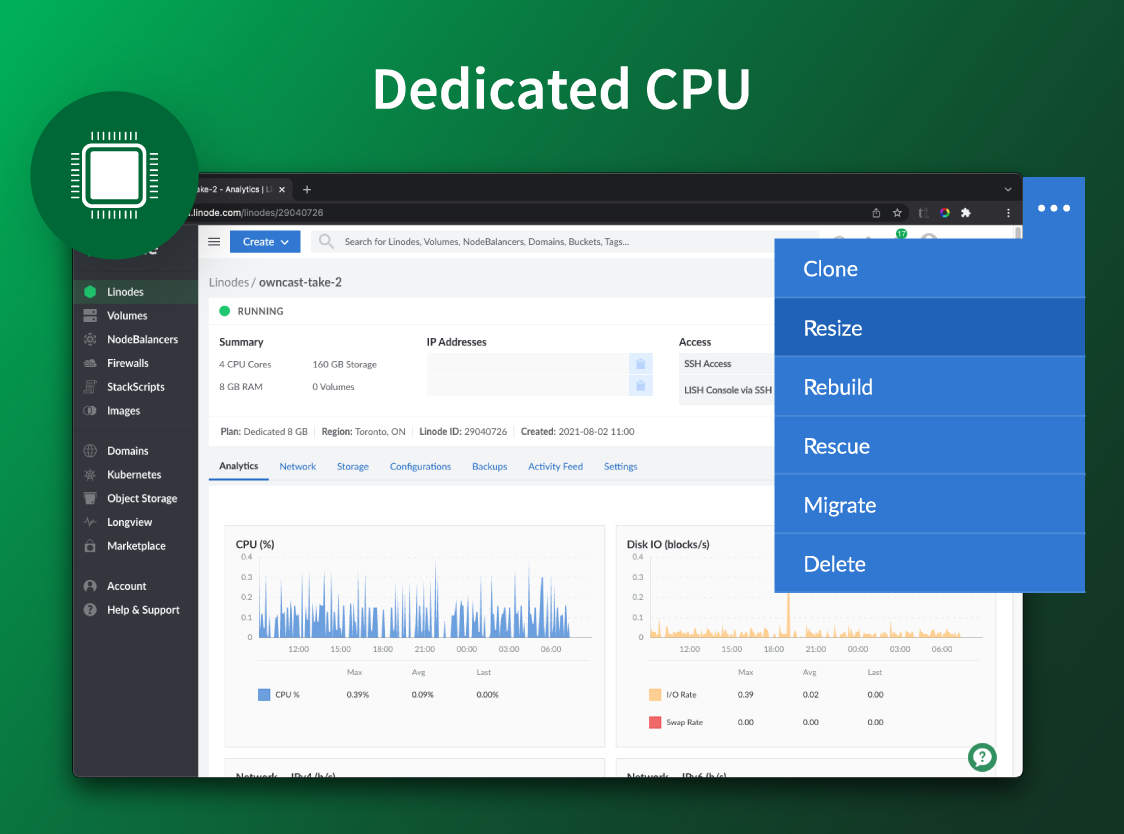
Screenshot of the interface to manage all LinodesScreenshot of the Cloud Manager used to create Linode instances, manage Kubernetes clusters, add backups to Linodes, deploy Marketplace Apps, or create Object Storage buckets.Screenshot of the fully-managed container orchestration engine to deploy Kubernetes clusters.Screenshot of dedicated CPU instances that run on their own CPU cores. No sharing the processor with other instances.