Altify’s suite of Salesforce native solutions guide and coach sellers to identify and map key relationships, uncover business insights, align sales processes to buying processes, qualify, manage and execute deals, and grow wallet share in accounts.
N/A
Oracle Sales
Score 8.0 out of 10
N/A
Oracle Sales guides sellers with intelligent recommendations to help them focus on the most valuable prospects at the right time. These machine learning-based CRM selling tools center around clean, complete customer data from internal and external sources.
While Skuid is not a match to what Altify does in terms of capabilities, Skuid did allow us to natively create the functions that we needed within the business in a way that was more useful than the Altify tools out of the box functionality. Altify does not offer anything for a …
Oracle Sales provides much more data than previous tools I've used. While others may be more user friendly or provide more graphic context, Oracle Sales by far has the most impactful data that I use day to day. Being said, I think Oracle Sales can make improvements to make this …
Oracle CX Sales was a comprehensive package just because of the modules offered. Compared to the products we evaluated and the in-house solutions we had, including maintaining data on excel and access databases, Oracle CX Sales was a breath of fresh air, considering we got a …
As compared to other CRM, this happens to be one of the best and most affordable as there are some cons, but the pros are great, and I have seen an increase in sales by using this platform. It works great for the sales process from start to end, like lead generation to closure.
I've used Salesforce and Hubspot. Every customer relationship management software has its pros and cons, but Oracle CX Sales (formerly Oracle Engagement Cloud and Oracle Sales Cloud) stacks up really well against the competition. Its data visualization tools are way superior, …
Engagement Cloud could be a competitor but also work in tandem by pulling together multiple disparate types of systems into one cohesive platform. Salesforce is just a better product for UI, but Engagement may be better suited for the backend.
Oracle Engagement Cloud (formerly Oracle Sales Cloud) is like most other Oracle applications in my experience. It is a robust, powerful tool at the core, but it's a little rough around the edges and requires frequent bug fixes, patches, etc. Our company ultimately decided to …
Director Of Business Development - Operating Room / Urology / Vein Therapy
Chose Oracle Sales
We had an individual here who had a lot of experience working for Oracle. She was able to bring her knowledge from working with her peers and get it installed to where we were in a position to take advantage of the services. We started using this over 5+ years ago so it has …
The belief was having all Oracle products would make it more seemless and easier to use. I am not sure that has been the case. Salesforce.com user experience is simply better and all the integrations could have been done with them.
It has better reporting capabilities and allow for more customization in regards to switching layouts between security roles or conditions. Also allows for more flexibility with customizations written in code. However, it's not always as user friendly in terms of search, …
Oracle Engagement Cloud was the only software that was all inclusive. There is contact management, lead sharing, sales tracking, lots of various reports and a helpful dashboard that blew everyone else out of the water!
I have worked with X2CRM and have been exposed to Accelo, Salesforce and MS Dynamics. I feel Oracle Sales Cloud is the standard to be met for SMB customers looking to scale quickly and efficiently. I believe it is the best solution for Mid-market and enterprise customer because …
From a user perspective, Oracle Sales Cloud stacks up very well to SalesForce. The amount of native pre-built connectors for the different pillars is attractive from a setup perspective as well as a pricing perspective. The mobility of Oracle Sales Cloud trumps the SFDC …
We're currently using a heavily customized instance of Oracle CRM OnDemand, which is quickly reaching the end of its effective life. We also evaluate salesforce.com before selecting Oracle Sales cloud, largely for financial (rather than functionality) reasons.
Clients considered JDEdwards solution for sales because they had used it before moving to Oracle Fusion Cloud but the unreliability of JDEdwards was a big red flag which prompted them to move to Oracle Sales Cloud.
Oracle Sales Cloud was our preference for a CRM cloud system because it had great additional features that we also wanted to utilise in addition to the traditional CRM. We really liked the lead tracking and the incentive sales compensation feature. Several department heads …
Well suited for accounts in pipe. I'm not sure how well the entire team experience will play out in reality. Resources are primarily available when the opportunity is piped.
In the market for Sales and Service, Oracle CX is the best especially in integrating with other systems. It has a stable and huge database that can handle a bunch of data. It gathers all data of customers, accounts, leads, opportunities, service requests in one place and related in a good way. The tools used for reports and analytics as BI is strong and great to use also it is not hard[.]
Sales Process Manager: The Altify Sales Process manager's biggest drawback is the lack of usability for the end user. Altify has an out of the box sales process or a custom one can be created based on the company sales process. The drawback is that unless the sales process includes very few items, it can be more cumbersome than helpful. The Rep walks through the Sales Process by selection whether they have "Completed" are "In Progress" or have "Not Completed" the sales process activities at each stage of the opportunity. Altify saves after each selection so there is considerable downtime as the user waits for their selection to be recorded before they can answer the next question. Altify has an option to automatically advance the Salesforce opportunity Sales Stage once a certain % or mandatory steps in the sales process are completed, however this is not entirely useful as it does not advance until the set % or mandatory marked processes within a Sales Stage are completed AS WELL as at least one process from the next sales stage. This becomes very confusing and cumbersome for the users. In most cases, the sales process manager becomes more of a micromanagement tool with managers requiring all items to be marked completed and the Users merely marking items to satisfy that requirement without getting the intended benefit of the guided selling experience.
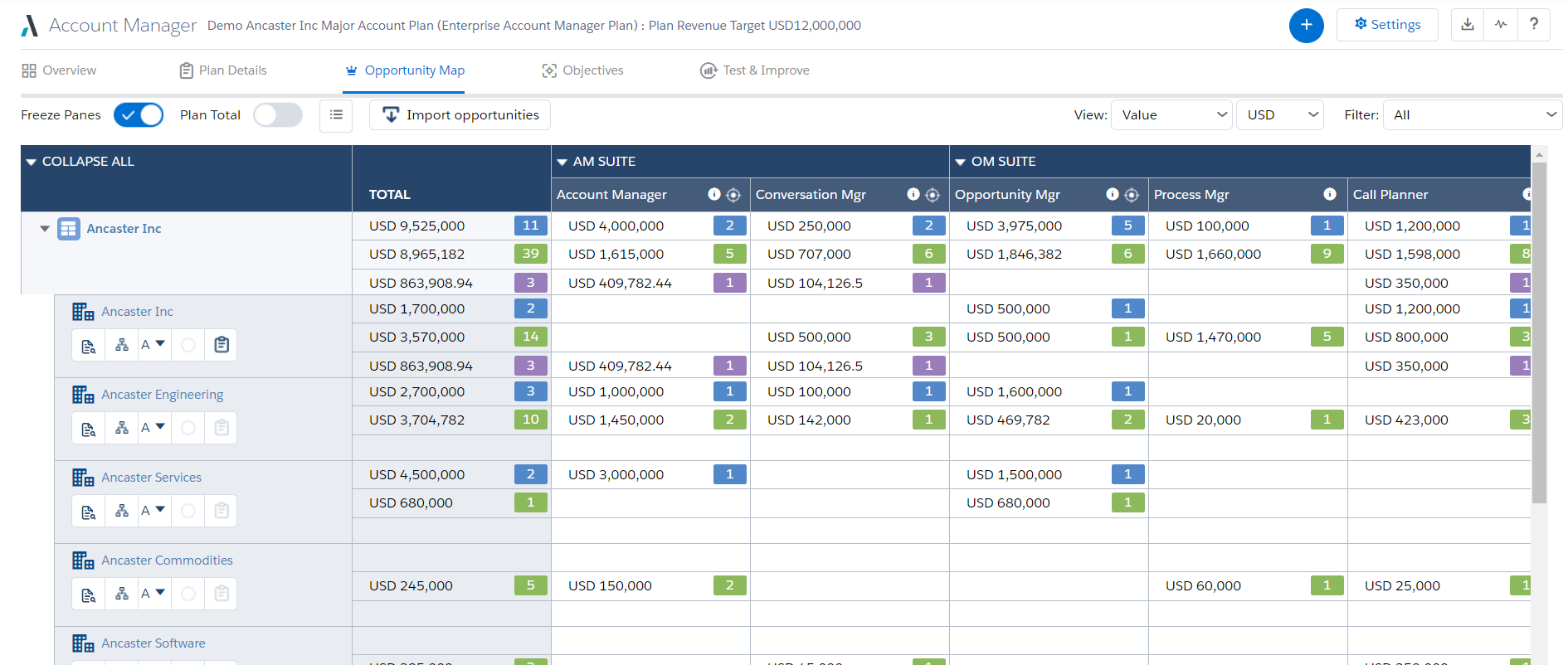
Account Plans: Account Plans can be grouped in both "does well" and "does poorly" for the Altify Suite. I will outline the bad in this portion of the review. Altify Account Plans do have some ability for customization, however the standard out of the box options are incredibly overbuilt. Filling out all of the information within the Account Plan can consume 40+ man hours for a single Account. While some of this information can be useful and important to note, other portions become more cumbersome than useful. The Completeness and Scorecard portions of the use a number of calculations. These calculations are explained at the bottom of the page but from a user perspective are very confusing and not straightforward. Most users that begin using account plans quickly abandon them because of the difficulty in setting them up correctly and the minimal insights that are gleaned out of the work put into them. One place for the greatest opportunity to improve account plans is in the objectives section, there the user can set objectives and activities (tasks) to meet them. The tasks must be manually selected to create an actual task in Salesforce and this cannot be assigned out to other SF Users. This portion of the Account plan would be improved if it could be used as a holistic account management platform to manage tasks across all the opportunities and potential opportunities, with an ability to assign them out to others in Salesforce within the account team.
Altify Max Insights: Altify max insights is intended to provide coaching advice at the opportunity level. This feature is tied into the opportunity manager. The drawback to this feature is that the insight mainly pertains to whether or not a user filled out all the steps in the opportunity manager: the sales process, the opportunity assessment, strategy, and the customer relationship map. The insights are far less action-oriented and more of a reminder to use the tool components. This tool just doesn't hold value, especially as it is an add on product.
Lack of Customization - While Altify does allow customization of some of their products and components, Altify has a ton of limitations. One of the most frustrating aspects is that all of the processes happen from their "black box" which is the dealmaker opportunity objects that Altify creates. This is essentially a shadow copy of the opportunities within Salesforce that then push changes to the actual opportunity. There is no way to tap into this shadow opportunity to either run custom processes or to even surface the Altify insights in a BI tool such as Einstein. This means that a lot of the use and functionality that Altify does do well cannot be leveraged for company insights or user end improvements.
Oracle CRM is incredibly complex making it fairly difficult to learn from scratch
The original implementation of Oracle CRM was a lengthy and involved process
We have had outages where we cannot connect to Oracle CRM which leaves us at a loss. I'm not sure what the solution to this is, but less outages would be ideal.
Overall our organization has completely moved to Oracle CX Sales and now is able to utilize the latest technology backed by AI to provide a much better experience to customers and saving money at the same time. So it's a Win-Win situation. I believe there is a slight learning curve to derive [the] full value out of this but once you are there, you can delight your customers.
The support the Oracle team gives is generally very good. They are patient, willing to help, and their training methods are collaborative and inclusive. They have conducted multiple support sessions and it’s always been a great user experience. The stellar team [is] always on hand to lend support when the right time comes and their helpdesk is always on hand to help.
Excellent online training material. On-demand always helps to access anytime, anywhere. Also, it is essential that in this day and age, video tutorials with actual product screenshots make the learning more useful and fun at the same time. Certifications help test knowledge gained during these tutorial sessions. This was a blessing for fresh users.
If you have never used a CRM program is is hard to know exactly what you need. We had lots of changes during implementation and even more afterward once the users started working in it everyday. Also the partner we used didn't inform us about Allotments and not being able to Batch delete custom objects (you can now in recent releases). There were so many unknowns, that if I had it to do over, I would educate myself more and ask more questions of the partner that we used for implementation.
While Skuid is not a match to what Altify does in terms of capabilities, Skuid did allow us to natively create the functions that we needed within the business in a way that was more useful than the Altify tools out of the box functionality. Altify does not offer anything for a more "light touch" opportunity, which is its greatest drawback. With Skuid we were able to create our own solution for these lighter touch opportunities
As compared to other CRM, this happens to be one of the best and most affordable as there are some cons, but the pros are great, and I have seen an increase in sales by using this platform. It works great for the sales process from start to end, like lead generation to closure.
Micromanagement (negative): By implementing Altify as the sales process management tool for our company during a change in sales methodology we created a micromanagement storm that left reps not truly gaining the benefit of the buyer-centric methodology. Rather than using the tool as a guide to the new process, it became a series of checkboxes that reps were mandated to fill out by management. This has left us unpicking the process to reengage the reps in a positive manner on how to work through opportunities in a customer-focused way. Sales process manager and opportunity assessment were disabled to try to fix this negative impact.
Account Plans (positive): While difficult for smaller accounts, the account plan feature did create a standard way for sales users to create account plans and manage their accounts better
It allows you to stay on top of reorder points for your existing customers. We call them attrition calls.
When you orders flowing in, it makes it easier to follow up with buyers for other business units since you already have pre-existing business.
As a sales organization, everyone in the company has visibility across the board into what is our profit at any given moment for the day, week, month and year. This keeps up on track for each of our goals.