Amazon Relational Database Service (Amazon RDS) is a database-as-a-service (DBaaS) from Amazon Web Services.
N/A
SingleStore
Score 7.5 out of 10
N/A
SingleStore aims to enable organizations to scale from one to one million customers, handling SQL, JSON, full text and vector workloads in one unified platform.
It was based on previous experience and a few things that are good about AWS, like S3 and Lambda, the ease of integrating AWS's in-house services, and, of course, support. So, our organization has decided to use AWS.
The AWS relational database service was selected because at the early stages of the implementation of the company product the team didn't have a lot of experience in creating and configuring database inside the company cluster, but there was a need to have a relation database, …
Amazon Relational Database Service (RDS) stands out among similar products due to its seamless integration with other AWS services, automated backups, and multi-AZ deployments for high availability. Its support for various database engines, such as MySQL, PostgreSQL, and …
In a few words, we are just to confortable working with oracle and sql server. Using RDS add another layer of distributed database in order to backup everything we have in case of a disaster and also complies with authorities locally and internacionally. All database we use, …
Deploying PostgreSQL by yourself may appear easy at first but running a production PostgreSQL cluster with millions of records is a hard task, especially for compliance, scalability, and security. RDS automates all complex tasks so you can focus on building your database schema …
With products like Google Cloud SQL, Azure SQL Database, AWS RDS stacks up quite well in all features. Features like licensing, performance, security comes to my mind the most. Another aspect is AWS's global reach.
There are a lot of factor we took into consideration the most important ones are: Ease of use and setup - Compared to other similar options Amazon RDS is very easy to setup just clicking few options and its ready for POC and for production very easy and flexible Terraform …
With the latest serverless technology Amazon Relational Database Service (RDS) has an edge over all its competitors, it works really fast with high log retention.
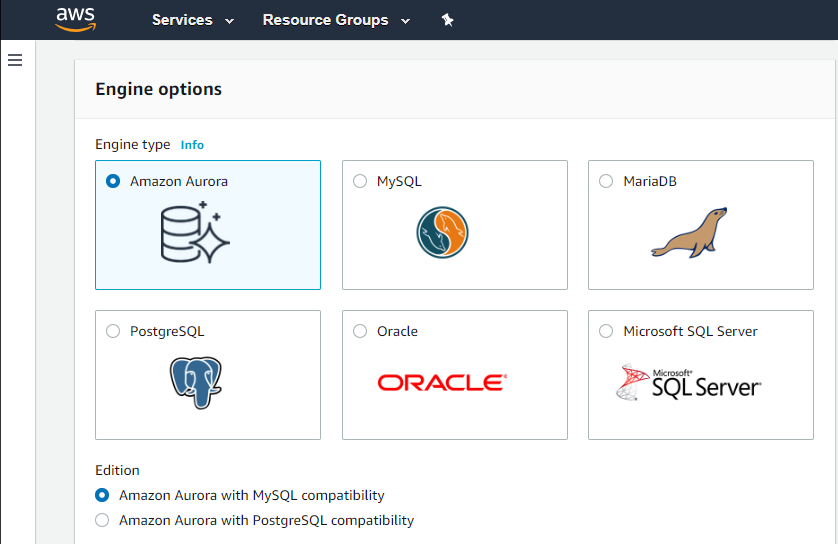
Amazon RDS supports a wider range of database engines, including MySQL,
PostgreSQL, Oracle, Microsoft SQL Server, and Amazon Aurora (MySQL and
PostgreSQL-compatible) than Google Cloud SQL. When compared to Google Cloud SQL, AWS provides a larger global footprint with …
Mongodb is nosql database and some clients prefer it. In our presentation we try to persuade them to use RDS with its pros and cons. The type of selection depends upon the actual need.
Although the Rackspace service is not comparable, even though it is very good, it requires a lot of administration on my part. Regarding Atlas, although it is not the same as RDS in terms of provisioning and administration panel, I mention it because I found it simpler and more …
Previously used Media Temple database hosting (now GoDaddy). While that endeavor was also successful, the AWS RDS is more secure, with higher availability and better documentation.
We have a strong preference for AWS managed services, and we find that RDS offers excellent integration with various AWS services, making it a seamless choice for our infrastructure. Furthermore, RDS supports integration with automation tools such as Terraform, enhancing our …
The main area that stuck out to me in looking at AWS RDS compared to Azure Data Lake Storage was still that RDS is simple to get up and running with over its competitors. The only negative and it holds true for both solutions is that can both be hard to estimate cost control …
During the migration from MySQL installed on Linux to AWS RDS, we were almost surprised as it was done by few clicks rather than too much configurations ans steps in case of traditional DB migrations. In no time our platform was up and running.
Installing, configuring, and managing Oracle Database can be challenging, especially for people who are new to Oracle products. Longer learning curves and higher operational overhead can be caused by this complexity. Amazon Relational Database Service is easy to understand and …
We consider initially only to have the back up product. After analysing different products, we realize that we needed a more complete and robust product such as Amazon Relational Database Service (RDS). Then, the option to hire Amazon Relational Database Service (RDS) was …
1: If your company is already deeply involved in the AWS ecosystem, such as AWS Lambda, Amazon S3, or Amazon Redshift, leveraging Amazon RDS might result in a more seamless integration of services. AWS offers a broad set of cloud services, which makes it easier to design and …
Amazon RDS excels with its widely adopted and mature ecosystem, supporting various database engines. While Azure SQL Database offers a tiered pricing structure and automatic patching, and Cloud SQL provides straightforward pricing and easy scaling, Amazon RDS's extensive …
I can only compare it with Exasol, which I have used a similar base, which manages the Hadoop scheme and is very similar to SingleStore. SingleStore has many advantages: being in the cloud, with just a couple of clicks I can increase the capacity, the configuration is super …
first of all SingleStoreis a cluster with high availability and easy to use. you need to design you tables / procedures such in a way that your SingleStore perform well and with handle heavy load
Reduces database sprawl, ETL costs, infrastructure expenses, etc. Supports horizontal scaling, unlike PostgreSQL & Aurora, and real-time analytics and fast transactions (HTAP), unlike Snowflake & ClickHouse.Handles high-volume workloads with thousands of concurrent queries. No …
SingleStore (memsql) out performs based on our analysis with sample data sets within org. We could see limitations with other products which SingleStore can overcall like scaling with data while performing with similar SLA. It also has the advantage of row store and column …
SingleStore outperforms Snowflake in real-time analytics and transactional workloads but lags in large-scale batch processing. Compared to MongoDB Atlas, SingleStore excels in complex SQL queries and joins, while MongoDB handles unstructured, document-based data better. Its …
Greenplum is good in handling very large amount of data. Concurrency in Greenplum was a major problem. Features available in SingleStore like Pipelines and in memory features are not available in Greenplum.
Gemfire was not scaling well like SingleStore. Support of both …
We previously used Bigquery for our application, and a single store gave us very good performance over Bigquery. But the comparison is not apples to apples, as Bigquery is more of a data warehousing solution.
SingleStore is just a bigger engine with more capability. Its ability to handle larger data sets with ease is its biggest advantage. These other database solutions are great for smaller scale projects that don't include large data sets but Singlestore greatly out performs in …
It has more APIs and other access methods. It has a multi-version concurrency control (MVCC) Distributed RDBMS that combines an in-memory row-oriented and a disc-based column-oriented storage with patented universal storage to handle transactional and analytical workloads in …
Its easier to query and faster. Ingestion is for the most part easier to understand and monitor and directly integrated with other storage solution products we use such as AWS S3. Singlestore overall is a better database to serve up an application large amounts of data very …
SingleStore is built for fast data ingestion and fast queries against large tables (> billions of rows). This is possible because of the column store engine that SingleStore uses. SingleStore also support a memory engine. Pipelines is also another big advantage. Being able to …
We knew early on that MySQL (Amazon Aurora) would not be suitable for this workload as it cannot query our time series data as fast as SingleStore. We also use MongoDB Atlas for another application but we could not achieve the raw speed we saw from SingleStore. Our technical …
We were initially using AWS Aurora which worked well at the time but as we grew it just felt like a lumbering beast - even with tier upgrades. We started looking at caching & search options to help make searches faster - we were already using redis. We looked at and even …
Timescale was the biggest alternative option we looked at for SingleStore, however the requirement to learn a new syntax (due to not being SQL compatible) was our biggest pain point.
Supporting a new language would require alterations to the Laravel framework, as this only …
SingleStore provides an abstraction layer in managing a sharded database solution reducing complexity for the FLOWD team. Coupled with the SingleStore Managed Service, we are partnering with SingleStore to provide FLOWD services to various utilities & councils.
SingleStore is eons faster than other database providers, and it absolutely crushes calculations & aggregations. While other providers may have a few quality of life enhancements over SingleStore, the speed benefits of SS far outweigh the cons. At the end of the day, speed …
SingleStore provides performance for real-time data analytics application where as Snowflake is more for data engineers and not fast enough for real-time data analytics apps.
As I said before, we felt that running queries on BigQuery for every query is really slow, especially from an user point of view. After seeing the drastically improved latency of SingleStore we decided to use to solve this issue. We currently use it to run low volume queries …
If your application needs a relational data store and uses other AWS services, AWS RDS is a no-brainer. It offers all the traditional database features, makes it a snap to set up, creates cross-region replication, has advanced security, built-in monitoring, and much more at a very good price. You can also set up streaming to a data lake using various other AWS services on your RDS.
Well-Suited Scenarios: Real-Time Analytics: Financial trading platforms requiring instant insights. Operational Dashboards: Retail businesses monitoring live sales. IoT Data Processing: Smart device monitoring with high data ingestion. Fraud Detection: Banks detect suspicious transactions instantly. Less Appropriate Scenarios: Archival Storage: Cold data storage with infrequent access. Low-Volume Workloads: Small-scale apps with minimal data processing needs. Complex ETL Pipelines: Heavy data transformations without real-time demands.
Automated Database Management: We use it for streamlining routine tasks like software patching and database backups.
Scalability on Demand: we use it to handle traffic spikes, scaling both vertically and horizontally.
Database Engine Compatibility: It works amazingly with multiple database engines used by different departments within our organization including MySQL, PostgreSQL, SQL Server, and Oracle.
Monitoring: It covers our extensive monitoring and logging, and also has great compatibility with Amazon CloudWatch
It is a little difficult to configure and connect to an RDS instance. The integration with ECS can be made more seamless.
Exploring features within RDS is not very easy and intuitive. Either a human friendly documentation should be added or the User Interface be made intuitive so that people can explore and find features on their own.
There should be tools to analyze cost and minimize it according to the usage.
It does not release a patch to have back porting; it just releases a new version and stops support; it's difficult to keep up to that pace.
Support engineers lack expertise, but they seem to be improving organically.
Lacks enterprise CDC capability: Change data capture (CDC) is a process that tracks and records changes made to data in a database and then delivers those changes to other systems in real time.
For enterprise-level backup & restore capability, we had to implement our model via Velero snapshot backup.
We do renew our use of Amazon Relational Database Service. We don't have any problems faced with RDS in place. RDS has taken away lot of overhead of hosting database, managing the database and keeping a team just to manage database. Even the backup, security and recovery another overhead that has been taken away by RDS. So, we will keep on using RDS.
I've been using AWS Relational Database Services in several projects in different environments and from the AWS products, maybe this one together to EC2 are my favourite. They deliver what they promise. Reliable, fast, easy and with a fair price (in comparison to commercial products which have obscure license agreements).
[Until it is] supported on AWS ECS containers, I will reserve a higher rating for SingleStore. Right now it works well on EC2 and serves our current purpose, [but] would look forward to seeing SingleStore respond to our urge of feature in a shorter time period with high quality and security.
When it comes to ingestion speed, SingleStore is probably at the top. Being able to create pipelines using SQL to ingest data from S3, Kafka, and other sources, is a great advantages. This means you can dynamically ingest data by customizing your SQL queries. SingleStore pipelines are pretty sophisticated, yet very simple. Few lines of codes and you are ingesting data, while still able to perform analytical queries on your billions of row tables.
I have only had good experiences in working with AWS support. I will admit that my experience comes from the benefit of having a premium tier of support but even working with free-tier accounts I have not had problems getting help with AWS products when needed. And most often, the docs do a pretty good job of explaining how to operate a service so a quick spin through the docs has been useful in solving problems.
The support deep dives into our most complexed queries and bizarre issues that sometimes only we get comparing to other clients. Our special workload (thousands of Kafka pipelines + high concurrency of queries). The response match to the priority of the request, P1 gets immediate return call. Missing features are treated, they become a client request and being added to the roadmap after internal consideration on all client needs and priority. Bugs are patched quite fast, depends on the impact and feasible temporary workarounds. There is no issue that we haven't got a proper answer, resolution or reasoning
We allowed 2-3 months for a thorough evaluation. We saw pretty quickly that we were likely to pick SingleStore, so we ported some of our stored procedures to SingleStore in order to take a deeper look. Two SingleStore people worked closely with us to ensure that we did not have any blocking problems. It all went remarkably smoothly.
Amazon Relational Database Service (RDS) stands out among similar products due to its seamless integration with other AWS services, automated backups, and multi-AZ deployments for high availability. Its support for various database engines, such as MySQL, PostgreSQL, and Oracle, provides flexibility. Additionally, RDS offers managed security features, including encryption and IAM integration, enhancing data protection. The pay-as-you-go pricing model makes it cost-effective. Overall, Amazon RDS excels in ease of use, scalability, and a comprehensive feature set, making it a top choice for organizations seeking a reliable and scalable managed relational database service in the cloud.
Reduces database sprawl, ETL costs, infrastructure expenses, etc. Supports horizontal scaling, unlike PostgreSQL & Aurora, and real-time analytics and fast transactions (HTAP), unlike Snowflake & ClickHouse.Handles high-volume workloads with thousands of concurrent queries. No need for ETL processes, unlike BigQuery & Snowflake. Works with JSON, relational, and key-value data, unlike ClickHouse.
Lower operational complexity - Installation and maintenance is pretty easy
Object scale when used can compete with Traditional Warehouse Systems like Teradata, Netezza, Greenplum
Adds lot of value to the business like couple of operations which never worked in traditional DBMS including HANA, Oracle In Memory, SQL Server In Memory just flew in SingleStore