Anaplan is a scenario planning and analysis platform designed to optimize decision-making in complex business environments so that enterprises can outpace their competition and the market. By building connections and collaboration across organizational silos, the Anaplan platform surfaces key insights.
N/A
Predictive Index Behavioral Assessment
Score 6.3 out of 10
N/A
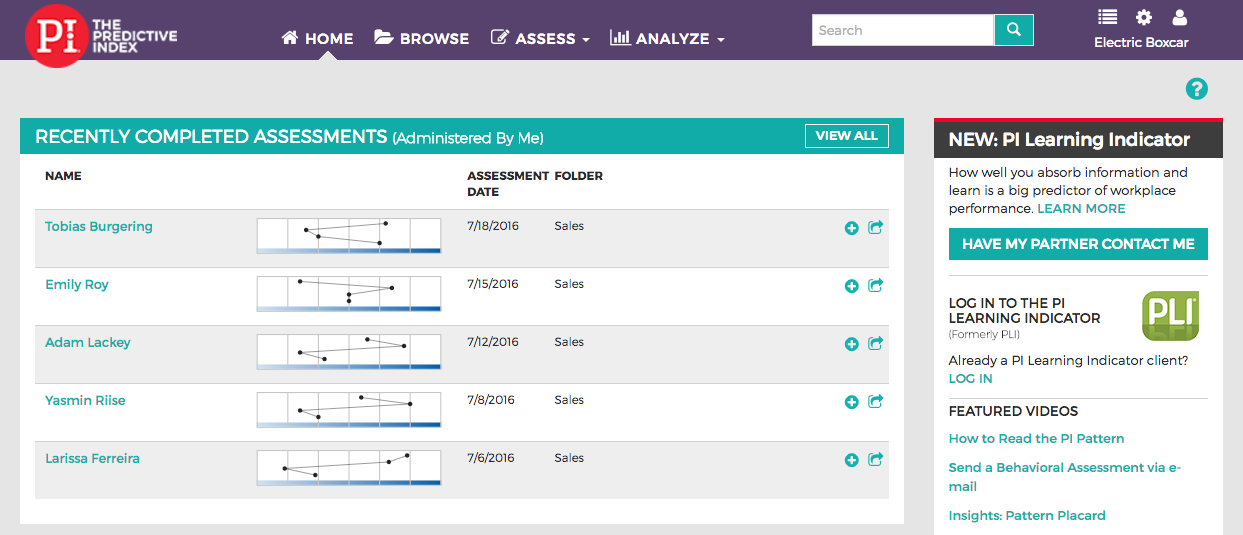
The PI Behavioral Assessment™ is a simple yet effective assessment that is broken down into four primary behavioral factors, or core drives. These core drives and their relation to each other create a behavioral pattern that provides a framework for understanding the workplace behaviors of candidates and employees. According to the vendor, the results allow users to better predict workplace behaviors and motivating needs. The PI Behavioral Assessment™ is a…
Anaplan vs Oracle Hyperion - Anaplan is far better calculation engine and way more modern. However, Anaplan still struggles to provide reporting, especially adhoc reporting in excel based off a data model.
Anaplan vs Pigment - Anaplan is a more proven product, however, Pigment …
Anaplan is easier to implement, easier to use, easier to maintain than these tools. It scales easily with the business. Workflows are easy to implement. It is easy to drill down and understand how the tool obtained a specific result, giving confidence in its calculations. …
Easy of use is Anaplan's main advantage. As Anaplan is code-less configuration, and the logic for model building is by far the simplest, it would make the learning curve less steep. This is very important when we are showing our clients that, their complicated planning scenario …
Anaplan is one of the only tools flexible to handle bespoke commission calculations. In addition to Sales Performance Management, Anaplan can be used to support other business functions, such as workforce planning or financial planning & analysis. Anaplan provides the …
Anaplan is a proven tool for scalable applications and is flexible to support multiple use cases. Its support is established and the user community is strong. Resources to support the product are readily available.
Anaplan is more powerful than Pigment considering that it is an Enterprise class system and is able to manage bigger data sets. Anaplan allows for advanced scenario modeling and formula capabilities along with custom reporting functionalities. Anaplan has proven its …
Anaplan and these other tools are very similar. I cannot say that I selected Anaplan over them as I have worked with and been involved with setting up a number of tools for clients. They all have their advantages and Anaplan is a very strong tool in the cloud planning space.
can be implemented across multiple use cases- also Anaplan is an enterprise solution. Had good reviews in market and also used by other competitors in industry
Both platforms are excellent but come with some challenges. They are often complex to configure and offer limited customization options. Their user interfaces are not very intuitive, and their reporting capabilities are somewhat restricted. The total cost of ownership is …
In my professional experience, I've exclusively worked with Anaplan. The tool's impressive features made learning it an ongoing, engaging process. Its continuous updates and capabilities kept me consistently learning and adapting, so I never felt the need to switch to a …
The tools generally fill different niches, Anaplan is the best for corporate and enterprise planning, OneStream's strengths are in Consolidations and working with large data sets by IT, and Pigment is a strong contender for finance teams at small organizations with less-defined …
Compared to OneStream and Venna Anaplan offers a more modern look and feel of the platform. It is better situated and maintained in regards of platform updates as it's a full SaaS software there are never any issues with the system version as it's always automatically up to …
Anaplan is using hyper block, so calculation is faster. The implementation of Anaplan is also very straightforward, so COE team can quickly catchup on the solution. If additional functions are required after go-live, COE can also support the implementation by themselves. …
Managing spreadsheets in Excel or Google Sheets becomes too time consuming as the business and team grows so transitioning to a tool like Anaplan is a natural evolution. I have used Power BI as a complement to Anaplan in the past in order to make the data that was consolidated …
Anaplan is cloud based which automatically removes the pain and risk that comes along with emailing around different versions of spreadsheets. Concurrent users can interact with different parts of the model at the same time greatly improving time spent adding inputs to the …
We selected Anaplan because of the breadth of their vision and their approach to tackle "planning" of all kinds and integrate planning processes into a true Connected Planning ecosystem. We found that their flexibility and ease of use ultimately provided a better avenue to …
Other assessments provide more than two questions [in] order to determine our candidate's skills. I do believe [some] variety might help Predictive Index Behaviour Assessment determine more accurate results since candidates would have to answer more questions about their …
Many years ago, I utilized Personalysis and it tended to put people into one of 4 main color groups. It also helped with knowing how to communicate with others. I like PI because there are so many Behavioral Profiles.
I have used MBTI, Strengthsfinder, Disc, Kolbe among others. I find they all have their place. PI was already in use at my company when I joined. However, as I became certified and used it more, I have found it very effective. The reports have just the right amount of …
I have only used PI. We assessed Culture Index recently to see if there were additional factors that would be helpful, however found it to be poorly worded and with significantly fewer resources for education, training and overall use.
The only other type of Behavioral Assessment I've used is the Strengths Finder and I don't know that I'd say it's anything like PI. It still gives us great information about a persons strengths but PI tells us more about a persons motivations.
DISC is similar but really only focuses on the employee in a business setting. The PI Behavioral Assessment looks at the employee as a person as well as an employee. It is not how you respond to a question but what attributes you have.
I haven't used any other assessments in the past, so I don't have anything to compare to...unfortunately. I think the PI is probably the strongest assessment out there, and most accurate. It's used worldwide, and has scientific backing to prove its validity. If I were to …
The other assessments that we examined felt more like an SAT exam than a recruitment tool. The results were difficult for our managers to read through and understand. There were a lot of words, with very little actually being said. The PI was succinct and precise.
From 2011-2016 we used DiSC and PI Behavioral Assessment together. We found DiSC to be more employee friendly, meaning employees don't need to be trainined administrators to understand their own report. However, our DiSC trained employee has left, and we opted to stick with …
We use multiple assessments for a variety of reasons. This one is the most versatile that we have. Others we use either for individual development or team development, but PI is the only one we use for Recruiting, individual development and team development.
We evaluated a number of alternatives. Most of them were cost prohibitive because they wanted to charge us per survey. We have a very seasonal workforce so that cost model was not going to work for us. With PI we have a fixed cost each year. Easy to budget... no guessing or …
Most of the other assessments in the marketplace are lengthy and complicated. The PI Behavioral Assessment is so user-friendly that many job applicants have told me they prefer it over other assessments they have taken. The other great thing about the PI assessment is that it …
Anaplan is best suited for strategic planning initiatives in industries like CPG, Manufacturing, FS, Pharma. It can handle multiple use cases for each function in the company like Supply chain, Finance, Sales and more. It is one of the best tools I have seen in scenario modelling. It is not suitable for very detailed level planning, essentially execution level eg. Production scheduling.
Predictive Index has served us well so far in helping determine key personality traits of salespeople we hire. How will they sell? Is sales a good fit for them? We have not expanded to use it with other teams/depts yet. We primarily use the behavioral assessment (not cognitive).
In Beta -> Hire -> New Candidates - > I would like to see the ability to create 1 or 2 additional "Type" folders that can be customized for my company. By being able to do this, I can more efficiently manage my potential candidates, rather that every time I go to review a position, having to make these individual selections each time. I would like the favorite icon and the pass icon to remain; however find it extraneous to have to sort through these candidates each time.
Anaplan is already an established market leader in enterprise planning area. Its flexibility to build multi-dimensional models, real time scenario plannings are proven to be the best features and successfully implemented by global organizations. Anaplan's ambitious product team is ensuring to roll out new features regularly based on customer/ partner feedback. e.g their new improved polaris environment has strong potential to build very large models without worrying about sparsity. The integration with other tools/technologies is being easier (e.g. cloudworks). Hence, considering Anaplan as a platform that has proved to be successful tool in enterprise level planning, its focus on regular feature enhancements and future release roadmaps I believe this platform has potential to evolve further along with our business processes and requirements
Anaplan is interesting because it is at the same time easy to use and difficult to use. An end user can navigate a well-constructed app, being pointed in the right direction every time they feel a slight bit of confusion, and find everything they need in what feels like a straight line. Similarly, a model builder (developer of sorts) can have the exact same experience, but the journey is longer and more complicated. End users have great experiences with Anaplan, but sometimes model builders have a frustrating one. That is not to say model building is hard (because it truly is not), but things change, and when things change in complex systems, the effort required simply to investigate where a model builder needs to make an adjustment may frustrate them but also frustrate their non-technical bosses. However, the reality is that with complicated businesses, complicated business problems, come complicated solutions. It is actually a testament to Anaplan's capabilities that it has taken on the biggest problems at the biggest companies. It may be daunting to adjust it in those environments, but at least you know it did meet the needs there, which is more than most tools can say.
Very easy to use for both administrators and those taking the assessment. This tool is really a game-changer for staffing, onboarding, and retention. It is like having a crystal ball sometimes with insights into the behaviors of job candidates and is critical for finding the right person for the right role.
There are very few outages. Maintenance is scheduled on two or three Saturdays per month, so as not to affect businesses. When there is an outage, users are kept informed of progress to restore the platform and typically this takes no more than an hour. Anaplan customer support is very responsive if we ever have questions about platform issues
Generally, pages load quickly and reports complete within a reasonable timeframe. However, when working with large or complex datasets or during times of multiple active users, performance can sometimes be impacted. That said, much of the performance depends on how the model is built and whether best practices have been followed. Optimized models tend to perform much better, so the experience can be somewhat subjective based on the setup.
Support quality has dropped since Thoma Bravo has taken over. I think some serious re-focus needs to happen here -- part of the beauty of being in the Anaplan community was how involved you felt in it before. Before I didn't dread sending a support ticket, now I am starting to.
The Customer Success team has been quite helpful during the times that I've interreacted with them. I've also found support and implementation to be responsive with any questions related to the initial set up phase or for on going support. Overall we've been pleased with the support offered by Predictive Index Behavioral Assessment.
In my opinion, in-person training is always the best if you have the option to do so. This allows real-time interactions with the instructions, whereas the online training I took required me to write-down questions, email them, and wait for responses. This slows down the process, as you can imagine. That said, in-person training is an extra cost and it likely isn't needed for everyone. I would suggest selecting a small number of people to take in-person training and then having them act as mentors to the rest of your team. That way, as the rest of the team takes the online training, they have a resource to help them in real time.
Learning made easy . One of the best trainings i have attended. Training was very detailed training by the trainer, which helped me understand the basics of the model building. Level 1 training was easy and instructor was most helpful here. Level 2 training was challenging but was able to go thru due to understanding of the basics.
Agile methodology and breaking the work down into sprints was very helpful. Implementation required a deeper dive into our data than expected for the consultants to be able to construct the data model. But once it was in place, the focus on knowledge transfer enabled us to be able to use the product effectively after the team rolled off.
Anaplan is one of the only tools flexible to handle bespoke commission calculations. In addition to Sales Performance Management, Anaplan can be used to support other business functions, such as workforce planning or financial planning & analysis. Anaplan provides the scalability needed for an enterprise-level solution. While taking longer to implement, it also can provide a greater ROI.
The other assessments that we examined felt more like an SAT exam than a recruitment tool. The results were difficult for our managers to read through and understand. There were a lot of words, with very little actually being said. The PI was succinct and precise.
We have managed to leverage Anaplan for financial planning and forecasting across the business. It is now used by almost every department, with more than 50 users (but I know of companies that have hundreds of users) and still the platform is quick and reliable. It is easy to make changes to divisions and departments or add users and apply different user settings - the core part of the model is not affected and end users can continue their work without any disruption
Reduction in time spent by sales ops team in processing compensation by almost 20 %
Ability to drill down into each compensation calculation to understand the details of how the comp is calculated. This has provided more transparency / traceability to end users
we are able to release updates to the system faster as it is easier to maintain and sync
The PI has been very helpful when analyzing employees. You cannot go wrong when you are able to see a candidate or employees work style.
The ROI is very positive. A lot of companies have a specific culture that they are trying to create or adhere to. This software helps you see if an employee would be a good fit for your company or not.