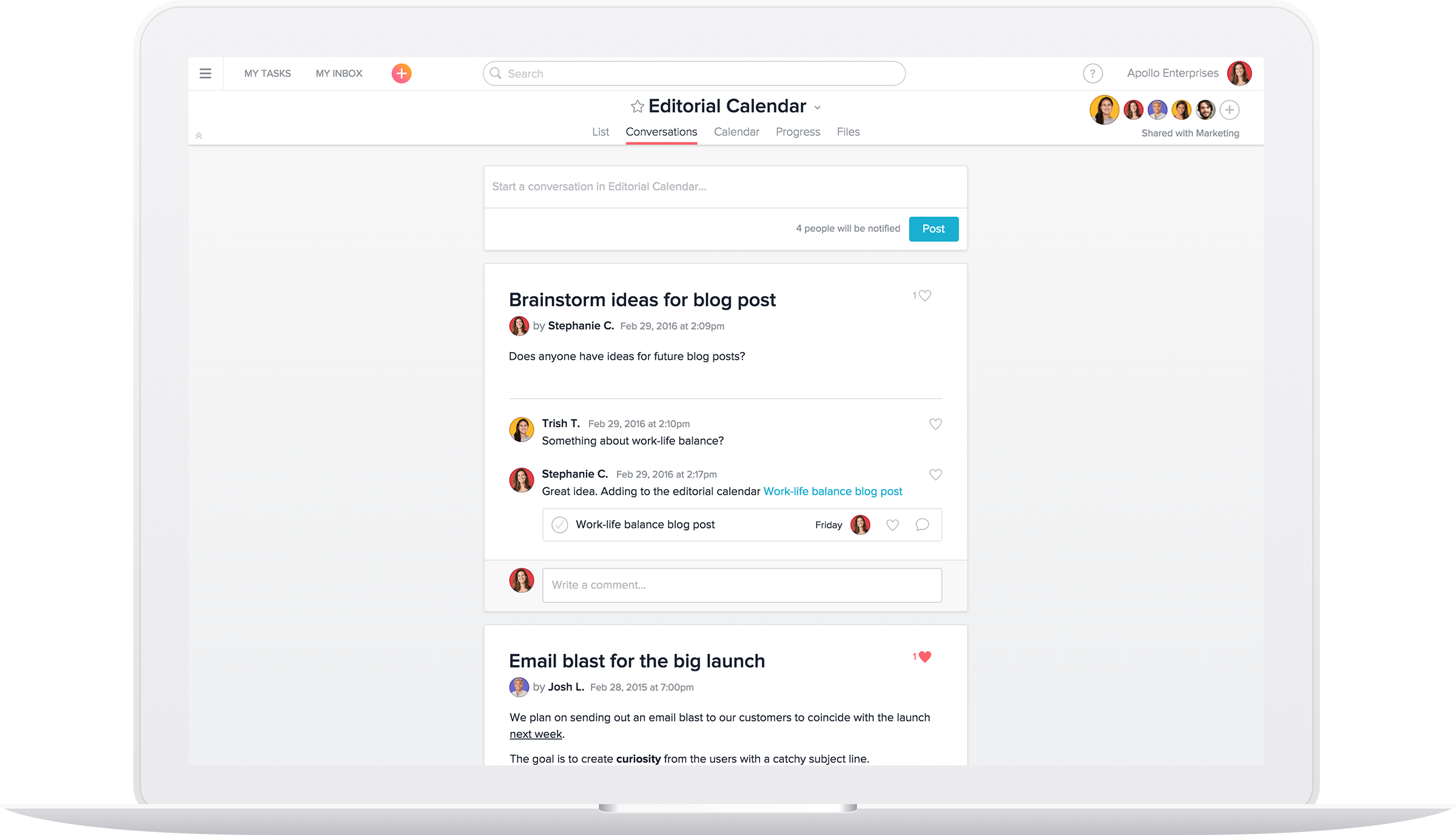
Asana is a web and mobile project management app. With tasks, projects, conversations, and dashboards, Asana lets an entire team know who's doing what by when, enabling workload balancing. Users can also add integrations for GANTT charts, time tracking and more.
$13.49
per month per user
Redmine
Score 6.1 out of 10
N/A
Redmine is a project management web application written using the Ruby on Rails framework. It is cross-platform and cross-database, and free to download and use as an open source project available on the GNU 2.0 license.
N/A
Pricing
Asana
Redmine
Editions & Modules
Starter
$13.49
per month per user
Advanced
$30.49
per month per user
Enterprise
Contact Sales
Personal
Free
No answers on this topic
Offerings
Pricing Offerings
Asana
Redmine
Free Trial
Yes
No
Free/Freemium Version
Yes
Yes
Premium Consulting/Integration Services
No
No
Entry-level Setup Fee
Optional
No setup fee
Additional Details
A discount is offered for annual billing.
—
More Pricing Information
Community Pulse
Asana
Redmine
Considered Both Products
Asana
Verified User
Anonymous
Chose Asana
Asana is very quick in terms of creating and assigning tasks. None of the above software does it with that efficiency. Redmine and JIRA both have a boring interface while Asana is modern and hip. The only major difference between them is the integration for Agile development …
I think that although they are tools for managing equipment and tools for bugs tracking, Redmine has a great advantage since it can be integrated with many third-party tools and that is the only tool of this type with which I have been able to integrate and integrate systems. …
The usability of Asana is broad since it's available in a variety of platforms that are widely used nowadays. I think that it would be great for people who are constantly on the move and switching devices, since it has allowed me to work from my phone, too. I also think that Asana has proven itself to handle a large quantity of work
It is a tool that does not is only for this use but with its great power of integration with other tools, we realized that in one solution we could cover many solutions. For instance, it is very well suited for git integration. Besides that, the quality team can assign tasks to the corresponding department. Maybe it is not very appropriate for very large and complex projects, where deeper monitoring of human resources, task deliverables, and deadlines is necessary.
The design and user-interface are a little outdated. It looks like a product that was designed ten years ago and doesn't have a polished look and feel like newer apps have.
It's not particularly designed to support agile-based project management methodologies such as Scrum.
I just can't see us getting it off of Asana any time soon, despite the many headaches it has caused us. We have too much data in there, too much time & training invested into it, too much at stake to move. If we were just starting out today, fresh, I don't know for certain that I would absolutely go the same direction, but I *think* I still would. I just haven't seen anything better yet. Maybe if Podio's support staff hadn't treated me like a worthless nuisance to them, I might feel differently, but the fact is that their task management is simply inferior to Asana's. That can't be denied, and in fact Podio said it themselves: "Tasks are a simple function. They cannot be customized. Tasks in Podio can be used for quick to-do's for you and your team members." In our operation, however, prompt task completion is a big deal; one task can't be completed until another one is done first, and closing the gaps between those tasks is critical in meeting deadlines and servicing our customers. Asana gets us there, the others don't.
It is very user-friendly. Takes a new employee an hour to start figuring out how the system works. That's an important factor. You don't want to encounter the issue where employees need a week to understand how the system works. For example, JIRA, I tried using it for a week and I still don't understand the complicated layout. Asana has a simple interface. Once you see it, you get it type of program.
Redmine is a great product to have in an organization. It's extremely flexible, costs much less to maintain than other alternatives, and as a tool, it is relatively fast to get experienced with. The primary advantages of working with Redmine are: flexible platform, API, open-source and highly configurable, stability.
I haven't had to use their support so I can't rate it. The fact that I haven't needed them reflects the ease of use of the product. I would recommend that any new users schedule a complete demo of the product to ensure that they are using it to it's fullest (there's a lot of useful features).
Redmine is free, easy to use and it's everything you could want in a free project management program. The fact that it has wiki integration and that it can track on such a granular level is amazing. Assigning tasks to other users, such as our development team, is fantastic and ensures we are always up-to-date on where we are what - on what projects.
Asana is a top-tier project management software that helps us organize and track projects from start to finish. It allows us to apply tasks/to-dos to multiple projects without duplication, divide complex projects into smaller tasks, and track project progress. It also helps us organize work on Kanban boards or linear lists. It stands out from the crowd in a big way compared to the competition.
Redmine is much for granular than Trello. The detail and record tracking in Redmine can't really be compared to that in Trello. While they can both track things and there is a record of changes... Redmine is more detailed and more geared toward long term projects where Trello is great for short terms notes and tasks.
The "free" bit definitely has a nice impact on ROI. Granted, there are other factors, but not shelling out a ton of cash at the outset is definitely a plus.
Once everyone gets into the flow of things, Redmine quickly becomes a huge factor in ensuring proper communication and quality in projects. Having everything centrally located reduces the time and effort needed to gather necessary information to proceed forward.