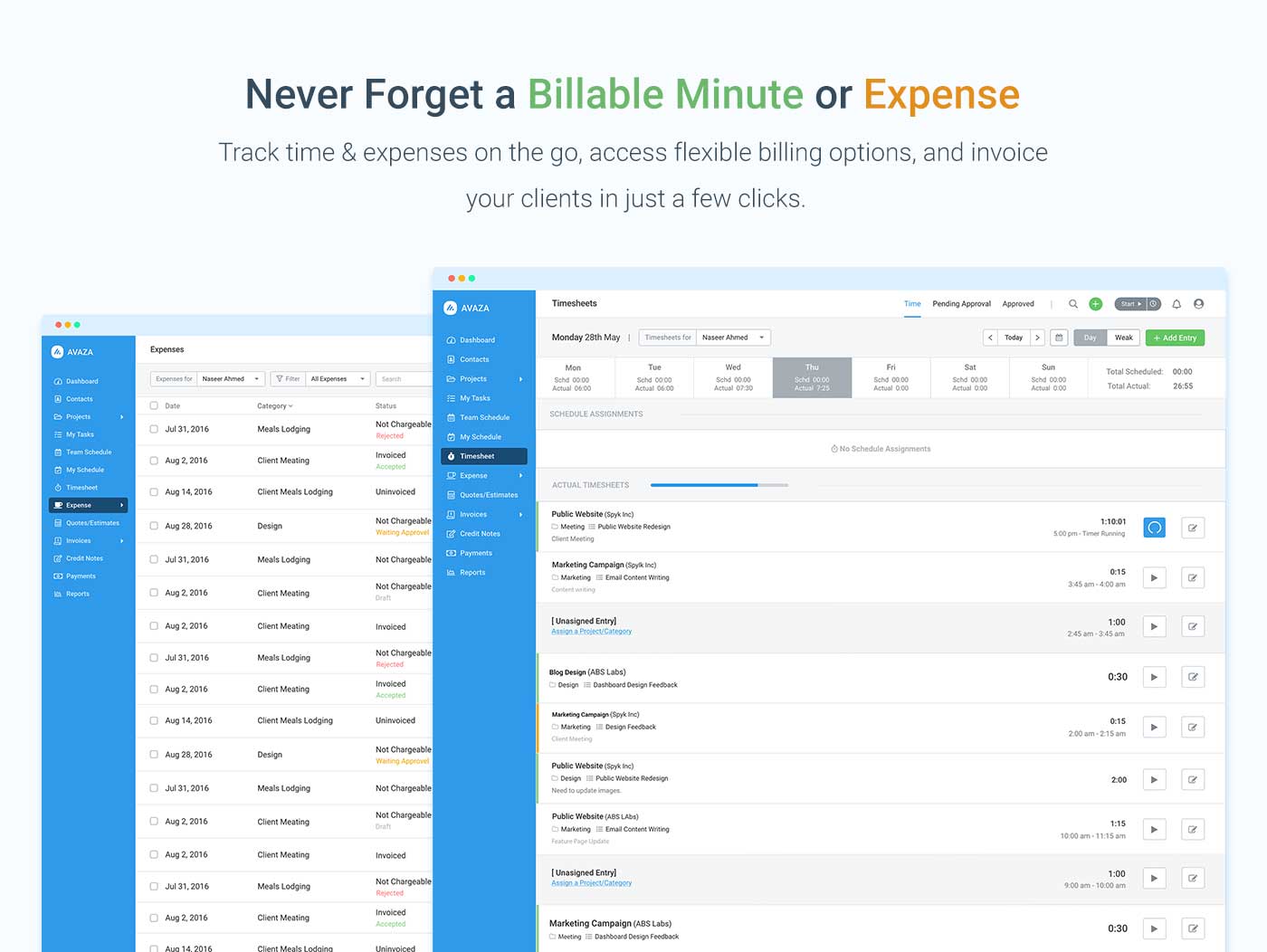
Avaza is a software suite targeted for all business sizes. It includes modules for project management and collaboration, resource scheduling, team chat, time tracking, expense management, quoting and invoicing. Depending on their business needs, companies can use as many, or as few, of the modules as they need. Avaza offers reporting functionality, and the project management module is designed with both list view and Kanban style task management, so users can choose…
Redmine is a project management web application written using the Ruby on Rails framework. It is cross-platform and cross-database, and free to download and use as an open source project available on the GNU 2.0 license.
Avaza's time tracking capabilities are much more detailed than Upwork's. Upwork focuses on simplicity, using a simple on/off button and a spot for taking notes about each project, but Avaza gives you more to work with, allowing you to add detailed notes and specify tasks.
I've used Trello before, but Avaza has way more features and is more applicable for cross-team collaboration. We selected Avaza for it's ability to not only project manage, but also for invoicing, expenses and it's ability to track time. We've gotten more accurate with estimate …
This is miles ahead of ActiveCollab. It has more features, the interface is easier to use and the invoicing is easier to use. Across the board better. We migrated from ActiveCollab, but that was just essentially a Fancier Wunderlist. If you just need one project and a few tasks …
Sysaid and Jira appear to be better alternatives, but they are expensive compared to Redmine, which is free. They are also not as easy to configure, compared to Redmine.
Jira is a great project management tool for software product life cycle management for an agile environment based on agile methodologies. Jira is an intuitive and modernized user interface design compared with Redmine but Redmine is a lightweight and affordable project …
As we've moved to using agile-based methodologies, we've started using Jira more, which is better suited for agile development. Jira looks and feels like a more modern web application and has greater flexibility and more features. I used Basecamp a long time ago for some small …
Redmine is much for granular than Trello. The detail and record tracking in Redmine can't really be compared to that in Trello. While they can both track things and there is a record of changes... Redmine is more detailed and more geared toward long term projects where Trello …
Redmine has a lot of the same functionality but is much easier to use. The project tends to have functions that only the most advanced PM would even look at. JIRA is easier to deploy in a cloud/managed environment: it also has better "apps" support. However, Redmine benefits …
Basecamp was very busy and seemed more into the "wow" factor than into being an efficient tool. Redmine has none of the characters or kid-like appearance of Basecamp's model. I found Basecamp to be too cluttered in views and its interactions confusing, making it difficult to …
Jira is new: it is easier to deploy in a cloud/managed environment: it also has better "apps" support. However, Redmine benefits from maturity, as well as a large base of experts who manage Redmine on a constant basis. Additionally, Redmine is fairly "easy" to set up: as long …
Redmine stacks up to its competitors by being free and open-source. Additionally, it is an easy tool to install and maintain in any operating system, like Linux and Windows. Administrators will not have so many headaches when getting it running. You can customize the code and …
Jira is currently the gold standard here, but it has a pretty substantial subscription price based on the number of accounts you need to create. Jira gets pricey, very quickly.
Redmine has a lot of the same functionality, but is much easier to use. Project tends to have functions that only the most advanced PM would even look at.
It can beat other services only as free, open source solution. Right now we've moved to Jira, and Redmine only stays on as an archive and is used by our editor's department.
I think that although they are tools for managing equipment and tools for bugs tracking, Redmine has a great advantage since it can be integrated with many third-party tools and that is the only tool of this type with which I have been able to integrate and integrate systems. …
There are teams who work hard, and there are those who work smart. Avaza helps you be the latter--it's is a great tool for any team collaborating on several projects, especially multiple projects with a lot of simultaneously moving parts. It has just about everything you need - from team schedules to timesheets, down to the task and sub-task monitoring. The best part for me is that we can switch from List View to Kanban to Gantt charts!
It is a tool that does not is only for this use but with its great power of integration with other tools, we realized that in one solution we could cover many solutions. For instance, it is very well suited for git integration. Besides that, the quality team can assign tasks to the corresponding department. Maybe it is not very appropriate for very large and complex projects, where deeper monitoring of human resources, task deliverables, and deadlines is necessary.
The design and user-interface are a little outdated. It looks like a product that was designed ten years ago and doesn't have a polished look and feel like newer apps have.
It's not particularly designed to support agile-based project management methodologies such as Scrum.
Redmine is a great product to have in an organization. It's extremely flexible, costs much less to maintain than other alternatives, and as a tool, it is relatively fast to get experienced with. The primary advantages of working with Redmine are: flexible platform, API, open-source and highly configurable, stability.
Redmine is free, easy to use and it's everything you could want in a free project management program. The fact that it has wiki integration and that it can track on such a granular level is amazing. Assigning tasks to other users, such as our development team, is fantastic and ensures we are always up-to-date on where we are what - on what projects.
I've used Trello before, but Avaza has way more features and is more applicable for cross-team collaboration. We selected Avaza for it's ability to not only project manage, but also for invoicing, expenses and it's ability to track time. We've gotten more accurate with estimate project hours, and therefore create more accurate proposals
Redmine is much for granular than Trello. The detail and record tracking in Redmine can't really be compared to that in Trello. While they can both track things and there is a record of changes... Redmine is more detailed and more geared toward long term projects where Trello is great for short terms notes and tasks.
The "free" bit definitely has a nice impact on ROI. Granted, there are other factors, but not shelling out a ton of cash at the outset is definitely a plus.
Once everyone gets into the flow of things, Redmine quickly becomes a huge factor in ensuring proper communication and quality in projects. Having everything centrally located reduces the time and effort needed to gather necessary information to proceed forward.