Azure DevOps (formerly VSTS, Microsoft Visual Studio Team System) is an agile development product that is an extension of the Microsoft Visual Studio architecture. Azure DevOps includes software development, collaboration, and reporting capabilities.
$2
per GB (first 2GB free)
ClickUp
Score 8.5 out of 10
Small Businesses (1-50 employees)
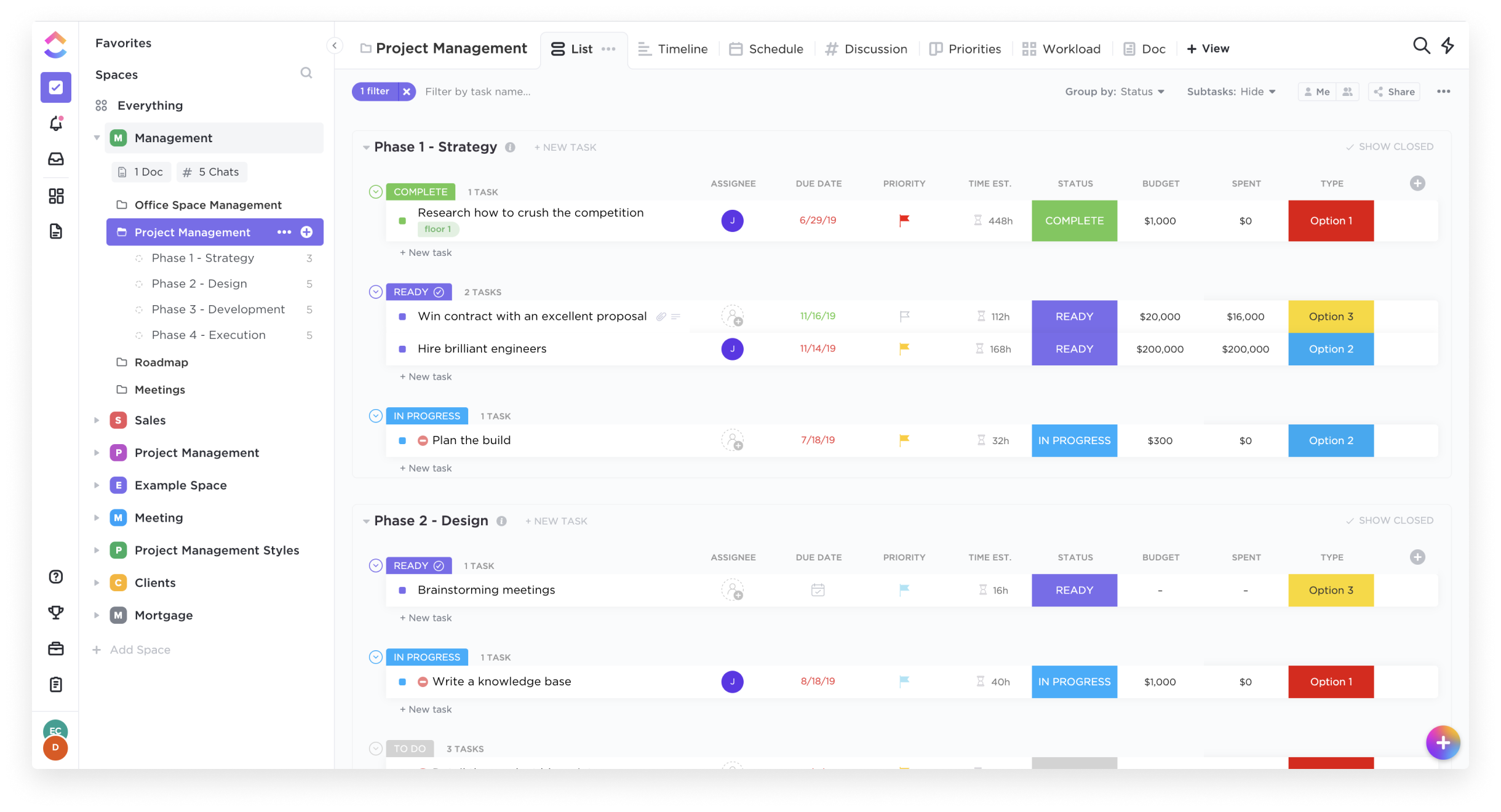
ClickUp is an all-in-one productivity platform. It’s a hub where teams can come together to plan, organize, and collaborate on work using tasks, Docs, Chat, Goals, and Whiteboard. Customized with just a few clicks, ClickUp helps teams of all types and sizes deliver work more effectively, to boost productivity to new heights. ClickUp aims to make the world more productive by removing friction caused by using many different applications. The platform boasts millions…
$0
Pricing
Azure DevOps Services
ClickUp
Editions & Modules
Azure Artifacts
$2
per GB (first 2GB free)
Basic Plan
$6
per user per month (first 5 users free)
Azure Pipelines - Self-Hosted
$15
per extra parallel job (1 free parallel job with unlimited minutes)
Azure Pipelines - Microsoft Hosted
$40
per parallel job (1,800 minutes free with 1 free parallel job)
Jira is fantastic for project management and customer facing portal. It is not good for pure development (no integration with Git, pipeline management, automated testing features). If DevOps were to integrate and adopt the project features of Jira as well as the customer facing …
The moment I have been working with this tool everything has benn operating efficiently. The software development process has borne positive results under scalable environment. The cost of running Azure DevOps Services us much lower as compared to other tools in the market. It …
ADO has better linking than Confluence and is adaptable for a specific need, whereas Confluence might be a bit more rigid, but it's also sort of along the same lines as to what can be done with both tools. ADO also had an ease of use to it and can do a bunch of stuff with it, …
Jira is super clunky and doesn't behave in a modern fashion. monday.com is too flexible and doesn't provide enough feature set. AWS is the most competitive, but it's hard to wrap your brain around all of the features and offerings provided by amazon. ADO does a better job of …
Azure DevOps has a drag and drop editor so that you can quickly drag build steps into a build or release pipeline. This is much faster than looking up the correct yaml syntax. Additionally, its support for Microsoft and Azure is great. If you're on the .net stack or you use …
Microsoft Planner is used by project managers and IT service managers across our organization for task tracking and running their team meetings. Azure DevOps works better than Planner for software development teams but might possibly be too complex for non-software teams or …
Trello is simple to use, but it's only for a Kanban board. Jira might be the same, but I don't really have enough experience with Jira to fully compare them. When I used it, it missed certain functionalities that I was used to in Azure DevOps. Visually it's a lot different too.
Azure DevOps Services have huge functionality and are well supported by Microsoft as well. You will get plenty of features in the marketplace and learning documentation.
Writing the Docker Images, Storing them in Azure Container Registry and then Deploying onto Azure Kubernetes Services is an Easier process which no other software/product is currently providing in the market. Best till date in terms of End to End deployment and maintaining …
Azure DevOps is widely used because of its collaboration and integration with various other tools. Here the assign of the sub task is quite easy compare to Jira. Also Azure Devops can we integrate easily with Git for better code representation and versioning. It reporting is …
Azure DevOps is a completed product and ecosystem. It offers a robust ecosystem that does everything that is needed. The above products do lack features like pipelines tasks, third-party integrations. Besides all cloud benefits, the main advantage of Azure DevOps Services …
Currently, we use both products, however, we use more the Atlassian suite. We have started recently using Azure DevOps for specific implementations and projects. We don't have any plan yet to migrate all our projects to Azure DevOps, we may in the next couple of years. …
We tested alternatives for Azure DevOps over time. We tested GitHub a while ago and back then lack of some features that now hast, like the project boards and private repositories. We will check GitHub next year.
We also tested AWS CodeCommit and found it very cryptic, …
Beside all cloud benefits, the main advantage Azure DevOps Services compared to Azure DevOps Server is the easier remote access for third party team members, and always up to date software. On the other hand, on prem deployment (Azure DevOps Server) makes complex access or …
The greatest strength of Azure DevOps Services (formerly VSTS) is that it's a one-stop solution for all agile project management instead of setting up bits of different software put together for each and every need. Azure DevOps Services (formerly VSTS) has a great ecosystem …
I prefer Azure Devops over all other code repository / ci/cd systems that I've used in the past. All features are integrated into a single service (back log, repo mgmt, deployment pipelines, artifacts, etc.). The tools are easy to use and super powerful.
Our company is already using a lot of Azure services and it makes more sense to start using Azure DevOps Services (formerly VSTS) when we needed a CI/CD tool. We tested different features of Azure DevOps Services (formerly VSTS) and found out that the build and release …
One of the foremost reasons that acted in favor of Azure DevOps was its all-in-one packed web portal which enabled easy access to all the CI/CD tools and kits. Customizable screens, notifications via Teams/mails, project views, etc. Most other tools/products offer only part of …
While GitLab has the same features as Azure DevOps, and a potentially more competitive price, its project management features are a bit more primitive. It could be helpful for small projects, but ultimately for our larger projects we went with Azure DevOps. Bitbucket has good …
Azure DevOps provides a full workflow from planning through to development through to production. After the acquisition of GitHub by Microsoft, GitHub is becoming more fully-featured with the features being ported becoming more polished in the transition. Both are great …
DevOps is more full-featured than its on-prem predecessor or any of the above with the possible exception of the Atlassian suite. I would say those two are roughly comparable. However, the ease of integration is much better with DevOps and other Microsoft products (although …
They are really close. Azure DevOps is better because of the deep integration with Microsoft technologies. Jira is better on the customization side. However, Azure DevOps is really improving on that front. They are releasing new features every other week now. Azure DevOps also …
I still use both. ClickUp is a little "bigger" and has some more tunning over details. When someone ask me about which to choose, my answer is "you must try them"... start using both and you'll find the best using them and asking users how they feel.
The big selling point of Notion is that it is completely customisable. I would say ClickUp is only slightly less customisable and because the framework and support is there in ClickUp, it is actually faster to onboard people too. ClickUp gives businesses a better foundation to …
Access is great - but not a shareable cloud environment. Monday.com is a close second - CU pips them at the post at this stage. It does become difficult to switch so the choice of tool at the beginning is very very important. The continuous improvements in CU gives me a lot of …
We used ClickUp because if offered the most versatility, while still remaining functional and efficient for our entire company. ClickUp offers features that save time for every team member, and it was very easy to implement and integrate within our company.
Love how ClickUp allows tasks to be opened in their own little window, where you can then see additional info. Monday.com forced us to have every field visible as a column, which lead to really complicated and difficult to navigate boards. ClickUp's Lists are cleaner, more …
I walked away from so many other products that I tried primarily because I wanted to have a task and productivity tool that allowed me to re-envision my 'data' at the task level. I wanted to be able to have Gantt views and dashboard views and then dive in deeper with comments …
ClickUp is more efficient than all of these tools combined. Trello only has one type of view, kanban. You can't customize it to list, dashboard, or calendar. Notion is much harder to manage my company's departments and connect everything like ClickUp. Notion doesn't have the …
It combines them all with a user friendly interface and a really nice workflow. It keeps work in as less places as possible which makes it easy for new colleagues.
ClickUp's features were far superior in terms of what we could do for project management and flexible enough we could adjust it to our use case. We found Notion too basic and Monday.com too restrictive. ClickUp is the perfect blend of what we need and their new features often …
I did not make the decision to move to ClickUp, but I did provide feedback and hear feedback from our internal team about how ClickUp centralizes a lot of the company wides resources into one space. I feel that ClickUp provides more dynamic workflow building beyond Jira and …
ClickUp is definitely a marked improvement in just about every way from Redmine. UI, functionalities, usability- all of it has been a much better experience in ClickUp. As for JIRA and AirTable, I think ClickUp's overall layout and organization style trumps those sites by …
All of them are based on activity management, however ClickUp stands out in several areas: integrations with other tools, management of several spaces simultaneously through views/dashboards, the vast majority of the tools listed do not allow me to have visibility of everything …
The best feature of ClcikUp over others is it's customization as well as hierarchy. Departments, clients, operations become easier to manage if the hierarchy is setup in a good way that can allow your business scale without altering it repeatedly. Customization is another …
It has been probably around 4 years. A big part of the decision between monday and ClickUp (CU) when we decided on a platform was the pricing model of CU was more suitable. There has been massive updates since we started using CU. So not sure how it stacks up now
ClickUp can be very simple, yet very advanced. That helps us get started while providing something we can grow into as well, to avoid a future switch again.
ADO is well suited for the visibility of day-to-day tasks and responsibilities as well as things such as Features, user stories, etc. Off the top of my head, I can't think of any scenario where it might not be well suited, as you can customize ADO to your liking to a degree.
Great for project management, reoccurring task management, building trackers and keeping track of what everyone is up to. Like all software that has great functionality, having solid governance and control over access is essential. I recommend ensuring that your admins/owners have a close eye on what is going on across the space or it can turn into an unmanageable nightmare.
Flexible Requirements Hierarchy Management: AZDO makes it easy to track items such as features or epics as a flat list, or as a hierarchy in which you can track the parent-child relationship.
Fast Data Entry: AZDO was designed to facilitate quick data entry to capture work items quickly, while still enabling detailed capture of acceptance criteria and item properties.
Excel Integration: AZDO stands out for its integration with MS Excel, which enables quick updates for bulk items.
Need to make the changes so that it doesn't occupy most of the CPU utilization and memory
Execution of Bulky SQl Queries leads to either the SQl being out of exception or the VS being unresponsive
Integration with Microsoft products is easy, but with non-Microsoft products it is more difficult, and you have to make a lot of configuration changes to integrate
With every upgrade of the Visual Studio, like from VS 2010 to VS 2013 , we need to upgrade our hardware/machine, as the VS hardware requirement also increases
If code is getting compiled in one visual studio, like in VS 2010, that the same code could possibly give an error when compiled in VS 2013, due to certain changes in keyword, data format, etc., with the VS upgrade
I don't think our organization will stray from using VSTS/TFS as we are now looking to upgrade to the 2012 version. Since our business is software development and we want to meet the requirements of CMMI to deliver consistent and high quality software, this SDLC management tool is here to stay. In addition, our company uses a lot of Microsoft products, such as Office 365, Asp.net, etc, and since VSTS/TFS has proved itself invaluable to our own processes and is within the Microsoft family of products, we will continue to use VSTS/TFS for a long, long time.
We're very pleased with how the system works in general. For over a year we've barely ever had any problems with ClickUp and there might have only been one or two times when it wasn't operational for us due to a global emergency. Moreover, when we had a problem once with renewing our licenses we've been contacted directly by our account manager and taken care of in a very professional way (with a due refund as well). The exceptional customer service makes us firmly believe that ClickUp is just the right tool for us.
Azure DevOps is a powerful, complex cloud application. As such there are a number of things it does great and something where there is room for improvement. One of those areas would be in usability. In my opinion it relies too much on search. There is no easy way to view all projects or to group them in a logical way. You need to search for everything.
Far easier to use than any other PM tool. ClickUp is incredibly intuitive and had us saving time and energy within the first week of implementation. In my opinion, PM software should make it easier to focus on the deliverables - it shouldn't take all your time and energy to learn how to use the tool in the first place. ClickUp is a user-friendly tool that actually helps us focus on what's important.
For over a year ClickUp was unavailable to us just twice for a couple of hours. I would say for a system this big and working globally that was a minor issue. They managed to fix all the issues within a couple hours and then it was back up and running perfectly fine.
The speed of ClickUp is average to be honest. This is one of the biggest flaws of the system, sometimes it's also lagging a little bit but we also have a lot of documents, lists etc. on our workspace. However, with the next version of ClickUp I've seen they are planning to increase the speed by almost 500%, probably by changing the technology, so I am more than looking forward to it.
When we've had issues, both Microsoft support and the user community have been very responsive. DevOps has an active developer community and frankly, you can find most of your questions already asked and answered there. Microsoft also does a better job than most software vendors I've worked with creating detailed and frequently updated documentation.
Support are genuinely helpful and really nice to deal with. I had a bug on my workspace that I’d been experiencing for a while. They looked into it for me and asked some questions. Once they found the issue and resolved it, they even filmed a video detailing how they’d fixed it. That level of support is fantastic.
There are multiple guides on literally all of the functions you can find within the system, therefore it's easy to learn anything you'd really like to use, starting from project and people management, down to Gantts, mind maps, time tracking, inviting Clients as guests to work with you on the projects and so much more.
Start small. Don’t try to build the most elaborate plans first. Resist the urge to get into Gantt charts if no one is used to them. Just get work written, add dates and assignees, and start getting used to it. If you did not use a work management tool before, you need to be gracious with yourself about the fact that you likely do not have the muscle memory for working this way yet. But you will get there.
And leverage people who know it if possible. Look for ClickUp experts and vendors. They can really supercharge your effectiveness at building the tool out and speed up the process.
Jira is fantastic for project management and customer facing portal. It is not good for pure development (no integration with Git, pipeline management, automated testing features). If DevOps were to integrate and adopt the project features of Jira as well as the customer facing interfaces, I feel it would be a complete project management system.
Every other tool I have used has been for organizing tasks and work only. There were some of the other features, but none of them had the ability to do everything we need to manage a project from start to finish
Scaling with ClickUp is superb. If you create a workflow best suited for your organization then it's all about creating new accounts and teaching the new employees the workflow you're using. It's that simple. There is no black magic when it comes to Clickup.