Chatter was a collaboration platform with integration into the business process and the ability to conduct actions like approving expense reports and creating support cases from the activity feed itself. It was acquired by Salesforce and is currently discontinued.
N/A
Stackby
Score 9.0 out of 10
N/A
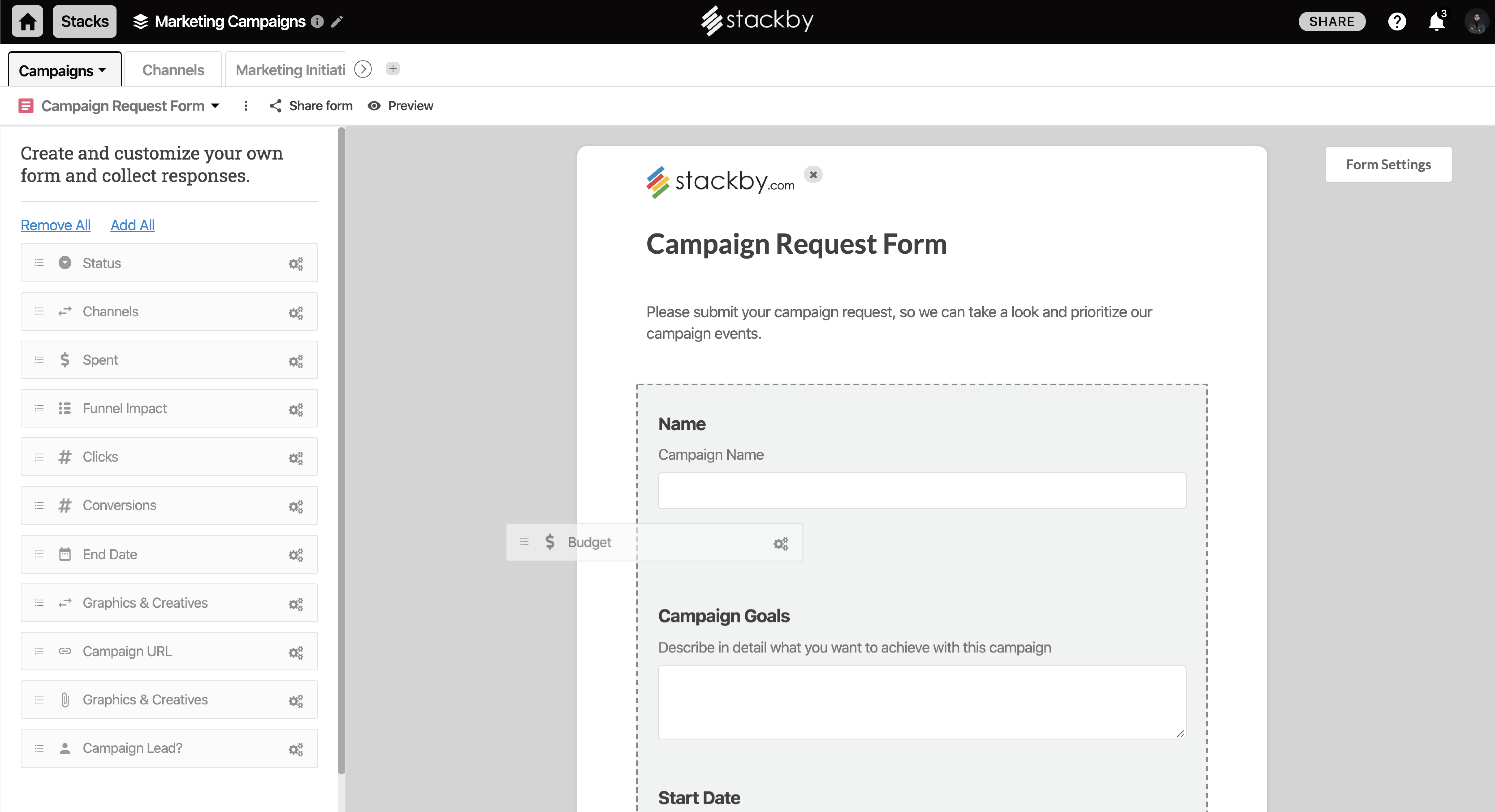
Stackby is designed to bring together the simplicity of spreadsheets, the functionality of databases and integrations with best business APIs to let anyone build their own tools, the way they want. No coding needed. Users can build a database from scratch, import data from pre-existing sources like spreadsheets or Google Sheets, or choose from over 100 pre-built templates across multiple categories. Stackby offers over 25 unique column types like text,…
$6
per month per user
Pricing
Chatter (discontinued)
Stackby
Editions & Modules
No answers on this topic
Personal
$6
per month per user
Economy
$10
per month per user
Business
$20
per month per user
Business Plus
$35
per month per user
Enterprise
Custom
Offerings
Pricing Offerings
Chatter (discontinued)
Stackby
Free Trial
No
Yes
Free/Freemium Version
No
Yes
Premium Consulting/Integration Services
No
No
Entry-level Setup Fee
No setup fee
No setup fee
Additional Details
—
20% discount for annual pricing.
More Pricing Information
Community Pulse
Chatter (discontinued)
Stackby
Features
Chatter (discontinued)
Stackby
Project Management
Comparison of Project Management features of Product A and Product B
Chatter (discontinued)
8.3
Ratings
7% above category average
Stackby
-
Ratings
Task Management
8.80 Ratings
00 Ratings
Gantt Charts
8.00 Ratings
00 Ratings
Scheduling
7.90 Ratings
00 Ratings
Workflow Automation
8.90 Ratings
00 Ratings
Mobile Access
8.00 Ratings
00 Ratings
Search
7.90 Ratings
00 Ratings
Visual planning tools
8.80 Ratings
00 Ratings
Communication
Comparison of Communication features of Product A and Product B
Chatter (discontinued)
8.4
Ratings
6% above category average
Stackby
-
Ratings
Chat
9.00 Ratings
00 Ratings
Notifications
7.10 Ratings
00 Ratings
Discussions
8.10 Ratings
00 Ratings
Surveys
8.00 Ratings
00 Ratings
Internal knowledgebase
8.00 Ratings
00 Ratings
Integrates with GoToMeeting
9.00 Ratings
00 Ratings
Integrates with Gmail and Google Hangouts
8.90 Ratings
00 Ratings
Integrates with Outlook
9.00 Ratings
00 Ratings
File Sharing & Management
Comparison of File Sharing & Management features of Product A and Product B
[Chatter] is the tool that makes our relations stronger. It provides advanced ways of communication. I have trained my many team members because of the easy features and functions of this tool, It is very user-friendly. Give it a try if you want to improve your relations with your customers. It will surely enhance the productivity of your organization.
Based on my experience, I can provide specific scenarios where Stackby is well suited and others where it may be less appropriate: Project Management: Stackby is an excellent choice for project management scenarios. Its ability to create custom databases, track tasks, assign responsibilities, and collaborate in real-time makes it highly effective for managing and monitoring project progress. CRM and Sales: Stackby is well suited for managing customer relationships and sales processes. Its customizable database structure allows for organizing customer information, tracking leads, managing deals, and generating reports. The ability to integrate with other tools further enhances its usefulness in CRM and sales workflows. Content Planning: Stackby is a great fit for content planning scenarios. Users can create databases to manage editorial calendars, track content ideas, assign tasks to team members, and monitor content performance. Collaboration features facilitate seamless content collaboration and ensure timely publishing.
Implement the same views available on desktop into the mobile app
Internal automations (like Airtable)
Ability to implement and display info as a dashboard (like Airtable)
Polish up the formatting of formulas, inputting them causes user frustration due to the formula input cursor jumping around
Better intelligence and ease of inputting data in bulk i.e have the fields automatically identify what data is being input and format appropriately (like Airtable does)
Chatter can fulfill at least 85-90% of our business requirements in an easy-to-use platform. Usability is a key requirement and we have had our share of bad usability experiences. In our experience, even the most novice users were able to pick up Chatter in a relatively short amount of time with little/no assistance.
It is easy to use but the impact of it feels like it is a bit antiquated. It does not feel collaborative and real time. Chatter is more akin to email versus Slack or Hangouts where it feels like problems are being solved as you are communicating.
Stackby is overall pretty easy to use, especially if you're used to something like Airtable or SmartSuite. Some of the pages seem like near exact clones (though they put their own creative spin on things). I'd prefer a slighty fresher interface (like SmartSuite), but I'm willing to sacrifice that for the better price and great customer service.
I haven't had to use support often, but when I have Salesforce was very responsive. Like with all things Salesforce, it is easy to use and doesn't have too many issues, so I don't think that people will have to use support often, but if so, they are easy to work with and helpful within the product.
Because Chatter is tied into our CRM I feel it is easier to use. Teams is better for instant answers and chats. Chatter is better for a data storage of ideas and answers. While they both have there advantages It is hard to say which is more valuable on their own
I have also tried Ora.Pm. Infinity has better graphical interface, but nowhere near as many features and the UI isn't as effective (i.e, moving around with keys). Grist has a much more technical interface and it comes from being more of a database/interactive spreadsheet vs Stackby. Grist has much more functionality in terms of formulas, but is much harder to learn to use and less other functionalities. Ora.PM is more of a test at a task management app, and doesn't compare - Stackby is much better.
This has had a very positive impact when it comes to verifying if proper communication has been had among teams. This helps us know when and what people have been informed of, which gives us the opportunity to regularly review our communication styles.
This has had a very positive impact when trying to find particular individuals in a very large company, and without any barriers.
This also provides a 'get networking' tool for new and existing individuals to the company, helping people gain influence and awareness among their stakeholders.