Cohesity offers AI-powered data security and management. Cohesity protects critical data workloads across on-prem, cloud-native, and SaaS with backup and recovery, threat intelligence, cyber vaulting, files and objects, and recovery orchestration.
N/A
CrashPlan
Score 7.7 out of 10
N/A
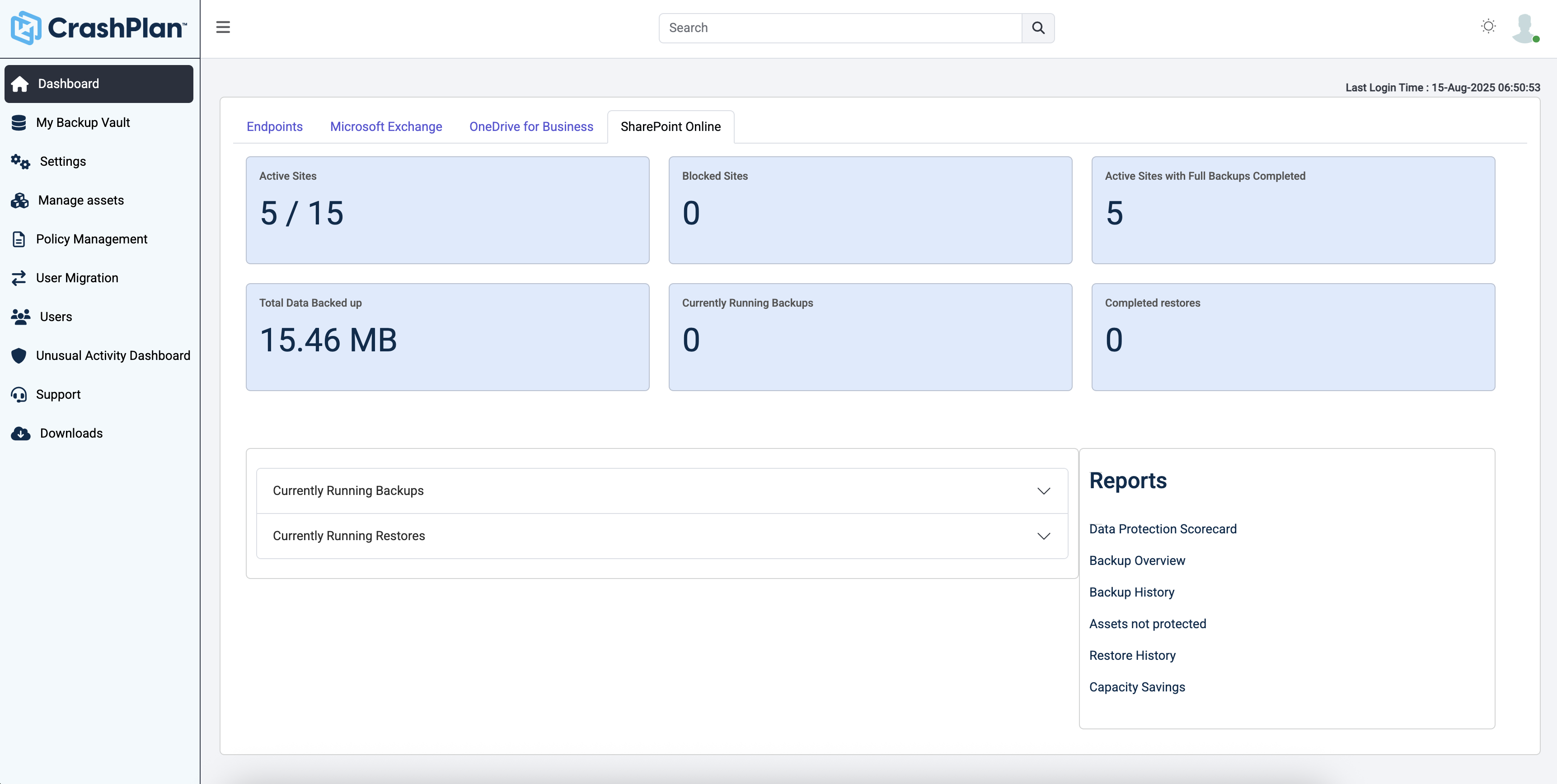
CrashPlan® provides secure, scalable, and straightforward endpoint data backup, to help organizations recover from any worst-case scenario, whether it is a disaster, simple human error, a stolen laptop, ransomware, or an as-of-yet-undiscovered calamity.
N/A
Pricing
Cohesity
CrashPlan
Editions & Modules
No answers on this topic
No answers on this topic
Offerings
Pricing Offerings
Cohesity
CrashPlan
Free Trial
Yes
Yes
Free/Freemium Version
Yes
No
Premium Consulting/Integration Services
No
No
Entry-level Setup Fee
No setup fee
No setup fee
Additional Details
—
Discount available for annual billing.
More Pricing Information
Community Pulse
Cohesity
CrashPlan
Features
Cohesity
CrashPlan
Data Center Backup
Comparison of Data Center Backup features of Product A and Product B
Cohesity
8.6
Ratings
3% above category average
CrashPlan
8.3
Ratings
0% below category average
Universal recovery
8.00 Ratings
9.00 Ratings
Instant recovery
8.10 Ratings
9.00 Ratings
Recovery verification
8.10 Ratings
9.00 Ratings
Business application protection
8.10 Ratings
7.00 Ratings
Multiple backup destinations
8.10 Ratings
8.00 Ratings
Incremental backup identification
8.10 Ratings
7.00 Ratings
Backup to the cloud
9.10 Ratings
8.00 Ratings
Deduplication and file compression
8.10 Ratings
00 Ratings
Snapshots
9.10 Ratings
00 Ratings
Flexible deployment
8.30 Ratings
8.00 Ratings
Management dashboard
9.70 Ratings
9.00 Ratings
Platform support
9.10 Ratings
8.00 Ratings
Retention options
10.00 Ratings
9.00 Ratings
Encryption
8.10 Ratings
00 Ratings
Enterprise Backup
Comparison of Enterprise Backup features of Product A and Product B
Cohesity is very well suited to protecting virtualised workloads and is a significant improvement over IBM Spectrum Protect which we’ve replaced by Cohesity. We also protect a Netapp workload and whilst the on-prem side works really well careful planning of protection jobs is needed if you’ll be archiving these to Cloud.
This is a great Cloud backup solution. The cost is low, the bandwidth is managed well within the application, and the footprint for the client on a machine is very small and provides a notification menu icon with info about what is happening now or very recently. This does not backup to anything locally, so if that is a requirement, it will not meet that need. It used to be able to backup from one machine to another remote machine at one time, but now it is only cloud-based.
The simplicity of the solution and the support behind implementation, training, and continued support.
The implementation and training are all done through the sales engineer, which provides for a seamless and great experience when it comes to starting with a new vendor.
How fast the solution works. When it comes to implementation (which is done in an hour or so) to backups, to actual recoveries, everything is just quick.
Code42 is the most affordable backup system offering unlimited storage that I could find. I came from SOS Online Backup, which I ultimately decided to drop after my monthly rate for their unlimited plan increased by 20x.
With Code42's unlimited storage option, I don't have to worry about the fact that my backups are significant in space. As a photographer with thousands of images at stake, I need to run large backups often.
Code42 runs continuously and silently in the background of my desktop computer. It is truly "set and go", so I don't have to think about it when I'm away. It runs until the designated drive has been fully backed up to my cloud storage. It will then automatically email me once the backup is complete (or, it will email me if it encounters any errors).
Customer service is above par. Anytime I need help, a chat agent is available (chat is my communication preference), they are always friendly, and go above and beyond to resolve my needs.
Reporting could always be better- executive-style reports have to be generated from data at multiple points.
Some tasks that could be brought to the UI that today we have to call support on (for example when an NFS mount is still active but we cannot see it from the UI)
The CrashPlan program installed on your computer is Java-based vs. a native application. While this makes development for CrashPlan easier, there are a lot of drawbacks to Java programs including more resources usage, less stability, and overall more clunky interface.
While this was also in the Pros category - CrashPlan is an extremely powerful and flexible program, which adds a great deal of complexity. Setting up CrashPlan isn't always a simple procedure, and depending on the complexity of your backup set, can take a while to tinker around with the settings to get everything to work properly.
The CrashPlan desktop program consists of a Java program front end, as well as a backend service - there are times when the backend service will crash, and the front end Java program will refuse to load. Typically, restarting the service or restarting the computer will resolve the issue, but sometimes more in-depth troubleshooting is required.
Perhaps one of the biggest downsides to CrashPlan is its price - at $10/month/computer CrashPlan is more than double the price of some existing backup services such as Backblaze (priced at $50/year/computer). To add salt to the wound, about a year and a half ago, CrashPlan discontinued their consumer options - which were very reasonably priced at $60/year for a single computer or a family plan priced at $150/year for up to 10 computers. When these options were discontinued, the cost of backing up with CrashPlan was effectively doubled for the same feature set.
Along with the previous example, CrashPlan had the option to back up to a remote machine on a different network with a free Crashplan account. This option was eliminated when the consumer line of services were discontinued.
While the backup service provided by CrashPlan are still first in class, the above two controversial changes have broken some trust between CrashPlan and its clients.
We have been very pleased with this backup solution. It is fast and reliable, and supports our VMware infrastructure. The company's support has been great, including proactively replacing our nodes when the flash memory was reporting high wear. Support is offered on-shore as well. We plan on continuing to use this product for the foreseeable future.
The Cohesity platform with its user interface is easy to implement, rack space-saving, and easy to use on a daily business basis. Backup jobs and policies are easy to define, multiple machines and objects can be grouped for the same tasks. In general, Cohesity makes backup admins' lives much easier.
Support is quick to respond but lacks that ongoing responsiveness if the issue is not simple. There will be large gaps in replies if they need to resort to escalation and when there are timezone differences between yourself and the person who picked up the ticket.
Friendly and knowledgeable support team available to assist with this product. Code 42 (formerly CrashPlan) offers unlimited storage options for reasonable costs, so you really can't go wrong with this product. They have been a reliable resource for our company, and I would recommend to others looking for an easy setup with unlimited storage.
We looked at Veeam and although it's a great product when we priced out the licensing of both primary and disaster datacenters it became much too expensive. Rubrik is a great product and very similar to Cohesity. In the end, Cohesity had a secondary storage play as well as a better UI and better compatibility with lower tier cloud storage. We also like the way Cohesity did protection jobs vs Rubrik's virtual machine centric backup. CommVault is a product we still use today due to its massive features and the ability for bare metal backups. Cohesity does a much better job in the area of UI simplicity, virtual backup ease, and ease of management.
CrashPlan (in my specific case the CrashPlan Pro or CrashPlan for Small Business (there seems to be somewhat of an ongoing identity crisis with the products) is significantly lower overhead, in terms of cost and complexity, when compared to the other two products I have evaluated/used. The downsides are that it is also significantly less functional than the other products. CrashPlan is, as I have said a good value simple point solution.
Tremendous cost savings as the amount of data you backup doesn't impact cost. One flat rate!
Implementation time was minimal and requires little to no maintenance. Since installation, I've not had to correct or fix any issues. It just works.
We opted to supplement Code42 with another solution that allowed us to backup data to a local repository due to the amount for data that changes in our firm.