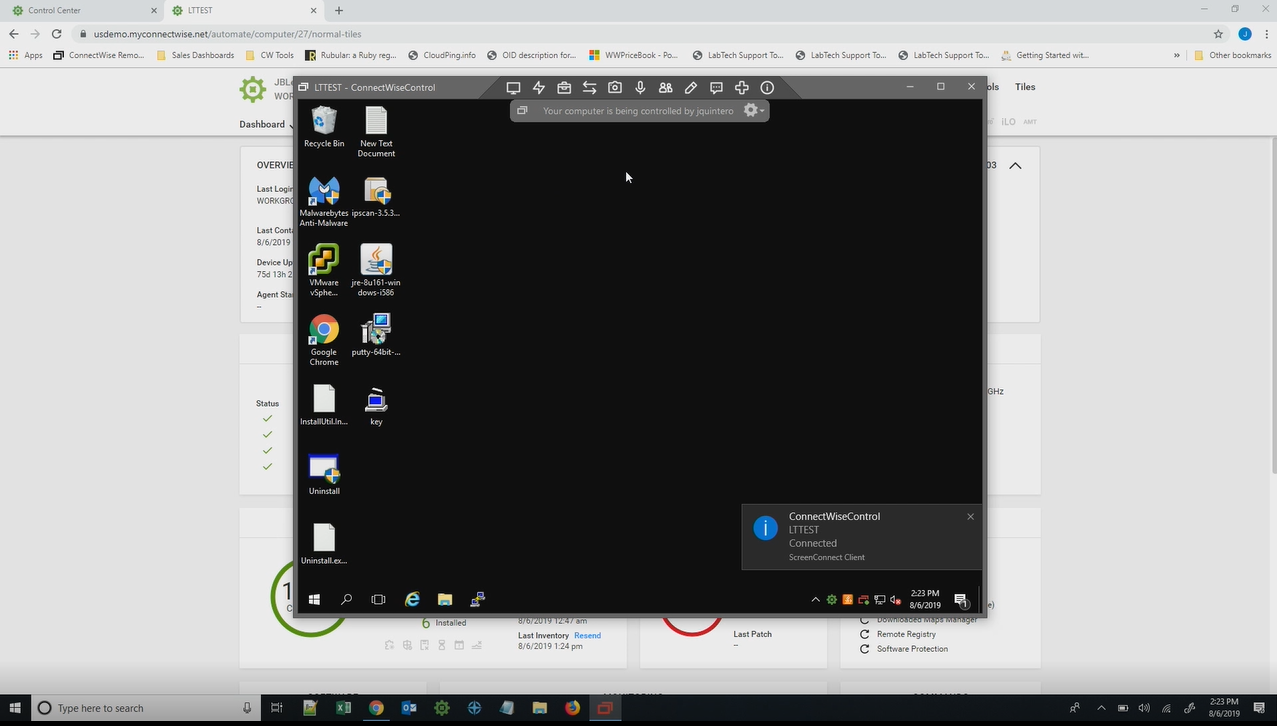
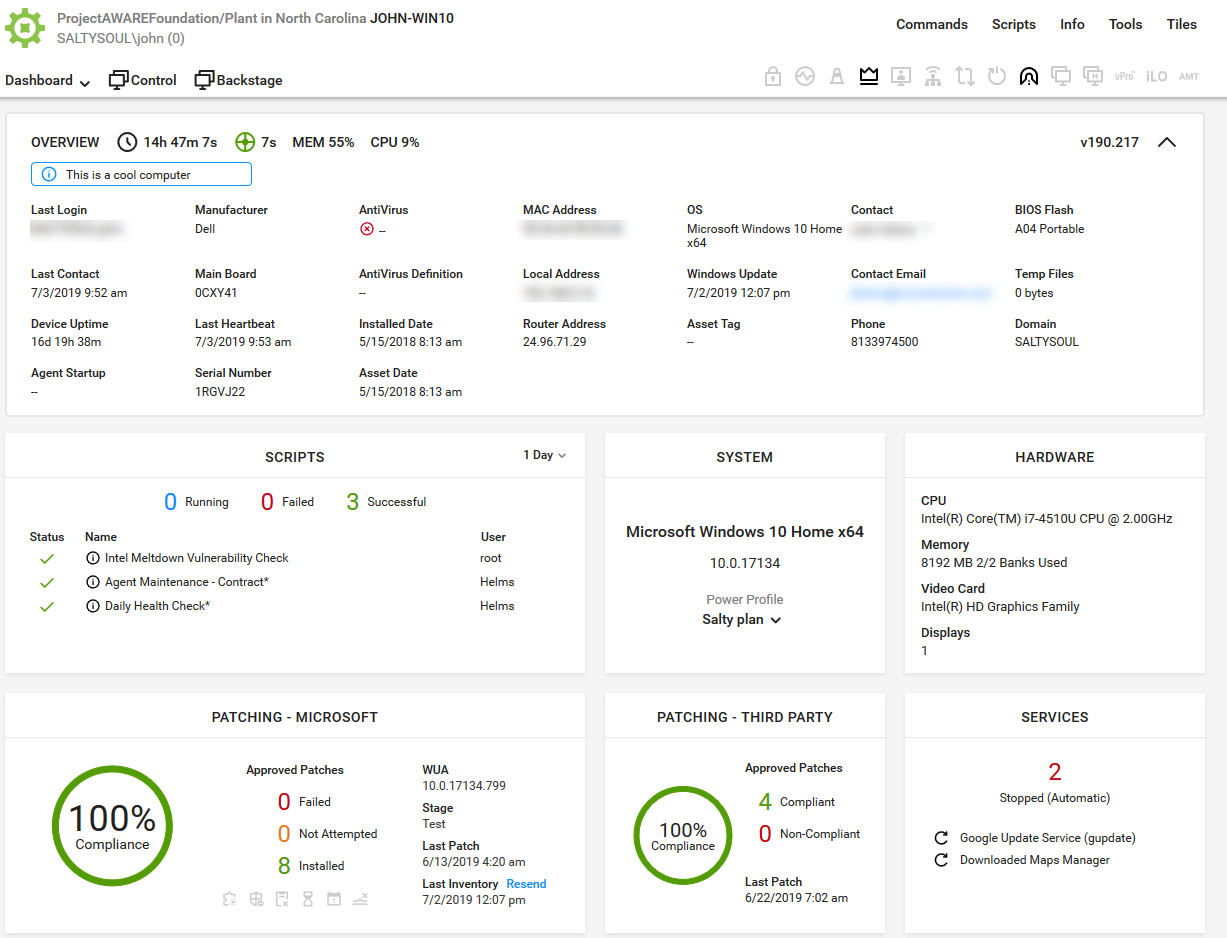
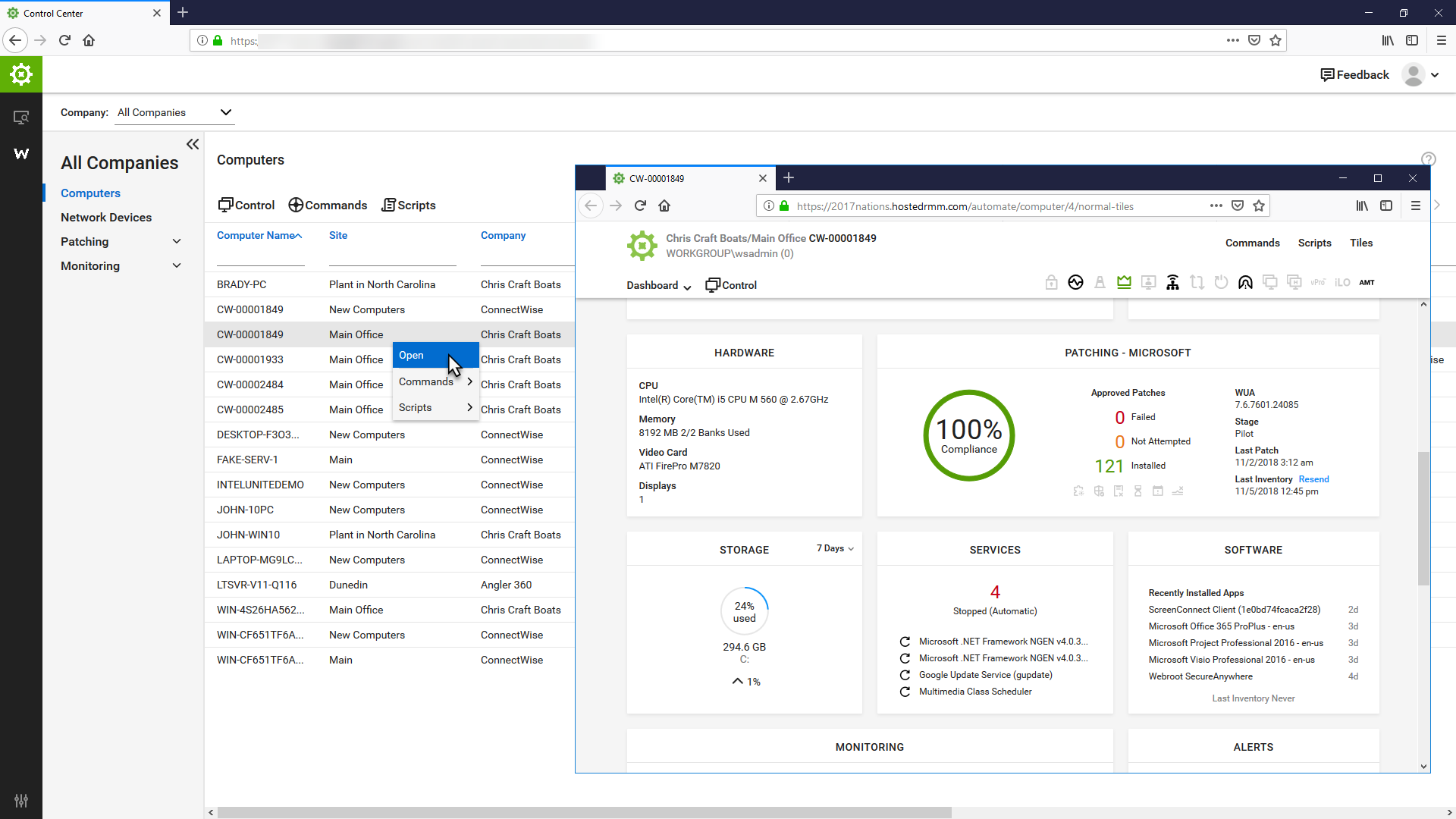
ConnectWise Automate, formerly LabTech, is a remote monitoring and management (RMM) platform. It provides powerful automation to discover and manage devices, monitor for problems, and scripts repetitive action.
$700
Ivanti Endpoint Manager
Score 6.9 out of 10
N/A
Ivanti Endpoint Manager increases user and IT productivity by helping IT administrators gather detailed device data, automate software and OS deployments, and quickly fix user issues.
Enable has a clunky interface more suited for management reporting versus technician toolbox and Ninja is very basic and lacks any significant bells and whistles behind basic remote command interface. Very poor in features to the point if being quite disappointing during a …
If we have to do it again, we would not choose to Automate due to the number of efforts and monetary investment (3rd party consultants) to implement it as well on going managing it. But, in comparison to the other RMM products we used in the past, Automate offers more …
I regret using ConnectWise Automate since we can't effectively add and remove clients and I feel like we're locked into a multi-year contract where only ConnectWise seems to be happy.
I have evaluated NinjaRMM, but it was after I was already familiar with ConnectWise Automate. While it seems like a good product, I found that ConnectWise Automate was more flexible in allowing me to make custom configurations to meet various business needs across different …
I believe the monitoring and alerts in Continuum command is better, but [ConnectWise Automate (formerly LabTech)] does have stronger scripting, and perhaps a better interface. N-Central is inferior on all fronts to both. I did not make the purchasing decision. I would myself …
It just seems like Automate is a tool for professionals who want to be the best proactive solution for their customers. There are so many different things built into Connectwise Automate which makes it a superior tool compared to anything else on the market currently. Once …
So as you can see from this review my experience is mostly with its desktop sharing aspect; however the IT support team use this more comprehensively as a monitoring, inventory, reporting, even application deployment tool that the above-mentioned apps don't have.
Automate is by far the best of all RMM solutions we have tried. The overall ease of use and support is much better than we have experienced with other RMM vendors.
I touched on this in the previous section some. Kaseya's choice of managed antivirus was very poor (KAV, a tweaked version of Kaspersky) when it first started. It took them a long time to fix anything, and the fixes usually produced new and different issues. Kaseya kept …
We ended up choosing ConnectWise because LogMeIn which is part of Continuum is slow and requires a lot of system resources and the patching is all that great within Continuum.
Automate is one of the best when it comes to RMM-applications in terms of features and ability to execute, however, where it is weak is in the necessity for an SME to run and maintain it and while it is quick and gets the job done, it is difficult to stack it up to a full …
Automate is the most well-established platform among its peers. Because it is part of a native ecosystem, you know that everything from remote management to ticketing to quoting an invoicing will work together. I have used other platforms, and many of them share core …
We switched from Kaseya to Automate 7-8 years ago - it was no contest at the time and Kaseya wasn't cutting it in a number of areas at that time that was really hurting us. I'm sure it's improved since then.
We have only previously deployed HoundDog/GFI and Autotask but evaluated all that we found. In the long run, none of the others compare with the features of ConnectWise Automate. Many others are less expensive but simply do not do all that ConnectWise Automate can do. We …
The Continuum RMM is very simplistic in comparison to Automate. The scripting engine in Continuum doesn't compare at all with the scripting in Automate. Continuum has a single level of agent grouping (all agents for a client are in a single group). For clients that have …
Automate is the most flexible and customizable tool on the market - but it's also the most complex and requires the most care and feeding to run smoothly...
We selected ConnectWise Automate over Kaseya as it provided many of the same features but less of the headache. Often times, scripts would not work in Kaseya or updates would not push. We have not had this experience with Automate, scripts and such just run when scheduled. …
ConnectWise has a wider scale and more functionality than LogMeIn. ConnectWise is better suited to large organizations. Training using the software is fairly simple getting techs off the ground.
Ivanti Endpoint Manager was good at Automated Patch Management and has a efficient Software Distribution methodologies. It is also has powerful Remote Control for Support and good inventory management
Ivanti's all-in-one concept is easier to standup, manage, and use than SCCM. Although SCCM requires Teamviewer for remote assistance, it is more reliable than Ivanti Remote Assistance. That being said, Ivanti provides a more robust solution that gives much greater granularity …
There is no silver bullet or perfect endpoint management tool but, after evaluating 17 different products for our organization, I found that Ivanti checked the majority of the boxes we needed. Ivanti is well-positioned in the market and constantly expands its portfolio.
Better in most all categories. On-prem was not an issue for my organization. MS SCCM was lacking features. Airwatch required increasing tiers of service in order to match [Ivanti Unified Endpoint Manager (formerly LANDESK Management Suite)] features, and lacked the robust …
ManageEngine had lots of the whizbangs but couldn't tie it all in together. It was a bit clunky and you still would need other products to get the job done. All-in-all it didn't seem like a full solution that would meet our needs.
Ivanti Endpoint Manager runs in the kernel so it is more robust than Workspace Control. It is also better at capturing settings. However, Workspace Control is much easier to administer and roll out. There is one interface where you can make all settings. We really miss that …
I think that the Ivanti EPM method of collecting inventory data is much more useful that the other products. The way that queries and scopes can be generated and then used across the board in all of the features makes for very dynamic use cases.
We are currently looking and re-evaluating EPM against these competitive systems. Because our evaluation is starting again, I will come back to this question.
I think Ivanti UEM is the best product out there as everything is laid out and you can accomplish anything you need to do. You do not need to re-invent the wheel or build tasks from the ground up. You just need to implement a good strategy and plan for what you wish to …
LANDESK is more modern and has a better UI for our HD techs. It is also vastly more expandable than Remedy was when we left it (approx. two years ago). It's not really a comparison of CRM to CRM though, and if it were I'd say LANDESK is 10-25% better, but the additional …
It's a solid contender in the endpoint management scene with so many competing products that may excel with certain features you are sure to find with IEM a solid tool that covers all bases.
IEM beats our old solution due to widest solution set. It does more, and does it more successfully and more thoroughly, that any other solution out there.
We have tried SCCM it was great but was not working so much. Well then we have used the central desktop from the Zoho corporation. Finally we got LANDESK Ivanti Endpoint Manager which has done all the things [in a] the single platform. [Zoho] is new system like Intune and …
Both solutions will effectively manage Microsoft patches to devices, but Ivanti goes the extra step. With Ivanti, we can manage third party patches, where SCCM would require a third party solution (like Ivanti, who a lot of SCCM customers use for third party). Ivanti also …
SCCM integrates really well within Windows, but IEM does exceptionally well with the Big 3 (Windows, MacOS, Linux). Anything you can do in one, you can do in the other.
I started out using GoverLan and not LANDesk. It was clunky in comparison and just did not have the features that LANDesk had in a nice, simple, and efficient package.
I recommend it to all IT colleagues; regardless of the size of the PCs with which you work most of the time, the application allows connection stability between computers that make it possible to continue working or taking care of the infrastructure from afar.
You need to push O365 or some product out to your institution. If you need to build out a reboot before and after and maybe something else, [Ivanti Unified Endpoint Manager (formerly LANDESK Management Suite)] can easily do that for you. It then can also use a query to determine who needs that product in your environment and then continue using that query to watch for the machines you targeted to show up once your push succeeded. If you need to, you can use the task scheduler and schedule your software distribution for a specific not in normal business hours or on a weekend.
Automated patching. The patch management is very robust and doesn't let us down. We can rely on it to do its job.
Scripting. The scripting engine and layout is excellent. It's very easy to work with and adapt Powershell scripts and other script to the native format with its functions. It also gives detailed logs to help determine why something went wrong if there's issues.
Software distribution - the ability to sit and provide software when a machine calls home works phenomenally well. You may also target based on certain conditions, ranging from LDAP queries down to hardware revisions of individual components.
Operating system provisioning - the range of choice in sequential execution is second to none. We migrated from MDT to Ivanti's providing with relative ease.
Patching and compliance - you're able to get extremely granular, and the rollout project templates make rolling it a particular patch from QA to Production an automated breeze
You can track all your clients information and every single job you do for them. You can do quotes, send them, add providers to compare prices, manage the calendar of the employees, assign tickets to the correct person, there is nothing you can't do with this tool.
Inside all the greatness, there are some works around that you have to do for specific duties that could be automated.
Make sure you keep notes on each client profile, you can use the private note section, it is secure and it works as a reminder of everything you need to do about that specific client, only you and your employees will see those.
Mac support - While it's the best I've seen with cross platform support, that doesn't mean they don't have a long way to go to catch up with the functionality of other tools that focus on one specific platform.
Product coherence - Their core product, the management suite, is great but with every new acquisition the company makes, it seems like there's another product that gets shoehorned into the picture. Making all those disparate pieces work smoothly together is something they're still working on.
Documentation - They come out with a lot of great features but some are so complicated I couldn't begin to understand the various facets of it all. I realize the days of published manual are long gone but even a PDF covering the major components in detail would be better than having to bump around in the dark until you have to call support for help.
Software Licensing Management - Every major release seems to completely rewrite this tool but they keep seeming to miss the mark. Lately it's a Microsoft Silverlight program that's very slow and has way too much data to be useful.
Web Console - The web console is all but unusable. The only way to really work on administration is to use the 32bit console which is great if you're running Windows but a fully featured web console would be much preferred.
Support and the Speed of supporting the latest technology is the main reason for not giving this a 10. But the product is powerful and flexible. The best way that I can sum it up is "You can get out of it what you put in to it"
As Microsoft evolves Intune, SCCM, MECM and combines their features into the MS EULA, Ivanti seems to be going the opposite where they are stripping out core products in favor of an EULA + A la cart pricing model that simply is more expensive than Microsoft's pricing. A few years ago, the gap was large enough to justify the extra cost of Ivanti, today the gap has closed significantly enough that the value add just isn't there for us.
Basic use of the product is fairly easy. Information about the machines you manage can be found in customizable dashboards, which can be unique for each user, and, therefore, properly suited to the users' needs/job function. This is not a 10 because some of the interfaces are very clunky (Patch Management), and some features are not intuitive and not well documented (reporting). Scripting and Patch Management have a fairly steep learning curve (For structure in patch management and syntax in scripting), but once learned, they work well.
Items are logically laid out and most are easy to find. The more advanced stuff can be trickier, but it is still not hard to find. There are a lot of options though, so remembering where some settings are, especially if you do not alter them often, can take a minute, but you will get to them fairly qiickly.
It used to be great, but then they broke reporting, speed and responsiveness with version 11 and the new Patch Manager. It's really bad and their support people are way behind on fixing so many bugs. They have really gone downhill. If they don't get it together soon, we'll start looking around.
Far too many issues that take ages to get resolved. Even their chat support takes a long time to get in contact with someone. When you do chat with a support rep they generally can't help you and just escalate the ticket. At least everything you've chatted about is now in the ticket.
TRM\TAM support has been generally very good. Getting reported bug fixes, design changes, UX problems resolved has been a pain. It is often difficult to get problems escalated beyond the TRM\TAM level. Support is fantastic when you can get it, getting it can often require more work than it should, and that is probably our biggest issue.
LabTech online training is very very thorough in training and helping individuals understand the theory and practical side of using a Remote Monitoring & Management. The training has multiple methods of explaining each section which helps to re-enforce everything about the Training Modules. I have had some Engineers lose their interest after a number of modules because they said that it was too much, that was too similar. I've found that the training is tailored towards a technical background but the Sales training does help NON technical individuals familiarize themselves with the Remote Monitoring and Management components and how it relates to Managed Services.
ConnectWise Automate was already implemented at all organizations I have used it at when I started at those MSPs. At my current MSP, we used professional services for a period after I took over management of it, and they assisted with changes that I saw needed to be made. While not specifically implemented, those services were well organized and well scheduled, and all things we discussed were tracked and recorded, allowing for good change management/tracking.
I have evaluated NinjaRMM, but it was after I was already familiar with ConnectWise Automate. While it seems like a good product, I found that ConnectWise Automate was more flexible in allowing me to make custom configurations to meet various business needs across different clients. I have also evaluated Addigy. While I think Addigy does a better job of managing apple devices, it is clunkier, and customization is harder in Addigy than in ConnectWise Automate.
Better in most all categories. On-prem was not an issue for my organization. MS SCCM was lacking features. Airwatch required increasing tiers of service in order to match [Ivanti Unified Endpoint Manager (formerly LANDESK Management Suite)] features, and lacked the robust inventory data we needed. Meraki was very simple to use, but did not meet our needs. I would say that most Airwatch customers aren't using all the features they are paying for, and could save lots of money by using Meraki instead.
As mentioned briefly previous there have been a couple of times where accessing servers at different sites due to point to point connectivity going down where this has been a big life saver
Centralized IT - all in one solution that is better in some areas than traditional niche software applications. You'll probably still spend the same amount of time with users on the HD line, but you'll be able to reduce the amount of time it takes for auxiliary Help Desk tasks (ticketing, reporting, background deployment, etc.)
Cost - This is a negative of course ;) But at some point you can save some money if you ditch SCCM or your other CRM