Contractor Foreman is an online construction management software for contractors and boasts users among contractors in more than 75 countries.
$588
per year
monday.com
Score 8.6 out of 10
Mid-Size Companies (51-1,000 employees)
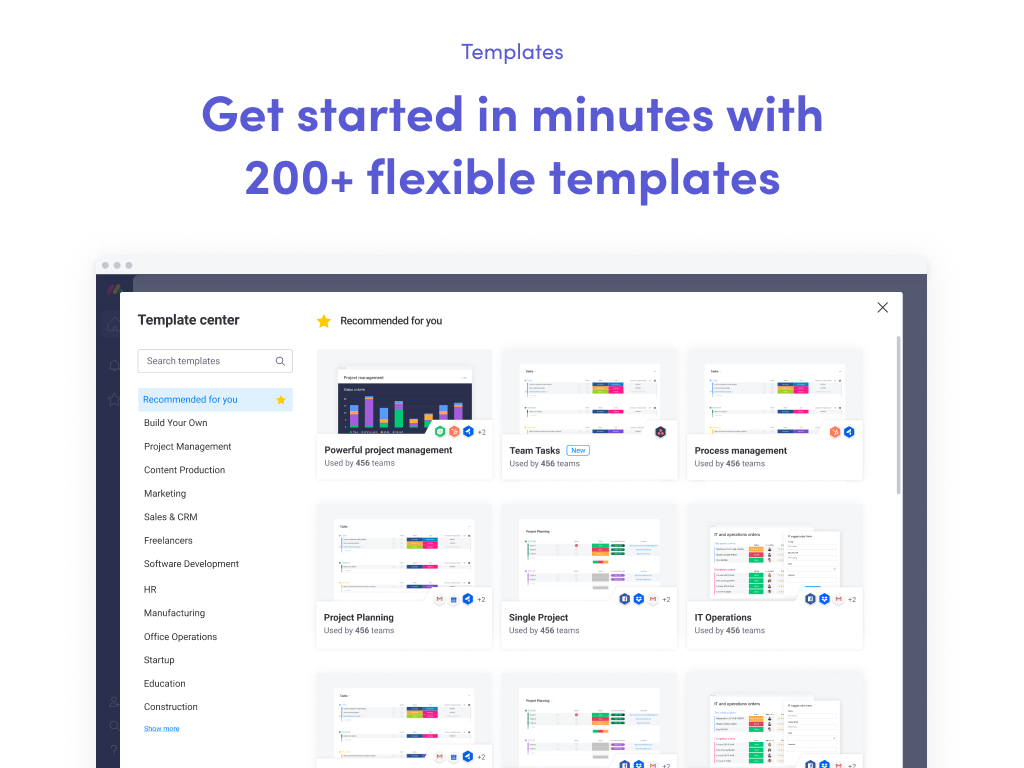
monday.com Work OS is an open platform designed so that anyone can create the tools they need to run all aspects of their work. It includes ready-made templates or the ability to customize any work solution ranging from sales pipelines to marketing campaigns, CRMs, and project tracking.
$12
per month per user
Pricing
Contractor Foreman
monday.com
Editions & Modules
Basic
$588
per year
Standard
$948
per year
Plus
$1,497
per year
Pro
$1,990
per year
Unlimited
$2,988
per year
Basic
$12
per month per user
Standard
$14
per month per user
Pro
$24
per month per user
Enterprise
Contact Sales
Contact us
Offerings
Pricing Offerings
Contractor Foreman
monday.com
Free Trial
Yes
Yes
Free/Freemium Version
No
Yes
Premium Consulting/Integration Services
No
No
Entry-level Setup Fee
No setup fee
No setup fee
Additional Details
Plans are based on features and licenses needed. Plus, Pro, and Unlimited plans include a 100-day money back guarantee.
monday.com was limited and I noticed myself integrating other programs rather than just using monday.com I used Zoho at a sales company and it was fine for that. One of my friends uses Zoho for HVAC and I liked the Contractor Foreman interface better.
I've used Buildertrend and Conconstruct near daily for a little over 10 years. They were both pretty solid. But the price kept going up without much value being added to the software. As they grew, they didn't upgrade with the growth, so the sites became slower.
Contractor Foreman’s pricing is much more cost-effective for small to mid-sized construction businesses, making it a better fit for my company’s budget. It offers an intuitive interface with pre-built construction templates, minimizing setup time and making it easier at least …
Contractor Foreman has been a great tool for managing a variety of projects, from home remodels to large-scale builds. It works especially well for keeping everything organized in one place, whether it’s estimates, schedules, or job costs. One scenario where it’s been really useful is in managing multiple jobs at once. With several remodels and new construction projects happening at the same time, having a centralized system to track progress, store documents, and communicate with subcontractors has helped keep everything on schedule. It’s also great for estimating—being able to quickly generate and send professional proposals has made bidding much more efficient. It’s especially well-suited for projects that require a lot of moving parts, like tracking permits and compliance documents. For larger jobs, like school construction, it helps ensure that all approvals, budgets, and schedules stay on track without getting lost in a mess of paperwork. Where it’s less ideal is for smaller, one-off jobs where a full project management system might be overkill. If it’s just a quick repair or a simple remodel, sometimes it’s easier to just handle things manually. The mobile app could also be a bit more intuitive for on-site use, especially for field updates and quick changes. Overall, it’s a strong tool for contractors managing multiple projects, budgets, and teams. It keeps things organized and saves time, especially on jobs that require detailed tracking and coordination.
Here, I will suggest that it is best to create employees, clients, or project reports. Easy to track with the dashboards. I did many integrations and developments. I can not list each of them here. I will say the best tool for management. I couldn't see criteria of unsuitable. But yes It will depend on the client's requirements. I will suggest it as very user-friendly tool for CEOs, CTOs, Managers, and company owners also for team.
Ensuring I have set up a Private board vs public board is not clear - it would be useful to have an additional alert when creating a board as I work with sensitive information. It will eventually be used in a team based environment but while I test the boards, they needs to be private.
Time tracking is clumsy, could be easier to record
Teams involved in content creation, such as marketing or editorial teams, could use monday.com to manage the entire content lifecycle. Boards might track content ideas, assignments, drafts, reviews, approvals, and publication schedules, helping teams collaborate and keep content production on track.
Mostly great, especially for the price. The features appear to have definitely been designed by a team with a depth of construction specific experience. I also highly rate the usability because of the vast vast amount of customizability inherent in the system. It appears that almost all forms and features are customabizable on the company level and even specific to different individual users.
It's straightforward to use and simple to understand. They have tutorials on different elements of the system that you can learn. The workflow there is very intuitive, drag and drop, which doesn't require a learning curve for most people. Templates that also make things more accessible can be found.
Many times we had issues that turned out to be errors and bugs. At first, we would be told forcefully that there were no bugs, then we would document them, and we would get an acknowledgement but no apology for essentially either gaslighting us or being ignorant of their system
Everything performs fairly well. Every now and then there are user errors where an employee will not click "ok" on a note they've created and simply exit out (I do wish that something was in place to prevent this, such as a pop "are you finished?")
Absolutely top notch! They were always there to help and immediately. Very happy with the communication they provided and the knowledge they had of their product. I would venture to say that they are one of the best in terms of support in their space.
monday.com only really care about accounts that have 20 seats or more. While this is great for monday.com, it pushes smaller organisations to evaluate alternatives. We rate monday.com highly in our organisation because key staff have already got good experience with the application and we know we will get to 20+ seats one day. But, till then the billing model and lack of permanent enterprise features is a dread.
To have someone walk you thru the features and capabilities of Monday.com is priceless. Someone also coming along later in the contract to see if you are maximizing the program to suit your company needs is beyond helpful. The staff that have provided this training are fun, creative and very patient.
We signed up for the accounts. Created the accounts. Ran the trial version and tested it live while we were running multiple projects and found that it was fitting our needs perfectly. When the trial ended and we were asked to purchase the full version, we did. We have found other ways to use it and it's a breeze.
I used Projul and Buildium when I was primarily managing rental properties rather than full home builds. Projul was great for estimating and invoicing, while Buildium served its purpose well at the time. Now, as a small construction company, Contractor Foreman provides everything we need in one platform, making project management much more efficient.
We decided to go with monday.com because they offered a free tier for nonprofits and because they are easier to use and offered additional features that we could not find on the other choices. Hands down, there was no better choice for us than monday.com.
For it to work across multiple departments and sites, I would like to see improvements made with integrations and automation. For this question, I am acknowledging not only the addition of internal triggers/automation, but also an expansion on external ones.
Cost Savings. Integration with QuickBooks and Bills improved financial control. 0-15% cost savings per project.
Time Savings: Streamlined project management led to a 20-30% reduction in administrative time, boosting on-site productivity, and with project tracking a 15-20% reduction in project delays.
Enhanced Collaboration: Centralized documentation and real-time updates improved team communication, increasing collaboration by 5-10%.
Overall, CF has provided a 10-15% return on investment annually through increased efficiency and cost control.
By using monday.com as an enablement tool for templated onboarding plans, we have been able to begin calculating the number of manager hours saved through our work (not defined yet).
monday.com's reporting tools also allow us to more easily report on the productivity and output of our team since we keep up with all projects and subitems in monday.com.