Epicor Eclipse is an end-to-end business system for wholesale distributors, as well as electrical, HVAC, plumbing and PVF businesses. Eclipse simplifies complex distribution processes found in today’s dynamic supply chains.
N/A
Sage 100cloud
Score 6.8 out of 10
Mid-Size Companies (51-1,000 employees)
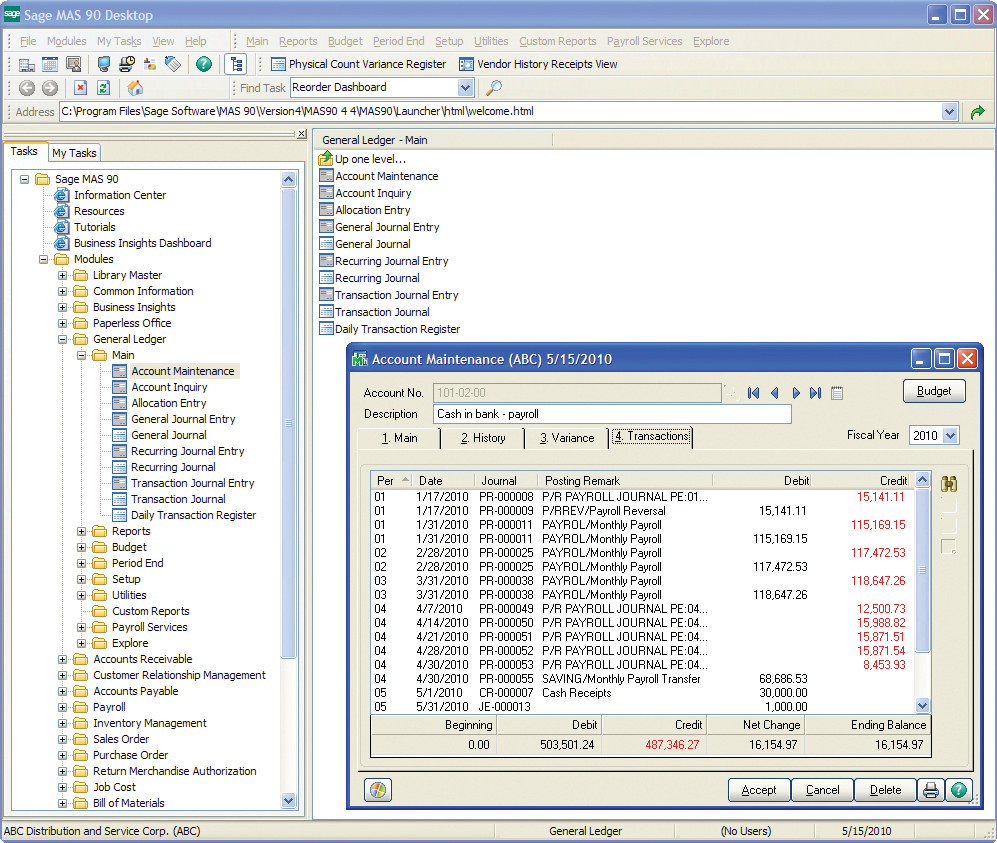
Sage 100 (or Sage 100cloud is a business management software offering a broad range of modules designed to meet the many needs of virtually any business. It encompasses financial operations and accounting, payroll, business intelligence, CRM, eBusiness, manufacturing and distribution.
N/A
Pricing
Epicor Eclipse
Sage 100
Editions & Modules
No answers on this topic
Sage 100 ERP Standard
Custom Pricing
Per Seat per Month
Sage 100 ERP Advanced
Custom Pricing
Per Seat per Month
Sage 100 ERP Premium
Custom Pricing
Per Seat per Month
Sage 100 ERP Online
$0
Per User per Month
Offerings
Pricing Offerings
Epicor Eclipse
Sage 100cloud
Free Trial
No
No
Free/Freemium Version
No
No
Premium Consulting/Integration Services
No
No
Entry-level Setup Fee
No setup fee
No setup fee
Additional Details
—
—
More Pricing Information
Community Pulse
Epicor Eclipse
Sage 100
Features
Epicor Eclipse
Sage 100
Payroll Management
Comparison of Payroll Management features of Product A and Product B
Epicor Eclipse
8.5
Ratings
17% above category average
Sage 100
8.5
Ratings
17% above category average
Pay calculation
10.00 Ratings
8.00 Ratings
Benefit plan administration
9.00 Ratings
8.00 Ratings
Direct deposit files
8.70 Ratings
10.00 Ratings
Customization
Comparison of Customization features of Product A and Product B
Epicor Eclipse
7.2
Ratings
5% below category average
Sage 100
6.5
Ratings
15% below category average
API for custom integration
7.80 Ratings
3.00 Ratings
Plug-ins
6.70 Ratings
10.00 Ratings
Security
Comparison of Security features of Product A and Product B
Epicor Eclipse
7.8
Ratings
5% below category average
Sage 100
5.0
Ratings
48% below category average
Single sign-on capability
8.00 Ratings
4.00 Ratings
Role-based user permissions
7.50 Ratings
6.00 Ratings
Reporting & Analytics
Comparison of Reporting & Analytics features of Product A and Product B
Epicor Eclipse
6.6
Ratings
9% below category average
Sage 100
7.0
Ratings
3% below category average
Dashboards
6.70 Ratings
2.00 Ratings
Standard reports
6.40 Ratings
9.00 Ratings
Custom reports
6.90 Ratings
10.00 Ratings
General Ledger and Configurable Accounting
Comparison of General Ledger and Configurable Accounting features of Product A and Product B
Epicor Eclipse
7.2
Ratings
7% below category average
Sage 100
7.6
Ratings
2% below category average
Accounts payable
6.90 Ratings
9.00 Ratings
Accounts receivable
6.80 Ratings
9.00 Ratings
Global Financial Support
7.10 Ratings
5.00 Ratings
Primary and Secondary Ledgers
7.20 Ratings
9.00 Ratings
Journals and Reconciliations
7.30 Ratings
9.00 Ratings
Configurable Accounting
8.30 Ratings
9.00 Ratings
Standardized Processes
6.70 Ratings
9.00 Ratings
Inventory Management
Comparison of Inventory Management features of Product A and Product B
Epicor Eclipse
7.1
Ratings
11% below category average
Sage 100
6.8
Ratings
15% below category average
Inventory tracking
7.40 Ratings
6.00 Ratings
Automatic reordering
6.70 Ratings
6.70 Ratings
Location management
7.70 Ratings
6.00 Ratings
Order Management
Comparison of Order Management features of Product A and Product B
Epicor Eclipse
7.4
Ratings
6% below category average
Sage 100
7.8
Ratings
1% below category average
Pricing
7.30 Ratings
9.00 Ratings
Order entry
7.70 Ratings
9.00 Ratings
Credit card processing
8.00 Ratings
4.00 Ratings
Cost of goods sold
7.80 Ratings
9.00 Ratings
Order Orchestration
7.40 Ratings
8.60 Ratings
Subledger and Financial Process
Comparison of Subledger and Financial Process features of Product A and Product B
Epicor Eclipse
7.2
Ratings
4% below category average
Sage 100
7.7
Ratings
3% above category average
Billing Management
6.90 Ratings
7.00 Ratings
Cash and Asset Management
7.40 Ratings
7.00 Ratings
Travel & Expense Management
7.30 Ratings
6.00 Ratings
Budgetary Control & Encumbrance Accounting
6.10 Ratings
8.20 Ratings
Period Close
7.50 Ratings
7.00 Ratings
Project Financial Management
Comparison of Project Financial Management features of Product A and Product B
Epicor Eclipse
5.7
Ratings
29% below category average
Sage 100
8.0
Ratings
5% above category average
Budgeting and Forecasting
6.80 Ratings
9.00 Ratings
Project Costing
7.20 Ratings
9.00 Ratings
Cost Capture
6.20 Ratings
8.00 Ratings
Capital Project Management
6.00 Ratings
8.60 Ratings
Customer Contract Compliance
7.70 Ratings
7.80 Ratings
Project Revenue Recognition
7.00 Ratings
7.80 Ratings
Project Execution Management
Comparison of Project Execution Management features of Product A and Product B
Epicor Eclipse
6.4
Ratings
7% below category average
Sage 100
5.0
Ratings
32% below category average
Project Planning and Scheduling
6.60 Ratings
5.00 Ratings
Task Insight for Project Managers
5.70 Ratings
5.00 Ratings
Project Mobile Functionality
6.40 Ratings
5.00 Ratings
Definable Resource Pools
00 Ratings
5.00 Ratings
Grants Management
Comparison of Grants Management features of Product A and Product B
Epicor Eclipse
8.0
Ratings
7% above category average
Sage 100
7.0
Ratings
7% below category average
Award Lifecycle Management
8.00 Ratings
7.00 Ratings
Procurement
Comparison of Procurement features of Product A and Product B
Epicor Eclipse
6.1
Ratings
13% below category average
Sage 100
5.0
Ratings
32% below category average
Bids Analyzed and Compared
5.10 Ratings
5.00 Ratings
Contract Authoring
6.80 Ratings
5.00 Ratings
Contract Repository
4.80 Ratings
5.00 Ratings
Requisitions-to-Purchase Orders Integrated
6.90 Ratings
5.00 Ratings
Supplier Management
6.80 Ratings
5.00 Ratings
Risk Management
Comparison of Risk Management features of Product A and Product B
Epicor Eclipse
4.5
Ratings
37% below category average
Sage 100
4.4
Ratings
39% below category average
Risk Repository
2.70 Ratings
5.00 Ratings
Control Management
6.20 Ratings
5.00 Ratings
Control Efficiency Assessments
4.50 Ratings
5.00 Ratings
Issue Detection
4.10 Ratings
3.00 Ratings
Remediation and Certification
3.80 Ratings
4.00 Ratings
Logistics
Comparison of Logistics features of Product A and Product B
Epicor Eclipse
4.9
Ratings
31% below category average
Sage 100
7.1
Ratings
6% above category average
Transportation Planning and Optimization
4.30 Ratings
7.00 Ratings
Transportation Execution Management
4.20 Ratings
7.00 Ratings
Trade and Customs Management
4.10 Ratings
7.00 Ratings
Fulfillment Management
6.30 Ratings
7.00 Ratings
Warehouse Workforce Management
6.30 Ratings
7.60 Ratings
Manufacturing
Comparison of Manufacturing features of Product A and Product B
Epicor Eclipse
5.0
Ratings
39% below category average
Sage 100
8.2
Ratings
10% above category average
Production Process Design
4.50 Ratings
8.40 Ratings
Production Management
5.70 Ratings
8.40 Ratings
Configuration Management
6.40 Ratings
8.40 Ratings
Work Execution
5.40 Ratings
8.00 Ratings
Manufacturing Costs
4.80 Ratings
8.00 Ratings
Supply Chain
Comparison of Supply Chain features of Product A and Product B
Epicor Eclipse
5.7
Ratings
22% below category average
Sage 100
7.8
Ratings
9% above category average
Forecasting
6.10 Ratings
8.00 Ratings
Inventory Planning
6.60 Ratings
8.00 Ratings
Performance Monitoring
5.60 Ratings
7.60 Ratings
Product Lifecycle Management
Comparison of Product Lifecycle Management features of Product A and Product B
For medium (with growing pains!) organizations, Epicor's Eclipse software would be a great distribution and point of sale software solution and competes well with other software solutions out there. For large distributors Epicor's custom programming has the ability to tailor their software to customers exact need. I feel the cost of the system would be prohibitive to smaller distributors.
For small and medium business in the distribution and light manufacturing space, Sage 100 is probably the best bang for your buck. As a very scaleable system, you can modify the system to meet the needs of a growing business without making gross changes to the core of the system
Their support has gotten worse over the years. They fired a large portion of staff in favor of cheaper new hires. It is getting slowly better over time as their support people are gaining experience, but decades of institutional knowledge was lost. Response time can vary wildly depending, which is troubling when you have an immediate need. They have made a partial mea culpa, but the situation is not fully remedied.
The user interface is clunky. The original interface, E-term, is a terminal based system (think DOS). A few years ago they rebuilt it using Java and called the new interface Solar, which is a more point and click, windows friendly version. Solar is slower, and so has been difficult for us to get the user adoption we've needed. In addition, any customization we do doesn't work in Solar. Now they have announced a new road-map to make it all web-based. Good luck to them, but it seems they spend all their time playing catch-up instead of making deep system improvements.
There are significant gaps in what Eclipse is able to do. Sometimes there are third party products (Proof of Delivery, E-commerce, Tax, etc.), and sometimes Epicor offers in house solutions (Job Management, EDI, etc.). In either case, there are a string of products we have to integrate and maintain to make Eclipse functional. Most of them require support contracts, and have varying degrees of support.
I use it every day and can't see a reason why I would stop unless I started a new job. If I were to leave my present position, the new job would be much more attractive if they were Eclipse users.
I would put this out to bid, if I were at the same organization. There have been a lot of improvements and changes in enterprise software and my preference would be to find a good web-based or cloud-based tool. Lower overall cost of ownership and improved efficiency would be my target criteria for a rebid of this.
This is very easy to use for someone that hasn't ever used the system before. Despite any preconceived notions about how a system should function they can learn this and become efficient with really not a lot of effort. I have used many systems and this is probably one of the easiest I have ever had to learn to navigate and use.
Overall Sage 100 has been pretty user friendly. If we have a question on anything, we are able to contact our implementation rep who helps us right away. Some of the Sage Field Operations may not be as intuitive for our field personnel to use. I wish the reports ran faster so that we could run and put together many reports quickly at once.
I haven't experienced any outages in the two years I have been using the system. It is always available as long as the computer is up. The only time I have seen it not be available was on occasions where we lost internet, or power and then we lost access to everything, not just Epicor Eclipse.
Everything in this system moves fairly quickly, that may be in part because we are a small company with only 21 users on the system at a time, or it may just be a the way the Epicor Eclipse works for any size company with any number of users. I can only speak for what I know and say that it is fast for our purposes.
The tier 1 support is trying, and sometimes they are successful. Sometimes they aren't. This topic isn't as black and white as the questions might suggest. Currently their Tier 1 support team is over seas, all items automatically go to Tier 1 and then when they can't help they either escalate it or tell me they need to check with someone else and they will get back to me. If they escalate me to Tier 2, then the issue comes back to the States and the support is usually at a higher knowledge/experience level and it can get resolved fairly quickly. If they don't escalate, then it might take weeks and multiple follow ups on my part before I either get a satisfactory resolution or finally get escalated.
We use a local software technology partner to help support our Sage100 needs. We do not need much assistance with Sage100. There are very few issues or questions.
The training classes that I have attended have been top notch. The presenters are extremely knowledgeable on their subject matter, including real-world application of the system. They aren't just software techs training end users, they seem to be end users that have become experts in the over functionality and capabilities of the system.
The on-line training is very good, and it is taught by the same people that do the live in-person training sessions. The difficult part of it is, asking questions about your specific company's nuances or special circumstances. I don't remember if you can access the on-line training sessions after you have taken them for reminders purposes, but if so that is a great asset.
I don't really know about the implementation, it was back in 1998 and I didn't start here until 2016. By the time I started here they had been running it for a number of years and most of the people that were here when it was implemented are no longer here, and the ones that are don't really have much to say about how the implementation went either bad or good.
We had an advantage in implementing the tool in that our director of Ops had been part of the team implementing the ERP for other users so we knew what to expect and were able to avoid a lot of the challenges people sometimes face with implementations. However, the process still took far longer than desired.
Most of my experience has been with Epicor's Prophet 21. For most distribution verticals, Prophet 21 is the only way to go. The comparison I've drawn is this: Prophet 21 is like a ferrari. Epicor Eclipse is like a reliable donkey. Both get you from point A to point B but Prophet 21 is going to get you there much quicker and with the kind of insight into your business that will help you thrive.
We have used Foundation and it did not work out well, so we selected Sage 100 because the implementation and functionality was much better. We didn't have to keep coming up with workarounds or complications on Sage 100. Also the data security is better.
I don't really know about the scalability. It's the same as it was when I started, I do know that you can buy more user licenses, but I think they come in packs of 5, which can be a problem if you only need 1 and will never use the other 4. But, again I'm not sure on that.
Reporting features allow tracking items trending downward which can glut inventory space and dollars if not adjusted
GMROI reports help analyze turn ratios and adjusted dollar values and margins of product lines.
Suggested Purchase Order features allowed controlled inventory purchases which avoid lost sales while managing overall dollars invested in an acquired product with the lowest freight costs possible.
Sage 100 has allowed us to better serve & manage our customers since we integrated it into our system in 1996. Since then, we have seen a lot of changes but, the consistent, simple layout has kept us re-newing our contract year after year.
Ordering inventory has been easier than ever since we integrated inventory tracking. No more ordering too much or too little.