Freshping was a website uptime monitoring tool with free and enterprise editions, from Freshworks. The product is no longer available to new customers.
$11
per month, billed annually
Pulseway
Score 9.9 out of 10
Mid-Size Companies (51-1,000 employees)
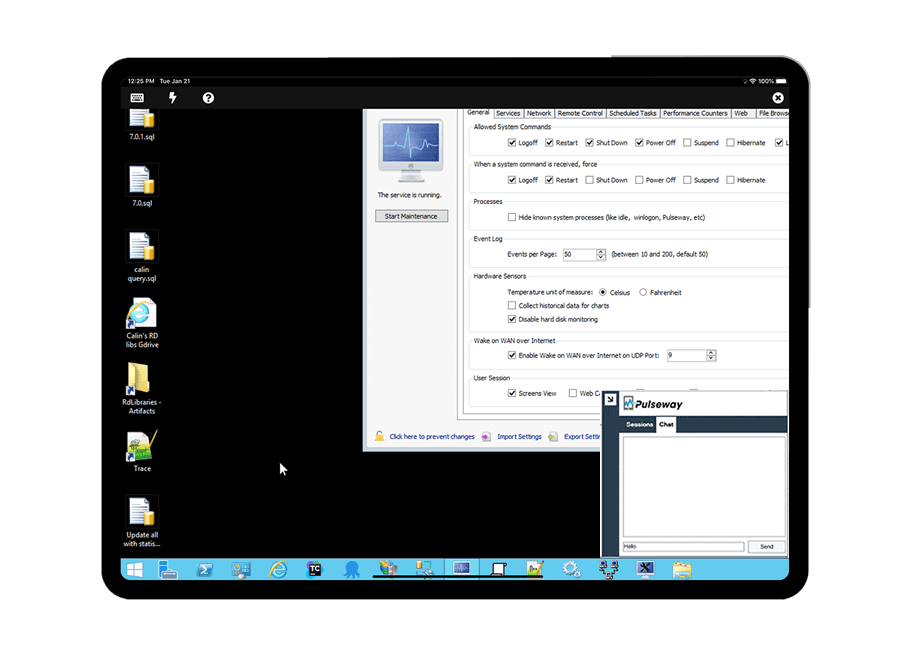
Pulseway is an IT monitoring and management solution that enables users to monitor, manage and control all systems and servers from a smartphone, tablet or browser. For system administrators, Pulseway sends a notification, so they can see an issue and sort it in seconds. Pulseway features: Automation: Auto-remediation workflows, so that IT issues are fixed before users even notice them. Mobile Access: Customers can monitor, manage, connect with…
$0.80
per month per installation
Pricing
Freshping (discontinued)
Pulseway
Editions & Modules
Blossom - 60 checks (can add more checks)
$11.00
per month, billed annually
Garden - 80 checks (can add more checks)
$36.00
per month, billed annually
Sprout
Free
50 checks (none additional)
Enterprise
$0.80
per month per installation
Offerings
Pricing Offerings
Freshping (discontinued)
Pulseway
Free Trial
No
Yes
Free/Freemium Version
No
Yes
Premium Consulting/Integration Services
No
No
Entry-level Setup Fee
No setup fee
No setup fee
Additional Details
Every additional 10 checks - $8/month billed annually
No hidden fees or contracts. Term-based discounts.
More Pricing Information
Community Pulse
Freshping (discontinued)
Pulseway
Considered Both Products
Freshping (discontinued)
Verified User
Anonymous
Chose Freshping (discontinued)
We did not choose Freshping over these, we selected it as an additional tool in our toolset. It is important to have multiple angles of monitoring, and FreshPing was a natural addition because of its integration with our existing trouble ticketing solution and it being …
We use Uptime Robot, and also some internal health checks, which report directly to our emails and chat applications. They all work "pretty fine," but unfortunately all of them have had some false positives or missed some minor downtime, so as for us, it doesn't add too much …
1. The fact there was no contract, we believe vendors should have to validate the usefulness of their product and their support to their customers every day, not just 1 or 2 months every few years. This is the same reason we allow our clients to leave …
I will admit, we started with Pulseway several years ago because we were able to start using it with a free account, which allowed us to install it on some in-house servers and gain experience with it. The other products we looked at all seem to require a considerable …
Pulseway has a more moderate learning curve compared to Nagios, which was overkill for our environment. Nagios also requires a server to run on, and we wanted to separate our monitoring from our hypervisor.
Pulseway has the most features, the best looking app with the best design and better usability than any others we evaluated. We liked the uniformity of the app design across all platforms (Windows, Android, Apple) and the notifications displayed on each platform. The price was …
Pulseway is by far the easiest to set up. The dashboard is very straight forward and has very little need for custom configuration. We use Pulseway to review basic server information and compare it to other similar servers to track outliers. It is very easy to see resources, …
Pulseway offers a reliable suite of tools at a reasonable cost. It has a lot of power in it if you are willing to put in the time to configure the automations and such in a way that works for you. They also integrate well with other tools offered by Kaseya.
Freshping is suitable for anyone looking for a service to monitor the status of applications without much trouble and effort on it. The free tier will sure be enough for a lot of users. I wouldn't recommend this if you need very customized checks to define being up or down of course, or a very custom status page.
Pulseway is well suited for just about any situation where there is a need to remotely monitor and manage computers. The most basic features are available to anyone with a free account, so even a home user can set it up and use to keep an eye on computers. The more sophisticated features require a fairly inexpensive subscription, but are well worth the cost for a business wanting to monitor the health of their servers, etc. My experience with Pulseway is limited to using it in situations where there are fewer than a dozen or so computers/servers being monitored. I'm not really sure how well it scales up, so I can't say if it is a good solution for a large corporation with hundreds or thousands of machines that need to be monitored.
There are a couple of computers that I keep ScreenConnect around for - as I lose connection with Pulseway and have to reestablish with ScreenConnect. I can't seem to get tech support interested in resolving this issue and it cost's me many $$ just to keep ScreenConnect running.
There is an issue with Webroot, their new endpoint solution. I can't get it to work - again, no help from Pulseway - they ignore my emails.
It's perfectly easy and straightforward to use. There's no need to read documentation, you just register and will surely be able to configure whatever monitor you want to set up. It's also very easy to use other features like the status page, reporting, alerts, etc.
The tool is easy to use however it is can be daunting with the amount of features available in it. Last I checked, their knowledge base was not very expansive and they relied a lot on the changelog for how to do some stuff. This can make it hard to learn how to do some more advanced things like the automation.
I have never had to use the support for Pulseway. However, when initially starting out, we would receive emails every so often asking how we are doing and if there is any support that they can provide. I would imagine that any request would be supplied with the same great support!
We did not choose Freshping over these, we selected it as an additional tool in our toolset. It is important to have multiple angles of monitoring, and FreshPing was a natural addition because of its integration with our existing trouble ticketing solution and it being completely free to use. Compared to PRTG, it is much easier to create a systems status/uptime page for the end users to view.
The 2 major factors were: 1. The fact there was no contract, we believe vendors should have to validate the usefulness of their product and their support to their customers every day, not just 1 or 2 months every few years. This is the same reason we allow our clients to leave at any time if we fail to meet their standards. 2. The ease of managing the product, we demoed other products that would have almost required a full time employee just to manage the RMM tool itself. The ease of use of Pulseway meant a tech could manage it as part of their other duties much improving the ROI. Note: We also felt NinjaOne met these same conditions but we evaluated it after having used Pulseway for a few years and while we found it a great product, possibly even superior, we didn't find enough reason to go through all the work and retraining to change over.
Problems can be dealt with more rapidly because I have access to systems from anywhere. I don't have to carry a computer with me nor do I have to find a location with potentially non-secure wifi to gain access to my systems.
I can handle 99% of my system admin tasks using Pulseway and never have to touch a system or connect to the console.
Pulseway gives so much control over a system that I don't need to spend extra money on other software to perform management tasks.