Google Trends is a search engine optimization software solution offered by .
N/A
Searchmetrics
Score 6.0 out of 10
N/A
The Searchmetrics Suite automatically analyzes your website and guides you through the optimization of your keywords, topic clusters (onpage) and thus your content, as well as backlinks (off page) / social links, and finally the information architecture of your pages. Clients are provided with international ranking data regarding several search engines like Google, Bing, Yahoo!, Yandex and Baidu etc. Integration of Web Analytics, enriches data with traffic, conversions and user signals, such as…
Overall I think that Ahrefs is a better product when it comes to really drilling down and getting all the data that you need in order to understand a given behavior or problem. Ahrefs is much more powerful in its feature set but does not have the same level of overall …
They are both great tools. I prefer Google Trends because of the location capabilities and being able to go hyper-local. It does not however provide the details on cost and competition like SEM Rush does.
Google Trends is probably the easier of the many other Google platforms to identify keywords. I haven't used other keyword platforms because I don't trust them—I rather use a tool directly from Google to evaluate popular keywords. That being said, Google Trends is very limited …
I like using Google Trends because it gives you a clear visual of seasonal trends and compares multiple queries at once. However, I do prefer using other systems like SEMRush and Ahrefs because they are more detailed in the information they give you regarding your website and …
It's not really an either/or thing — I use the complete "Google Marketing Stack" including Analytics, Trends, Keyword Planner, Search Console, etc. It's also essential to integrate some of their data, like making sure Google Search Console and Google Analytics are connected — …
Google Trends provides insights that are only available through Google, however, it does not include other important trends such as those on social media or via their competitors.
I've used SEMrush, while more of a SEO Manager than keyword trend analyzer, it does have that option as it does relate to SEO management, but between the two, its nice to have the option in SEMrush, but Google Trends is better at doing the trend analyzing than SEMrush is.
One of the most obvious reasons why I chose Google trends over other keyword research platforms is because it's free. At the same time, it also has the most relevant and easy-to-use features out of the bunch. Google Trends does not have as many features as SEMRush or BuzzSumo, …
We used multiple platforms. Google Trends is just one of them! It's important to have multiple tools to check and reference back and forth. Google Trends is totally free for everybody so why not give it a try.
Google Trends tends to be slightly more accurate than the other products, because Google has access to more user data for the algorithm to take into consideration when providing trends and information. We like this tool because it also aligns better with the Google tools we use …
We use Google Search Console and Moz mostly for our website improvement, and Google Trends we use mostly to look for trends: what people are searching for now. Google Trends is free and has very clean, simple and understandable user interface, it gives lots of usable data for …
There really isn't a product I know of that does what Google Trends does. I do use https://soovle.com/ in a similar fashion. I recommend trying Soovle out for content ideation.
Google AdSense is much more detailed, but requires the user to be logged in and have an active Google Adsense account, sometimes it's quicker to just use Google trends.
Google Trends has the biggest source of data and is the most accurate. It cannot be used without any other tool because of its own limits (keyword suggestion, semantical analysis, etc.).
Google Trends is sometimes a helpful supplement to other analytics and advertising tools, but it is not very useful as a standalone analysis tool. We have seen much more benefit from the intelligence and audience information built in to our other core tools. Better predictive …
Google Trends and Open Web Analytics are both similar and different. While both products allow a user to track the popularity of a given webpage or search term, Google Trends is more effective in providing content and suggesting trends. Furthermore, I liked the ability to use …
Google Trends is a great place to start in the content curation, content research, blog post writing, and resource page creation process. It is not, however, a place to do serious SEO optimization. Tools like Moz, or Analytics SEO would be a better place to go after you do …
They're different tools and thus have overlap, but still do quite different jobs. So there really is no exact comparison, in free to use tools, to Google Trends out there. If it could generate periodic reports it would be even better.
We originally selected Searchmetrics because we got more bang for our buck. On the research end, we could do unlimited searches without the cost of the service going up. As for the historical data, we could store more trending data and do deeper research than we could with the …
Google Trends is appropriate in so many scenarios, but I definitely suggest it for content ideas and inspiration. Many people utilize it after already writing their content to add in popular phrases or words, but that is not enough. The platform should be used prior and during the content creation process so that you can use the data to see what your audience/customers are interested in at the moment and create the content based on their interests. It can help, but I find it much less appropriate to use it after your article, eBook, etc. is already written. Maximize on this useful tool by ensuring the topic you're writing about is relevant in the first place before simply adding in popular keywords. An article that's written based on what's trending will be far more successful than an article that solely has popular phrases added to it.
Searchmetrics does a great job when doing optimization of your content and keywords. It is less appropriate when doing off page optimization like backlinks.
Allows you to search keywords and phrases in certain locations to see search volumes, this is huge and helps us be successful with our Google Ad campaigns.
Shows us insights into trending topics which allows us to stay in the know and apply any relevant trends to current clients.
Year in Search and Trending Topics provides us great inspiration for our ads
Being able to search in certain locations gives us a ton of help when setting up campaigns and doing our keyword research for clients.
Being able to compare multiple keywords or search terms side by side is extremely helpful.
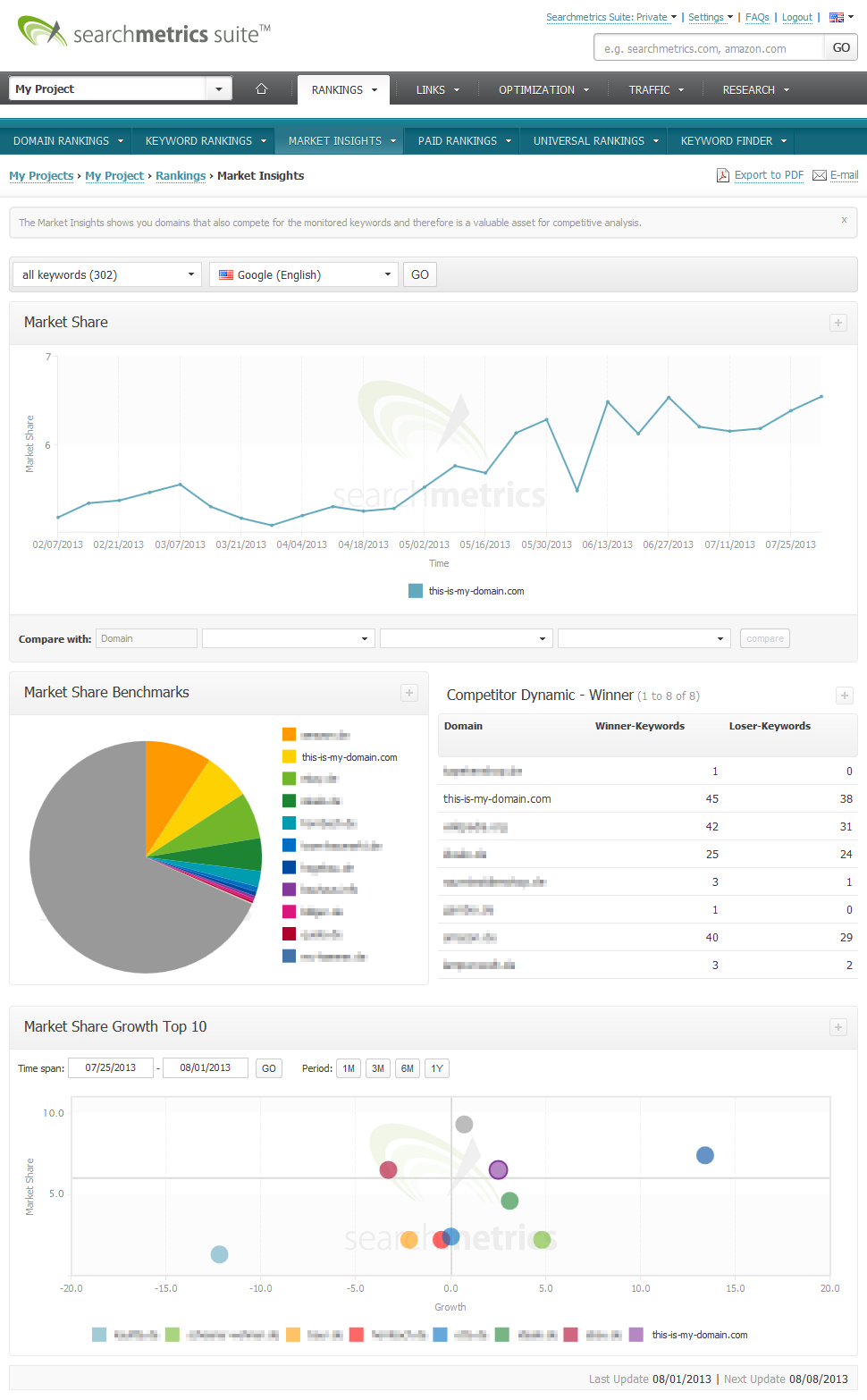
Content optimization, give one or more keywords to Searchmetrics and the webpage you want to rank for those keywords. Searchmetrics will check your page and compare it with other web pages that rank for your given keywords.
Competitor research, find out what keywords your competitors are ranking for.
Keyword research, what keywords are you using and which keywords could be new opportunities for your project.
A lot of competitor SEO research sites offer suggestions on how to improve SEO ranking or changes that could be made to page title or descriptions, but Searchmetrics is a research only product and does not offer suggestions.
Not sure if all of their contracts have an auto-renew, but ours did and we missed the 30-day notice to opt out and are now stuck in a new full year contract...
Adding mobile tracking requires a new contract and is an additional add-on
We are currently using an agency and do not need Searchmetrics services at this time. If we do need research metrics in the future, we will probably go with them. The only deterrent is that we got suckered into an additional year with them because we were a few days late on opting out of the auto-renew. Although I was very upset about getting stuck an extra year paying for services I do not need, that is probably the only issue I have with the company, so if you can avoid that, it's a pretty good product.
Google Trends is very easy to use. you just search for a certain keyword or phrase, and it tells you how often that keyword or phrase is searched, where in the world it is searched, and over the last decade, how often it is per year.
I haven't needed to use any support for Google Trends. However, I've used Google's support in general and it's a hit or miss. Usually, there's a long wait or they don't understand my problem. They are the only ones that can help, so sometimes I feel stuck. They prioritize paying customers for sure.
I've used SEMRush, while more of a SEO Manager than keyword trend analyzer, it does have that option as it does relate to SEO management, but between the two, its nice to have the option in SEMRush, but Google Trends is better at doing the trend analyzing than SEMRush is.
We originally selected Searchmetrics because we got more bang for our buck. On the research end, we could do unlimited searches without the cost of the service going up. As for the historical data, we could store more trending data and do deeper research than we could with the competitor. The monthly fee was almost half (if i remember correctly, but it's been a few years) of what what we were paying before with a competitor.
I can't really give a measurement of how Google Trends has directly contributed.
Since Google Trends is free I would have to say that it is all positive ROI.
I can say that Google Trends definitely makes it easier to accomplish my business objectives of delivering the most relevant and insightful advice to my clients regarding their SEO, Social Media Publishing, and Online Advertising.