Google Analytics 360 (formerly Google Analytics Premium) was an enterprise-level analytics solution that was sunset in July of 2024.
$150,000
Up to 1 Billion hits/month
Heap
Score 8.0 out of 10
Mid-Size Companies (51-1,000 employees)
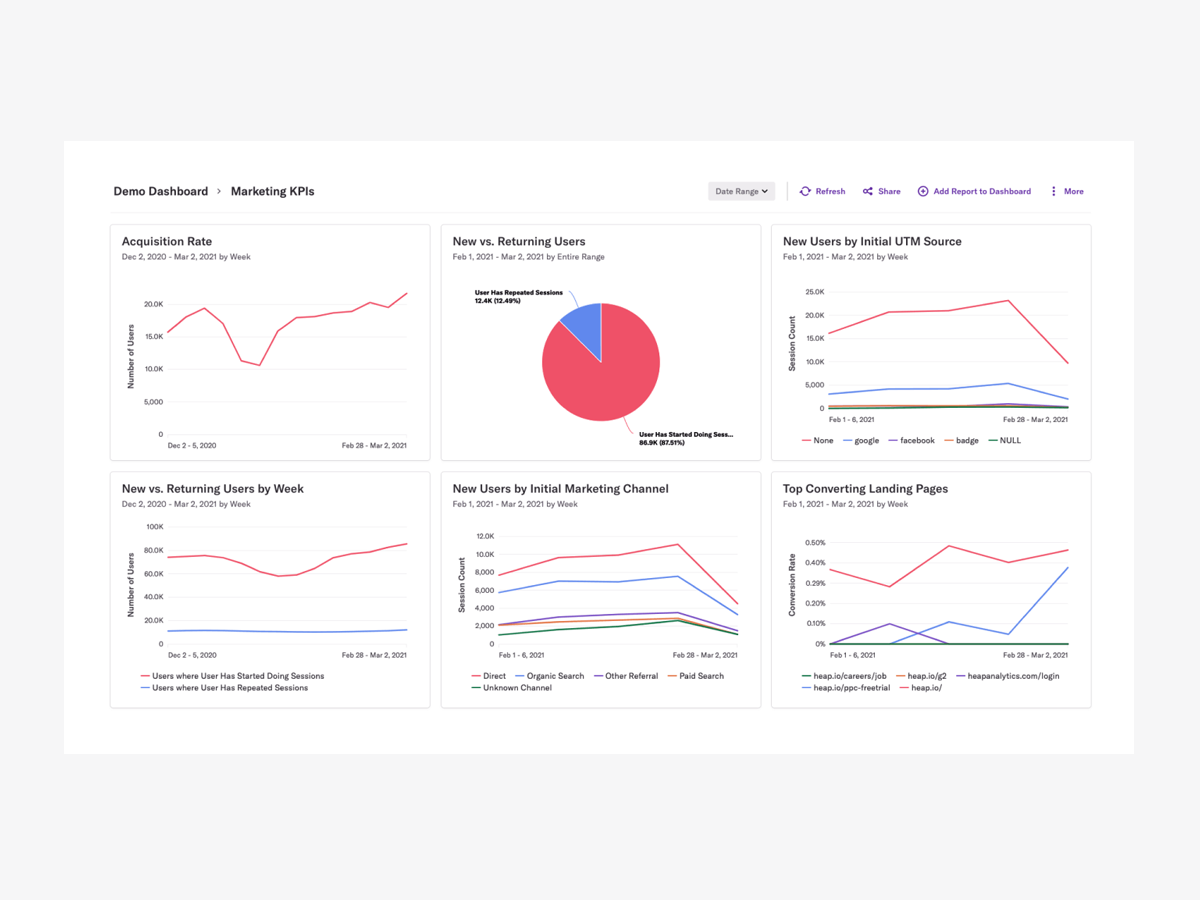
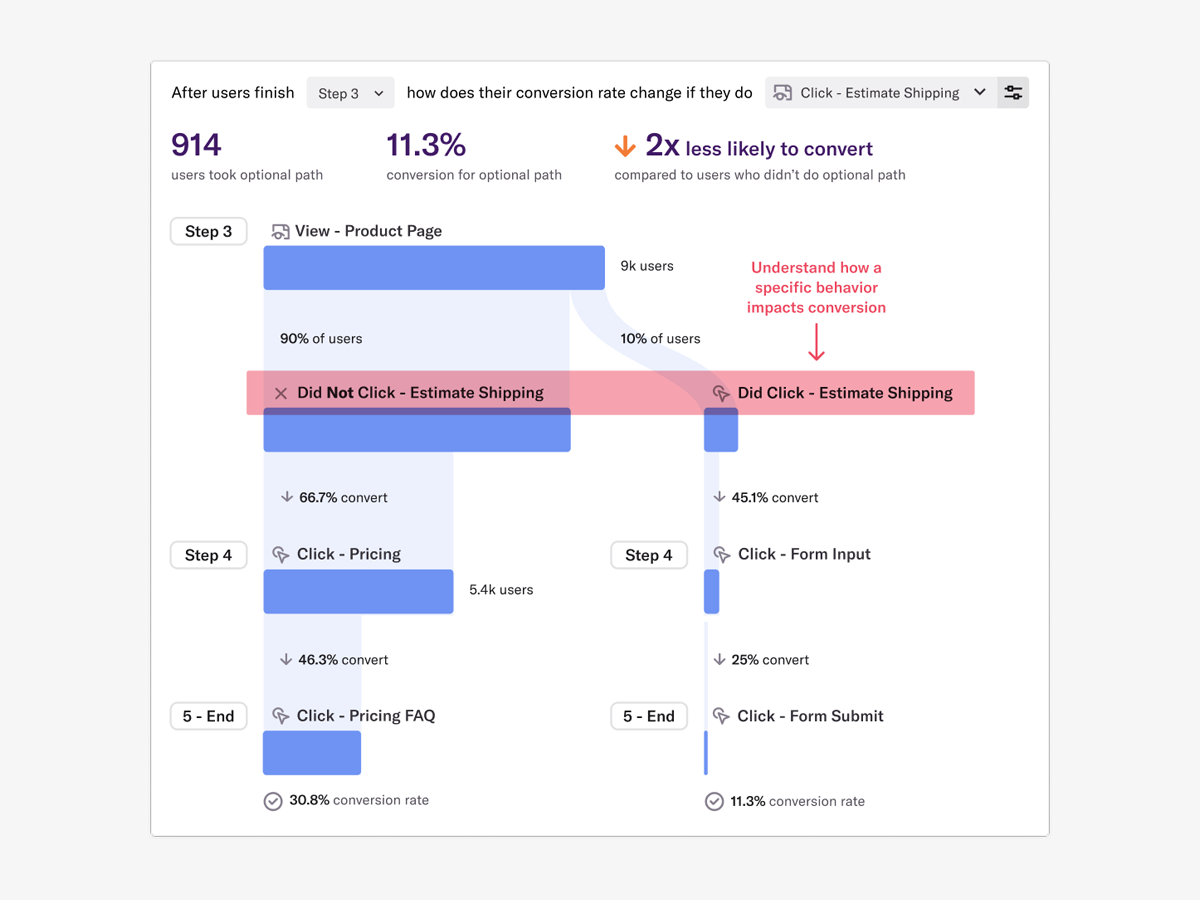
Heap is a web analytics platform captures every user interaction on web iOS with no extra code. The tool allows you to track events and set up funnels to understand user flow and dropoff. It also provides visualization tools to track trends over time.
$0
Up to 10k sessions/month
Pricing
Google Analytics 360 (discontinued)
Heap
Editions & Modules
Google Analytics Premium
$150,000
Up to 1 Billion hits/month
Google Analytics
Free
Free
$0
Up to 10k sessions/month
Growth
Starting at $3,600 annually
Up to 300k sessions/year
Pro
Contact Heap Sales
Custom sessions per month and unlimited projects
Premier
Contact Heap Sales
Custom sessions per month
Offerings
Pricing Offerings
Google Analytics 360 (discontinued)
Heap
Free Trial
No
Yes
Free/Freemium Version
Yes
Yes
Premium Consulting/Integration Services
No
No
Entry-level Setup Fee
No setup fee
Optional
Additional Details
—
Heap pricing is based on session volume. A session is a period of activity from a single user on your app or website. It can include many pageviews or events.
There are a lot of good alternatives out there for a fraction of the cost. Also, another good reason you might want to consider another platform is due to privacy concerns. I have nothing against Google, but Google collects a lot of data about users from various Google …
Since our data is on Bigquery it is very easy for us to connect our database to this platform which is very challenging for us to connect the data integration part to other platforms so this is the primary reason for us to choose this platform. The second reason to choose this …
As long as the budget isn't in question, then I think you get a lot more for your money for 360. Having more confidence in the data is essential, your typical GA suite is good but there are limitations. These limitations unfortunately mean that a lot of the time you are having …
We prefer Google Analytics 360 because it is a simple-to-use tool that is very useful for tracking web traffic through real-time statistics, updates, and recommendations. It can create custom reports in the application itself, generating the desired results.
I have looked at this - when clients use it. It is very expensive for a small business owner or solopreneuer. Google Analytics 360 is free and does the job I need it to do.
Features like user segmentation and visualization of user behavior and journey.
Custom reporting and creating custom tables with different metrics is what we miss.
Big Query, Google Optimize and other features.
Unless you have very complex and edge case analytics needs, Google Analytics [360 (formerly Google Analytics Premium)] is likely going to be the best choice. From both a cost and usability stand point, Google wins. Adobe has the edge case when you need to create really custom …
Amplitude is an alternative for Google Analytics and we have implemented Amplitude also. We choose Google Analytics over Amplitude because of features like segmentation of users, creating cohort, seeing the user's behavior and journey. Amplitude has all of the data but it's not …
Google Analytics and Adobe Analytics are both great products and solutions. Each has advantages and disadvantages that need to be evaluated based on your business needs and the people you have to leverage them. Google Analytics is a lower overall investment than Adobe Analytics …
GA is more extensive than Heap, however, it's also more difficult to wrangle the data into our own warehouse. Heap data is easier to integrate as it has data sharing for Snowflake where GA doesn't, at least not when used it. I believe Heap is less expensive.
Piano Cxense and Chartbeat, in conjunction with Google Analytics are the suite of tools that we use to monitoring and measure our sites performance in realtime and historic.
Adobe Analytics is a robust tool, feature-rich, and good reporting. It has focused on understanding user behavior and e-commerce performance at its core. However, with the sophistication comes difficulty in use and the ability for simple reporting and analysis. The setup of …
Google Analytics Premium is more simple and focused on marketers' needs with a clear advantage for driving improvements to advertising, especially with the Google tech stack. Adobe Analytics is very complex and great for enterprises, especially those that want to measure …
Associate Director, Client Leadership for Michelin
Chose Google Analytics 360 (discontinued)
I work with a lot of analysis for my client along with A/B tests of statistics. Google Analytics Premium provided a complete and application of results even faster, the data shared between optimize and analytics is a very big competitive advantage.
There are no competitors to this software, honestly. It's in a league of its own. Premium is truly an all-in-one tool that few can do without, and it's absolutely shocking the amount of data that it can compile. If you're looking for an excellent source of information this is …
Google Analytics is much more user friendly and requires less day to day management. Google Analytics should be the platform of choice unless there are complex business reasons to choose Adobe.
Google Analytics had a reliable means of accessing data, but also translating raw data into credible results. In general, its functionalities are simple to understand, train others, and implement.
Hubspot spends too much time trying to sell you on other products instead of assisting you with your current product in a consultative manner. Google customer support doesn't consult per se, but they do focus on the current product at hand without constantly trying to upsell …
Google Analytics and Adobe Analytics are very similar. I wasn't involved in the decision making process at my organization, as we had GA well before I began in my position. However, GA has a suite of other tools that complement Web Analytics that makes it extremely easy to …
Google Analytics stacks up for high level traffic and marketing data but not ideal for enterprises looking user level product interactions in detail. On the other hand Heap stood out for its automatic data capturing, faster onboarding, easy to use dashboards, Highly integrable …
For me, Heap is much simpler to utilize. I've previously used Google and Adobe Analytics but switched to Heap because it provide better features and is easy to integrate. Without a specialist's assistance, I am able to construct dashboards and am convinced that they are useable …
Heap is better because its easy to use, easy to install. With Heap you just add a snippet of tracking code to your header, instead of having to instrument each event like you do with other tools.
all of them may have their own strong suits but Heap is backed by best in class ML and AI algorithms. not only that all this powerful and robust backends are well handles also from the frontend. no matter how good your software is, if it is somewhat hard to navigate or to get …
Heap is better then Pendo and Amplitude. Compared to Amplitude, Heap is cheaper and easier to analyze and use. Configurations might be cumbersome but in the long run, users find it very seamless and easy. Compared to Pendo, Heap offers much superior analytics, event …
The ability to view events in real time as they occur, restrict them to just show mine, and then create dashboards using those events is the finest feature for me. It eliminates the requirement for constant 100% accuracy in documentation maintenance and guessing. I can monitor …
Heap had an edge over Google analytics in many ways. Few points to consider Heap over GA. 1. Low code implementation and less involvement of engineering team. 2. Great reporting dashboard with additional feature of of showing user journey, that helps understand user behaviour
Other applications help to achive the requirements using the current data, but Heap has two driven model one is dependent on past data which is also known as predictive framework and also one dependent upon fly which is adaptive framework. And integration is other tools is …
Heap offers a ton of functionality on a single platform.It also has an smart data science layer to offers suggestions for next steps in the analysis, allowing us to explore alternative paths we may not think to take. The low-code option for updating data is appealing, and there …
Heap blows away the competition in this space in my opinion. Amplitude was the closest competitor but did not have the ease of instrumentation that Heap offers out of the box. Google Analytics has gotten worse year after year and was borderline worthless for our business, as …
Tableau offers more advanced features, but at a much higher cost across all dimensions: price, difficulty of implementation and integration, onboarding effort, prior knowledge required, etc.
Compared to GA, Heap provides a much better UI, and its a much better product analytics tool (considering GA's main functionality is not for Product analytics) Overall, of you, are searching for Product analytics I would choose Heap instead of GA.
Heap is much easier to use versus Google Analytics. Previously, I was using Segment to get channel level data. However, Segment is not a customizable tool to understand top of funnel/web performance in the same way Heap does. Heap Connect is excellent when it comes to creating …
Heap is much easier for me to use. With Adobe Analytics, I needed to work exclusively with a product analyst whose whole job is working in Adobe Analytics. I can create dashboards without help from a specialist and feel confident that they are functional, actionable, and usable …
I didn't select heap. Someone else did. I wasn't consulted during the process either, it was there before I arrived and we recently renewed, but I wasn't part of that process. Hotjar was alright, the heapmap is a neat way to quickly show non-experts where we might have an …
I think this is a great platform as long as there is a dedicated team which is going to spend reviewing the data and also taking out insights from it, making it beneficial. It was well suited for me when working with a client that had a very large amount of traffic, with a large range of complex products on offer. This tool allowed us to be able to do more with the data and segmenting it more which ultimately drove our relationship forward, but also the results that we saw
Heap is well suited for 1. Capture customer journey with session replay 2. Identify customer behaviour and improve overall customer experience 3. Frequent and quick implementations and modifications 4. Comparative analysis for historical marketing insights Heap is not so well suited, if the aim is to capture only analytics data without any goals to improve upon customer experience / targeting appropriate users based on data tracking.
It is an excellent cloud analytics platform that is easy to install and configure and easy to deploy and use, allowing us to measure web traffic and other tools.
It is an entirely online tool; it does not take up hard disk space like other desktop tools.
Since this tool is draggable, Google is constantly adding more features.
Even beginners who do not have a custom dashboard can get information. If there is a problem somewhere on the site that needs to be investigated, Google Analytics 360 will notify you.
The Auto Capture function does indeed save quite a bit of time, and being able to build new reports off historical data is really valuable.
Interface is really intuitive and user-friendly. Much easier to pick up and use than GA.
Building reports out on the fly is really quick and easy, allowing you to give right into all kinds of analyses.
The Event Definition screen is really useful, giving a quick glance at the most used events, which you then decide to turn into conversions or goals if you want.
As far as I can tell, this is the ultimate large scale analytics platform. It does so much and can be a very powerful tool. Maybe it's overwhelming for newbies, but that's kinda what the pro Google consultations are for.
Although I've never been personally responsible for paying the GA 360 bills, I know it's very pricey ($150K/year last I checked). If your business is managing a lot of high-traffic sites, and maybe you resell other Google services, then it's probably worth it for the dashboard and integration. So... it's expensive, and by definition, not for everyone.
I believe that once Google Analytics Premium releases some additional eCommerce capabilities, it will be the best tool on the market for multi-site customers. Google does an amazing job of fully vetting out new features and functionality before releasing them publicly, so I have found very few issues with the functionality and usability of the tool. Some of the other big players in the industry are too quick to release new features, and they are often riddled with bugs and defects. I know that when I set something up with Google Analytics Premium, I'm getting a reliable, strong product that will deliver what it promises.
Heap helps me understand key data points without fussing with the formatting of a dashboard. It gives me the benefit of data analyzation without the fuss of the formatting - as well as the ease of sharing data collected with my colleagues
Google Analytics Premium has a very easy to use and intuitive User Interface. It's easy to find anything you are looking for and apply different segments to reports on the fly. This is very important especially if you are doing report comparisons. It's also an aesthetically pleasing design, making the general experience pleasant.
Sometimes, Heap has issues reconciling similar selectors, and I have not found the manual tagging system to be the most intuitive, especially when best practices are not used when designing the front-end infrastructure. Even so, it helps that the data is unmodified, and all analytics are done through an interfaced layer, so damage and confusion [are] not permanent.
I've never run into any issues with Heap's availability, Heap is always there when I need it. I haven't run into any issues like application errors or unplanned outages during my 2+ years of using Heap. Each and every time I log in to Heap I have a completely functional experience
On a scale from 1-10, Heap loads pages fairly quickly. The only time I experience delays is when I am loading a graph with perhaps too many events or filters on the page. But in terms of creating or searching for events or viewing reports, I don't ever experience a lag.
Everyday support is primarily through chat and email with the centralized, general team. Its as you would envision with an anonymous individual attempting to figure from "page one." Often responses are later in the day or next day.
At first signing, one account person is assigned along with an initial individual to assist in onboarding. There's an interview of the goals with GA360, but the provided deliverable document is limited in the review of one site. Also, after delivery of the onboarding document, you are left with an account individual who is looking for expanded vertical integration with other Google products.
Heap support has allowed us to troubleshoot and test a lot of different items. Their support team is always helpful and friendly, even when we come to them with the most complicated questions. I think this greatly improves the value proposition of the product because their support team is knowledgable and friendly.
There is a ton of information online about Google Analytics, but Google Analytics Premium users will have dedicated support and training from Google or an Authorized Reseller.
If you already have the basic version of GA installed, "getting" GA Premium happens immediately through a virtual flipping of the switch - no need to re-implement. You'll want to expand your use of custom dimensions and metrics (you get 10x the amount with Premium). Ideally, you'll be using a tag management solution to talk with GA Premium, in concert with implementing a dataLayer (to note, Google's Tag Manager platform is covered under the same GA Premium SLA, and it's free). There are some welcomed "configurations" with GA Premium, such as integrating with DoubleClick products, activating data driven attribution models, and building roll-up executive reports - but all of these are easy point and click solutions. In comparison with any other enterprise analytics solution, implementing GA and GA Premium is traditionally easier and more flexible. And if you have any trouble or need an extra set of hands for implementation, GA Certified Partners like LunaMetrics can help
The implementation was smooth and easy. The Heap team helped us with implementation and it went great! Within a few weeks, we were fully up and running and utilizing the platform to its full capability. This is an additional thing that has made this platform so great and we couldn't recommend it enough.
Since our data is on Bigquery it is very easy for us to connect our database to this platform which is very challenging for us to connect the data integration part to other platforms so this is the primary reason for us to choose this platform. The second reason to choose this is that this platform will solve our problems of multiple departments of product, marketing, business, and analytics rather than choosing separate platforms for different departments
Heap is better because its easy to use, easy to install. With Heap you just add a snippet of tracking code to your header, instead of having to instrument each event like you do with other tools.
The most challenging part of using Heap in a growing organization is the naming and structure in which reports and dashboards are organized. I work within the marketing department and our Heap leader internally works within the IT/Product department, which makes it challenging because we often don't speak the same language, so the learning curve has been steep without any specific use-case examples to leverage online.