IBM Cloud Bare Metal Servers vs. Microsoft Azure

Overview
ProductRatingMost Used ByProduct SummaryStarting Price
IBM Cloud Bare Metal Servers
Score 8.7 out of 10
N/A
IBM Cloud bare metal servers are cloud servers configurable in hourly/monthly options, on-demand, from any location—with a selection of standard features and services for small businesses and enterprise demands. Users can customize RAM and SSDs with 11M+ configurations from which to choose.
$0.51
per hour
Microsoft Azure
Score 8.5 out of 10
N/A
Microsoft Azure is a cloud computing platform and infrastructure for building, deploying, and managing applications and services through a global network of Microsoft-managed datacenters.
$29
per month
Pricing
IBM Cloud Bare Metal ServersMicrosoft Azure
Editions & Modules
IBM Cloud Bare Metal Servers
starting at $0.51
per hour
IBM Cloud Bare Metal Servers
starting at $241.00
per month
Developer
$29
per month
Standard
$100
per month
Professional Direct
$1000
per month
Basic
Free
per month
Offerings
Pricing Offerings
IBM Cloud Bare Metal ServersMicrosoft Azure
Free Trial
YesYes
Free/Freemium Version
YesYes
Premium Consulting/Integration Services
NoNo
Entry-level Setup FeeOptionalNo setup fee
Additional DetailsIBM Bare Metal Servers offer a choice between hourly or monthly pre-configured servers or can be customized with single to quad processing solutions. Bare metal servers are available worldwide and with no monthly contracts. Amonthly bare metal server built to spec can be ordered and made available in two to four hours—with 500 GB/month outbound bandwidth included. An hourly bare metal server can be ordered, and it is made ready for in 20 to 30 minutes. Public outbound bandwidth is charged per gigabyte.The free tier lets users have access to a variety of services free for 12 months with limited usage after making an Azure account.
More Pricing Information
Community Pulse
IBM Cloud Bare Metal ServersMicrosoft Azure
Considered Both Products
IBM Cloud Bare Metal Servers
Chose IBM Cloud Bare Metal Servers
IBM Cloud Virtual Private Cloud features are easy on customizing and the capability to manage all project data types is effective. Creating reliable reports and secure data transfer through Cloud service is amazing. The product Automation tools are stable, capacity planning …
Chose IBM Cloud Bare Metal Servers
IBM Cloud Bare Metal Servers is more effective and the capabilities for networking and servers performance management is more productive. Through IBM Cloud Bare Metal Servers tools the multiple project data management and data transfer across entire Cloud service is more secure …
Chose IBM Cloud Bare Metal Servers
better performance and robustness
Chose IBM Cloud Bare Metal Servers
Well As we use other IBM Cloud services it is easier for us to implement the services from the same and easier and also implementing VPC, we have found it to be highly secure and cost-effective also.
Chose IBM Cloud Bare Metal Servers
Huawei was our first consideration. However, it had significant operational difficulties. Hence we had to move away from Huawei.
Chose IBM Cloud Bare Metal Servers
Configured file systems on bare metal servers and was able to increase the size whenever required. Can limit the costs initially to understand the application demand and need. Later, have the flexibility to increase the size of the file system as the application grows bigger …
Chose IBM Cloud Bare Metal Servers
IBM Cloud Bare Metal Servers meet our app requirement, and the support is good as well.
Chose IBM Cloud Bare Metal Servers
Came down to Price and the 20TB "free" egress made it a winner.
Chose IBM Cloud Bare Metal Servers
The Best part of this IBM Cloud Bare Metal Servers is performance and a very highly usable part is Security stuff. everyone needs to secure their data and work with a smoothly running app. for this reason I select this server rather than another one. I will use it in feature …
Chose IBM Cloud Bare Metal Servers
I considered AWS EC2, but found the difference in operating costs compared to IBM Cloud Bare Metal Servers to be too great. It is the data transfer fee.AWS EC2: 0 cost for upload, pay-as-you-go for download IBMCloud Bare Metarl Servers: no cost for both upload and downloadIn …
Chose IBM Cloud Bare Metal Servers
UI is very easy and simple to navigate and not confusing and cost effective when compared to IBM for few features.
Chose IBM Cloud Bare Metal Servers
In fact, we have the same functionality on both. Brazil Azure and AWS had started offering those options before IBM, so IBM was [at a] disadvantage, now both are tied.
Chose IBM Cloud Bare Metal Servers
Microsoft Azure, Amazon Virtual Private Cloud (VPC), Google Cloud Storage and Oracle Database Cloud Service
Chose IBM Cloud Bare Metal Servers
IBM brings the full suite, and coupled with Bare Metal, developing within the IBM / Softlayer SDK's and keeping smtp mail delivery, CDN, data block/object storage all from one place is simple. We were also evaluating DNS via Cloudflare before we departed IBM Cloud services.
Chose IBM Cloud Bare Metal Servers
IBM Cloud Bare Metal Servers is in every case better compared to the next seller items that are accessible in the market. This item gives us quick execution with bunches of safety and different highlights. No vacation and incredible specialized help are benefits of this item.
Chose IBM Cloud Bare Metal Servers
We had considered AWS EC2. They offer similar functions we require. But we feel IBM is better due to the version changes that they implement and the security features.
Chose IBM Cloud Bare Metal Servers
I would say that they are comparable in alot of ways and work about the same. Most cloud vendors today don't have alot of differentiations for the tasks that I perform on a daily basis.
Chose IBM Cloud Bare Metal Servers
AWS and Google are also providing very similar solutions but when we take a closer look at our needs and the pricing model each of the providers have, it is quite obvious for us to choose IBM.
Chose IBM Cloud Bare Metal Servers
We vetted various competitors of IBM to gain better insight into our purchases. Again, this for most part depends on your organization, but IBM's advanced analytics platform is on par with most of the bigger platforms. They have developments that ease the speed of development …
Chose IBM Cloud Bare Metal Servers
I selected IBM Cloud Virtual Private Cloud (VPC) because of 5 points that I thought and was proven correct based on my experience using the service. First is security which I strongly talked about all throughout my review. Secondly is agility. The third is Isolation. Fourth is …
Chose IBM Cloud Bare Metal Servers
IBM's documentation and support for IBM Cloud for IBM Cloud Pak for Automation was stronger than with Google Cloud.
Chose IBM Cloud Bare Metal Servers
The AWS Bare Metal is a non-starter. $5000 for a "weaker" server than IBM offers and way, way, more configuration. GCP is still on-boarding their bare-metal solutions. The other places, such as digital ocean or rackspace tend to be pricier and you get less power. The only other …
Chose IBM Cloud Bare Metal Servers
Offers a good price compared to Google Compute Engine, but we think deploying machines on Google to be a bit simpler due to the interface.
Chose IBM Cloud Bare Metal Servers
I would take Schematics over CFTs!

We are deploying AWAF (F5 ASM) in VPC instances which are superior to AWS WAF in policy features.
Microsoft Azure
Chose Microsoft Azure
Obviously this is just based on the virtualisation part of the product, but VM's in Microsoft Azure are well managable and no need to invest in hardware, which gives it an edge in a time where the need for VM's is getting less and less.
Chose Microsoft Azure
I feel that Microsoft Azure typically outperforms Google Cloud Platform in hybrid cloud capabilities, integration aspects, and, primarily, security compliance features. Azure offered superior integration with Microsoft's enterprise software ecosystem, and it's second to none in …
Chose Microsoft Azure
Mostly due to the ecosystem. I don't think there is anything in AWS that we would be missing out when using Microsoft Azure. We use Microsoft products on on-premise servers and also M365 / Office services that are well supported in Microsoft Azure. The pricing between AWS and …
Chose Microsoft Azure
AWS is good for linux virtual machines and mac virtual machines, Microsoft Azure doesn't do mac VMs. However, in my opinion Microsoft Azure is better in every other aspect, easier to use and just as cost effective.
Chose Microsoft Azure
AWS takes the cake here just due to how simple it is to configure IAM roles, users, and policies. Microsoft Azure is nearly neck-and-neck and could probably overtake them in the near future. Splunk for logging isn't that great and Microsoft Azure does a solid job but they could …
Chose Microsoft Azure
Microsoft Azure is a comprehensive platform that offers almost all functionalities and can provide even more. Due to ongoing extensive developments, additional functionalities are continuously being added and improved. Many new functionalities are also being added that are …
Chose Microsoft Azure
While Azure is a solid and robust platform, VMWare is a much better product with greater usability and features.
Chose Microsoft Azure
Azure works well with the items selected above - ex. Barracuda for backups. Integration is simple and functions.
Chose Microsoft Azure
Azure is more user friendly and provides much required scalability and flexibility.
Chose Microsoft Azure
AWS is the most stable cloud options but Azure has done well in last few years and provides good options specifically for Microsoft customers and who are more familiar with Microsoft technologies like WINDOWS, MS SQL SERVER, GITHUB, VISUAL STUDIO etc. Google cloud is more …
Chose Microsoft Azure
Azure is an ideal platform for disaster recovery and backup. It is very flexible because of its site regeneration capabilities and other features. All of our data can be backup, regardless of the language or operating system. Azure’s inherent flexibility comes from its status …
Chose Microsoft Azure
Remote accessibility for the mass people from the different places where both free and premium service is available that's why people choose Microsoft Azure. The main reason of switching from that to Microsoft Azure is the cost of operation and operating flexibility. The …
Chose Microsoft Azure
AWS and Azure are distinct classes, regardless of how we view them or which sub-areas. Their capabilities are the most comprehensive and sophisticated. Azure will benefit existing Microsoft customers, but AWS has a slight market share advantage. Microsoft Azure offers many …
Chose Microsoft Azure
Veeam Backup for Google Cloud Platform
Chose Microsoft Azure
Ease of use. Multiple Data centers across the globe. Load management. Backup and recovery options.
Chose Microsoft Azure
Because Microsoft Azure has more integrations and possibilities. Also most of the biggest companies are using it, so it gives the security and the back up to trust and work with confidence.
Chose Microsoft Azure
As I continue to evaluate the "big three" cloud providers for our clients, I make the following distinctions, though this gap continues to close. AWS is more granular, and inherently powerful in the configuration options compared to [Microsoft] Azure. It is a "developer" …
Chose Microsoft Azure
We actually utilized multiple cloud stacks, depending upon the customer environment and need. Those that heavily used MS products (Office on-prem or 365), Teams, etc, found it a better fit, with easier integration, for their needs.
Chose Microsoft Azure
I would say that Azure stacks up pretty good and sometimes better in comparison to what Google Cloud Platform has to offer. I don't like GCP for its absurd licensing fees and it's expensive for just Using EC2 Instances. However, DigitalOcean and AWS can offer far better …
Chose Microsoft Azure
The most common alternatives are Amazon Web Services and Google Cloud Platform. AWS is known for its non-existent customer support and abysmal documentation - Azure is clearly better on both fronts. Google Cloud Platform is a solid product, but in my experience Azure Functions …
Chose Microsoft Azure
Integration with other Microsoft products makes Azure stand out quite a bit. However, if you need to use open source software and to integrate with Linux systems then AWS or Google Cloud might be better alternatives. Google did not even come close to Azure in terms of …
Chose Microsoft Azure
Evaluated both AWS and GCP for a similar set of use cases to realize that AWS required additional third-party add ons to be purchased for load balancing vs. Azure's out-of-the-box capabilities offered for free. GCP on the surface was lower cost but the cost of running …
Features
IBM Cloud Bare Metal ServersMicrosoft Azure
Infrastructure-as-a-Service (IaaS)
Comparison of Infrastructure-as-a-Service (IaaS) features of Product A and Product B
IBM Cloud Bare Metal Servers
8.3
Ratings
3% above category average
Microsoft Azure
8.5
Ratings
6% above category average
Service-level Agreement (SLA) uptime8.80 Ratings9.00 Ratings
Dynamic scaling8.60 Ratings8.00 Ratings
Elastic load balancing8.50 Ratings9.00 Ratings
Pre-configured templates8.00 Ratings8.00 Ratings
Monitoring tools8.20 Ratings8.40 Ratings
Pre-defined machine images8.30 Ratings8.00 Ratings
Operating system support8.40 Ratings8.90 Ratings
Security controls8.50 Ratings9.00 Ratings
Automation7.70 Ratings8.00 Ratings
Best Alternatives
IBM Cloud Bare Metal ServersMicrosoft Azure
Small Businesses
DigitalOcean Droplets
Score 8.7 out of 10
DigitalOcean Droplets
Score 8.7 out of 10
Medium-sized Companies
SAP on IBM Cloud
SAP on IBM Cloud
Score 9.5 out of 10
SAP on IBM Cloud
SAP on IBM Cloud
Score 9.5 out of 10
Enterprises
SAP on IBM Cloud
SAP on IBM Cloud
Score 9.5 out of 10
SAP on IBM Cloud
SAP on IBM Cloud
Score 9.5 out of 10
All AlternativesView all alternativesView all alternatives
User Ratings
IBM Cloud Bare Metal ServersMicrosoft Azure
Likelihood to Recommend
8.2
(0 ratings)
8.9
(0 ratings)
Likelihood to Renew
-
(0 ratings)
10.0
(0 ratings)
Usability
-
(0 ratings)
9.4
(0 ratings)
Availability
-
(0 ratings)
6.8
(0 ratings)
Support Rating
7.3
(0 ratings)
8.0
(0 ratings)
Implementation Rating
8.0
(0 ratings)
8.0
(0 ratings)
User Testimonials
IBM Cloud Bare Metal ServersMicrosoft Azure
Likelihood to Recommend
IBM Cloud Bare Metal servers are best suited if you are looking for an alternative for adding computing resources to your organization's IT domain. The costs of owning and maintaining a physical resource in the organization are far more than renting computing resources on the cloud. The bare-metal servers allow you to utilize the entire server for your organization's requirements.
Read full review
Actually, migrating to Microsoft Azure is a good solution for almost any situation, especially when all components of your network are ready to become cloud-based. The only drawback I personally encounter frequently is that older software packages cannot always be easily picked up and moved to Microsoft Azure in an optimal manner.
Read full review
Pros
  • Performance - the servers perform really well, even under stress. We have some long build processes running concurrently, and the server [can] serve other applications without any problems.
  • Secure - for the most part, the servers are very secure and IBM provides many tools to help [make] sure the servers stay that way.
  • Highly Available - while we have experienced various downtimes and outages with other IBM Cloud offerings, so far, we have not experienced any with [IBM Cloud] Bare Metal Servers.
Read full review
  • Azure simply provides end to end life cycle. Starting from the development to automated deployment, you will find [a] bunch of options. Custom hook-points allow [integration] on-premise resources as well.
  • Excellent documentation around all the services make it really easy for any novice. Overall support by [the] community and Azure Technical team is exceptional.
  • BOT Services, Computer Vision services, ML frameworks provide excellent results as compare to similar services provided by other giants in the same space.
  • Azure data services provide excellent support to ingest data from different sources, ETL, and consumption of data for BI purpose.
Read full review
Cons
  • Firmware upgrades are not always easy to perform and can be required at unusual time intervals at different datacenters.
  • No networking monitoring is available.
  • Changes on the IBM side can cause an outage, so you MUST plan for redundancy when building out.
Read full review
  • In our experience, Azure Kubernetes Survice was difficult to set up, which is why we used Kubernetes on top of VMs.
  • Azure REST API is a bit difficult to use, which made it difficult for us to automate our interactions with Azure.
  • Azure's Web UI does a good job of showing metrics on individual VMs, but it would be great if there was a way to show certain metrics from multiple VMs on one dashboard. For example, hard drive usage on our database VMs.
Read full review
Likelihood to Renew
Due to cloud computing taking over the market, I have moved to cloud computing. It is so much easier upgrading or downsizing a virtual server on the cloud vs bare metal. I find it way more convenient on cloud computing. The provisioning takes way too long for bare metal servers.
Read full review
We have been very satisfied with Windows Azure and now a lot of our business depends on it as more teams are now deploying their applications into Azure. Our next step is to have our Infrastructure team move their resources to Azure. It will take awhile for that to happen but we are positive that it will.
Read full review
Usability
No answers on this topic
Microsoft Azure's overall usability has been better than expected. Often times vendors promise the world, only to leave you with a run-down town. Not the case with our experience. From an implementation perspective, all went perfect, and from the user-facing experience we have had no technical issues, just some learning curve issues that are more about "why" than "how"
Read full review
Reliability and Availability
No answers on this topic
It has proven to be unreliable in our production environment and services become unavailable without proper notification to system administrators
Read full review
Support Rating
Great responsiveness and detailed know-how from the team. Self Explanatory and good resources on the Web to resolve issues. Good communication on issues via email. Good response times on issues which arise and where we have received support from the IBM support team. We believe that IBM is a great Partner to base our IT applications and we believe that a critical infrastructure like a cloud backend will be well served if we continue to base it on IBM.
Read full review
Support is easy with all the knowledge base articles available for free on the web. Plus, if you have a preferred status you can leverage their concierge support to get rapid response. Sometimes they’ll bounce you around a lot to get you to the right person, but they are quite responsive (especially when you are paying for the service). Many of the older Microsoft skills are also transferable from old-school on-prem to Azure-based virtual interfaces.
Read full review
Implementation Rating
The implementation of this software took place as we planned. The performance time taken for full functionality was very reliable with positive results. The customer support team was the best team I have ever met in my career experience. They are always with timely responses when reached to offer any help.
Read full review
As I have mentioned before the issue with my Oracle Mismatch Version issues that have put a delay on moving one of my platforms will justify my 7 rating.
Read full review
Alternatives Considered
Configured file systems on bare metal servers and was able to increase the size whenever required. Can limit the costs initially to understand the application demand and need. Later, have the flexibility to increase the size of the file system as the application grows bigger and bigger without any hassle.
Read full review
I feel that Microsoft Azure typically outperforms Google Cloud Platform in hybrid cloud capabilities, integration aspects, and, primarily, security compliance features. Azure offered superior integration with Microsoft's enterprise software ecosystem, and it's second to none in my opinion. This made it the natural choice for most, especially if heavily invested in Windows, Office 365, or Active Directory deployments. We chose Azure over GCP because we simply needed Windows workload support as a strong driver, more access to global regions, and let's not forget that most tech teams in an organization are Microsoft Certified, which makes skillset transfer from on-prem to cloud a minimal learning curve over shifting to a different provider.
Read full review
Return on Investment
  • [I feel] IBM caused significant damages to their acknowledged "gross negligence." [...] [In my opinion,] holding customers/data hostage to limit gross negligence is an extremely poor practice.
  • [With my experiences,] our investment was a tremendous loss in time & resources. Their lack of support, [in my opinion,] has caused us to pivot our entire business model and revenue stream. Our product re-launch has been setback by ~18 months due to damages caused by [in my experience, to be] IBM's gross negligence.
Read full review
  • Times and growth went into it. By balancing on-premises maintenance with continuous cloud improvements, we’ve budgeted and planned endlessly increased capacity.
  • In today’s world of cyber-crime, clients can put even more faith in what they’ve heard. We built an innovative single-sign-on hub for all users. Also, other business platforms use Azure application gateways, reducing worker switching time and increasing productivity.
  • Its step can automate to improve the investment. In addition, we can integrate our organization’s credentials into an authorization for other systems.

Read full review
ScreenShots

IBM Cloud Bare Metal Servers Screenshots

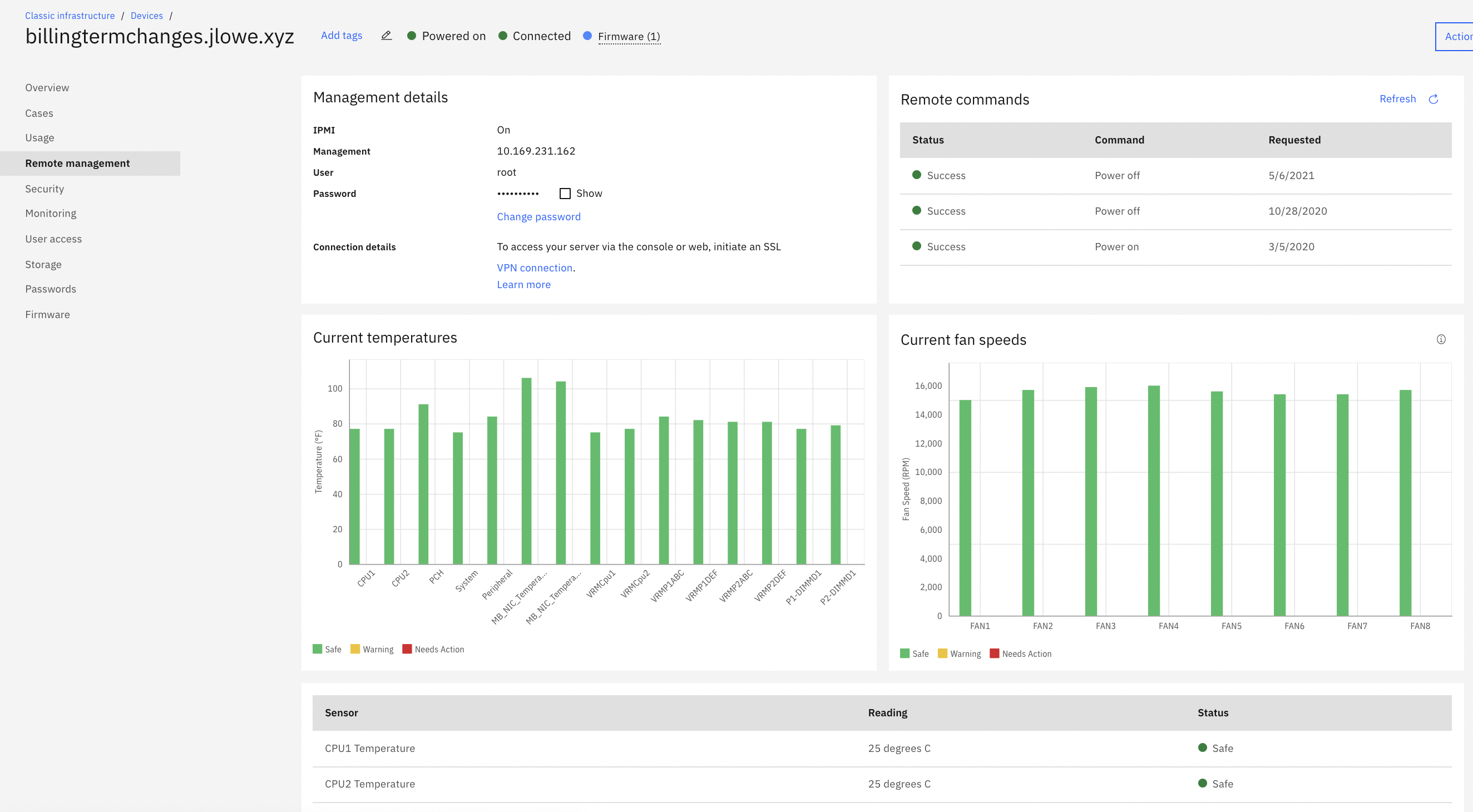
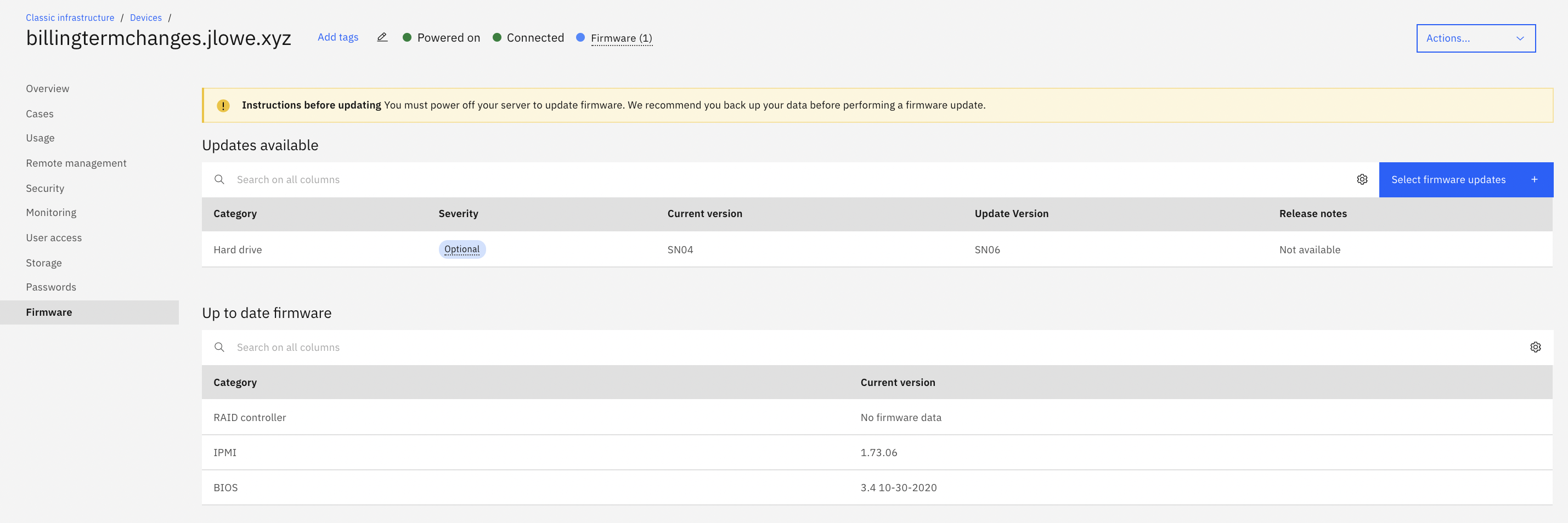
Screenshot of ConfiguringScreenshot of Bandwidth ProvisioningScreenshot of Remote ManagementScreenshot of Firmware Management