Instana, an IBM company since the December 2020 acquisition, provides APM services for SOA, microservices, containerized applications and Kubernetes, and cloud native applications, as well as discovery and monitoring for IT assets.
$18
per month per Managed Virtual Server (MVS)
Nexthink
Score 7.0 out of 10
N/A
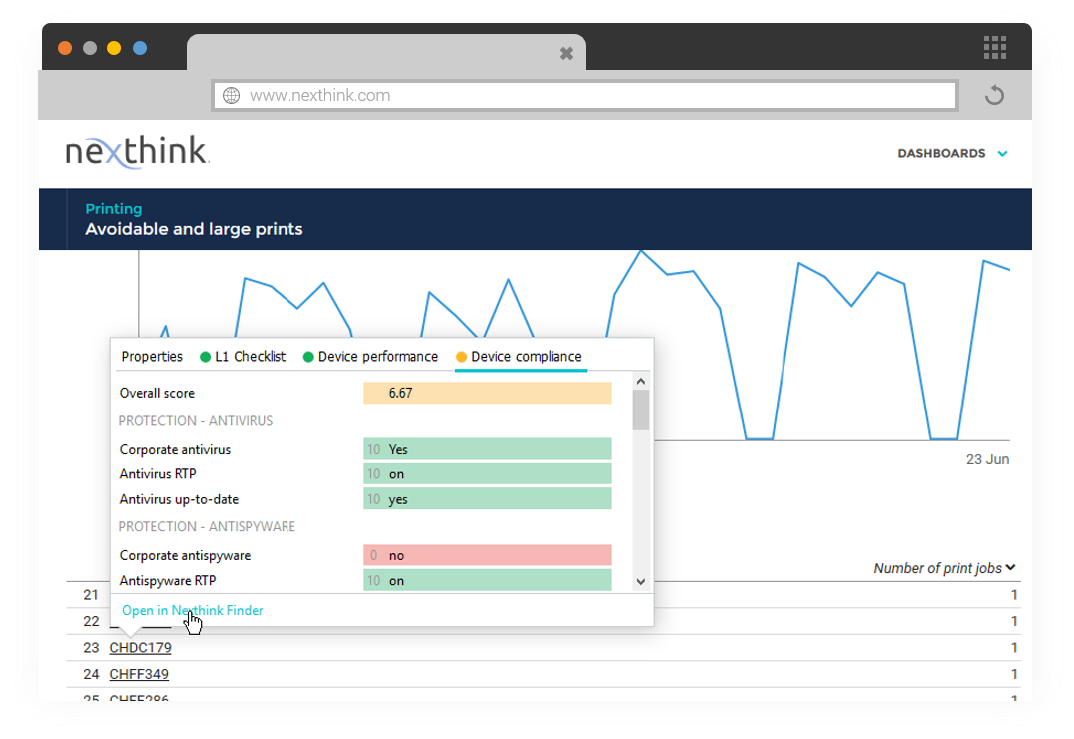
Nexthink Workplace Experience is a cloud-native platform allowing IT teams to manage the Digital Employee Experience (DEX) by providing insights across devices, applications, users, operating systems, locations and organizational units.
We chose IBM Instana for its very affordable price, the ease of use of the solution, which was perfectly suited to our needs and specifications, and the feedback from our teams, who had no trouble getting to grips with it in a very short time.The IBM Instana solution is very …
IBM Instana provides 60 seconds granularity whereas the other products use time series data IBM Instana automatically detects the Service Endpoints which helps us trace all the calls pinpointed to service endpoints. IBM Instana provides complete Auto Discovery with no …
Automatic application discovery with one agent installation instead of manual configuration for each application and multiply agents for each technology stack.
Automatic tracing for application calls without the need to add complex configuration and application instrumentation.
Senior Manager - Performance & Reliability • Information Technology
Chose IBM Instana
1- ROI is higher as the budget is much less than other 2- the way of calculating license is much better and fit us and this affect the ROI 3- the ease of implementation
The primary reason we choose IBM Instana was that is was compatible with nearly all of our apps without requiring any modifications to our code. We are really happy that we decided to adopt IBM Instana.
IBM Instana meet LMRA requirements, as IBM Instana is more useful to deep-dive each transaction from Real-user monitoring itself when compared to other APM's in the market. Also gives more flexibility especially from the support perspective to identify bottlenecks and to …
As a DevOps engineer, I've explored various Application Performance Monitoring (APM) tools, including New Relic for real-time insights, AppDynamics for code-level visibility, Dynatrace for AI-driven monitoring, Datadog for comprehensive observability, Splunk for log management, …
Splunk is also a wonderful tool for log analysis and operational troubleshooting however auto discovery and dependency flow creation makes Instana standout. We have to do a lot of preprocessing to ingest and format data in Splunk and then write complex queries for gathering the …
We chose IBM Instana for several reasons, and the most important one is that we didn't have to make changes in our code for nearly all of our applications for it to work. We are happy with the decision we made to use IBM Instana.
We have used them and for the moment we have chosen IBM Instana first of all because of the price because it is accessible and it works in terms of the results we have obtained, also the way of presenting the schemes and the performance of the systems is very good.
Superior value for money, simpler license approach with automated functions (installation, detection, update, and alarm). Nothing can stop IBM Instana's footprints in the international market as it progressively gains strength and grows in the market. With fair and inexpensive …
New Relic has it's own perks but when it comes to large infrastructure, we always face some issue at stability but IBM Instana never fails here. In my opinion, Inbuilt dashboard and inbuilt alerting feature what makes IBM Instana better than compared to other tools. I think …
In my experience, they both have independent strengths and shortcomings, though I have found IBM Instana to be much better for general monitoring and setting up alerts to get ahead of any problems. Contrastly, I think humio/falcon has been easier to use when it comes to …
Nexthink had better integration and a better user interface. 1E did not have the engagement capability which is so critical to many of the actions we complete using Nexthink. Nexthink had better trending data capabilities. 1E did not capture and hold data the way Nexthink does …
Also reviewed are Aeternity, Lakeside, and HP Proactive. The selection window wouldn't let me enter these, so putting them here. Nexthink was chosen mainly because of a broader set of use case potential, however, another huge point was the culture of the company. They value …
Nexthink is on the bleeding edge of employee feedback, which allows you to focus on the highest priorities, that in turn enables delivery of the best digital experience.
Principal Engineer - Global Desktop Infrastructure Services
Chose Nexthink
We leveraged several off the shelf performance tools prior to engaging with Nexthink (Windows Performance Toolkit, PCMark, etc.). Once we did our proof of concept with Nexthink, we knew we'd found the right tool for our organization.
We have explored using other end-user experience management tools but Nexthink stood out to us as the best option. It is very easy to get started with Nexthink using their "Nexthink Learn" platform. From there the integration of the different product offerings was seamless. …
Nexthink approaches the problem from the employees view. Using the perception from employee sentiment campaign to help steer the conversation within IT departments and not in an echo chamber that we’re used to. The community platform alone gives everyone that uses the platform …
Nexthink is the market leader in terms of measuring real user experience w.r.t End-user device. Systrack sensors work great but the GUI is not very attractive. Aternity is another great solution when integrated with other riverbed solutions like Appresponse, NetIM, and …
With enterprise IT assets in a multitude of ecosystems, cloud infrastructures and sometimes still left stuck in a legacy on prem architecture, IBM Instana makes it easy to get the right data to drive development and / or DevSecOps processes with tangible input from the target environment itself.
I've been managing desktops for 20+ years and Nexthink was the missing tool out of my toolbox. Just to give some perspective, if you were building and maintaining a house, Nexthink would be comparable to switching up from a hammer and nails and to full blown using a nailgun. Nexthink is a solution accelerator and a well thought out toolset to give you the customer experience at a glance. It allows for so much more visibility just with the default set of data points the Collector (agent) gathers, which is A LOT, and grants you the ability to gather even more data with remote actions. All of this evidence cuts how the "it could possibly be this" and "maybe it's that" discussions when you're troubleshooting an issue. It may not provide the exact answer all the time, but it gives you a "compass point" on where you need to start looking to resolve the issue. Also the service monitoring, activity monitoring, and critical event thresholds really empower the teams to know when a problem is happening and they can get ahead of it before the first call even reaches the Help Desk. Nexthink is a cornerstone tool in our environment for end user experience and I'm excited to see where the go next.
I believe that the "live" option in monitoring does not truly update the status in real-time, thus I must manually update to feel comfortable.
The call analysis tool might be improved, third-party resources are restricted, and the pricing is slightly more than competitors in comparable categories.
Sometimes it's a bit of a task when we spot an issue and need to provide machine logs for Nexthink to investigate. I believe this isn't the case when you go and use Nexthink cloud.
I think the documentation can be improved. It can be very hard to follow and lacks detail.
Instana has been able to fulfill our all requirement and provide out of box solution for multiple component like AWS RDS Monitoring and real time alerting setup on basis of that. it is also easy to integrate with other open-source alerting and monitoring tools which makes it easier to incorporate into our solutions
IBM Instana totally alters our monitoring approach since it increases the stability of the system and simplifies the process of problem solving. And since it helps to lower the degree of alert exhaustion that we experience, it is a total game changer for us.
As a DevOps engineer, I've explored various Application Performance Monitoring (APM) tools, including New Relic for real-time insights, AppDynamics for code-level visibility, Dynatrace for AI-driven monitoring, Datadog for comprehensive observability, Splunk for log management, Stackify Retrace for error tracking, and Raygun for crash reporting. Each tool offers distinct features, and the choice depends on specific use cases, technology stacks, and organizational needs. Thorough evaluations, considering factors like ease of use, integration capabilities, and scalability, help in selecting the most suitable APM solution for effective application monitoring in a DevOps environment.
We have explored using other end-user experience management tools but Nexthink stood out to us as the best option. It is very easy to get started with Nexthink using their "Nexthink Learn" platform. From there the integration of the different product offerings was seamless. Nexthink provides a wide variety of library packs that come ready to use out the box, simply import them and start using them. The customisable dashboards have given our product and service owners more visibility than they've ever had before. The Nexthink community is one of the best I have been a part of, everyone is actively sharing ideas and promoting innovation. Nexthink regularly hosts user groups that bring their clients together to discuss use cases and the value they have generated using the tool. They are also very transparent with their roadmap and what they are working on, ensuring the focus is aligned to the needs of the customer.
Let's me monitor and pinpoint issues across multiple critical systems and applications that work in tandem, reducing drastically, the time in identifying root cause and solving the issues.
Let's me deep dive into issues found with a lot of detailed information about particular requests , and find proper solutions by my own research or even with Gen AI assistant using Watson.x or you could prompt your AI solution of choice as well.
All systems fail at some point, so IBM Instana gives stakeholders ease that large complex and critical systems that affect the very livelihood of people is being observed with pinpoint precision and that issues are addressed promptly and with compass pointing north towards the problem's root cause and solutions.
The biggest ROI has been how Nexthink has helped us is with regards to time. Due to Nexthink, we are able to find/resolve issues much faster due to the great detail that Nexthink shows regarding a device history.
Nexthink allows us to be proactive in our troubleshooting. This is a huge ROI, as it provides a summary of our users issues they are facing, and we can then prioritize our time with reaching out to the end users to solve issues before they become major problems for the end user later.