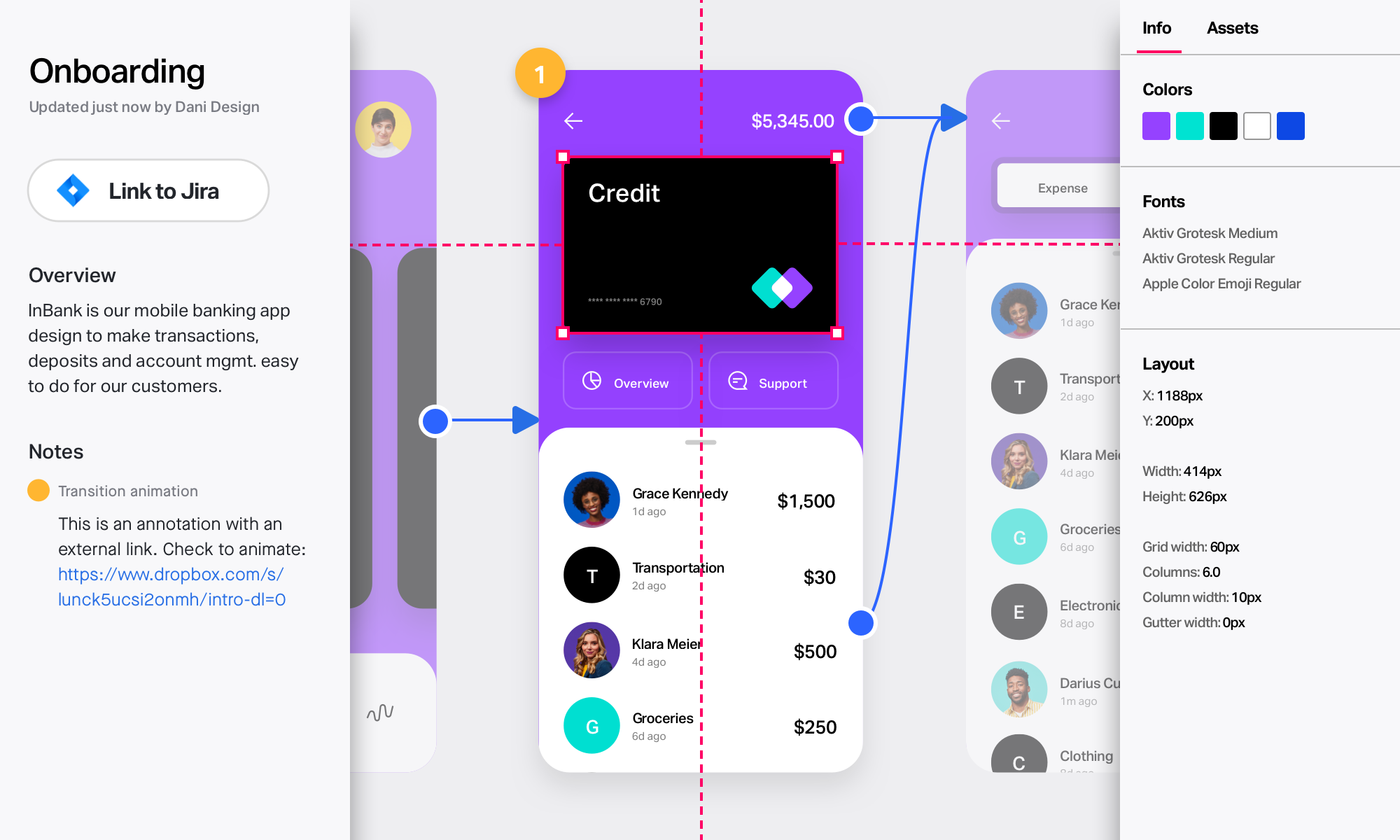
InVision is a collaborative design and prototyping platform with features such as freehand drafting mode and interactive mockups, collaboration, idea management, user testing, and integration with Slack and other collaboration tools. According to the vendor, 1 million designers are using the free version.
$0
Miro
Score 9.2 out of 10
N/A
Miro empowers cross-functional teams to flow from early discovery through final delivery on a shared, AI-first canvas. With the canvas as the prompt, Miro’s AI capabilities keep teams in the flow of work, and scale shifts in ways of working.
$0
Pricing
InVision
Miro
Editions & Modules
Free
$0
Pro
$7.75
per user/per month
Enterprise
Contact Sales
1. Free - To discover what Miro can do. Always free
$0
2. Starter - Unlimited and private boards with essential features
$8
per month (billed annually) per user
3. Business - Scales collaboration with advanced features and security
$16
per month (billed annually) per user
4. Enterprise - For work across the entire organization, with support, security and control, to scale
contact sales
annual billing per user
Offerings
Pricing Offerings
InVision
Miro
Free Trial
No
Yes
Free/Freemium Version
No
Yes
Premium Consulting/Integration Services
No
No
Entry-level Setup Fee
No setup fee
Optional
Additional Details
—
Monthly billing also available at $10 per month for the Starter plan, or $20 for the Business plan.
I have only used InVision as a tool for designing mockups. I wouldn't be able to draw a fair comparison to other tools since I have more experience with InVision.
I used InVision for a while - it was interesting but without many features, the work was still very manual, the tool was soon discontinued at the company I worked for. I've used FigJam, it's a good tool, but very simple in features, which is why Miro is so important, we always …
I think we all found Miro a lot easier to use than Mural. It's a different concept entirely than Figma and InVision but it acts as the first step in our design process. We typically start in Miro before going to Figma.
I dislike Mural and InVision as they have fewer functionalities and seem less intuitive for clients to work with. Miro has network effects that most clients have used before. However, we as consultants tend to be able to use each: if our client uses Mural, we do too. But in our …
Miro has much more plugins and integrations when compared to InVision Freehand. The fact Miro is a stand-alone program actually has a lot of advantages. FigJam is catching up nowadays just because it's built-in Figma so everything is closely integrated. But it is also a pro …
There are so many reasons why I prefer Miro to FigJam. The connections are essential to me articulating my thought process. I have never said this about a piece of software before, but everything I make inside Miro is beautiful. Often, I recreate visual deliverables made in FigJ…
We tested every product, but the biggest problem we encountered was that most of them required plugins in order to centralize all of our work. Other problems included the products' excessive price, which was higher than Miro's. Last but not least, Miro offered us an all-in-one …
Miro seems to be the OG of whiteboard-based brainstorming collaboration software. Some competitors may offer more or different features. The learning curve is not steep, so a group can easily switch apps if needed, but the saved files may not necessarily be compatible between …
Miro has a low barrier to start and onboard. Miro is focussed on collaboration and not design. Miro has advanced workshop tools and features that help organising workshops. Miro has an intuitive way of working that encourages team members to set up boards themselves and …
Miro has many more features and tools than Conceptboard and Mural, and it is also more pleasant to use. Now, when I have to compare it to Freehand, it becomes a bit more difficult to find significant differences. Miro wins in having more templates, but Freehand had better …
Miro is the best for sharing ideas on an infinite canvas with a clean and uncluttered whiteboard area, and crucially (unlike the others) clients don't need to register or login to Miro in order to view and comment on a board.
Miro has more features and is more flexible than other products. Freehand, for example, seems to be too focused on wireframes. Additionally, it is now adopted by the entire company, not just the design area, which is how I previously used the other mentioned products.
Miro has more features and is more flexible than other products. Freehand, for example, seems to be too focused on wireframes. Additionally, it is now adopted by the entire company, not just the design area, which is how I previously used the other mentioned products.
Trello works okay for the narrow purposes I have tried: running retrospectives. I have used the other products for the same types of usecases that I use Miro for. They just really suck. The main problem is that it feels way, way clunkier to use the board. What Miro excels at is …
Miro is much more flexible in terms of plugins, much scaleable, and very handy in terms of usage, AI tool in it helps a lot to quickly get the template and make life more easier. I found the Miro is much more advanced than any tool I used in the past. I love this.
As compared to other tools Miro is easier to use, has an easy learning curve, can be used by folks in a variety of roles from engineering to designers, has an intuitive UI, easy single sign-on integration, has an easy to use desktop app version that helps to speed up the work.
Miro stands out as a brainstorming and collaboration tool that supports cross collaboration and multiple inputs exceptionally well. It is especially good at providing templates to accelerate kick offs and diagraming logic with smart, connectors.
We looked at lots of different products when selecting, not all of which I can remember; this was two years ago. Miro came out head and shoulders above the others for ease of use, functionality, integration, plugins, and training.
I find Miro to be the most user focused, and easy to navigate, with the most robust features. Log-in is easy for clients too. The basic platforms may all function about the same...but I like the visual appeal and presentation of the menus better in Miro. Generally, I think it …
InVision is well suited for design reviews and immersing yourself in the experience of an app-to-be. As a Product Manager, it's difficult to take abstract concepts, user pain points, and business needs, and produce a vision for an app without a visual aid to communicate a vision. InVIsion offers PMs, designers, and developers the opportunity to sketch a vision, communicate about it with inline commenting, and shareable with other stakeholders.
I remember a project where all our different teams were involved in it. I created a board with timelines, KPIs, and customer journey stages, and each team added their input live. We were all able to work together in real time, view the entire project, and leave comments without switching apps, which is why it worked fantastically for us. Everyone benefited from the hours of time it saved, and we made a good profit on that project, for which I was named employee of the month.
Designs can be very slow to load on mobile devices, particularly when they include many screens.
There isn’t an offline version of the full app, which feels less-than-ideal for many of our teammates who live in areas with more spotty internet.
There are limited functionalities to portray animations and transitions. This hasn’t been a huge issue, but it makes the app feel a little out of date, considering the range of such functionalities in other apps.
When using the find functionality to locate an item in a Miro board, I do not like that it keeps my previous searched term. Other programs, like Excel, do this but they have it so that you can easily overwrite the previously-searched term.
It would be helpful if you could search by a particular frame, instead of the entire board. For our quarterly backlog review, we often have items that carry over, so there are duplicates on the board. Being able to search by a frame would make this easier.
Understanding who can access a board is not always clear to me.
I have advocate for the renew of Miro quite few times, however, it is not under my control as the decision is made in another team with their own budget. I would buy for my own entrepreneur projects (1-2 members) as I do know the value and work there 100%. So, I would pay out of my own pocket to get the value. However, If I wouldn't know the value it provides, it would be hard to decide with the current freemium features
The platform is flexible, easy to use, and simple because Miro is a great visualization tool that makes it easy to collaborate on creating charts. It helps in creating workflows and other designs easily and securely. It supports integrations with major cloud storage solutions and office suites. On top of that, it provides a decent free plan, which is sufficient for basic usage.
I only give a 9/10 because of the speed at which it loads. I have never experienced issues with Miro logging me out early, or some other technical issue causing the program to crash, or even it just loading in perpetuity without ever actually coming up (unlike other programs such as SFDC). It take a minute for all of my boards to come up after I click on it in my favorites, but besides that, it's all good.
Sometimes it gets quite slow and there is a correlation between this and the size of the board. Hence we are trying to segment the boards based on product stages or projects so that the size doesn't go big. When you go from discovery to delivery on a simple board, it will get large and difficult to load, even crash or go white screen
I didn't need to contact InVision support, as I've never needed it. They have an intuitive UI, and most of the questions are answered in their help portal or in tutorials online. Since many people use it, there a great resources available on for example YouTube. No problems so far with InVision.
We have never reached out to or contacted support because Miro's platform has been incredibly intuitive and user-friendly. The comprehensive resources available, such as tutorials, documentation, and community forums, have provided all the guidance we needed. The seamless integration with our existing tools and the reliability of the platform have ensured that we rarely encounter issues that require external assistance. This self-sufficiency has allowed us to focus more on our projects and collaboration without interruptions. Overall, our experience with Miro has been smooth and efficient, eliminating the need for additional support
There was a series of webinars which Miro hosted with our organization that went over the basics, then progressively became more advanced with additional sections. The instructors were knowledgeable, and provided examples throughout the sessions, as well as answered peoples' questions. There was ample time and experience on the calls to cover a range of topics. The instructors were also very friendly and sociable, as well as honest. Of course Miro isn't a "God-tool" that does absolutely everything, but the instructors were aware and emphasized the strengths where Miro had them and sincerely accepted feedback.
Easy to learn, Miro has a series of videos on YouTube that effectively taught this program to my team members and me. The program is drag-and-drop and works excellently. People pick up on how to use it efficiently, and it's great for organizing ideas more freely. This product is more challenging for some older audiences who are not accustomed to using a touchpad, but for most, it was very easy to use.
[InVision] provides the ability to iterate really quickly, in fact, it is so intuitive that can be applied on live wireframe designing, while the ideas are being scratched and stormed from the team in a single discovery session, as well as allowing and giving access to the whole organization to the final outcome
Miro is the more collaborative option, offering the ability for many individuals to work on the same item real-time. Though it does create some duplicate entry, we've found this added cost is minimal compared to the opportunity cost of lost collaboration.
Miro is great for scaling. In every department and subdivision across my entire organization, there is someone using it. From Sales to marketing, to manufacturing and operations; and even in legal and finance, there isn't a process or a department that is not using Miro, and if they aren't, they're missing out! Even at the highest to the lowest levels of the organization, it is essential for virtual collaboration.