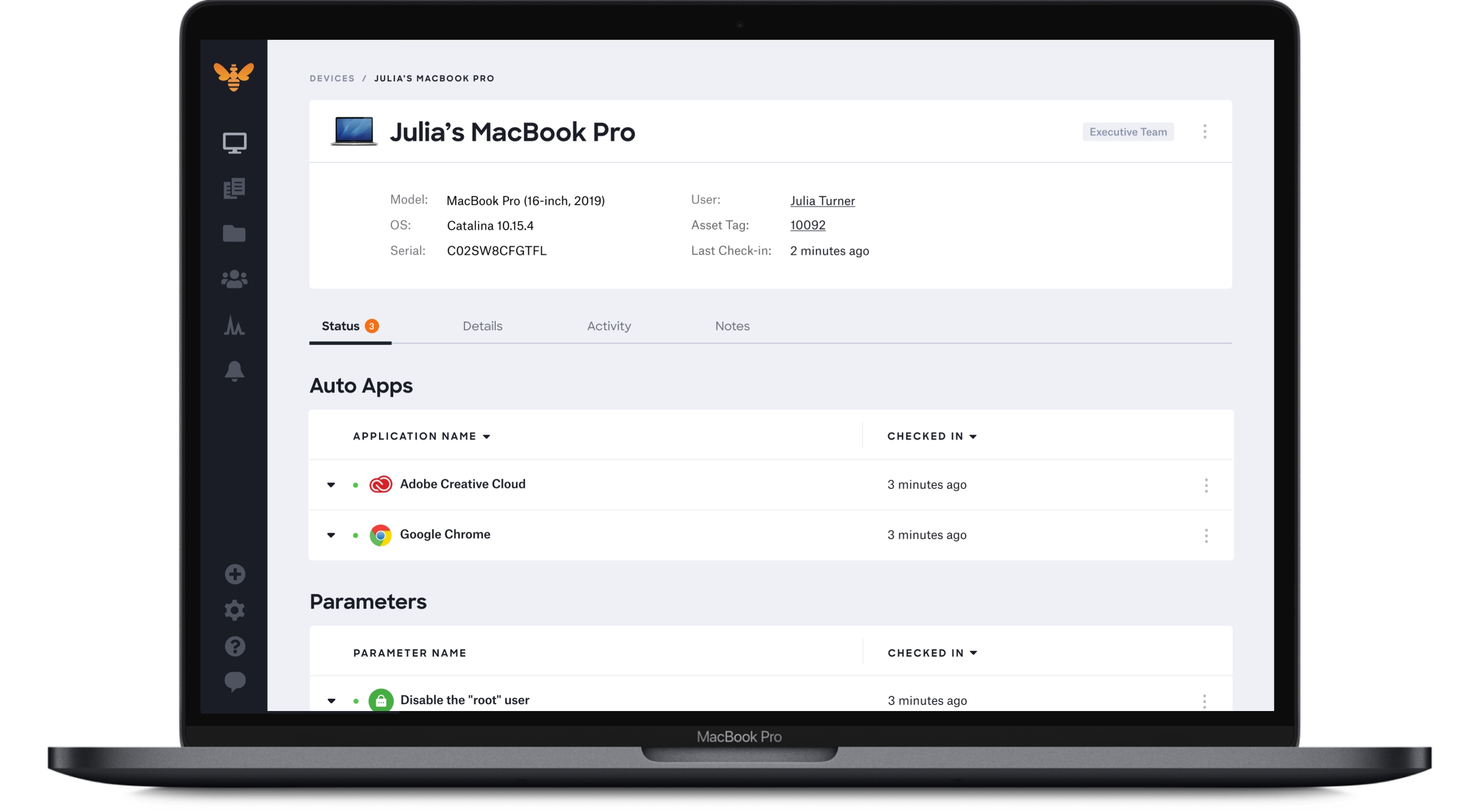
Developed exclusively for macOS, Jamf Protect provides a solution to maintain endpoint compliance, monitor for, respond to, and remediate security incidents on macOS with minimal impact to the device and end-user experience. Jamf Protect detects Mac-specific threats, and prevents known malware from running on devices and quarantines them for later analysis. Jamf Protect forwards data to a system of record to ensure a security posture, fleetwide, stays compliant by monitoring security settings on…
N/A
Kandji
Score 5.2 out of 10
Mid-Size Companies (51-1,000 employees)
Kandji is an Apple device management software solution for macOS, iOS, iPadOS, and tvOS, from the company of the same name in San Diego.
N/A
Pricing
Jamf Protect
Kandji
Editions & Modules
No answers on this topic
Offerings
Pricing Offerings
Jamf Protect
Kandji
Free Trial
No
Yes
Free/Freemium Version
No
No
Premium Consulting/Integration Services
No
No
Entry-level Setup Fee
No setup fee
No setup fee
Additional Details
—
All plans billed annually.
More Pricing Information
Community Pulse
Jamf Protect
Kandji
Considered Both Products
Jamf Protect
Verified User
Anonymous
Chose Jamf Protect
I find that all of the products have the same features; however, Jamf Protect is stronger if managing macOS devices. Also, it is one license so what you pay covers all of the features and does not require additional licenses for features like USB device control. The CIS …
Sophos was our main endpoint for all our windows and macOS devices. However with the newer releases of macOS Sophos started to become more problematic to deploy. Moving over to Jamf protect was the obvious choice and cost wise a lot more beneficial for us. It's monitoring and …
ESET was a massive resource hog and more often than not blocked legitimate things like creative cloud products. Admin interface was a nightmare to navigate and clunky to use. Delays in getting a stable product that worked on silicon and for new OS was an other major factor in …
In some aspects, Jamf Protect was far superior to the others mentioned above. The only downside I can see is that it is only macOS which could be a problem for hybrid environments.
Jamf Protect is much lighter on system usage. It also has exclusive access to the threat protection baked into macOS. This lets Jamf Protect leverage the great work Apple is doing, and gives admins a way to extend that as well as view reports.
Both MDMs have issues with employee's laptop passwords and being able to reset those password. We switched to Kandji because laptop PWs were connected to Gmail PWs. However, there were continous "password sync" errors that it ended up being a huge headache for everyone.
With Intune, they aren’t friendly with Macs. We had to add each app individually and constantly update the packages for updates. Even when we do everything right, it still doesn’t work all the time.
The main reason we went with Jamf Protect was because we wanted a dedicated macOS security endpoint. Is was easy to implement and migrate over from our previous endpoint provider. As a university we have lab macOS devices that multiple users use. So we have Jamf Protect profiles that block the use of external drives and other other profiles that allow it. We different user accounts requiring different access this can get a bit messy when deploying the config profiles at login for each user that signs in.
Kandji would be excellent for a company that has Mac fleets and is currently using Intune or Jamf as their MDM. Kandji is cheaper than Jamf and way easy to configure than Intune.
Jamf Protect is easy to manage. It is a separate interface from Jamf MDM which is nice for Security Operations teams. It allows Security teams to manage only the Security aspects without having to dig through all of the MDM configurations. For exception uses cases, Jamf Protect does provide options to customize settings where needed.
Switching from our old MDM to Kandji: "We'll set you right up with an integration specialist" and it'll be "so easy." Greatly incorrect. The change took months and was a disaster at best. So many things I had to figure out that they never mentioned, or I had to keep going back to them to get more information. "Oh, we forgot to mention that!" - said about a dozen times. Also, I had to go to our former MDM to ask them how to do it because "Kandji can only help on the Kandji side of things - not the other MDM side." Well yes, but then don't make it sound like you can and will do that part in the first place!
I find that all of the products have the same features; however, Jamf Protect is stronger if managing macOS devices. Also, it is one license so what you pay covers all of the features and does not require additional licenses for features like USB device control. The CIS compliance aspects generally look better in in Jamf as compared to Crowdstrike.
They promised us we could add devices as needed. I even had that written in an email. However, they rescinded that promise and required us to add devices in buckets of 50. That means, since we had 55 users, we had to pay for 100 licenses.
Password issues were made much worse by using Kandji instead of our old MDM (Hexnode).
Overall, Kandji created major headaches with laptop instead of improving.