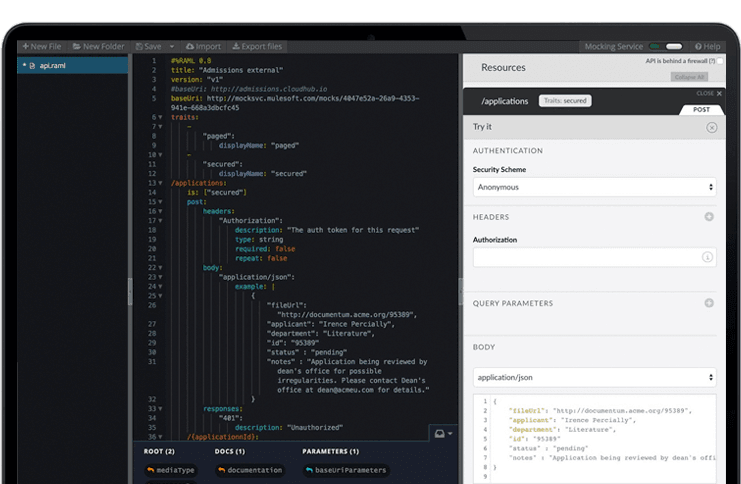
Jitterbit is a cloud integration technology for cloud, social or mobile apps. It provides accessibility for
non-technical users, including easily creating API’s and data transformation scripts within the
integrations.
$100
Starting Price Per Month
Anypoint Platform
Score 7.8 out of 10
N/A
The Anypoint Platform developed by MuleSoft and acquired by Salesforce in early 2018 is designed to
connect apps, data, and devices anywhere, on-premises or in the cloud. This platform was built to
offer out-of-the-box connectors as well as tools that architects and developers can adopt quickly to
design, build and manage the entire lifecycle of their APIs, applications, and products.
Jitterbit plays well in the general-purpose integration that can be used to integrate multiple systems and used by different departments within an Enterprise. I see it as a more basic option for Boomi that is less expensive. So if you are looking for something like Boomi, and …
Jitterbit is completely cloud-based and offers a cleaner way to connect to SOAP API endpoints. SQL Server Integration Services has a larger ecosystem of plugin connectors by third parties (at a cost), but the downside is that you still need to use something like Visual Studio …
Scribe - we had problems with this product (jobs were running long, some jobs would finish incomplete without any warning or info, etc) and we wanted more functionality/configurability -- keep in mind this was 3 years ago, so the product may have changed since then!
Evaluated Dell Boomi and Celigo as alternatives prior to purchasing Jitterbit. We went with Jitterbit at that time because we could handle all changes ourselves without any assistance from Jitterbit, and we liked their size and nimbleness. Dell Boomi was too big for us, and …
Our decision was based on the cost at the time. Jitterbit's cost model has changed since then, so it might be a different decision now if we have to re-evaluate.
Hands down, Jitterbit is more cost-effective than Informatica, either on-prem or cloud and the value only goes up from there. Reusability and ease of creation make in-house training simple and the end result is we leverage Jitterbit for much more than what we initially …
Customer Relationship Management (CRM) System Administrator
Chose Jitterbit
I actually use all three of these products: Jitterbit free, DemandTools and PeopleImport. I use DemandTools and PeopleImport most often and usually only use Jitterbit free when the other two won't launch or connect.
The Jitterbit data loader is a dramatic improvement over the standard Salesforce Apex Data Loader. Both applications are free or included with Salesforce but I would only recommend Jitterbit for users who need to run data jobs against Salesforce.
Initially we were looking at building our own integration capability from scratch, but deliverable timelines pushed us to purchase this product. Other than Biztalk, I do not know which other products we looked at.
Performance Testing Engineer / Front End Developer /System Analyst
Chose Jitterbit
Honestly we didn't evaluate too many other middle ware products, at least that i am aware of its possible our system architect did without my input. But we were given a trial of JitterBit a very good training session and decided it was a perfect fit for us and it has been a …
Verified User
Anonymous
Chose Jitterbit
We did not compare it with other integration tools.
Jitterbit works flawlessly for simple data loading tasks. Anything more complicated, such as deduping objects or cleaning data on a grid would require a more substantial program such DemandTools, but for small, ad-hoc tasks Jitterbit is hard to beat.
Jitterbit was a better match for the project we used it for because of the depth and breadth of scripting language and the nature of the platform. That being said, the project we threw at it was a tough one. I am almost certain we could not have completed it with the other …
Verified User
Anonymous
Chose Jitterbit
The support that Jitterbit has provided on paper as well as in the real world is great and this was certainly in our top pick list when we did our build/buy analysis.
What set Jitterbit apart was the flexibility and the capability to copy existing transformations. Since we were rolling out a world-wide data integration program for an enterprise ERP, it was essential that we could implement once and reuse. We could add error captures really …
Anypoint Platform
Verified User
Anonymous
Chose Anypoint Platform
AWS is a very good tool but still evolving and offers a small set of API management features. The main reason why we chose MuleSoft Anypoint Platform API Manager is because it is well suited with the APIs developed in Mule ESB.
Once we have moved all of our system integration APIs to the MuleSoft Anypoint Platform, we will need to communicate with a wide variety of external systems. All of our business and service logic is stored in the aforementioned core systems. Anypoint Platform (and all of our …
Overall a better experience in pricing negotiation with the Sales team. The breadth of services offered by Mulesoft was really important and the expertise offered by our consulting partner influenced the decision. The overall deployment was completed well within the timelines. …
Once we use [MuleSoft] Anypoint Platform to host all our system integration APIS, we need to exchange data with a lot of different resources. Those listed systems are our main systems that hold all business and logic behind our service. The integration from Anypoint Platform …
We selected Mulesoft for speed of implementation. We did not have the luxury of time and needed a solution that can be learned and implemented within weeks so we can take advantage of newly formed partnerships. The training that was provided to use during our pre-sales and …
We believe Anypoint Platform is best in breed and has features that match nearly any other iPaaS offering. It also allows for accomplishing much more challenging and complex integrations due to the ability to connect to nearly any system, use custom connectors, and embed …
The main problem with this software is the different connector type that is used for different protocols except for a different SAP connector. There is only one connector called SAP. It will be great if there will have a different connectors like idoc, RFC, proxy, etc.
Anypoint has tons of capabilities baked in one platform, and other competitors like Built.io or Workato may not have all those like Anypoint Exchange. However where these products shine are in usability, as it's ridiculously easy to build integrations using Built.io. I was …
Anypoint Platform is really very easy to adopt for application integration. Simple UI and easy data weave language allows user to focus on business portion only. The API management and deployment of application are hassle free. We have selected Anypoint platform because it is …
Dell Boomi is kind of similar in drag and drop implementation. However, it doesn't have as many connectors (shapes in Dell Boomi). Moreover, it also doesn't have deployment stuff on its own.
Informatica is way behind Dell Boomi and Anypoint Platform, but users are still using it …
Compared to Dell Boomi the API management suite of Mulesoft is much mature, however if its only about the integration , then i would always go for Dell Boomi, as there is no infrastructure setup that needs to be done from the developer's end.
The main reason why we chose Anypoint API Manager is because it is well suited with the APIs developed in Mule ESB. AWS, on the other hand, is a very good tool but still evolving and offers a small set of API management features.
API led architecture focus with a decent API ecosystem for developer collaboration, policy management and declarative implementation. Batch processing, visualization, Anypoint MQ and ObjectStore leave a lot to be explored. Multiple deployment models make it worth considering.
It enables customers to expose their APIs in a very simple and fast way. It can be used by non-expert developers. It is compliant with all major connection and data representation world standard.
We provide options to customers to choose from the best tools. Customers are the decision makers. Personally, because of open-source and large community base, MuleSoft is the repo in the market.
It is a powerful tool with smart intelligence. The drag and drop feature makes my work easy. The tool has great connecting support which is the best reason to use the tool on a daily basis. Powerful functionality with designing and implementing APIs. Hosted on public IP.
Small to medium sized companies are great prospects for this product. It's pretty easy to set up, learn and maintain. You can scale it too, so start with an easy integration, learn the ropes and expand your usage. If you have fairly simply needs for a handful of fields and just one or two external systems to feed into Salesforce, this is the go-to product. If you're a larger company needing more complex integrations where extremely high reliability is needed and any downtime means revenue loss, you probably already have a different product in mind. Then again, you probably have an entire team that handles integrations and a data warehouse to support it!
MuleSoft Anypoint Platform is best tool in the market for developing APIs with complex structures communicating with various different types of applications including web applications as well as legacy applications. Also applications including database connectivity for fetching and updating data in the DB tables. I cant think of any scenario which MuleSoft Anypoint Platform could not be used for developing the integrations.
Provides wide range of popular connectors like salesforce, netsuite, sftp and many more. A user can easily integrate with those services using specific connector.
Support API development using RAML and desing tool. The platform is very good in data type classification.
Cloud deployment and post deployment monitoring is easy. A user can configure application worker as per need. Alert and notifications are real time.
Some of the more advanced transformation possibilities aren't exactly clear without a lot of digging. Very basic connections (e.g. map this field to this field) along with basic transformation scripts (e.g. multiply X * Y) are super easy. But I know there are a ton more features and functionality that I feel is somewhat buried in the product
Has more features than what we really need so we're paying for more than we use. Sort of like paying for an Abrams tank when all we really need is a Toyota Corolla.
Not a value product, tends to be expensive.
Takes a while for developers to learn to use Mulesoft Anypoint.
I have been evaluating other tools as a continuous improvement practice. I would like something that would be easier to use for a non-technical user. I work for a small organization and have no back-up for Jitterbit if something happens to me. We don't have the technically savvy employees to understand it.
MuleSoft Anypoint Platform is really very easy to adopt for application integration. Simple UI and easy data weave language allows user to focus on business portion only. The API management and deployment of application are hassle free.
Anypoint Platform support is very responsive. There is also a huge knowledge base and an active online forum where answers to most questions can be found. When needed support engages the engineering group so adequate solutions or workarounds are always provided.
Hands down, Jitterbit is more cost-effective than Informatica, either on-prem or cloud and the value only goes up from there. Reusability and ease of creation make in-house training simple and the end result is we leverage Jitterbit for much more than what we initially considered it for. Having used Oracle and TIBCO before as well, I find they are the tools of yesterday, not able to keep up in terms of functionality or price. Mulesoft would be a more relevant comparison, and I feel we lean on Mule far more than Jitterbit, but both tools have their place and their strengths (and weaknesses!).
Once we have moved all of our system integration APIs to the MuleSoft Anypoint Platform, we will need to communicate with a wide variety of external systems. All of our business and service logic is stored in the aforementioned core systems. Anypoint Platform (and all of our APIs) makes it easy to connect to various other platforms. In order to link to these many other systems, connectors and/or components are utilized, and they are simple to configure and integrate.
We moved from a product that was failing regularly (jobs were running long, some jobs would finish incomplete without any warning or info, etc) to Jitterbit - a very stable product if you give it the recommended server size it needs.
It has made crafting solutions for data movement and transformation quick!