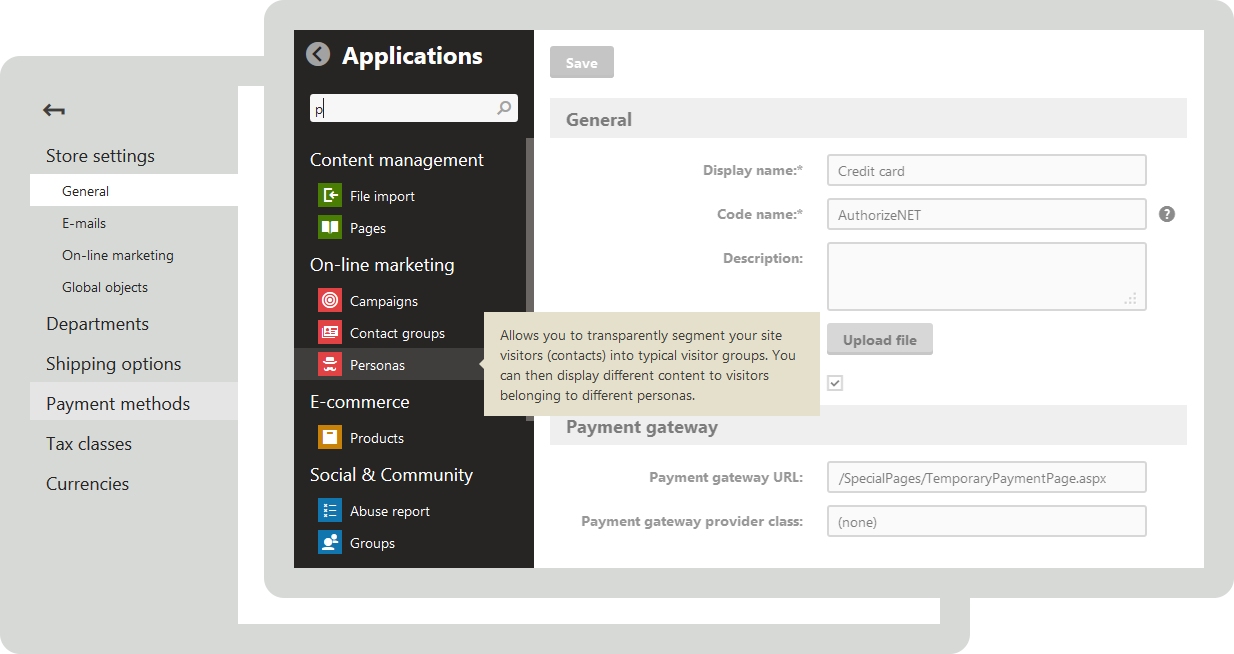
Kentico is a web content management system for building websites, online stores, intranets, and Web 2.0 community sites. Kentico CMS uses ASP.NET and Microsoft SQL Server for development via its Portal Engine, using Visual Studio, or through Microsoft MVC.
$9,999
Subscription license
Salesforce Commerce Cloud
Score 8.0 out of 10
N/A
Salesforce Commerce Cloud (formerly Demandware) is a cloud-based eCommerce solution that touts flexibility and scalability for enterprises. It features merchandising tools, such as sorting, filtering, and image zooming.
N/A
Pricing
Kentico Xperience
Salesforce Commerce Cloud
Editions & Modules
Kentico Xperience Business
$9,999 / year
Subscription license
Kentico Xperience Business
$14,999
Perpetual license
Kentico Xperience Enterprise
$17,999 / year
Subscription license
Kentico Xperience Enterprise
$29,999
Perpetual license
Kentico Xperience Corporate
Upon request
No answers on this topic
Offerings
Pricing Offerings
Kentico Xperience
Salesforce Commerce Cloud
Free Trial
Yes
No
Free/Freemium Version
Yes
No
Premium Consulting/Integration Services
No
No
Entry-level Setup Fee
Optional
No setup fee
Additional Details
—
B2B Commerce:
Starter - $4 price/order
Growth - $6 price/order
Plus - $8 price/order
B2C Commerce:
Starter - 1% Gross Merchandise Value
Growth - 2% Gross Merchandise Value
Plus - 3% Gross Merchandise Value
B2B2C Commerce:
1% Gross Merchandise Value
More Pricing Information
Community Pulse
Kentico Xperience
Salesforce Commerce Cloud
Considered Both Products
Kentico Xperience
Verified User
Anonymous
Chose Kentico Xperience
Kentico provided us with a far more robust and customizable platform than lower-cost alternatives such as Wix or Squarespace, and was available at a much lower cost of entry than Ektron. It required a lot fewer fiddly uses of extensions than Wordpress, though some custom …
We selected Kentico for our particular project to match up with another site we had and it was more financial wise for us than other solutions we looked into. A big thing for us was that we needed to have language management and Kentico being an international country was a good …
Previously we used Microsoft SharePoint as a content management system and it was very limited, required a ton of support, and we encountered bugs on a weekly/monthly basis.
All of the negatives that we had associated with SharePoint went away when we switched to Kentico. It was …
Marketing email coordinator (part time contract project)
Chose Kentico Xperience
I recently started learning Sitecore which resembles Kentico in some aspects, and I find Kentico to be more user-friendly and intuitive. Sitecore is a more robust system, but in my opinion it gives content administrators too many options, and has a way steeper learning curve. …
Kentico is a lot easier, more fluent and slicker than these products. It is easy to setup, use and teach others, so content can be managed by multiple users without any special training or skills i.e coding. It is definitely a lot more expensive so you are paying for a premium …
Kentico 8 really is a drastic improvement over previous versions of Kentico - the whole system is light years faster, much more intuitive to use and nicer for all users involved.
When discussing Kentico with clients, I find myself uttering the same phrase repeatedly. "Kentico provides 95% of the functionality of high-dollar CMSs at a fifth of the price." This allows clients to use the dollars they would have previously put towards licencing into feature …
I've used SiteCore, Ektron, Joomla!, Wordpress, and SharePoint (if you want to count that as a competitor for CMS). Kentico 8 blows them all out of the water. Nothing is more intuitive in the way that content is created, the way the site is setup, and how efficient rollouts can …
When compared to the above solutions the value that Kentico offers is much higher when compared to the price of these other solutions. Kentico will do 90% of what Sitecore and Ektron and Adobe do, and those other solutions will do 90% of what Kentico does. In my opinion they …
Better than all of the above on almost every level. SiteFinity comes closest from a developer tool perspective and Umbraco from a flexibility perspective.
Out of these CMS systems I've worked in, Kentico is still hands down the easiest to build and manage.
Ingeniux was a failed project, it was too cumbersome to work in (MVC based), it was a nightmare to do any custom dev work in it, couldn't debug, and their own staff couldn't get …
The competitive toolset and streamlined development process that Kentico provides allows for it to be a viable option at a fraction of the cost of other solutions.
It seems to have better organization and better extendability. In comparison to WordPress, the support that is offered by Kentico is incredible. When comparing to Sitecore, the price point makes it much more affordable for smaller to mid-size organizations that need a great CMS …
When deciding on Kentico we compared 2 other products, all vendors provided either provided 1 to 2 demos. Compared to the other vendors, the Kentico product worked as expected when demonstrating compared to the other two vendors that had a range of problems in their product …
WordPress - I do like WordPress, and we propose this CMS as an option to Kentico, but I firmly believe that unless everything happens to work perfectly, WordPress will cost more money to develop in the long run. Aside from that, WordPress has intrusive updates very regularly, …
The greatest thing about Kentico is its API-first development focus. What most people don't realize, but is the most telling item for developers, is that ALL of the Kentico UI is an API client using the publicly available API. If you can see it in Kentico, you can do it, or …
Kentico is to most full featured for large corporate sites needing multiple versions. WordPress may update more frequently, but Kentico has released 2 updates in the 2+ years I've been using it, which is fantastic.
At Bit-Wizards we have used many open source CMS tools like Word Press and Joomla as well as enterprise solutions like SiteCore and Ektron. The open source challenges are stability and security of the platform. Support for correcting those issues depends greatly on the …
Wordpress is much quicker and lighter, but not as robust and is suitable in different situations. Sitecore and Kentico offer similar functionality, but with a different approach to development. Sitecore has a much higher price point and similar functionality, so in my opinion …
Salesforce Commerce Cloud
Verified User
Anonymous
Chose Salesforce Commerce Cloud
Salesforce Commerce Cloud is the leader in CRM and in managing customer contacts and details. It integrates very well with our ERP, NetSuite owned by Oracle Cloud. Salesforce Commerce Cloud is easy to use and has more functionality compared to competitiors. Salesforce Commerce …
1. The learning curve of Shopify is not too steep, so it does create hinderance for non-technical folks 2. I personally found the AI-powered insights in Shopify to be more accurate than the ones provided in Salesforce Commerce Cloud.
I think Salesforce Commerce Cloud is significantly better than ServiceTitan for both ease-of-use and overall functionality. ServiceTitan has a lot of deliverability issues when sending emails that we don't encounter on Salesforce Commerce Cloud thankfully. Also, I think …
Salesforce Commerce Cloud is as good as the other platforms. On some of my past reviews I pointed out what Magento and Shopify do better than Salesforce Commerce Cloud and what Salesforce Commerce Cloud does better. To quickly recap: -Salesforce Commerce Cloud makes it very …
I think Salesforce Commerce Cloud is great. Like mentioned previously, it is easy to use and keep track of our dealer information and customer information. We do also use Hubspot and it would be nice if they intigrated better but they both have good uses. Salesforce Commerce …
We selected Salesforce Commerce Cloud due to the options available on the back-office for merchants. The availability to create complex scenarios. The scalability for multiple countries and languages. The integration with other Salesforce solutions already in place to create …
All relative to your organizational size. Shopify works for small to mid, Magento for small to large, commerce tools would be a large-scale plus. Hire a skilled consultant to help you make a decision of this caliber!
Salesforce Commerce Cloud offers a wide variety of features such as pages, versions, static links etc which makes it unique when compared with any other tool. It has a powerful searching mechanism with which we can search with keywords to find related articles with those …
All the options and demos were good; we see them all efficient and best suites; the option to choose salesforce commerce cloud came into the picture when we thought of integrating customer service and promotions as we already use salesforce service cloud as the support backbone …
We also explored Shopify and thought it did a pretty good job of what we were looking for. I think the thing that really sold us is that we already have Salesforce Sales Cloud and Marketing Cloud so this was an easy addition for us to make. It's a lot easier to have all our …
We selected Salesforce Commerce Cloud over other vendors in order to enhance customer relationships. Maintaining existing customers is comparatively easy. It thus helps to maintain strong customer focus and also to improve partner and supplier relationships. In addition, in …
Salesforce Commerce Cloud might be pricer than competitors but it surely worth the difference. The tool is integrated with Salesforce CRM, and a full usage of Salesforce asset adds value to its adoption. The implementation of the tool was smooth and fast. All the team that use …
Salesforce Commerce Cloud offered more product variables than Shopify. Salesforce was a proper SAAS solution whereas CS-cart wasn't and required more internal dev
We did not bother shopping around before or after the experience we had. We gave up on trying for the time being as the headache is not worth the fight. We are better suited [to] growing our business natively, locally, and through more economically sound methods.
Shopify's similarities to Salesforce Commerce Cloud are mainly with bulk uploading, shipments, and customization. [Shopify] doesn't let you add team members from different departments, as it's a blank back end store CRM. The commerce cloud goes above and beyond with seamless …
As I said before, I feel as though Salesforce Commerce Cloud stacks up well. It is definitely the market leader but when someone is the market leader they can get complacent and be less responsive to client needs than someone might not want to admit to. All in all, I think it …
Associate Director, Client Leadership for Michelin
Chose Salesforce Commerce Cloud
Since we are operating within the Salesforce platform such as the DMP and Marketing Cloud, integrating Commerce Cloud was an efficient and consistent way to streamline the processes.
In the end, we just wanted something that felt like SFDC which could translate better to our commerce needs. We wanted to stick with one ecosystem over multiple products for the sake of integration. We plan to stay within the salesforce world for a while to come so this worked …
At the time, Salesforce was the leader in the Gartner quadrant and it was an easy to use platform that really understood us. They had a process of understanding your needs and adapting the solution to those needs. The services they provide are really useful.
From the initial discovery and research, it appeared to be far more robust. It was presented as an enterprise-level solution that can grow and scale with the company. Having the Salesforce name and innovation associated with it is something that really helped sway the decision …
Salesforce is a much more integrated piece of software and integrates into your entire technology stack much more seamlessly. In comparison to other products we demoed, their technology was far superior with a much nicer UX/UI design. When it came to training, SF more clearly …
Well suited for marketers that do not have in-house web programming or web designing resources available. Less appropriate for people that aren't computer savvy (i.e. don't know how to use basic programs like email, Excel, PowerPoint) or for those who are not detail-oriented because if you skip certain steps when adding/editing content, your webpage won't render correctly and/or create negative impact for search engine optimization without you knowing it.
Salesforce Commerce Cloud is well suited for medium to large sized eCommerce platforms (mainly B2C but B2B could work as well) who are looking to streamline their web processes and website functionalities while incorporating multiple departments. If you are a small business and have tighter margins, this may not be the best choice for you as there may not be as many opportunities to utilize all of the CRM's features and you may be at a financial loss because of it. Otherwise, this platform is great for organization and providing a helping hand in your eCommerce roadmap!
Ease of use for the developer, content authors, and internet marketers that use it. The user interface in Kentico 8 truly is amazing and easy to pick up with no training.
Strong customization and integration capabilities, including the built in REST service, Integration Bus, and elegant API. I love the fact that if there is anything not in the box we can use the system to extend it or connect it to any CRM, ERP, or other third party service very easily.
Large out of the box functionality. There is an extremely high level of value that the platform provides. Instead of having to build extra modules for things like Event Booking, Forums, Polls, or E-commerce, they are already there for us to use.
Ability to control the HTML output of the site at a very fine level. Creating HTML5 is very easy in Kentico and implementing any design, as responsive, is totally possible in the system.
The ability to get a very high level of insight into the visitors journey through the website and market back to them with the Contact management, Lead Scoring, and Marketing Automation modules is very impressive.
The scalablity of the system is impressive. Running a very highly trafficked web site is totally possible with Kentico and its strong caching and web farm capabilities.
The support that Kentico provides is top notch, 24/7 global support is included with any purchase, 7 day bug fix policy, and excellent documentation
The development community is engaged and ready to help if you are a developer learning Kentico, and the Kentico partner community is very strong as well.
Demandware business manager features a very robust set of options to accomplish many merchandising and content tasks out of the box. For typical retailers, there are usually very simple ways to accomplish common tasks.
The ability to schedule content and tie unique content to session data is particularly useful and fully featured.
Many features that would typically be missing from a home-grown CMS and would require development are included in business manager and easily controlled by marketers.
Their slogan - "Right First Time Technology" - I get what they mean, but some things may be lost in translation. This is a sentence fragment in English, and some clients may be turned off by it.
Easier to understand documentation - their official documentation could use an overhaul. All of the information is there, but most of their code examples need to be fleshed out a bit. This aspect of their product can be very hard to navigate for first-time Kentico developers.
Email Queue - this should be in the same section as Email Marketing; currently this is under Configuration
The #1 pain with Demandware as a developer has been Pipelines. Originally development on this platform was designed as a visual drag, drop, and configure model. You would create these logic flows (pipelines) in the visual editor, made up of nodes (pipelets) and connectors. These quickly got out of hand and turned into a spiderweb. Worse they were not like anything that most developers are used to. Pipelines save to XML but the markup was not clean and difficult to merge or diff, to say the least. I guess they were aiming for a more simple model but quickly realized that was not sufficient for real-world applications. To their credit, Demandware recognized this and has been steadily moving toward a clean, pure-code model.
The benefits of SaaS and the quick release cycle can be a mixed blessing. Features and API's can and do change from time to time. When you're using a platform like this you cannot build it and forget about it. It's not obvious to everyone but you're signing up for some amount of maintenance over time to keep things up to date.
The platform has a flaw that still hasn't been resolved. Each Demandware customer "realm" has many instances for development, staging, production, etc. All of the instances have their own user accounts and passwords, and you have to log in to each instance separately. It's very frustrating as an admin or developer, though less so to business users who will only need to access one instance. Demandware could really use a Single Sign On!
Demandware has a marketplace for third-party extensions to add pre-build integrations with other systems. While there is a reasonably broad selection of third-party vendors, I have to point out that the quality of many of these components has been sub-par. There are a few gems but many are clunky and quickly cobbled together, and surely require further investment of time. Demandware needs to do a better job of quality assurance with third-party vendors.
We are locked into Kentico for the long haul. It provides us with an easy and flexible solution for a very non technical company to create a site and have the features they want, especially with the inclusion of EMS into our license. Now we have a true platform to build and grow our solutions.
A huge factor influencing our decision to remain on the Demandware platform is that our new parent company is standardizing all its luxury brands in the US on it. We are fortunate. However, even if we had remained an independent company, I believe we would continue on the Demandware platform for all the reasons outlined in this review. I appreciate the stability the platform has provided to our eCommerce site in the last three years as well as the continuous improvements and technological advances being rolled out that will allow us to keep the site fresh, engaging, modern and stable. I've heard many horror stories from colleagues on other platforms who struggle with the expense and complexity involved with making what should be minor and simple changes and updates to their sites.
It seriously is one of the best interfaces I have ever used. I also love the fact that I can use UI personalization to secure any functionality by user or role that I don't want that role to have access to. The best part is the customization of the UI, I can add in any button, tab, or menu item I want through it, no code required.
The overall ease of using the system. Consolidation in location for our team members. Mobile application for on the go research, as many of our team members are constantly traveling to job sites or to meet clients. No more duplicate calls to current customers, since we have 12 different divisions that span the company. Mostly the ability to look at the database when our team members begin cultivating a new lead/prospect with a potential customer to see if anyone within the team has a relationship with that person or the company they work for.
Their support staff is friendly, knowledgeable, and will work with you until your issue is fixed. This could take a few phone calls back and forth, but they are very diligent in helping you.
They are very responsive and a support technician will be assigned quickly. Even if there is further clarification needed for the ticket, or a solution is not immediately available, you feel that someone is there and staying on top of the issue. Most common issues are resolved quickly and satisfactorily.
Previously we used Microsoft SharePoint as a content management system and it was very limited, required a ton of support, and we encountered bugs on a weekly/monthly basis. All of the negatives that we had associated with SharePoint went away when we switched to Kentico. It was really night and day and Kentico has really helped us move forward and become much more efficient.
All relative to your organizational size. Shopify works for small to mid, Magento for small to large, commerce tools would be a large-scale plus. Hire a skilled consultant to help you make a decision of this caliber!
Kentico has allowed us to deliver to clients more quickly, more cheaply, and with high quality to our clients. It's an inexpensive licensing model, an easy development platform, and powerful enough we can deliver amazing results to our clients.
Kentico's quick setup and deployment model has allowed me to very quickly ramp up new developers. This saves money and time.
We routinely see extraordinary returns in visits, time on page, and other critical metrics after rolling out Kentico-based systems/applications.
Salesforce Commerce Cloud ends up paying for itself in the long run so long as customers are taking advantage of its full capabilities.
I would highly recommend trying it or consulting a partner like us about it if you have an interest and think you could benefit. A thorough business analysis will tell you if this segment of Salesforce is right for your objectives.