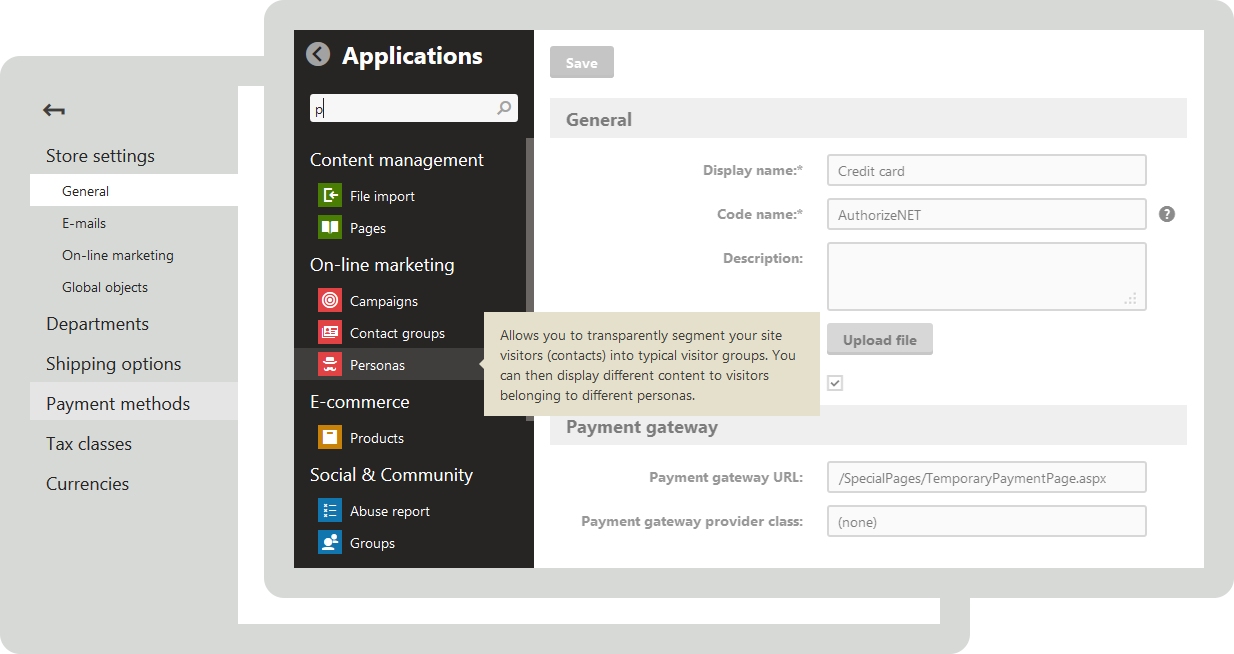
Kentico is a web content management system for building websites, online stores, intranets, and Web 2.0 community sites. Kentico CMS uses ASP.NET and Microsoft SQL Server for development via its Portal Engine, using Visual Studio, or through Microsoft MVC.
$9,999
Subscription license
Spryker Cloud Commerce OS
Score 6.4 out of 10
N/A
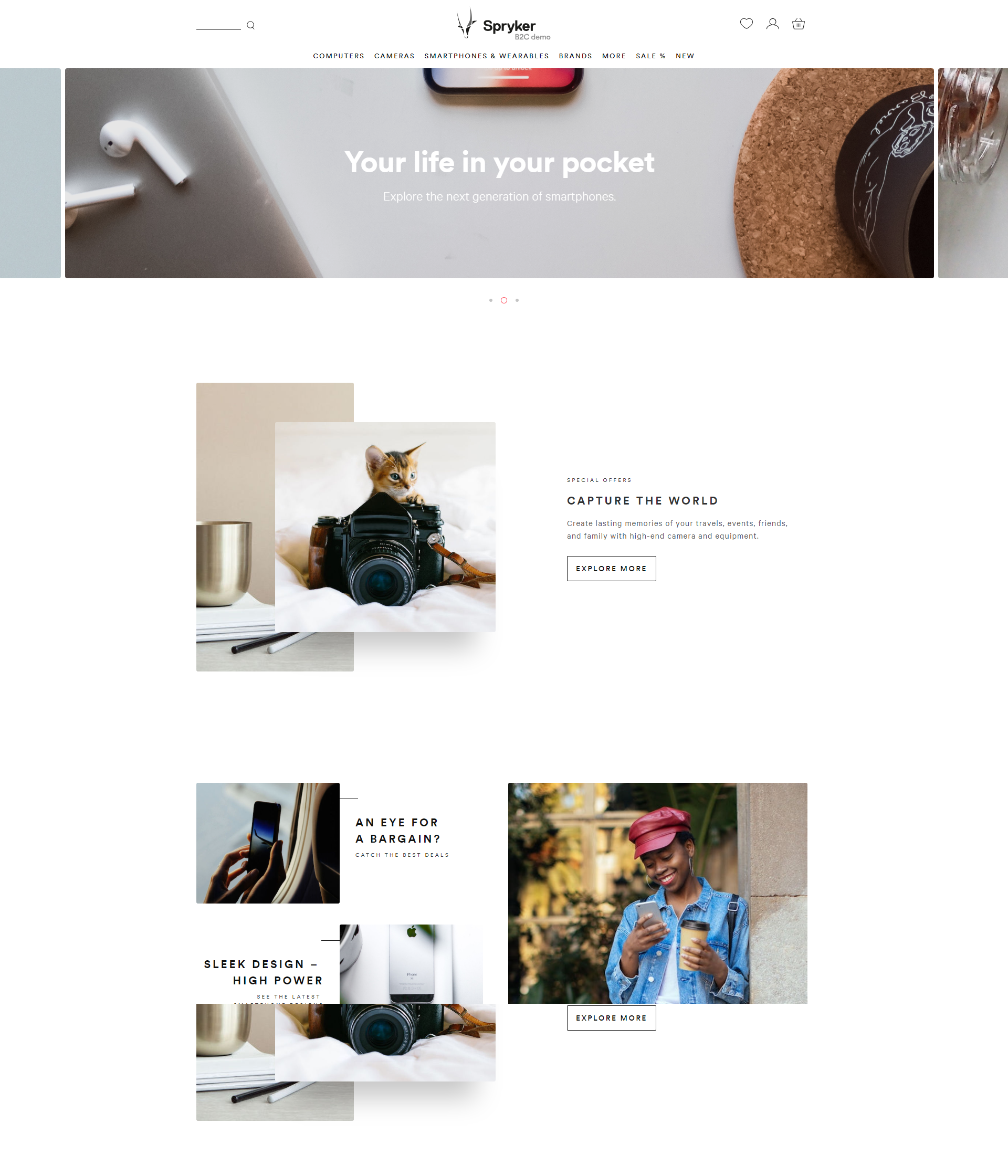
Spryker Cloud Commerce OS is a modular Commerce System that enables B2B, B2C, and Marketplace business models through any customer interface, touchpoint, and device. Boasting extensibility, best-in-class performance, and fast time-to-market, the vendor states Spryker is trusted by brands such as TOYOTA, HILTI, and TomTailor. The Spryker Cloud Commerce OS NOW version has been specifically developed for manufacturers and brands who want to reach customers directly online.
Pricing is based on the duration and terms of your contract with the vendor. This entitles you to a specified quantity of use for the contract duration. If you choose not to renew or replace your contract before it ends, access to these entitlements will expire.
More Pricing Information
Community Pulse
Kentico Xperience
Spryker Cloud Commerce OS
Features
Kentico Xperience
Spryker Cloud Commerce OS
Security
Comparison of Security features of Product A and Product B
Kentico Xperience
7.1
Ratings
14% below category average
Spryker Cloud Commerce OS
-
Ratings
Role-based user permissions
7.10 Ratings
00 Ratings
Platform & Infrastructure
Comparison of Platform & Infrastructure features of Product A and Product B
Kentico Xperience
7.5
Ratings
10% below category average
Spryker Cloud Commerce OS
-
Ratings
API
8.00 Ratings
00 Ratings
Internationalization / multi-language
7.00 Ratings
00 Ratings
Web Content Creation
Comparison of Web Content Creation features of Product A and Product B
Kentico Xperience
7.0
Ratings
9% below category average
Spryker Cloud Commerce OS
-
Ratings
WYSIWYG editor
8.00 Ratings
00 Ratings
Code quality / cleanliness
7.10 Ratings
00 Ratings
Admin section
7.20 Ratings
00 Ratings
Page templates
7.10 Ratings
00 Ratings
Library of website themes
5.80 Ratings
00 Ratings
Mobile optimization / responsive design
8.00 Ratings
00 Ratings
Publishing workflow
6.20 Ratings
00 Ratings
Form generator
7.00 Ratings
00 Ratings
Web Content Management
Comparison of Web Content Management features of Product A and Product B
Kentico Xperience
6.9
Ratings
4% below category average
Spryker Cloud Commerce OS
-
Ratings
Content taxonomy
6.30 Ratings
00 Ratings
SEO support
7.20 Ratings
00 Ratings
Bulk management
5.10 Ratings
00 Ratings
Availability / breadth of extensions
7.90 Ratings
00 Ratings
Community / comment management
7.90 Ratings
00 Ratings
Online Storefront
Comparison of Online Storefront features of Product A and Product B
Kentico Xperience
-
Ratings
Spryker Cloud Commerce OS
7.9
Ratings
1% above category average
Product catalog & listings
00 Ratings
8.30 Ratings
Product management
00 Ratings
7.50 Ratings
Bulk product upload
00 Ratings
8.10 Ratings
Branding
00 Ratings
8.20 Ratings
Mobile storefront
00 Ratings
8.40 Ratings
Product variations
00 Ratings
7.80 Ratings
Visual customization
00 Ratings
7.40 Ratings
CMS
00 Ratings
7.20 Ratings
Online Shopping Cart
Comparison of Online Shopping Cart features of Product A and Product B
Kentico Xperience
-
Ratings
Spryker Cloud Commerce OS
8.6
Ratings
11% above category average
Abandoned cart recovery
00 Ratings
8.80 Ratings
Checkout user experience
00 Ratings
8.30 Ratings
Online Payment System
Comparison of Online Payment System features of Product A and Product B
Kentico Xperience
-
Ratings
Spryker Cloud Commerce OS
8.4
Ratings
1% above category average
eCommerce security
00 Ratings
8.40 Ratings
eCommerce Marketing
Comparison of eCommerce Marketing features of Product A and Product B
Kentico Xperience
-
Ratings
Spryker Cloud Commerce OS
7.6
Ratings
1% below category average
Promotions & discounts
00 Ratings
7.90 Ratings
Personalized recommendations
00 Ratings
6.80 Ratings
SEO
00 Ratings
8.10 Ratings
eCommerce Business Management
Comparison of eCommerce Business Management features of Product A and Product B
Kentico Xperience
-
Ratings
Spryker Cloud Commerce OS
8.4
Ratings
5% above category average
Multi-site management
00 Ratings
8.20 Ratings
Order processing
00 Ratings
8.80 Ratings
Inventory management
00 Ratings
8.50 Ratings
Shipping
00 Ratings
8.00 Ratings
Custom functionality
00 Ratings
8.60 Ratings
Best Alternatives
Kentico Xperience
Spryker Cloud Commerce OS
Small Businesses
Bloomreach - The Agentic Platform for Personalization
Well suited for marketers that do not have in-house web programming or web designing resources available. Less appropriate for people that aren't computer savvy (i.e. don't know how to use basic programs like email, Excel, PowerPoint) or for those who are not detail-oriented because if you skip certain steps when adding/editing content, your webpage won't render correctly and/or create negative impact for search engine optimization without you knowing it.
Spryker is very well suited (B2C and/or B2B) for big companies with complex and individual business models or also if your company needs a certain level of customization. Very good fit, if you need a scalable system. It is rather not the perfect fit for small companies or companies with very basic E-Commerce needs.
Ease of use for the developer, content authors, and internet marketers that use it. The user interface in Kentico 8 truly is amazing and easy to pick up with no training.
Strong customization and integration capabilities, including the built in REST service, Integration Bus, and elegant API. I love the fact that if there is anything not in the box we can use the system to extend it or connect it to any CRM, ERP, or other third party service very easily.
Large out of the box functionality. There is an extremely high level of value that the platform provides. Instead of having to build extra modules for things like Event Booking, Forums, Polls, or E-commerce, they are already there for us to use.
Ability to control the HTML output of the site at a very fine level. Creating HTML5 is very easy in Kentico and implementing any design, as responsive, is totally possible in the system.
The ability to get a very high level of insight into the visitors journey through the website and market back to them with the Contact management, Lead Scoring, and Marketing Automation modules is very impressive.
The scalablity of the system is impressive. Running a very highly trafficked web site is totally possible with Kentico and its strong caching and web farm capabilities.
The support that Kentico provides is top notch, 24/7 global support is included with any purchase, 7 day bug fix policy, and excellent documentation
The development community is engaged and ready to help if you are a developer learning Kentico, and the Kentico partner community is very strong as well.
Extendable - you can extend the core functionalities to every business need.
Scalable - the technical implementation supports a highly scalable system approach.
Adjustable - besides implementing new functionalities the core functionalities can be adjusted to the business needs.
Up-to-date - compared to other E-Business solutions, the technological foundation of Spryker is growing, with the technological development and implementations [which] are kept up-to-date with quarterly releases.
Their slogan - "Right First Time Technology" - I get what they mean, but some things may be lost in translation. This is a sentence fragment in English, and some clients may be turned off by it.
Easier to understand documentation - their official documentation could use an overhaul. All of the information is there, but most of their code examples need to be fleshed out a bit. This aspect of their product can be very hard to navigate for first-time Kentico developers.
Email Queue - this should be in the same section as Email Marketing; currently this is under Configuration
We are locked into Kentico for the long haul. It provides us with an easy and flexible solution for a very non technical company to create a site and have the features they want, especially with the inclusion of EMS into our license. Now we have a true platform to build and grow our solutions.
It seriously is one of the best interfaces I have ever used. I also love the fact that I can use UI personalization to secure any functionality by user or role that I don't want that role to have access to. The best part is the customization of the UI, I can add in any button, tab, or menu item I want through it, no code required.
Spryker's usability depends a lot on custom development. Therefore, I would like not to consider usability as something that comes with Spryker Cloud Commerce OS. Spryker Cloud Commerce OS; however, brings all the tools needed to design a solution with great usability.
Their support staff is friendly, knowledgeable, and will work with you until your issue is fixed. This could take a few phone calls back and forth, but they are very diligent in helping you.
Support suffered from Spryker Cloud Commerce OS's rapid growth. Contacts, department heads, and support systems changed frequently. Support processes as well as documentation are rather poor. One notices that they are putting more effort into the customers recently, but in the course of growth, there is still a lack of focus here. As a customer, I would like to see growth at a slower pace and a phase of stabilization.
Previously we used Microsoft SharePoint as a content management system and it was very limited, required a ton of support, and we encountered bugs on a weekly/monthly basis. All of the negatives that we had associated with SharePoint went away when we switched to Kentico. It was really night and day and Kentico has really helped us move forward and become much more efficient.
If you compare Spryker with commerce solutions on the market, you will notice that the focus is not on the front end. Spryker assumes that the store is only one of many possible channels through which customers order today and in the future. To understand the differences, one must therefore take a look at Spryker's architecture. This is divided into the Spryker [Cloud] Commerce OS (the backend with all process-related components), the front-end modules for B2C and B2B, as well as the integration modules (middleware) and interfaces (Glue API).
Kentico has allowed us to deliver to clients more quickly, more cheaply, and with high quality to our clients. It's an inexpensive licensing model, an easy development platform, and powerful enough we can deliver amazing results to our clients.
Kentico's quick setup and deployment model has allowed me to very quickly ramp up new developers. This saves money and time.
We routinely see extraordinary returns in visits, time on page, and other critical metrics after rolling out Kentico-based systems/applications.
Time-To-Market: With Spryker you can run MVPs in less time and you can test new functionality with certain groups of users.
Due to its speed it is very likely to have reoccurring customer because of a very good customer experience.
With Spryker our customers increased their revenue especially in times of Corona where orders doubled and Spryker was able to cope with the load with no substantial increase in server power.