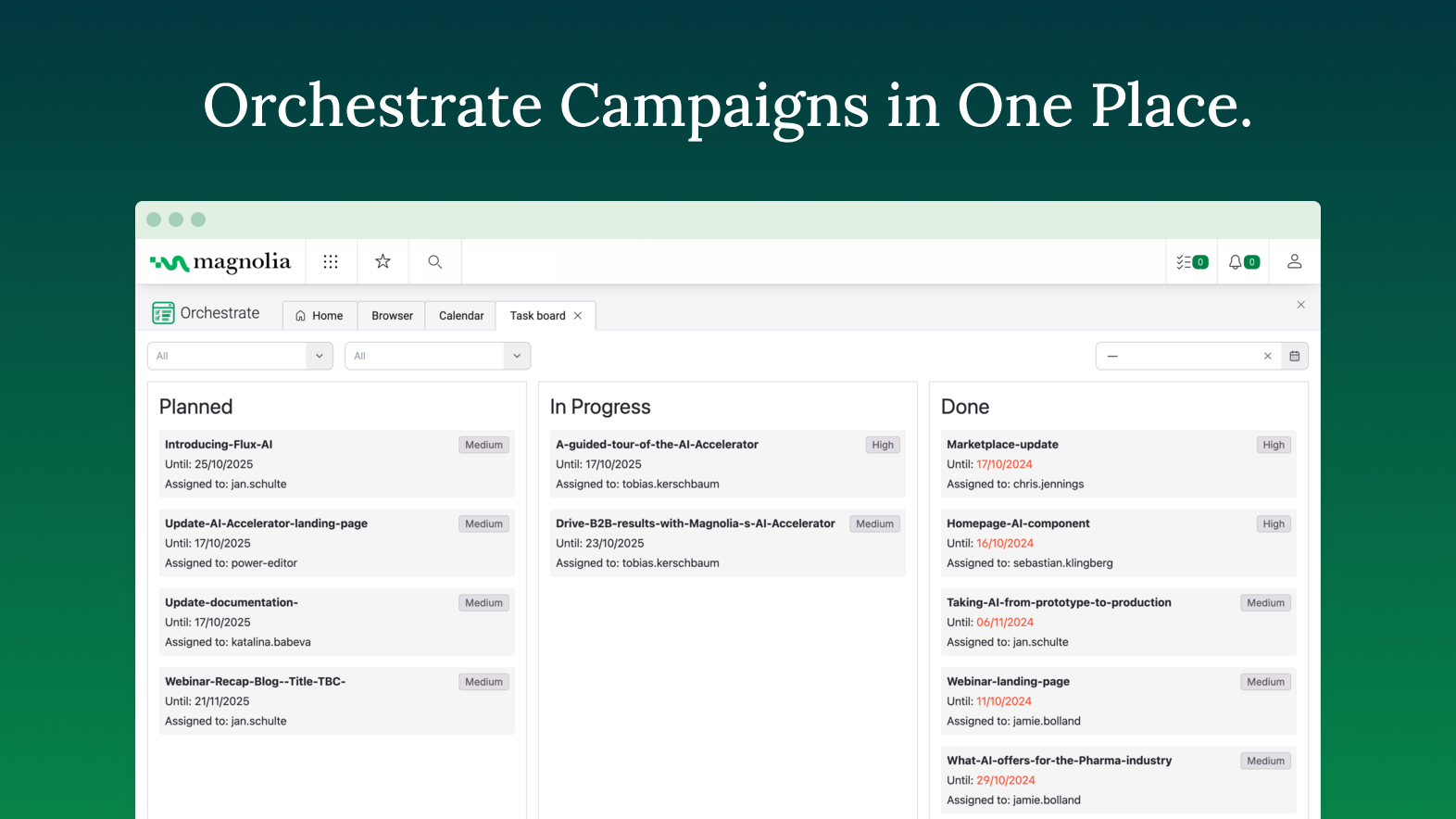
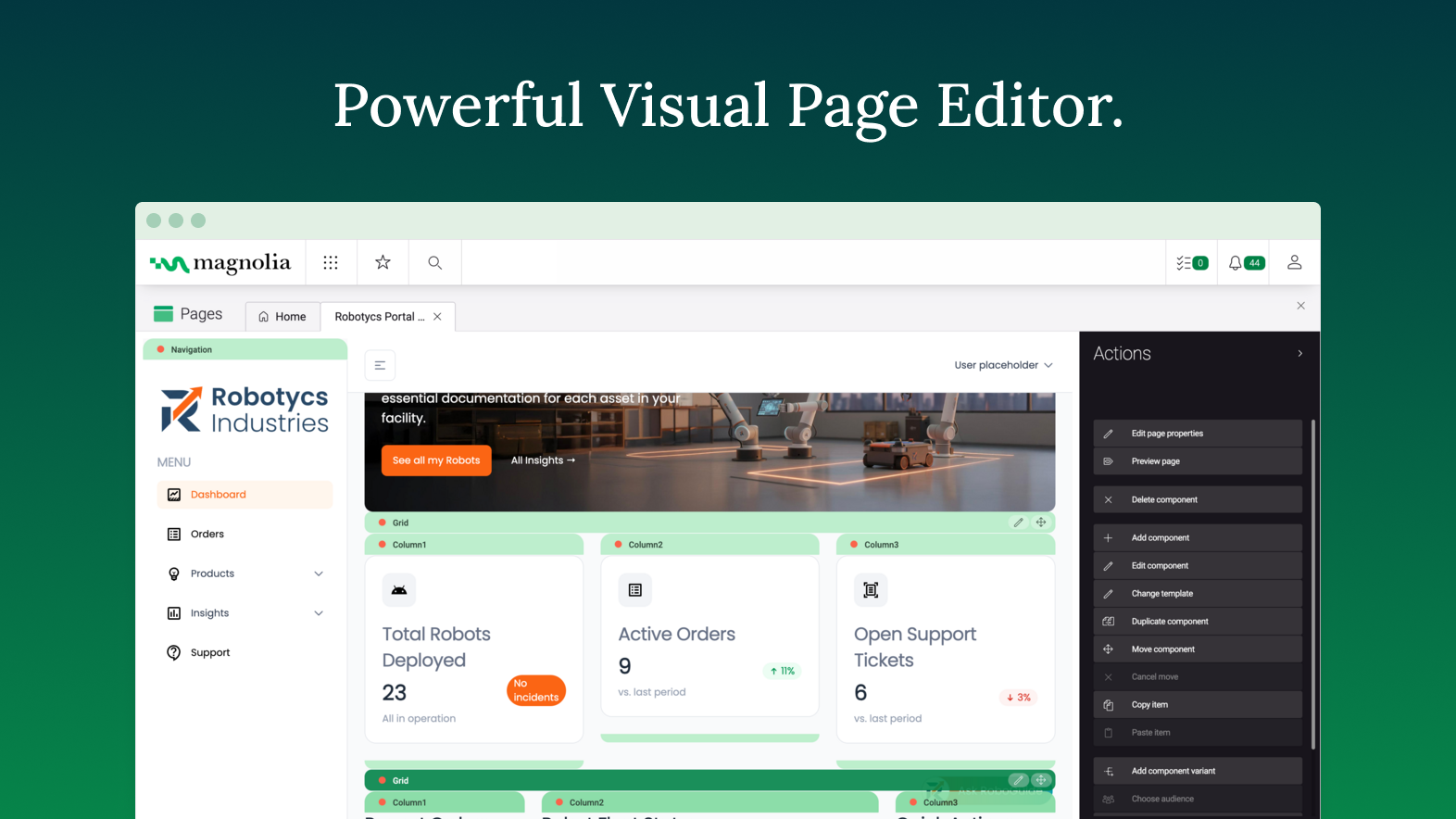
Founded in Switzerland in 1997, Magnolia is a CMS used to build composable digital experiences. Magnolia helps create fully integrated customer experiences and speeds up digital delivery of content. Magnolia boasts 480 enterprise customers, thousands of Community Edition deployments, and more than 200 certified Magnolia Partners around the world. They further state that their enterprise customers include Sanofi, Generali, the Atlassian, The New York Times, Harley Davidson, and Union…
$3,500
per month
Salesforce CMS
Score 8.4 out of 10
N/A
Salesforce Marketing Cloud Personalization (formerly Salesforce CMS) is a hybrid CMS allowing users to author content once and deliver it anywhere, in or out of Salesforce. Users create content, define content access, and define channels so they can share content and limit access to appropriate contributors. For an experience built with Salesforce, users can choose from two of the company's “what-you-see-is-what-you-get” (WYSIWYG) tools: Experience Builder and Commerce Page Designer. If the user…
N/A
Pricing
Magnolia
Salesforce CMS
Editions & Modules
DX Core
$3500
per month
DX Cloud
$6000
per month
No answers on this topic
Offerings
Pricing Offerings
Magnolia
Salesforce CMS
Free Trial
Yes
No
Free/Freemium Version
No
No
Premium Consulting/Integration Services
No
No
Entry-level Setup Fee
No setup fee
No setup fee
Additional Details
—
—
More Pricing Information
Community Pulse
Magnolia
Salesforce CMS
Considered Both Products
Magnolia
Verified User
Anonymous
Chose Magnolia
Magnolia DXP offers similar or more capability compared to the other platform, while much easier to implement. For example, Adobe Experience Manager tend to be more monolithic in nature, heavier footprint compared to Magnolia. Hence when implementing a DXP, it is much faster to …
The Broadleaf CMS was quite basic and was not a full fledged CMS and hence we had to chose Magnolia to address the business requirement for our B2B platform
Magnolia is in a league of it's own vs the other platforms I have previously used. Rather than being a turnkey solution Magnolia puts the power into the hands of your company and developers allowing you to build anything you can imagine. Being a DXP rather than a CMS Magnolia …
Magnolia is not as costly as other enterprise grade platforms and is easier to deploy, more reliable and less resource hungry. It's often also easier to use and certainly easier to use than it's Open Source counterparts. It also manages content in a much more structured manner …
I've used several CMSs like AEM and EpiServer, and comparatively, they all excel at different things. Magnolia is the best to develop for/against. Episerver has the best/most fluid UI in terms of content editing, and the overall admin experience AEM is just all around sucks.
Similar to how one might choose a specific programming language to solve a specific problem, Magnolia has its place among the rest, depending on the use case. While it does not have the most pleasant user experience compared to others, its customization options are streets …
Cost was prohibitive for SiteCore. We liked the support that Magnolia gives us in terms of being an actual Company. We love open-source, but have had problems with Umbraco in the past in terms of upgrade paths etc.
Of all the ones we looked at that met our requirements Magnolia was clearly the best value for money and had a solid background that you could trust and that could take care of you in case of problems.
For us, Magnolia is the best option for our needs. FirstSpirit by eSpirit is missing on the list. We are moving away from FirstSpirit as it feels outdated. Wix has better usability, but is not suitable for enterprise. WordPress I would only recommend for private projects. …
Putting all together: capabilities, support, community and price... Magnolia is the best combination, maybe not the best on each aspect, but for sure in the combination
I choose Magnolia in front of everyone since it is one of the content managers that best adapts to all the modifications that are required by businesses
One of the most important points that magnolia has over other products is the possibility of extending its functionalities. Being open-source, it is possible to inspect how everything is done and replicate it to change functionalities. In this way, many features that customers …
I use magnolia because my client asked for it in the beginning because he had a long history of using magnolia for years. I think magnolia is middle-hight rated in the stack of similar products. Maybe it's not very well-publicized and it needs better marketing techniques or …
Good documentation and examples Online demos to mess with and test functionalities Easier to install Better knowledge about the product Ability to centralize content of the same type in apps Better performance in some scenarios Better usability: In the newest versions, …
Especialista Digital Experiences Platforms en atSistemas
Chose Magnolia
Magnolia is a good competitor in the DXP scenario: Reduced costs License costs are contained, what brings customers the ability to develop their business with a minor impact Open source platform It helps customers to adapt the platform to some special needs DXP …
Magnolia has all flexible capabilities that offer the user the best cloud marketing experience and great functionalities for effective data analytics generation. Reporting through Magnolia tools is also another important aspect since it allows the production of effective …
Magnolia has an automatic, and speedy social media publication extension, which spread content to all social sites. Also, the insertion of extensions and plugins is more effective when on Magnolia against the opponents. Magnolia admits and adopts diversity, hence, it is a …
Salesforce is magnificently more robust and functions much better when managing complex sales cycles with multiple individuals and products. With simple sales cycles and few products, Excel is a strong contender.
Salesforce CMS stacks up as a Customer management system because it has a more user friendly snd intuitive interface. The UX is better and more modern. It can be customised and extended. There are always learning opportunities and updates for the system so it keeps on …
Salesforce CMS is way better with both optimization and reporting both of which Sonar Scheduling lacked. Our ability to skill technician or prioritize was lacking with Sonar. The API was very delayed with Sonar so changes on the Gantt had a delay that would throw off other team …
This fits into the mold with the other Salesforce services. Once you get used to the suite and the nuances of each platform, things become easy. Just read any documentation first, as jumping in will only get you so far, and the more connections with the other apps, the more …
Hubspot CSM is a bit easier to use, but not as strong for bigger markets like enterprise. Also, it's a bit annoying having to log into different platforms. Being able to do everything directly in Salesforce is pretty nice.
Salesforce more so compliments these products, rather than stacks against them. We don't have any products similar to Salesforce CMS, so in lieu of that, these are the products we were using that mesh the easiest with Salesforce CMS in terms of proceeding through the …
In my opinion, Salesforce CMS is the most complex of these offerings, and probably the most complex platform of its kind. It was selected by another stakeholder - I would likely have chosen something less expensive and more intuitive to use. The robust feature set is amazing, …
We used the Catalyst product of Totango. It was not great as it was hard to navigate, and it did not offer any reporting capabilities at all, nor did it speed up our day-to-day tasks.
As our business heavily relies on Sales Cloud, Service Cloud, and Marketing Cloud, we need a CMS that works natively with our existing Salesforce Data. Other platforms would require third-party connectors or custom API development, making integration more complex and expensive. …
I would say Zoho seemed very remedial when compares with the functionality of Salesforce CMS. Zoho might be better for those just starting out and don't need the full functionality of what Salesforce CMS is capable of. Used Zoho at a previous employment and I didn't think it …
I was uninvolved in my organization's CMS selection, but I used Freshdesk at another organization and generally prefer Salesforce CMS due to greater functionality and wider use cases. Unlike Freshdesk, Salesforce CMS is built for processes besides customer support ticketing, …
I have not researched other products. The last two companies I have worked for both used Salesforce CMS and had no intention of changing providers. I cannot think of a time where someone told me they did not like Salesforce CMS. When you have a solid solution like Salesforce …
Pulls data from Sales Cloud, Service Cloud, and Marketing Cloud to dynamically update content, we didn't want to use too many 3rd party tools that would expose our busines to threats
I used to use WebWave at my previous firm and felt like it was more for website creation rather than content sharing internally. I was also in a different role so I meant my needs at my last firm. My focus has changed and now Salesforce CMS is the best product for my team to …
Integration with this tool are immensely incredible it make us efficient whenever we need to see the data of our client. It helps us to make our lives easier in terms of sending rates, follow-ups, Outbound call and more importantly constant assurance that we have our process on …
If you need a business CMS that brings along a good amount of features and also give you the chance to develop features on your own, Magnolia would be a good choice. Even if you have not the fitting infrastructure around, Magnolia provides you different ways like SAAS oder PAAS. If you have to review your code our have any problems the team behind will helps in a short time. Without using the connectors it is not so easy to connect special functionalities like Marketing tools or optimization tools. The DAM is very slow if you have an huge amount of documents and pictures to store for your website - you have to add an external DAM.
If you have a large customer base and a large amount of data on each of your customers, it is really strong in creating personalized content that your salespeople can use in their pitch meetings—and then setting up workflows for automated for lifecycle journey creations to automatically go out to customers.
Versatility of defining actions for custom handlers.
Reloading classes when code is modified in a local dev environment is nice. While it doesn't seem to work when changes extend beyond the method body (i.e., adding methods), it remediates the pain of long startup times.
Easy to use, just like Salesforce's other products. Many users can sit down and figure it out in no time, and with a little training become power users.
Fast and secure - Salesforce is a leader in the cloud world so you get consistently fast results and security that is top notch in the industry.
Accessible from anywhere - if you use cloud CMS already this is a no-brainer, but for those that do in-house CMS still, this is a major difference. Mobile access from anywhere on the planet without a VPN is something you just can't do without the cloud.
Organizations that are new to Salesforce need to be prepared for report building and other configurations. Customization is a great feature, but it can be overwhelming if not impossible for a brand new user.
Salesforce Trailhead is robust but can be confusing and overwhelming.
I'm currently comfortable with only using Salesforce CMS or any iteration on a desktop.
Magnolia is an innovative CMS, for example it is possible to use the ipad to manage the contents. Magnolia’s team works hard to improve the product; the community is small but active and the support for the enterprise version is good. Magnolia’s team asks the users what they think and what they need, and the new functionalities planned for Magnolia 5.3 are very exciting for example the content personalization.
It will be too difficult to change to a different software. We are fully integrated, and if things are not working well, it would be way worse to try to move to a different platform.
There are a ton of small things that could make this CMS great Off the top of my head... 1) Better navigation between a component and its corresponding node in the jcr ( devs often have to flip between a page and a spot in the jcr even though there could be a button to take you from a page/component in the pages app to its location in the JCR) 2) Why does a content editor need to open the page to edit the page properties? They could just as easily edit the dialog from the tree view if they have many pages to touch, and it would save them time by not having to render the page.
Strengths: - Intuitive for Salesforce Users – If you’re already working within the Salesforce ecosystem, the Salesforce CMS is easy to navigate, with a clean UI, drag-and-drop content management, and reusable assets for quick updates. - Seamless Integration – Since it connects natively with Experience Cloud, Marketing Cloud, and CRM, it allows for efficient multi-channel content distribution without needing extra third-party tools. - AI-Powered Personalization – The ability to deliver dynamic content based on user profiles and engagement data is a huge plus, making content delivery more relevant and impactful. Challenges: - Learning Curve for New Users – If you're not already familiar with Salesforce, the interface can feel overwhelming, requiring training to fully leverage all features. - Limited Customization & Workflow Automation – While it works well for structured content, advanced approval workflows and deep editorial customization are limited compared to enterprise CMS platforms like Adobe Experience Manager. - Media & Design Limitations – Salesforce CMS is not as robust for managing rich media-heavy content, which can be frustrating for teams needing more flexibility in multimedia presentation.
It's a lean and performant platform. You don't need to put reverse proxy servers in front of it to speed it up (although that does make it go even quicker) as there are various layers of caching built in to the application. While it's a little cryptic, the internal caching system is actually quite configurable and can be tuned to the right sort of content.
Often what tends to surprise many an IT manager is that you can run it on relatively modest hardware. We've often been met with "are you sure ?" but the reality is that it doesn't need a whole lot of horsepower.
You always get an answer based on your SLA. But you always get a solution. That's the successfactor in this case. To often i was frustrated about people in a company without even a clue what there product is about or how to solve a problem. Magnolia's Support Team does a very good job and try to help you in most of the cases
I've never really had to contact support. It's at the point where we have people in the organization that are our specific go-to inhouse support teams for Salesforce. Again, that goes back to what I said about there being a point where just too much is added to Salesforce that you have to hire someone to be the go-to person of Salesforce. There is only so much their support team can do for you. I wouldn't expect Salesforce Support to have any sort of understanding of the weird issues I deal with!
Magnolia DXP offers similar or more capability compared to the other platform, while much easier to implement. For example, Adobe Experience Manager tend to be more monolithic in nature, heavier footprint compared to Magnolia. Hence when implementing a DXP, it is much faster to build using Magnolia, at a much lower TCO. The other platform like Kontent.ai and Strapi are pure headless platform and offer lesser features. What really make Magnolia different is the APAC team, who are all out to support their client in the implementation, ensuring their client maximize their platform and the project implementation is successful. This is some thing that is not experienced when using other platform(s)
Salesforce CMS is way better with both optimization and reporting both of which Sonar Scheduling lacked. Our ability to skill technician or prioritize was lacking with Sonar. The API was very delayed with Sonar so changes on the Gantt had a delay that would throw off other team members. Sonar was cheaper but Salesforce CMS is way more capable.
We have placed web content management in the hands of the organisation than retained it within the technology team.
We were able to quickly move to MVP and release and we are now focussed on moving the platform forward at some pace whilst not being burdened with BAU work inside the technology team as so much as self-service to trained organisational users
The use of the SAAS/PASS has inbuilt business resiliency as specialist work and aspects such as underlying security is done by Magnolia and we are able to focus internal effort on building out the platform.