Desktop Central from ManageEngine is a client desktop management with patching, remote control, and configuration.
N/A
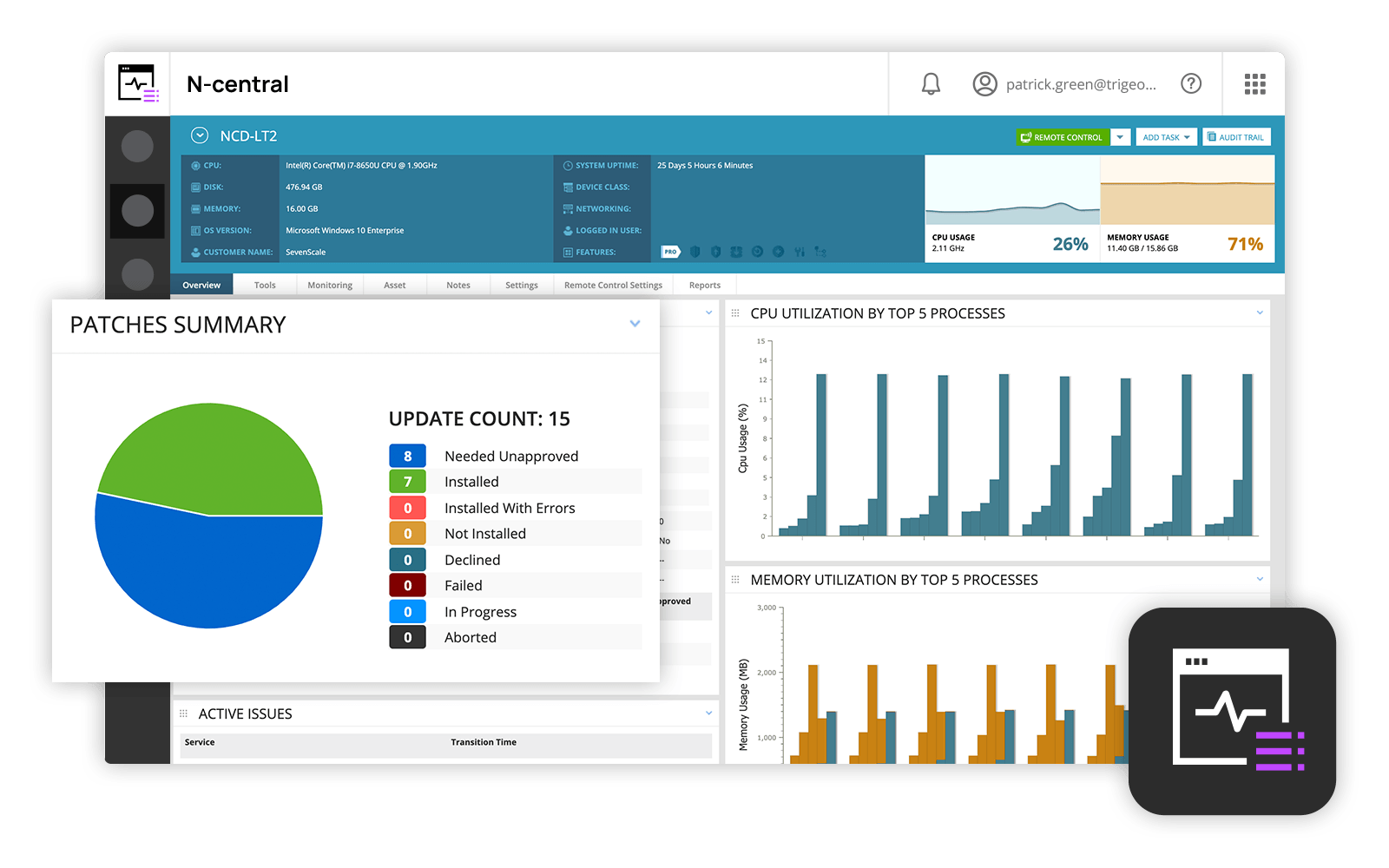
N-able N-central
Score 8.9 out of 10
N/A
MSPs
and IT professionals use N-able™ N-central® to monitor and manage devices and complex
networks remotely. N-central provides
visibility and efficiency as the user's needs scale. N-central can help users:
1. Proactively monitor everything on a customer network—not just servers
and workstations—and troubleshoot.
2. Stay on top of threats with features like MFA, antivirus, integrated endpoint
detection and response, data backup, disk encryption, email protection,…
N/A
Pricing
ManageEngine Endpoint Central
N-able N-central
Editions & Modules
No answers on this topic
No answers on this topic
Offerings
Pricing Offerings
ManageEngine Endpoint Central
N-able N-central
Free Trial
Yes
No
Free/Freemium Version
No
No
Premium Consulting/Integration Services
No
No
Entry-level Setup Fee
No setup fee
No setup fee
Additional Details
—
—
More Pricing Information
Community Pulse
ManageEngine Endpoint Central
N-able N-central
Considered Both Products
ManageEngine Endpoint Central
Verified User
Anonymous
Chose ManageEngine Endpoint Central
ManageEngine Endpoint Central outperformed N-Central with its user-friendly interface, robust security features, and seamless patch management. Its scalability and comprehensive endpoint protection convinced us, offering a superior balance of functionality and ease of use. …
I selected N-able N-central as I liked the idea of easy-to-work with pricing that integrates with other PSAs (specifically ConnectWise PSA aka Connectwise Manage). I did not succeed with that. I'd use any of the other tools instead. The integration is problematic as the default …
Patch management is a HUGE time saver. Simply being able to push patches out to devices without having to physically go around to each one save a ton of time. Inventory tracking has also helped us better manage equipment. We are all human and make mistakes, and this helps to eliminate or catch many of those mistakes. With ManageEngine Endpoint Central scans showing us who is using the device and what else is plugged into it, saves us from having to search for devices when they are being refreshed.
In my opinion, N-able N-central is a good "learn your lesson and move onto something better" tool. I've used many RMM tools over the years and I feel that this one is slow, does a terrible job with reporting, alerting, monitoring, software deployments, etc. The ability to turn on services like AV, backup, etc easily is cute, but you're not going to be able to use your own tools with this easily. In my experience, if you do turn those tools on for testing during the trial, you'll be charged later (despite it being a trial). They also turn off your ability to monitor these increased costs or to turn them off yourself. As a company, I found that they were impossible to work with. The sales team is right there if you want to buy something - but if you need anything other than to buy something, in my experience, they take days or weeks to navigate. I found that they are not a terribly ethical company and are more concerned with making a few dollars than creating a partnerships with MSPs. I can see value is in the advertised price of $99 for a hundred endpoints. However, you need to remember to not trial any other tools (like AV, backup, etc).
It helps to facilitate the administration of a network of workstations and servers.
The deployment of applications and updates is very easy to implement, and greatly facilitates keeping workstations and servers up to date.
The commissioning of the solution is very simple, and with the help of the external gateway, it allows for the supervision of all equipment, as long as they have internet access.
We can manage multiple mobile fleets, with user smartphones on one side and industrial smartphones with specific missions on the other. The possibility of applying a kiosk mode is not negligible.
Robust patch management: it is easy to set up patching groups via tags, and configures patch management profiles and maintenance windows.
Remote Control: as long as the agent checks in, it is very quick and easy to take control of an endpoint, either in a separate session (RDP, kick the current user out), or to join the existing session of the current user, to provide desktop support or collaborate remotely.
Given these factors, organizations would individually assess their experience with Endpoint Central to determine its renewal likelihood. If you're considering renewal, it might be helpful to gather feedback from users within your organization, review performance metrics, and assess how well Endpoint Central aligns with your current and future endpoint management needs.
Overall we have liked our solar winds experience, however, as our company has grown to support larger enterprises, this product does not have the functionality that our teams need in order to fully support them. The lack of granularity with backups and lack of ability to support nutanix environments is slowly drawing us into the use of other tools.
The application itself is great. However, I have little insight to what the patches are doing. Being able to see patch download progress, not just the status, would be great. The user interface could also use an overhaul. The countless menus, sometimes containing similar if not duplicate tabs can be frustrating to navigate.
The user interface is fairly straight forward, with logic groupings for objects. I did not deploy this software, but am one of the daily administrators. Once you get the correct agent package (Which can be a challenge) the integration into AD is not bad. The UI could be more customized, but that may have been a design choice.
The immediate chat support is great and very helpful. However, if you need escalated support or have a deeper need that the chat tool can't help with, you will experience significant wait times and slow responses. The time zone difference becomes painful to the point of often just giving up.
Every time we have reached out to SolarWinds they are quick to respond, even offering support chat 24/7. Their support team is great and works with you to find solutions to issues. They have taken items we had issues with before and used those to create updates so that the issue is handled better in the future.
Kaseya's system of handling patch management was not as intuitive as Endpoint Central, however in some respects it was easier to set up. Kaseya VSA and ConnectWise are also more geared towards managed service providers that handle multiple organizations versus a single company's IT department, which Endpoint Central seems more designed for. Intune, while helpful for machine management, does not have the level of overall endpoint management and inventory management and is better used alongside another endpoint management tool
Most advanced, and other technicians in the business already used it before. NinjaOne was a close competitor, but lacked some features that we ideally need. ITarian was too basic but was MUCH cheaper. For a startup MSP, it would be much more attractive. Splashtop was just for remote connections, which we used for some time before realizing full RMMs were a better fit for our requirements.
We have been able resolve and complete any requests which include things like software deployment or issues that include troubleshooting, much faster and more efficiently. This has had a sharp decrease in our response times and also time it takes to complete these requests or incidents.
The mobile device management features have allowed us to be able to have a much tighter grip on security. This means we have dramtically decreased our device vulnerabilities and risk of data breaches. This has saved us lots of time and money.
The remote features that are available have helped a lot with user's being able to work remotely and allow our organisation to sustain hybrid work. It means user's can still be as productive and IT support is as efficient no matter where the user is working.
The product definitely increases productivity. Technicians can spend a few seconds to take care of remote tasks with a few clicks as opposed to minutes to get a user to start a remote control session, or worse, going on site to work on a piece of equipment.
The packaging of the features makes selling and pricing the product fairly straight-forward and convenient. This saves our sales team time from trying to work with add-ons when pricing our services - the product makes it easy to just have an "all you can eat" package at a set price.
When something goes wrong with the product, our business and our customers suffer. If for example, a bug causes all managed computers to reboot, our customers call in, resulting in our technicians being booked solid doing damage control. This also causes loss of trust with our customers - we can't simply blame the product, the customer trusts us to provide them a service and if the product fails, we fail.