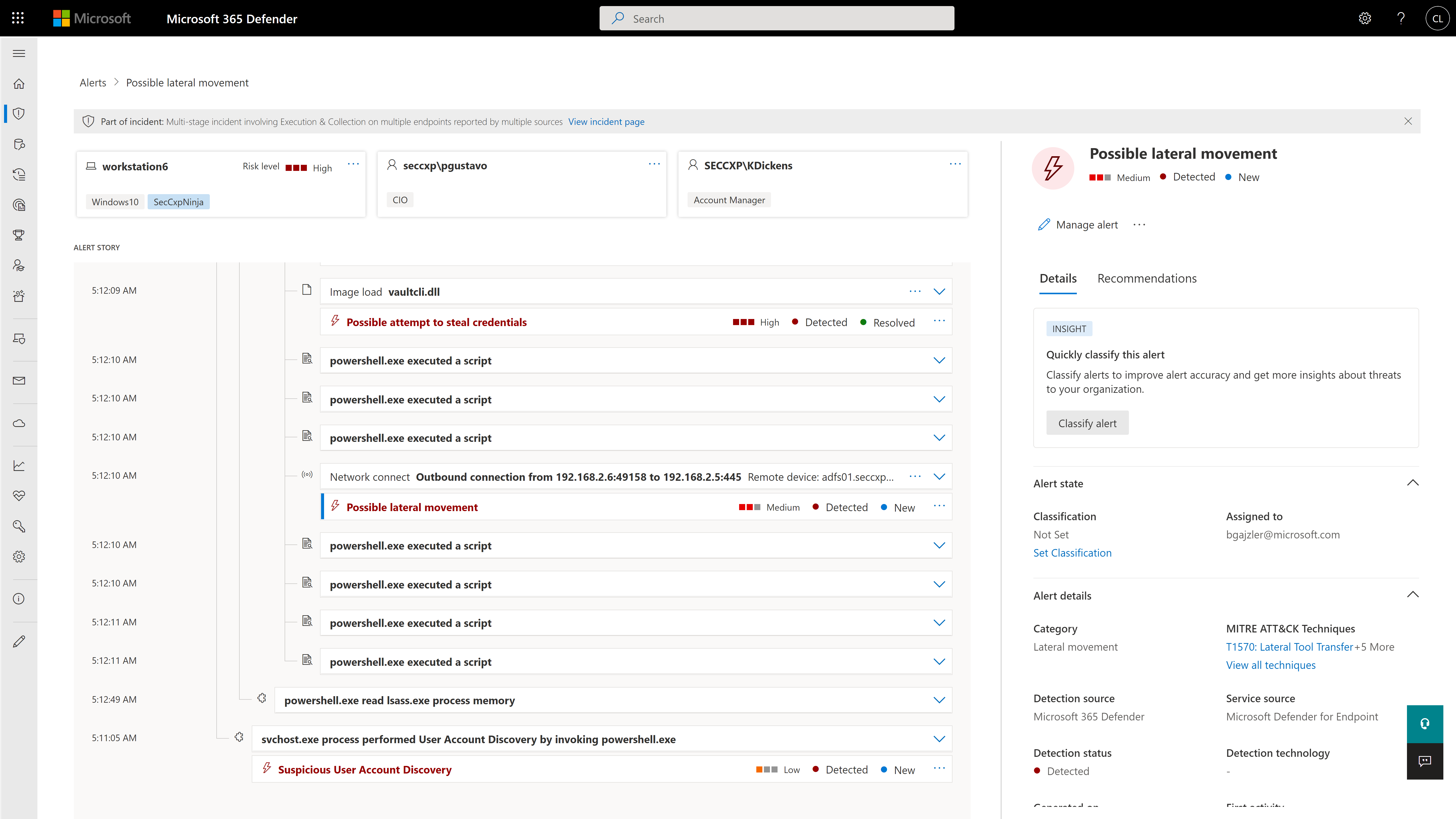
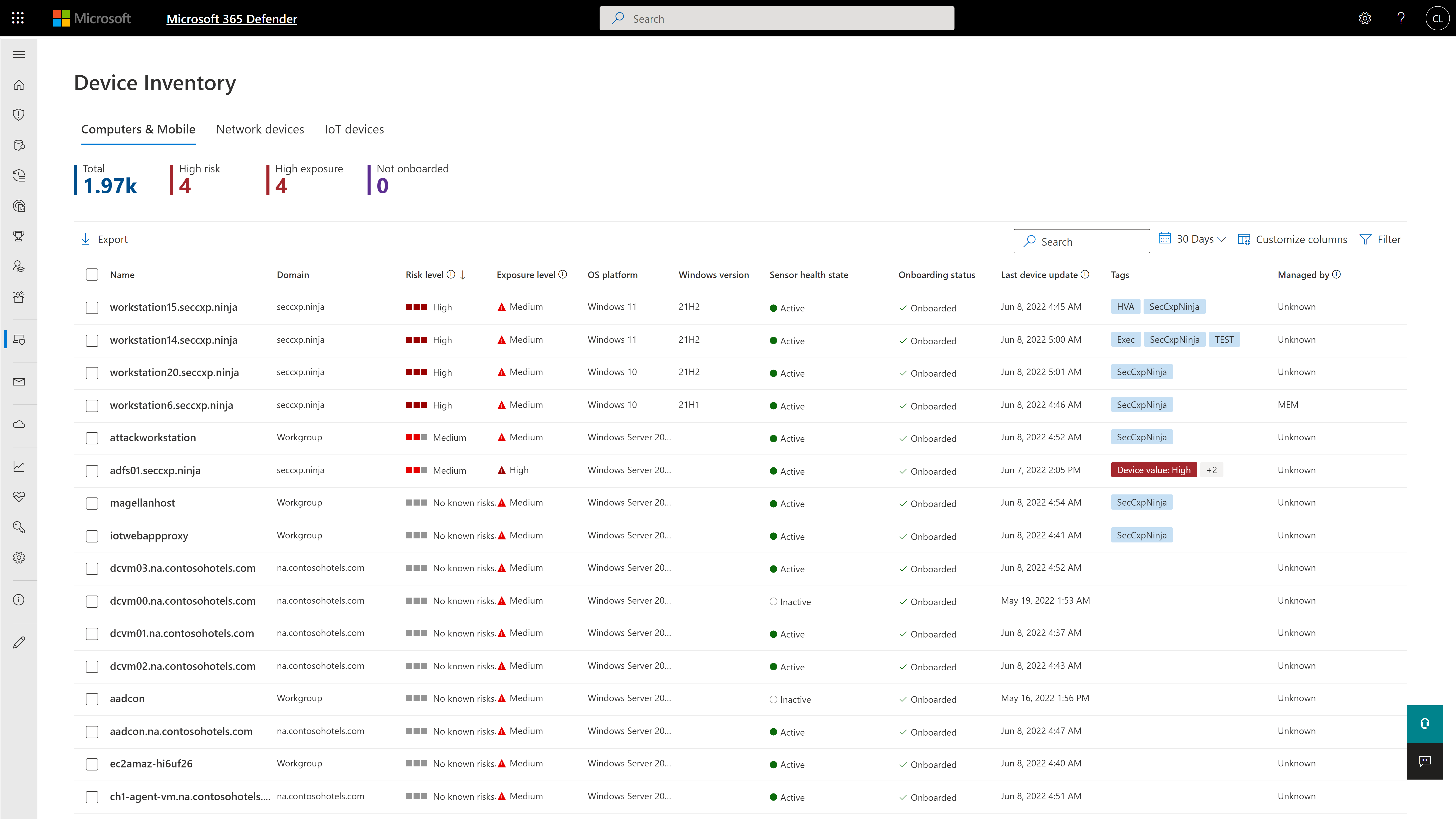
Microsoft Defender for Endpoint (formerly Microsoft Defender ATP) is a holistic, cloud delivered endpoint security solution that includes risk-based vulnerability management and assessment, attack surface reduction, behavioral based and cloud-powered next generation protection, endpoint detection and response (EDR), automatic investigation and remediation, managed hunting services, rich APIs, and unified security management.
$2.50
per user/per month
InsightIDR
Score 9.5 out of 10
N/A
In addition to their incident response service, Rapid7 offers InsightIDR, a combined XDR and SIEM that provides user behavior and threat analytics.
$5.89
per month per asset
Pricing
Microsoft Defender for Endpoint
Rapid7 InsightIDR
Editions & Modules
Academic
$2.50
per user/per month
Standalone
$5.20
per user/per month
InsightIDR Advanced
$5.89
per month per asset
Offerings
Pricing Offerings
Microsoft Defender for Endpoint
InsightIDR
Free Trial
Yes
Yes
Free/Freemium Version
No
No
Premium Consulting/Integration Services
No
No
Entry-level Setup Fee
No setup fee
No setup fee
Additional Details
—
*500 asset minimum. Billed annually. All amounts are shown in U.S. dollars. International prices vary.
We have not used anything else other than Microsoft Defender for Endpoint. Maybe we've used other antivirus software like Sophos and things like that. They're just not all encompassing and that's why we moved to use this product.
I have been working with customers that they are transitioning from Sentinel One, CrowdStrike to Defender for Endpoint, right? So I think it's because they see the value in the product and also they see how much they can save in terms of the cost for companies because they …
We previously used CrowdStrike on our servers. However, the seamless integration of Microsoft Defender (MD) with XDR and the entire Microsoft ecosystem led us to choose Microsoft Defender for Endpoint (MDE).
What we love more about this product is the way this pro gets integrated into the other family of solutions, especially Defender for Identity or the XDR solutions. We think that the market, the customers are full of unattended consults coming out from different vendors and that …
Microsoft Defender for Endpoint is more advantageous in our windows heavy infrastructure and it was unparalled in the ease of integration with windows endpoints. Security breaches, system crashes and outages with other competitors like Crowdstrike made it easier for us to go …
CrowdStrike Falcon is also a good solution for endpoint protection which offer EDR Soultion, threat hunting and AI driven threat protection. Sophos Intercept X combines next-gen antivirus with advanced EDR capabilities with its deep learning technology, exploit prevention, and …
Microsoft Defender for Endpoint is unique for its effortless deployment into the Microsoft ecosystem, where it taps the broadest set of threat intelligence from more than 1.5 billion endpoints. Its state-of-the-art AI-powered automated investigation and remediation minimize …
We started onboarding macOS devices on jamf and started managing it. Because Defender for Endpoint is not working as expected for and compared to price and functionality we are switching from it.
CrowdStrike and SentinelOne. CrowdStrike, you have to deploy it, but it's the defender, it's already baked into the operating system. Same thing with SentinelOne.
I'm not familiar. It's just been one year plus that I started using, so I've just started using Defender, so I really don't know how to compare it with others.
I would say at the end all they are doing the same, but with the benefit that we don't need to install anything. So it's just kind of enabling and then the functionality is available, so other products need to be installed, which is not necessary with the defend
We use Defender in the cloud. We are currently using Defender in the cloud and also evaluating the XDR solution for programmatic. It's just arguments, the defense in depth. You have Defender Endpoint and then you have what you have in the cloud as well, so it's just augmenting …
Before using Defender for Endpoint, we basically had the starter version of the Microsoft product, which comes prebuilt into the system. We had them using in the initial run, but then what usually happened was the employees started disabling it, and that usually made, we guys …
I am a big fan of Tanium actually, so I think it is good. Tanium seemed like it was maybe a little bit easier, but maybe the capability was lacking. Maybe that's the reason why it seems like Defender for Endpoint might be a little harder to understand. There might just be more …
CrowdStrike Falcon, and Sentinel One are other big ones that we use a bit. Cisco Secure Endpoint we've evaluated as well. Cisco Secure endpoint capability-wise doesn't match up to Defender, SentinelOne, and CrowdStrike both do, but the cost profiles are a bit higher. So most of …
I would say not to name specific company names, because I'm a partner with one of them and that's the account that I work with. But I use some competing solutions that I would say are pretty heavy from an overhead perspective with the agent that has to be installed in the …
The biggest advantage it has the lightweight agent and smooth and less traffic chaos in network during log collection. Cloud Security always require extra efforts but InsightIDR reduce that burden as it has highly anticipated agents to which knows what they need to do when they …
Other products are OK, but they lack the robust permissions and their interfaces are much much less intuitive. Rapid7's prioritization system for vulnerabilities makes more sense given their context as the developers of Metasploit. We thought we might be able to switch and save …
We tried other solutions, but our Network, which is mostly in different locations with different OEMS , was well suited by Rapid7. Rapid7 works with different workflows and SIEM solutions, which was a requirement of the SOC solution. Visibility allows the security operation to …
Many of the top-tier providers of this technology do a comparable job. However, we selected Rapid7 because of their reputation in the area of user behavior analytics, cost, # of SOC locations (due to our selection of their MDR service), support, company growth in other areas …
Both products would do what we needed them to, but Rapid7 InsightIDR made more sense from a cost perspective. We did a proof of concept of both products, and they were pretty evenly matched in their own ways. Forescout had a better interface, but in the end the interface of …
Between Rapid7 InsightIDR and Crowdstrike, we liked Rapid7 InsightIDR due to the functionality of the system and the features Rapid7 InsightIDR has. Rapid7 InsightIDR was very easy to deploy in our environment to our endpoint devices. We like the scanning capabilities and the …
Because of its integration with Windows, it is very easy to deploy and manage. Any IT department should be able to leverage the software and interface. The admin portal provides weighted recommendations that comprise the Secure Store, offering admins, security teams, and business owners valuable insights into their security footprint without requiring a strong security background. The software would be ideal for small and mid-sized businesses that cannot dedicate resources to security. Larger enterprises would also benefit, but may require the enhanced license.
It has been brilliant for us in terms of understanding the behaviour affecting our endpoints and assets. We have full visibility of our alerts, which menas we can act on them immediately. We use a single pain of glass with dashboards that can be easily drilled down into to get further information. It has laso helped us eo create bespoke reports for senios Managmeent, while at the same time supports other teams like Network Mnagement and Operations.
One, it's crazy lightweight, so compared to some of the competitors that we also have used with our security services, it's really lightweight and so I don't have a lot of overhead on the system that it's running on.
Rapid7 InsightIDR does a very good job at keeping virus definitions up to date so that our threat intelligence is very up to date when knowing what to protect against.
It helps us by scanning all of our infrastructure components and highlights where improvements need to be made in security so we can be proactive with our security initiatives.
It has automated response mechanisms to triage and resolve any potentials risks allowing us to save time in the long run.
So the fact that Defender for Endpoint still works with signatures is actually, I don't know, a little difficult for us because, I mean, since Microsoft trusts those signatures, you can easily inject code. And we've done it many times. To show that you can inject code through vulnerabilities like CV 2013, 99, and 33 but still keep the signature. So because of the trust of those signatures, the malware just kind of slides into the environment without Defender knowing. That's the first part. The second part is that the behavioral analysis is not precisely its Prime. It's not Defender's best capability for endpoints. So, Defender does not identify all behaviors considered by other EDRs in the market.
Microsoft Defender is closely catching -up in market with existing competitors they have added DLP endpoint & DLP Network and Cloud DLP solution last year with OCR capabilities. I would say Microsoft Defender is not legacy Vendor in end point security, the need to learn from other vendors in market and focus on new XDR technologies, which is going to be new battle for all vendors
Because in terms of the usability is easy to understand, it's easy to manage, obviously you need to have specific skills to do that, but I would say that even the console and the product is walking through the flow that you are looking for on this console.
Microsoft Defender for Endpoint chugs along just fine no matter what we throw at it and what systems it's running on. It doesn't take up a lot of resources either, so that's welcomed.
Overall support is really good for this product. Since it's a Microsoft product, you will get good support from a number of different resources, including knowledgebase articles on the web, support from Microsoft technicians, and documentation (which tends to very thorough). Also, there is a vast user support community for this product, so user support forums would also be another valuable channel to get help if needed. I don't envision too many people will have issues/problems with the product, as it tends to run good overall.
Deployment was handled by our team here and everything went pretty smoothly. We did have a few hiccups in our test group, but that only took a bit to get ironed out.
Microsoft Defender for Endpoint offers strong integration with Microsoft 365 and Azure services, which provide a unified security experience. While McAfee Trellix is known for solid antivirus, Microsoft Defender excels in integration in the ecosystem.
Between Rapid7 InsightIDR and Crowdstrike, we liked Rapid7 InsightIDR due to the functionality of the system and the features Rapid7 InsightIDR has. Rapid7 InsightIDR was very easy to deploy in our environment to our endpoint devices. We like the scanning capabilities and the console we felt was very easy to use and can be easily caught up to our IT staff. Also during vulnerability scans, we felt that Rapid7 InsightIDR was able to detect more and any competitor out there.
Rapid7 InsightIDR has allowed us to be proactive in securing our systems as the vulnerability scans give us a lens at what we need to fortify when it comes to security.
In recent incidents its allowed us to save time and money as it mostly detects issues accurately and we are able to bring systems back quickly without too much downtime for the business.
With recent updates, we are confident that Rapid7 InsightIDR is a good solution for the long run as they are always making adjustments to their platform and improving it with every release.