Microsoft Planner is presented as a solution to organize teamwork with intuitive, collaborative, visual task management. With it, users can create Kanban boards using task cards with files, checklists, and labels. Users can collaborate in Planner and Microsoft Teams and check visual status charts—all in the Microsoft cloud.
N/A
monday.com
Score 8.6 out of 10
Mid-Size Companies (51-1,000 employees)
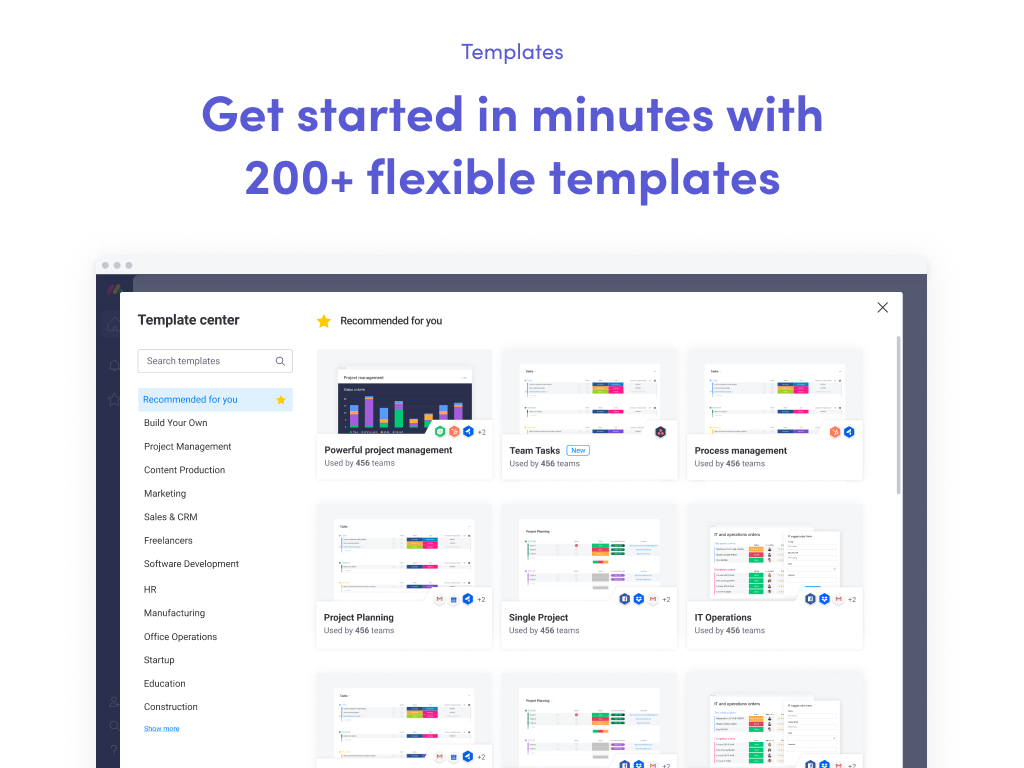
monday.com Work OS is an open platform designed so that anyone can create the tools they need to run all aspects of their work. It includes ready-made templates or the ability to customize any work solution ranging from sales pipelines to marketing campaigns, CRMs, and project tracking.
Our organization chose MS Planner because it is an included tool in the MS Suite, and since we are unfortunately replacing our current and much better project management tool due to a consolidation of the tech stack. However, it doesn't appear that any of the teams using the …
In my experience, Microsoft Planner has much less features and less effective than other project management tools. But, it's free and included as part of Microsoft 365, so senior management may think it's saving them money. However, the poor productivity and the inefficient …
The Planner has a more straightforward and intuitive interface, making it ideal for teams that want to get started quickly without a steep learning curve. Additionally, Planner is more budget-friendly, making it a better option for smaller teams like mine. Additionally, …
Microsoft Planner stands out for its seamless integration with Microsoft 365, making collaboration with tools like Teams, Outlook, and SharePoint effortless. Its user-friendly interface, with drag-and-drop features and color-coded labels, simplifies task management. Microsoft …
Compared to the other options, we already had access to Microsoft Planner, preconfigured accounts, and support and ordination from tech internally to use it. We previously used Wrike, I wanted to use Asana, and other people in the organisation either used Microsoft Project, or …
Microsoft Planner was included in our package of Microsoft email. Thus, we [don't] have to pay anything separately. This is was the main reason. However, the functionality we required was similar. [Microsoft] Planner also gives a schedule calendar where we can add tasks as per …
While Asana and Trello are mature products, Planner is getting there pretty quickly. Since our organization is on the Microsoft ecosystem, it helps to use SSO for most of the apps that are within the same license. It helps save money and does the work. For proper project …
Microsoft Planner won out over Todoist due to it's ability to integrate other software and allow us to be able to do more work in one software. The project management functions were superior as well. Probably the biggest advantage was the task management. We liked how it worked …
Have moved to JIRA in my recent project. I can say Microsoft plan is a good option but JIRA is more powerful compare to this tool. The only thing is its integration and easy communication feature between teams or assigned groups stand it out while comparing with the similar …
Microsoft Planner has a clear cut edge over all the other project planning software of having its native and extensive capability of integrating with the Office 365 apps which everyone uses heavily. Also, it is highly accessible and usable to a large extent through PDAs and …
Planner provides better integration with Microsoft products that are used across the organization as a whole. It provides better connection to SharePoint, MS Teams, MS Office products, and even in MS Outlook, which is the company's email client.
Many areas of the company still use Trello to organize their activities and tasks, but gradually Microsoft Planner must replace the activities. Users are often "attached" to familiar technologies, but Office 365 takes advantage of the more organized use of the tools. This year …
I would recommend Planner for light project / team management with strong MS Teams integration. For a PMO / large project with resources/cost/gantt management, I would really recommend MS Project.
Planner, tho its user interface could be improved, was leaps and bounds better than TYA suite. Their user interface is difficult for many at our job site to use, especially the older generation. The decision to bring it in was largely a corporate decision. Individuals likely …
Trello is better as a one off product, but if you use the Microsoft suite then Planner integrates better into the rest of your day-to-day apps. The integration into team members' calendars and mail makes the ease of assigning tasks across our organization well worth using the …
Microsoft Planner is far superior and doesn't require expensive training to give people access to it. It is far easier to customize and allows for people to add projects and milestones without the cumbersome interface that Agility offers. I would far rather use Microsoft …
We tried to select software from various tools, and in the end we chose Planner both for economic reasons (it is included in the Microsoft 365 license we have in the company) and for its ease of use (we have no particular or specific needs, such as advanced scheduling or ticket …
Main reason is that it is cost efficient because we're already using Microsoft 365 and it's literally part of the ecosystem. No need to purchase any other software. Microsoft is also a well known company, credible for providing business solutions and has a strong enterprise …
Planner is free and integrated with other Microsoft products that we use. We don't have a need for something more sophisticated given the price it would have cost to purchase licenses for a dedicated task/project mgmt tool.
It's been a while since trying Asana, so it's hard to say. I think they are very similar from what I remember, but maybe monday.com has more reporting and customization possibilities?
monday.com offer much of the standard tools and seems to be ever evolving. They seem to take feedback and constantly upgrade the tools. If all the tools are there, the differentiating factor might be the cost, any integrations you may need, and the visual "chemistry". To me, …
We chose to move from Zoho to monday.com when our company started growing exponentially. Overall, our team was thankful for the change because we were growing at far to fast of a speed for Zoho's tools to keep up with us. monday.com is a better, beefier platform with far better …
We decided to go with monday.com because they offered a free tier for nonprofits and because they are easier to use and offered additional features that we could not find on the other choices. Hands down, there was no better choice for us than monday.com.
When I arrived at my org, I was initially disappointed to hear that we used something other than Asana for project management. Fast forward just a few months, and I became a complete monday.com convert. While its organization is similar to Asana's, it's user interface, …
I would say this is one of my least favorite applications. I don't find it super user friendly due to the extreme amounts of customization. It feels like my information is in there somewhere, but I can never find it easily. I think that it looks a lot prettier than asana which …
monday.com seems to solve the issues and concerns for our marketing and graphics needs. I personally use Asana for my projects and tracking purposes and monday.com for my interations with Marketing and their needs.
monday.com is much easier to use and offers all the tools of google suite in one spot for task management. I use gsuite services still but in an entirely different way. If there is something that needs to be shared with the team or is important that I will need to refer back to …
Monday.com is the broadest scope work management software I have used. Its interface is basic and takes some getting used to, but the programming options are highly advanced and extremely effective.
I also use the other selected. But I prefer monday.com because it is more clear (visually and intuitively), and also because I have been using it for longer than the others. However, there is the price factor that must be taken into consideration
Monday.com is far more intuitive than Salesforce with it's automation features, lists are better and customizable and it makes things easier for everyone on the team.
Salesforces is a great CRM system but I feel as though it falls short as a collaborative project management …
As a developer, I have utilized the mentioned apps to integrate processes for clients, and I have found monday.com to be superior due to its abundance of features compared to others. Choosing monday.com provides enough capabilities for teams and managers to handle work in one …
monday.com is a much better tool for keeping track of tasks and assignments than MS Planner. In most situations where we used MS Planner we have switched to using monday.com instead.
monday.com is so much easier to use & project-tracking is not only easy to do, but the visuals are far from complicated & make it that much easier to keep track of everything.
I feel monday.com is easier to use than the others listed. Specifically, I used to use Trello in the past and I really liked it. I even recommended others to use it but since working in monday.com, I found it has so many more features that meet our teams needs and we have found …
monday.com has the only interface that is 100% customizable, can use public and private boards, can be shared with customers, produce Gantt charts, and has THE MOST integrations "in house". The professional relationships that monday.com has established to be "on board" with …
I searched for some other alternatives like monday.com, and I also tried them. For example, I have experience with Sloneek. But monday.com just feels different. I think it beats the competition in every way. You can also use monday's free version, and it is still a good task …
I chose monday.com because of its flexibility and ability to adapt to our needs. Throughout our work, I've seen how it helps us increase productivity and efficiency, which solidified my decision.
The easy of use and configuration is where monday.com has had an advantage. The ability for all our users to startup on the platform has helped to incorporate it into our enterprise environment quickly.
Actually, monday.com and Trello, although they are digital board systems, are both very different from each other. Trello is a simpler system that, although its function is also the organization of tasks, its visual system gradually overwhelms the user by "piling up" each post …
monday.com is simpler and easier to grasp, apply and navigate than Clickup, but the Clickup free version has so much more functionality available than the monday.com free / low-cost options (sorry, but it's true!). Google tasks is really simple and I shouldn't really compare …
Microsoft Planner is a user-friendly visual tool for organizing tasks and workflows. It’s great for team collaboration, integrates seamlessly with Microsoft 365 tools like Teams and Outlook, and offers flexibility for projects of all sizes. Additionally, it provides mobile and web access for seamless productivity on the go. That’s a big plus right there.
Here, I will suggest that it is best to create employees, clients, or project reports. Easy to track with the dashboards. I did many integrations and developments. I can not list each of them here. I will say the best tool for management. I couldn't see criteria of unsuitable. But yes It will depend on the client's requirements. I will suggest it as very user-friendly tool for CEOs, CTOs, Managers, and company owners also for team.
Ensuring I have set up a Private board vs public board is not clear - it would be useful to have an additional alert when creating a board as I work with sensitive information. It will eventually be used in a team based environment but while I test the boards, they needs to be private.
Time tracking is clumsy, could be easier to record
It is a very useful tool that brings teams in sync with one another. The integration with other Microsoft products makes it an obvious choice because you don't have to purchase a license for a completely different tool that doesn't have cross-functional capabilities with the software you already use on a daily basis.
Teams involved in content creation, such as marketing or editorial teams, could use monday.com to manage the entire content lifecycle. Boards might track content ideas, assignments, drafts, reviews, approvals, and publication schedules, helping teams collaborate and keep content production on track.
The tool is easy to use, but it is just as easy to set up. No specific skills are required, but its usefulness in our work is immediately apparent. Colors are very helpful in creating a clear interface and providing a very precise overview of the tasks to be performed.
It's straightforward to use and simple to understand. They have tutorials on different elements of the system that you can learn. The workflow there is very intuitive, drag and drop, which doesn't require a learning curve for most people. Templates that also make things more accessible can be found.
Everything performs fairly well. Every now and then there are user errors where an employee will not click "ok" on a note they've created and simply exit out (I do wish that something was in place to prevent this, such as a pop "are you finished?")
monday.com only really care about accounts that have 20 seats or more. While this is great for monday.com, it pushes smaller organisations to evaluate alternatives. We rate monday.com highly in our organisation because key staff have already got good experience with the application and we know we will get to 20+ seats one day. But, till then the billing model and lack of permanent enterprise features is a dread.
To have someone walk you thru the features and capabilities of Monday.com is priceless. Someone also coming along later in the contract to see if you are maximizing the program to suit your company needs is beyond helpful. The staff that have provided this training are fun, creative and very patient.
We signed up for the accounts. Created the accounts. Ran the trial version and tested it live while we were running multiple projects and found that it was fitting our needs perfectly. When the trial ended and we were asked to purchase the full version, we did. We have found other ways to use it and it's a breeze.
Our organization chose MS Planner because it is an included tool in the MS Suite, and since we are unfortunately replacing our current and much better project management tool due to a consolidation of the tech stack. However, it doesn't appear that any of the teams using the current program intend to use MS Planner due to its poor functionality. We will likely be pivoting to Jira instead.
We decided to go with monday.com because they offered a free tier for nonprofits and because they are easier to use and offered additional features that we could not find on the other choices. Hands down, there was no better choice for us than monday.com.
For it to work across multiple departments and sites, I would like to see improvements made with integrations and automation. For this question, I am acknowledging not only the addition of internal triggers/automation, but also an expansion on external ones.
Saved over $1000 each year by not having to purchase a third party tool for our content planning
Not sure that I can provide a hard number to this, but having the oversight to see when something is coming due and making sure everything gets executed in time
By using monday.com as an enablement tool for templated onboarding plans, we have been able to begin calculating the number of manager hours saved through our work (not defined yet).
monday.com's reporting tools also allow us to more easily report on the productivity and output of our team since we keep up with all projects and subitems in monday.com.