Microsoft Planner is presented as a solution to organize teamwork with intuitive, collaborative, visual task management. With it, users can create Kanban boards using task cards with files, checklists, and labels. Users can collaborate in Planner and Microsoft Teams and check visual status charts—all in the Microsoft cloud.
N/A
Planview AgilePlace
Score 9.9 out of 10
N/A
AgilePlace is a project management solution built around flexibility, data-driven analytics, and workflow automation. The software was acquired by Planview in December 2017 to expand that company's capabilities.
Our organization chose MS Planner because it is an included tool in the MS Suite, and since we are unfortunately replacing our current and much better project management tool due to a consolidation of the tech stack. However, it doesn't appear that any of the teams using the …
In my experience, Microsoft Planner has much less features and less effective than other project management tools. But, it's free and included as part of Microsoft 365, so senior management may think it's saving them money. However, the poor productivity and the inefficient …
The Planner has a more straightforward and intuitive interface, making it ideal for teams that want to get started quickly without a steep learning curve. Additionally, Planner is more budget-friendly, making it a better option for smaller teams like mine. Additionally, …
Microsoft Planner stands out for its seamless integration with Microsoft 365, making collaboration with tools like Teams, Outlook, and SharePoint effortless. Its user-friendly interface, with drag-and-drop features and color-coded labels, simplifies task management. Microsoft …
Compared to the other options, we already had access to Microsoft Planner, preconfigured accounts, and support and ordination from tech internally to use it. We previously used Wrike, I wanted to use Asana, and other people in the organisation either used Microsoft Project, or …
Microsoft Planner was included in our package of Microsoft email. Thus, we [don't] have to pay anything separately. This is was the main reason. However, the functionality we required was similar. [Microsoft] Planner also gives a schedule calendar where we can add tasks as per …
While Asana and Trello are mature products, Planner is getting there pretty quickly. Since our organization is on the Microsoft ecosystem, it helps to use SSO for most of the apps that are within the same license. It helps save money and does the work. For proper project …
Microsoft Planner won out over Todoist due to it's ability to integrate other software and allow us to be able to do more work in one software. The project management functions were superior as well. Probably the biggest advantage was the task management. We liked how it worked …
Have moved to JIRA in my recent project. I can say Microsoft plan is a good option but JIRA is more powerful compare to this tool. The only thing is its integration and easy communication feature between teams or assigned groups stand it out while comparing with the similar …
Microsoft Planner has a clear cut edge over all the other project planning software of having its native and extensive capability of integrating with the Office 365 apps which everyone uses heavily. Also, it is highly accessible and usable to a large extent through PDAs and …
Planner provides better integration with Microsoft products that are used across the organization as a whole. It provides better connection to SharePoint, MS Teams, MS Office products, and even in MS Outlook, which is the company's email client.
Many areas of the company still use Trello to organize their activities and tasks, but gradually Microsoft Planner must replace the activities. Users are often "attached" to familiar technologies, but Office 365 takes advantage of the more organized use of the tools. This year …
I would recommend Planner for light project / team management with strong MS Teams integration. For a PMO / large project with resources/cost/gantt management, I would really recommend MS Project.
Planner, tho its user interface could be improved, was leaps and bounds better than TYA suite. Their user interface is difficult for many at our job site to use, especially the older generation. The decision to bring it in was largely a corporate decision. Individuals likely …
Trello is better as a one off product, but if you use the Microsoft suite then Planner integrates better into the rest of your day-to-day apps. The integration into team members' calendars and mail makes the ease of assigning tasks across our organization well worth using the …
Microsoft Planner is far superior and doesn't require expensive training to give people access to it. It is far easier to customize and allows for people to add projects and milestones without the cumbersome interface that Agility offers. I would far rather use Microsoft …
We tried to select software from various tools, and in the end we chose Planner both for economic reasons (it is included in the Microsoft 365 license we have in the company) and for its ease of use (we have no particular or specific needs, such as advanced scheduling or ticket …
Main reason is that it is cost efficient because we're already using Microsoft 365 and it's literally part of the ecosystem. No need to purchase any other software. Microsoft is also a well known company, credible for providing business solutions and has a strong enterprise …
Planner is free and integrated with other Microsoft products that we use. We don't have a need for something more sophisticated given the price it would have cost to purchase licenses for a dedicated task/project mgmt tool.
AgilePlace is better than JIRA when it comes to ease of use and intuitiveness of the tool. Card based model and ability to customize/tailor the way you want makes AgilePlace is a great tool. Look and feel as well as colored cards, makes the board layout much more easier to …
All these tools are different and have different uses. Depending upon SDLC your organization uses, you would use any of these tools. They all have their plusses and minuses.
Originally, we had evaluated two other tools next to Planview LeanKit: Kanbantool and Kanbanflow. The latter was a close contestant for productive use, as it was also very customizable and a joy to work with and look at. It also had lower user fees and a mobile integration.
Front-End Web Developer, Office of Mediated Education
Chose Planview AgilePlace
I use Trello a bit for personal use. It's much less powerful than LeanKit, but it's also a better design and simpler to use. ServiceNow has some kanban board stuff built-in, but I wasn't super impressed with it. JIRA seemed to be even more complex than LeanKit for the short …
I think that LeanKit is very similar to Asana's Kanban feature and Trello, but is much less sleek looking than Asana. Asana's clean and sleek UI makes me enjoy project management much more than LeanKit. It might sound silly that the UI makes so much of a difference to me, but …
Our company uses LeanKit, Pivotal Tracker, and Trello. It all depends on what team you're on. There's even a team that just does KanBan on a whiteboard. In the end, I would tank LeanKit above Pivotal Tracker, but below Trello. The differences are relatively subtle between …
Both VersionOne and Trello are good products. VersionOne is for the real hardcore Agile shops who want to track and report on everything related to the Agile process. Trello is a tool that works for Agile, but really is just a simple list making/tracking tool. Both tools serve …
I have used Trello, which is not as robust for tracking and customizing workflows as LeanKit is. It does not scale well to big teams. JIRA is the standard project management software but does not support Kanban well.
Nearly all the other tools I evaluated against are free, so that's one area where LeanKit is not as competitive. LeanKit does allow the experience to be much more customizable, though.
Being from QA I prefer Spiratest and QC for the fact my team can do all our work in one program and it is linked. But the tech department as a whole prefers Leankit as it is the tool of choice based on ease of use and overall performance.
While LeanKit was not designed for project and task management, we selected it because of its collaborative nature as a project and task management platform for our marketing team. It was also selected because our engineering and product management teams were using Leankit. We …
Microsoft Planner is a user-friendly visual tool for organizing tasks and workflows. It’s great for team collaboration, integrates seamlessly with Microsoft 365 tools like Teams and Outlook, and offers flexibility for projects of all sizes. Additionally, it provides mobile and web access for seamless productivity on the go. That’s a big plus right there.
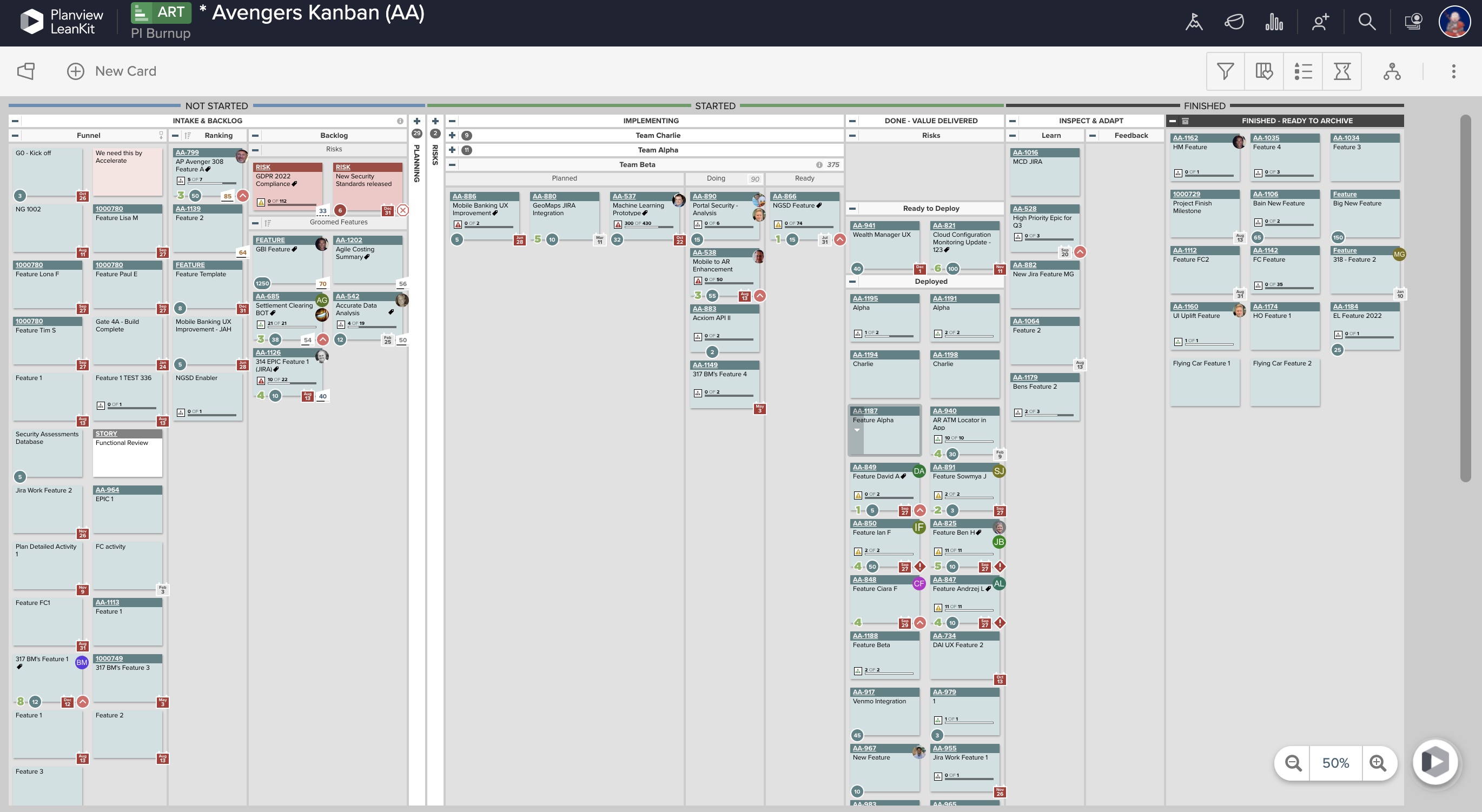
AgilePlace is a great way for teams, or individuals, to bring visibility to the work in process and in their backlog. The color coding and icon use helps to quickly analyze the type of work or status of the work. The product team is doing a good job at listening to their user's feedback and implementing improvements. Where it falls short is when reporting needs to occur.
Okta Integration: We love using SSO for all our SaaS apps, and as new team members join, they can be automatically joined to the appropriate LeanKit boards.
Filtering and viewing: Can filter and refine by several fields as well as custom fields. Assigned Users, Tagged, Card Type, Date, etc
Their analytics and reporting can be helpful for PMs, especially if they have several teams they oversee.
It is a very useful tool that brings teams in sync with one another. The integration with other Microsoft products makes it an obvious choice because you don't have to purchase a license for a completely different tool that doesn't have cross-functional capabilities with the software you already use on a daily basis.
The tool is easy to use, but it is just as easy to set up. No specific skills are required, but its usefulness in our work is immediately apparent. Colors are very helpful in creating a clear interface and providing a very precise overview of the tasks to be performed.
LeanKit isn't the best designed Kanban system I've seen, but overall it's pretty usable. The boards I've used are pretty complex, so it can be difficult to find things. I found that searching and filtering for specific cards was somewhat of a challenge. Dragging a card from one lane to another is kind of a fun way to get things done though.
Every time I have reached out to the AgilePlace support team I have received a timely response in addition to professional & personal feedback. Their consultants are knowledgeable and the management team is happy to jump in and help when needed.
Our organization chose MS Planner because it is an included tool in the MS Suite, and since we are unfortunately replacing our current and much better project management tool due to a consolidation of the tech stack. However, it doesn't appear that any of the teams using the current program intend to use MS Planner due to its poor functionality. We will likely be pivoting to Jira instead.
Originally, we had evaluated two other tools next to Planview LeanKit: Kanbantool and Kanbanflow. The latter was a close contestant for productive use, as it was also very customizable and a joy to work with and look at. It also had lower user fees and a mobile integration. In the end, we picked Planview LeanKit because of several reasons: Aesthetics: The look was much more clean and professional. Reporting: It was obvious from the start that we could use Planview LeanKit as a tool for improvement. API: We needed to integrate the Kanban into our central systems and Planview LeanKit API was (and still is) a way to do it. Card Headers: This sounds like a simple thing, but the headers above the titles fit our work perfectly and looked perfect, which helped the decision.
Saved over $1000 each year by not having to purchase a third party tool for our content planning
Not sure that I can provide a hard number to this, but having the oversight to see when something is coming due and making sure everything gets executed in time