Microsoft Planner is presented as a solution to organize teamwork with intuitive, collaborative, visual task management. With it, users can create Kanban boards using task cards with files, checklists, and labels. Users can collaborate in Planner and Microsoft Teams and check visual status charts—all in the Microsoft cloud.
N/A
Planview ProjectPlace
Score 8.4 out of 10
N/A
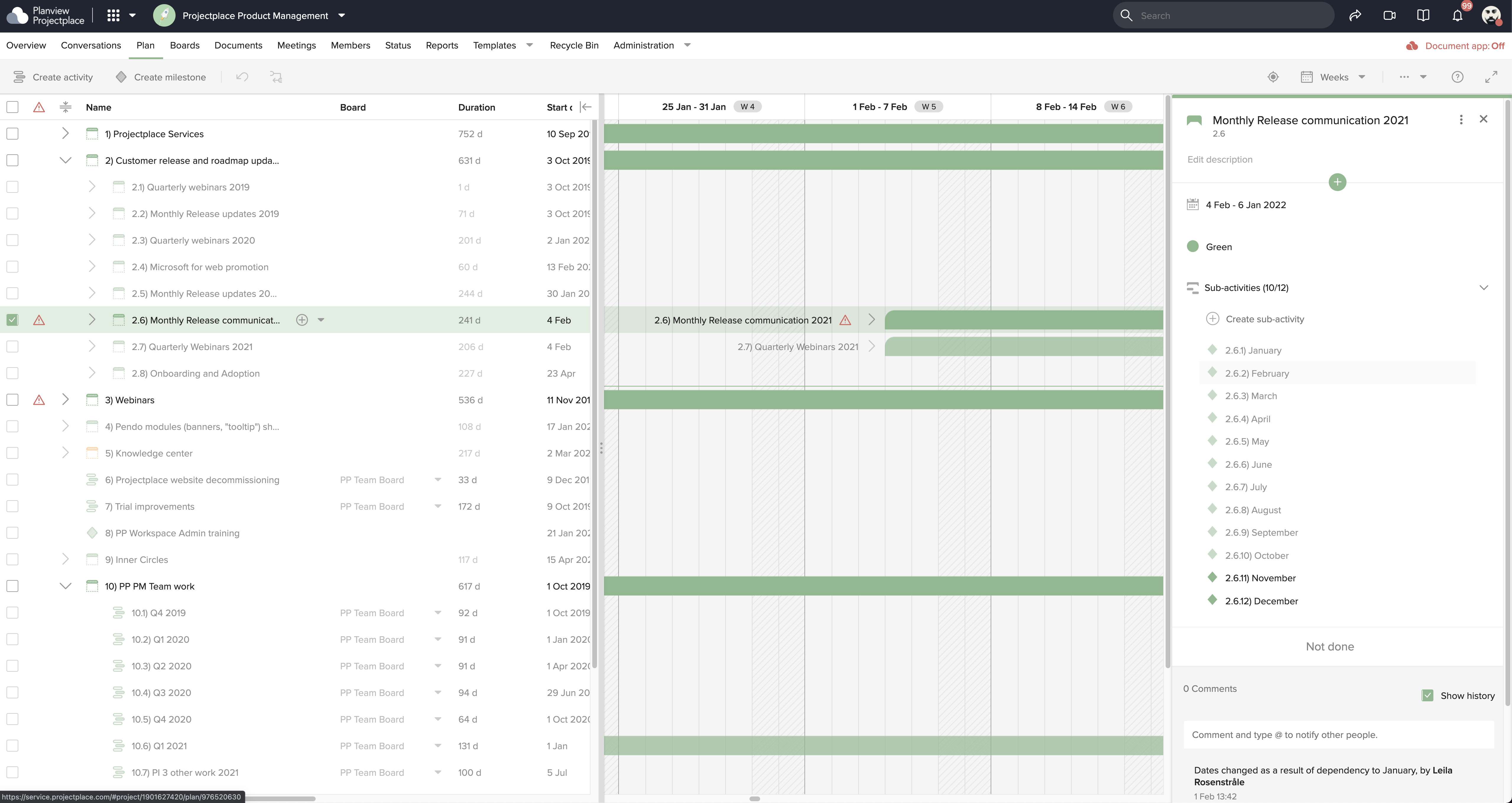
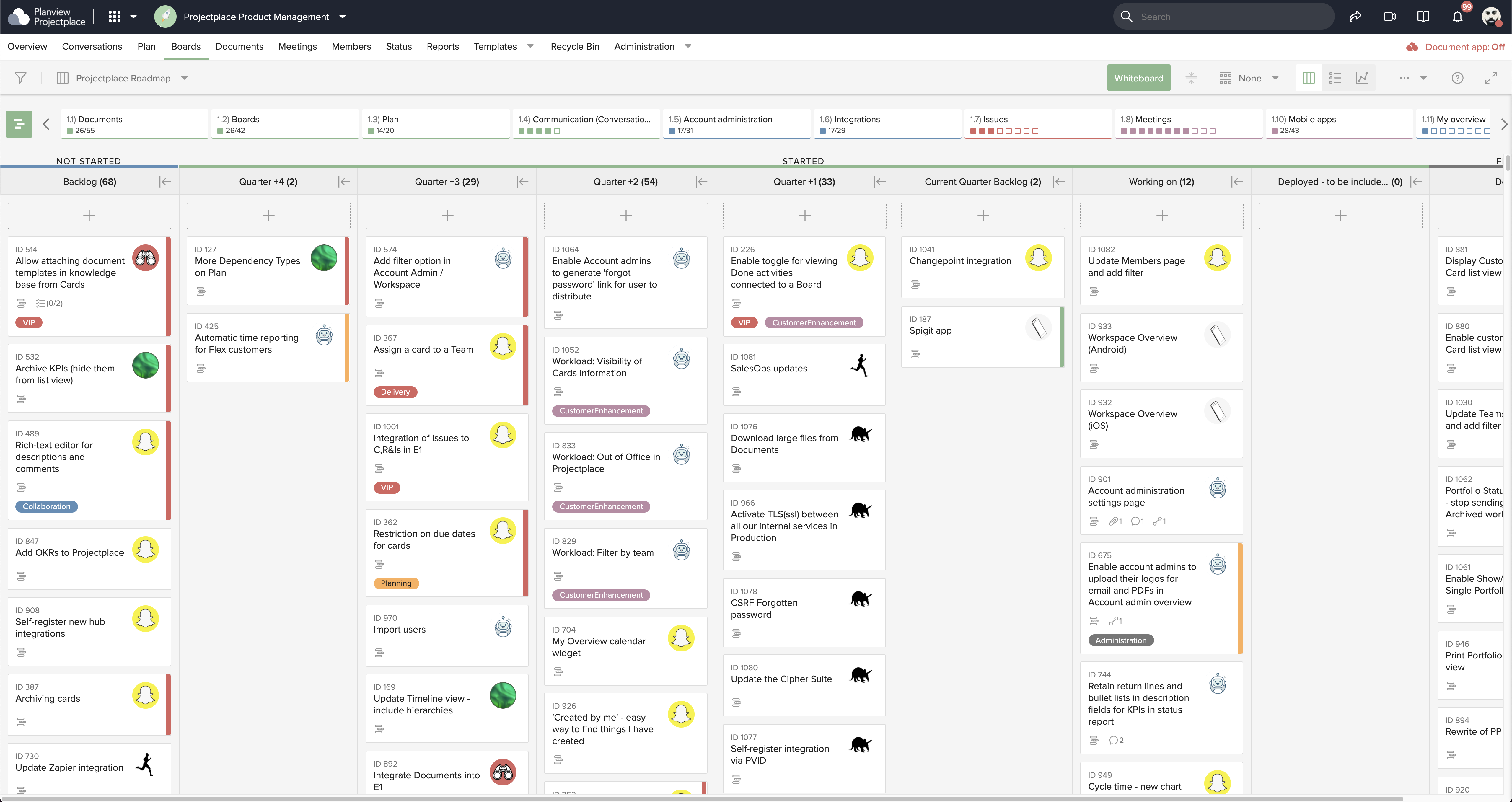
Projectplace is a collaborative work management solution. The vendor says the product is built with teams of all sizes and complexity in mind, from virtual teams of five to entire global enterprises with tens of thousands of active users. It is also designed to incorporate waterfall and agile workflows.
Our organization chose MS Planner because it is an included tool in the MS Suite, and since we are unfortunately replacing our current and much better project management tool due to a consolidation of the tech stack. However, it doesn't appear that any of the teams using the …
In my experience, Microsoft Planner has much less features and less effective than other project management tools. But, it's free and included as part of Microsoft 365, so senior management may think it's saving them money. However, the poor productivity and the inefficient …
The Planner has a more straightforward and intuitive interface, making it ideal for teams that want to get started quickly without a steep learning curve. Additionally, Planner is more budget-friendly, making it a better option for smaller teams like mine. Additionally, …
Microsoft Planner stands out for its seamless integration with Microsoft 365, making collaboration with tools like Teams, Outlook, and SharePoint effortless. Its user-friendly interface, with drag-and-drop features and color-coded labels, simplifies task management. Microsoft …
Compared to the other options, we already had access to Microsoft Planner, preconfigured accounts, and support and ordination from tech internally to use it. We previously used Wrike, I wanted to use Asana, and other people in the organisation either used Microsoft Project, or …
Microsoft Planner was included in our package of Microsoft email. Thus, we [don't] have to pay anything separately. This is was the main reason. However, the functionality we required was similar. [Microsoft] Planner also gives a schedule calendar where we can add tasks as per …
While Asana and Trello are mature products, Planner is getting there pretty quickly. Since our organization is on the Microsoft ecosystem, it helps to use SSO for most of the apps that are within the same license. It helps save money and does the work. For proper project …
Microsoft Planner won out over Todoist due to it's ability to integrate other software and allow us to be able to do more work in one software. The project management functions were superior as well. Probably the biggest advantage was the task management. We liked how it worked …
Have moved to JIRA in my recent project. I can say Microsoft plan is a good option but JIRA is more powerful compare to this tool. The only thing is its integration and easy communication feature between teams or assigned groups stand it out while comparing with the similar …
Microsoft Planner has a clear cut edge over all the other project planning software of having its native and extensive capability of integrating with the Office 365 apps which everyone uses heavily. Also, it is highly accessible and usable to a large extent through PDAs and …
Planner provides better integration with Microsoft products that are used across the organization as a whole. It provides better connection to SharePoint, MS Teams, MS Office products, and even in MS Outlook, which is the company's email client.
Many areas of the company still use Trello to organize their activities and tasks, but gradually Microsoft Planner must replace the activities. Users are often "attached" to familiar technologies, but Office 365 takes advantage of the more organized use of the tools. This year …
I would recommend Planner for light project / team management with strong MS Teams integration. For a PMO / large project with resources/cost/gantt management, I would really recommend MS Project.
Planner, tho its user interface could be improved, was leaps and bounds better than TYA suite. Their user interface is difficult for many at our job site to use, especially the older generation. The decision to bring it in was largely a corporate decision. Individuals likely …
Trello is better as a one off product, but if you use the Microsoft suite then Planner integrates better into the rest of your day-to-day apps. The integration into team members' calendars and mail makes the ease of assigning tasks across our organization well worth using the …
Microsoft Planner is far superior and doesn't require expensive training to give people access to it. It is far easier to customize and allows for people to add projects and milestones without the cumbersome interface that Agility offers. I would far rather use Microsoft …
We tried to select software from various tools, and in the end we chose Planner both for economic reasons (it is included in the Microsoft 365 license we have in the company) and for its ease of use (we have no particular or specific needs, such as advanced scheduling or ticket …
Main reason is that it is cost efficient because we're already using Microsoft 365 and it's literally part of the ecosystem. No need to purchase any other software. Microsoft is also a well known company, credible for providing business solutions and has a strong enterprise …
Planner is free and integrated with other Microsoft products that we use. We don't have a need for something more sophisticated given the price it would have cost to purchase licenses for a dedicated task/project mgmt tool.
Though Monday.com is a great tool, but Planview ProjectPlace beats it by a fraction when it comes to ease of use and navigations. On top of that, ability to connect Projects in Planview ProjectPlace to Planview Portfolios open up whole new horizons for the Projects, like …
Notion is an open book that allows you to create whatever you want... nice but having some bumpers makes creating and implementing a solution a bit easier. ProjectPlace is simple to get started and use. You might miss out on a cool feature or two, but I think the lack of a …
Both Planview Project Place and Planview PPM Pro have their own strengths. We use both; PPMPro is our portfolio tool, while Project Place is a project delivery application.
Planview ProjectPlace has worked globally for our Company. We are many teams across the globe. Utilizing Project Place keeps everyone on task no matter where they are in the world. We selected ProjectPlace because of it's ease of use and functionality. To be able to see in …
It offers a simpler alternative that's easier to manage by the less tech-savvy people. I also think that Planview Projectplace has managed to keep the product updated compared to other project management tools. Miro is perhaps the one that comes to mind, but while evaluating, …
I like both Trello and Planview Projectplace. I think that Planview Projectplace lends itself to being used for larger companies and more in-depth tasks. I like Trello more really because of its ease of use and user interface.
Projectplace has many similar features in terms of conversations, document storage, and timesheet tracking. However, I think where it offers improved performance is in use of Kanban boards to promote more agile project environments over a waterfall type environment. I also …
Most of these others don't have many of the features that are available in Planview Projectplace. The agile methodology is in a true sense covered by Planview Projectplace, not by Asana nor Wrike. In confluence, one has to link up with Jira for full functionality, but in …
Microsoft Planner is a user-friendly visual tool for organizing tasks and workflows. It’s great for team collaboration, integrates seamlessly with Microsoft 365 tools like Teams and Outlook, and offers flexibility for projects of all sizes. Additionally, it provides mobile and web access for seamless productivity on the go. That’s a big plus right there.
Planview ProjectPlace is a vibrant platform that manages all activities and schedules different roles based on their urgency, importance, and requests. Further, Planview ProjectPlace outlines the need for proper documentation with the aim of accurate referencing. Tasks are credibly shared, and proper reporting is enhanced to transform firms' work environment. ; Lastly, Planview ProjectPlace brings sustainable email integration for enterprises.
Under the time tracking, it would be nice to have a set template that would load each week and not have to click a button to load the previous week's template.
Somehow making it more intuitive.
Having to add in each service line and each detail that I cover for every service line each week is a bit ridiculous.
It is a very useful tool that brings teams in sync with one another. The integration with other Microsoft products makes it an obvious choice because you don't have to purchase a license for a completely different tool that doesn't have cross-functional capabilities with the software you already use on a daily basis.
I have loved using Projectplace the last few years, however with recent budget issues, we likely need to cut costs in this area, and Projectplace is on the higher price point for project management platforms. There are also a lot of features in Projectplace that our team doesn't utilize/doesn't apply to our workflow needs.
The tool is easy to use, but it is just as easy to set up. No specific skills are required, but its usefulness in our work is immediately apparent. Colors are very helpful in creating a clear interface and providing a very precise overview of the tasks to be performed.
Easy to use platform and provides the user with an amazing experience and straightforward tools that empower and help execute tasks with fast performances that allow quick and easy service delivery. Easy on implementation and get started immediately with enterprise-ready Planview Projectplace and start to connect with teams and departments at once.
I do not think Planview Projectplace is as polished and refined as other project management tools, nor is it as simple and easy to use as other free tools. Integration with the tools we required was difficult to impossible with our staff and toolset. The overall design seemed dated, and we preferred the look and feel of Jira.
Our organization chose MS Planner because it is an included tool in the MS Suite, and since we are unfortunately replacing our current and much better project management tool due to a consolidation of the tech stack. However, it doesn't appear that any of the teams using the current program intend to use MS Planner due to its poor functionality. We will likely be pivoting to Jira instead.
It offers a simpler alternative that's easier to manage by the less tech-savvy people. I also think that Planview Projectplace has managed to keep the product updated compared to other project management tools. Miro is perhaps the one that comes to mind, but while evaluating, we saw fewer issues with Planview Projectplace. Overall, the decision came down to the project manager, that had previous experience and recommended the product. For me, using a product from a smaller company is better because I know that there will be a focus on improving it, unlike, for example, Microsoft products that can be discontinued at any moment.
Saved over $1000 each year by not having to purchase a third party tool for our content planning
Not sure that I can provide a hard number to this, but having the oversight to see when something is coming due and making sure everything gets executed in time
[We have the] ability to support remote work through projects that scale across multiple groups
We have large-scale quarterly projects, so the ability to save and duplicate project templates are helpful for us to keep track of tasks down to the specific card