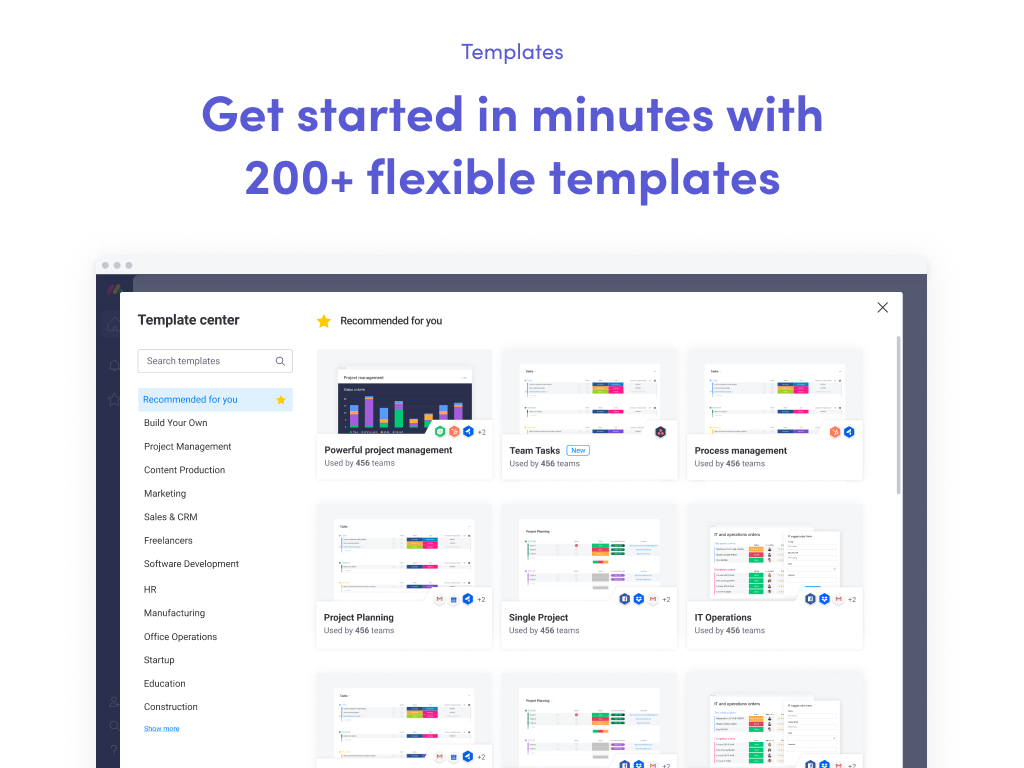
monday.com Work OS is an open platform designed so that anyone can create the tools they need to run all aspects of their work. It includes ready-made templates or the ability to customize any work solution ranging from sales pipelines to marketing campaigns, CRMs, and project tracking.
$12
per month per user
Yardi Voyager
Score 7.9 out of 10
N/A
Yardi Voyager provides residential and commercial property management software. Capabilities include integrated accounting, lease renewal workflow, and modules for multi-family, senior, and affordable housing, as well as retail, office and industrial units.
The company was founded in 1984 and has 4,000 employees and 35 offices around the world.
N/A
Pricing
monday.com
Yardi Voyager
Editions & Modules
Basic
$12
per month per user
Standard
$14
per month per user
Pro
$24
per month per user
Enterprise
Contact Sales
Contact us
No answers on this topic
Offerings
Pricing Offerings
monday.com
Yardi Voyager
Free Trial
Yes
No
Free/Freemium Version
Yes
No
Premium Consulting/Integration Services
No
No
Entry-level Setup Fee
No setup fee
No setup fee
Additional Details
Yearly plan: Save 18%
Monthly plan also available
—
More Pricing Information
Community Pulse
monday.com
Yardi Voyager
Features
monday.com
Yardi Voyager
Project Management
Comparison of Project Management features of Product A and Product B
monday.com
8.9
Ratings
15% above category average
Yardi Voyager
-
Ratings
Task Management
9.50 Ratings
00 Ratings
Resource Management
9.30 Ratings
00 Ratings
Gantt Charts
8.40 Ratings
00 Ratings
Scheduling
8.60 Ratings
00 Ratings
Workflow Automation
9.60 Ratings
00 Ratings
Team Collaboration
9.40 Ratings
00 Ratings
Support for Agile Methodology
8.80 Ratings
00 Ratings
Support for Waterfall Methodology
7.00 Ratings
00 Ratings
Document Management
8.50 Ratings
00 Ratings
Email integration
9.40 Ratings
00 Ratings
Mobile Access
8.60 Ratings
00 Ratings
Timesheet Tracking
9.10 Ratings
00 Ratings
Change request and Case Management
9.60 Ratings
00 Ratings
Budget and Expense Management
9.20 Ratings
00 Ratings
Professional Services Automation
Comparison of Professional Services Automation features of Product A and Product B
Here, I will suggest that it is best to create employees, clients, or project reports. Easy to track with the dashboards. I did many integrations and developments. I can not list each of them here. I will say the best tool for management. I couldn't see criteria of unsuitable. But yes It will depend on the client's requirements. I will suggest it as very user-friendly tool for CEOs, CTOs, Managers, and company owners also for team.
I think it really depends on what you're looking to get out of the system. In terms of managing, updating, creating, and following prospect records, Yardi Voyager is absolutely fantastic. There are a number of existing API integrations already on the market that can connect into the record, and I commissioned a custom one to be built to work with the website that seems on the whole to work fairly flawlessly, so long as your community codes aren't regularly changing. That said, you definitely need to do strong onboarding with anyone coming into the system, particularly if they have limited former CRM experience. There's a great opportunity to input (and aggregate reports) from multiple facets of the system, but if people are inputting poor data, or missing it entirely, or you haven't formalized an even plan for things like Source and Sub Source then even the best system is likely to end up disappointing you and your stockholders when it comes time to analyze data. But, when used properly I'm impressed with how robust it is.
Ensuring I have set up a Private board vs public board is not clear - it would be useful to have an additional alert when creating a board as I work with sensitive information. It will eventually be used in a team based environment but while I test the boards, they needs to be private.
Time tracking is clumsy, could be easier to record
Upon disposition the retrieval of all on line documents by unit instead of tcode.
Menus are all over the place and need to be standardized.
Ease of finding reports, seems like if you are looking for a recurring pmt report typing recurring payment would get you the result, but instead it is a payment manager analytics report.
Teams involved in content creation, such as marketing or editorial teams, could use monday.com to manage the entire content lifecycle. Boards might track content ideas, assignments, drafts, reviews, approvals, and publication schedules, helping teams collaborate and keep content production on track.
We have invested 5 years of setup, implementation and training on Voyager. It's doing a very good job for us and I feel we've only scratched the surface of its capabilities. Yardi support has been very responsive with very little down time. The training materials are great from Client Central
It's straightforward to use and simple to understand. They have tutorials on different elements of the system that you can learn. The workflow there is very intuitive, drag and drop, which doesn't require a learning curve for most people. Templates that also make things more accessible can be found.
I'm coming from the perspective of a fairly tech-adept person, so I didn't find the system too hard to learn. That said, I do feel some of the buried menus and the system's own internal search feature could use some improvement, but I have that feeling about the vast majority of CRMs I've ever used. There may be a little bit of a struggle to onboard/train up someone who isn't used to this sort of system, but once up and going it should be smooth sailing.
Everything performs fairly well. Every now and then there are user errors where an employee will not click "ok" on a note they've created and simply exit out (I do wish that something was in place to prevent this, such as a pop "are you finished?")
monday.com only really care about accounts that have 20 seats or more. While this is great for monday.com, it pushes smaller organisations to evaluate alternatives. We rate monday.com highly in our organisation because key staff have already got good experience with the application and we know we will get to 20+ seats one day. But, till then the billing model and lack of permanent enterprise features is a dread.
The local office is very knowledgeable, however recently it seems that Yardi has begun to route calls offshore and the knowledge base there does not seem to be as strong as the USA based support centers. All customizations are done by offshore personnel, which presents issues in terms of the language barrier and time zone differences.
To have someone walk you thru the features and capabilities of Monday.com is priceless. Someone also coming along later in the contract to see if you are maximizing the program to suit your company needs is beyond helpful. The staff that have provided this training are fun, creative and very patient.
We signed up for the accounts. Created the accounts. Ran the trial version and tested it live while we were running multiple projects and found that it was fitting our needs perfectly. When the trial ended and we were asked to purchase the full version, we did. We have found other ways to use it and it's a breeze.
If you are converting from another system, grouping your properties by subsidy type seemed to help us. We were able to focus on a half dozen properties at a time, rather than the entire portfolio.
We decided to go with monday.com because they offered a free tier for nonprofits and because they are easier to use and offered additional features that we could not find on the other choices. Hands down, there was no better choice for us than monday.com.
Yardi is more user-friendly, dynamic, and comprehensive than other similar products in the real estate space. While there is some ramp-up time to learn the system, Yardi is pretty intuitive and literal, which removes much of the confusion that other systems offer. Voyager also allows us to integrate better with outside vendors, as it is one of the most common ERP systems on the market.
For it to work across multiple departments and sites, I would like to see improvements made with integrations and automation. For this question, I am acknowledging not only the addition of internal triggers/automation, but also an expansion on external ones.
By using monday.com as an enablement tool for templated onboarding plans, we have been able to begin calculating the number of manager hours saved through our work (not defined yet).
monday.com's reporting tools also allow us to more easily report on the productivity and output of our team since we keep up with all projects and subitems in monday.com.
Yardi saves much time whenever my company is involved in consulting a property manager or an asset manager on their real estate asset. Because we can look at their Yardi financials, it's easy to tell where cash is being spent.
Yardi has a positive ROI by making us able to answer these questions quickly, and thus keep clients happy.