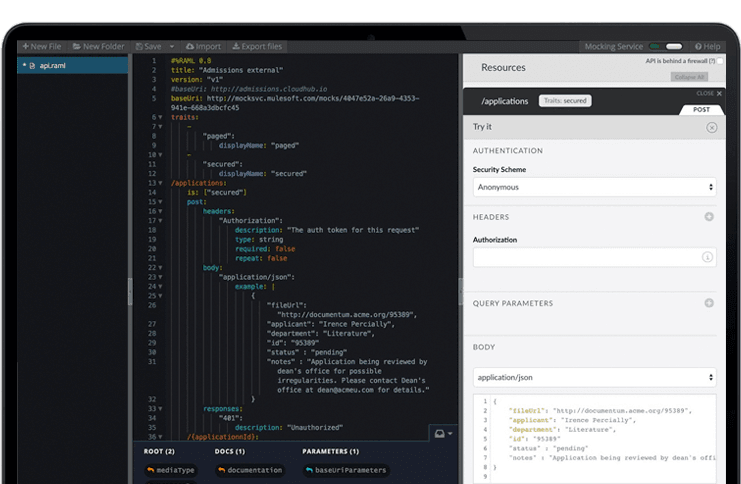
The Anypoint Platform developed by MuleSoft and acquired by Salesforce in early 2018 is designed to
connect apps, data, and devices anywhere, on-premises or in the cloud. This platform was built to
offer out-of-the-box connectors as well as tools that architects and developers can adopt quickly to
design, build and manage the entire lifecycle of their APIs, applications, and products.
N/A
RabbitMQ
Score 7.7 out of 10
N/A
RabbitMQ, an open source message broker, is part of Pivotal Software, a VMware company acquired in 2019, and supports message queue, multiple messaging protocols, and more.
RabbitMQ is available open source, however VMware also offers a range of commercial services for RabbitMQ; these are available as part of the Pivotal App Suite.
N/A
Pricing
MuleSoft Anypoint Platform
RabbitMQ
Editions & Modules
No answers on this topic
No answers on this topic
Offerings
Pricing Offerings
Anypoint Platform
RabbitMQ
Free Trial
Yes
No
Free/Freemium Version
Yes
No
Premium Consulting/Integration Services
No
No
Entry-level Setup Fee
No setup fee
No setup fee
Additional Details
—
—
More Pricing Information
Community Pulse
MuleSoft Anypoint Platform
RabbitMQ
Features
MuleSoft Anypoint Platform
RabbitMQ
Cloud Data Integration
Comparison of Cloud Data Integration features of Product A and Product B
MuleSoft Anypoint Platform is best tool in the market for developing APIs with complex structures communicating with various different types of applications including web applications as well as legacy applications. Also applications including database connectivity for fetching and updating data in the DB tables. I cant think of any scenario which MuleSoft Anypoint Platform could not be used for developing the integrations.
If you are looking for a message broker, RabbitMQ is pretty good. Its API lets you create tons of queues on demand and publish to all of them at once, while you can have 10+ consumers on each queue. It also does a good job of absorbing bursts of traffic. We've seen our queues get backed up to 3 million messages with no problem. In the modern era of GDPR, you may run into problems with keeping messages encrypted out of the box in-flight and at-rest with RabbitMQ. Not saying it's impossible, but it's tough to set up and you have to pay a high overload.
Provides wide range of popular connectors like salesforce, netsuite, sftp and many more. A user can easily integrate with those services using specific connector.
Support API development using RAML and desing tool. The platform is very good in data type classification.
Cloud deployment and post deployment monitoring is easy. A user can configure application worker as per need. Alert and notifications are real time.
What RabbitMQ does well is what it's advertised to do. It is good at providing lots of high volume, high availability queue. We've seen it handle upwards of 10 million messages in its queues, spread out over 200 queues before its publish/consume rates dipped. So yeah, it can definitely handle a lot of messages and a lot of queues. Depending on the size of the machine RabbitMQ is running on, I'm sure it can handle more.
Decent number of plugins! Want a plugin that gives you an interface to view all the queues and see their publish/consume rates? Yes, there's one for that. Want a plugin to "shovel" messages from one queue to another in an emergency? Check. Want a plugin that does extra logging for all the messages received? Got you covered!
Lots of configuration possibilities. We've tuned over 100 settings over the past year to get the performance and reliability just right. This could be a downside though--it's pretty confusing and some settings were hard to understand.
Has more features than what we really need so we're paying for more than we use. Sort of like paying for an Abrams tank when all we really need is a Toyota Corolla.
Not a value product, tends to be expensive.
Takes a while for developers to learn to use Mulesoft Anypoint.
It breaks communication if we don't acknowledge early. In some cases our work items are time consuming that will take a time and in that scenario we are getting errors that RabbitMQ broke the channel. It will be good if RabbitMQ provides two acknowledgements, one is for that it has been received at client side and second ack is client is completed the processing part.
MuleSoft Anypoint Platform is really very easy to adopt for application integration. Simple UI and easy data weave language allows user to focus on business portion only. The API management and deployment of application are hassle free.
RabbitMQ is very usable if you are a programmer or DevOps engineer. You can setup and configure a messaging system without any programmatic knowledge either through an admin console plugin or through a command-line interface. It's very easy to spin up additional consumers when volume is heavy and it's very easy to manage those consumers either through automated scripting or through their admin console. Because it's language agnostic it integrates with any system supporting AMQP.
Anypoint Platform support is very responsive. There is also a huge knowledge base and an active online forum where answers to most questions can be found. When needed support engages the engineering group so adequate solutions or workarounds are always provided.
I gave it a 10 but we do not have a support contract with any company for RabbitMQ so there is no official support in that regard. However, there is a community and questions asked on StackOverflow or any other major question and answer site will usually get a response.
Once we have moved all of our system integration APIs to the MuleSoft Anypoint Platform, we will need to communicate with a wide variety of external systems. All of our business and service logic is stored in the aforementioned core systems. Anypoint Platform (and all of our APIs) makes it easy to connect to various other platforms. In order to link to these many other systems, connectors and/or components are utilized, and they are simple to configure and integrate.
It is very easy to use as it has a simple function to connect and use RabbitMQ. It is having Fast Learning curve, Any newbies can learn it in a week or month. It is having proper documentation, we are able to find all the details about its functionality and usage of it. The Features of RabbitMQ are providing are matching with our business requirements.
Earlier we had a problem with missing work items with our own implementation but later using RabbitMQ is solved a problem. Now our job processing mechanism is highly reliable.
We also had a problem with scaling, processing 1k work items per second. RabbitMQ helped us to scale well with increasing work items.