Whether launching a first test or scaling a sophisticated experimentation program, Optimizely Web Experimentation aims to deliver the insights needed to craft high-performing digital experiences that drive engagement, increase conversions, and accelerate growth.
N/A
Oracle Marketing
Score 7.1 out of 10
N/A
Oracle CX Marketing (formerly Oracle Marketing Cloud) is a solution designed to enable marketers to plan and execute automated marketing campaigns via email, display search, video advertising, and mobile while delivering a personalized customer experience for their prospects.
N/A
Pricing
Optimizely Web Experimentation
Oracle Marketing
Editions & Modules
No answers on this topic
No answers on this topic
Offerings
Pricing Offerings
Optimizely Web Experimentation
Oracle Marketing
Free Trial
Yes
No
Free/Freemium Version
No
No
Premium Consulting/Integration Services
No
No
Entry-level Setup Fee
Optional
Optional
Additional Details
—
CX Marketing pricing is a function of usage.
More Pricing Information
Community Pulse
Optimizely Web Experimentation
Oracle Marketing
Considered Both Products
Optimizely Web Experimentation
Verified User
Anonymous
Chose Optimizely Web Experimentation
The ability to do A/B testing in Optimizely along with the associated statistical modelling and audience segmentation means it is a much better solution than using something like Google Analytics were a lot more effort is required to identify and isolate the specific data you …
I do not have any issues with AB Tasty. They are great. We went with Optimizely because they have several other products that will work together with our business model. Optimizely has grown and it now offers many other products that work with experimentation like CMS, CMP, ODP …
Optimizely is highly intuitive, allowing marketers or non-technical folks to run experiments without complicated coding. It also allows for various types of experimentation, including A/B tests, multivariate tests, and personalization. This capability will enable teams to run …
None of them have a best in class stats engine and live within an ecosystem of marketing technology products the way that Optimizely does, so the scalability of using any one of those tools is limited as compared to using Optimizely Web Experimentation.
It's a lot more, well, site stacked, it's way better than that. Adobe Target. I think the UI is easier to use on Optimizely. The one thing that I would say comparatively is our analytics talking to each other. Obviously Adobe, we use Adobe Analytics and Adobe Target, so they …
Optimizely is more user-friendly and cost-effective, ideal for experimentation-focused teams, while Adobe Target excels in advanced personalization and seamless integration within the Adobe ecosystem, making it better suited for large enterprises.
Optimizely Web Experimentation was more robust and able to handle the broad array of sites we run than VWO. It has been a great platform to easily add additional sites onto, but still providing a universal overview of all of them, making management a simple task.
we used Optimizely Web Experimentation then AB Tasty but came back to Optimizley because of its robust stat sig and features as well as all of the products we will be able to work in synchronization.
I think that Optimizely Web Experimentation is much easier to implement and use, but the entire Adobe Experience Cloud provides a ton of value if you have multiple products.
Honestly, Optimizely Web Experimentation has its pros and cons just like any other tool. We use Optimizely because we have resources here in the country that can help us when e have issues. The support team being local helps a lot so we don't have long wait times to get things …
Eloqua is better than Iterable in many aspects as it has lots of features which Iterable is nowhere even near too. Iterable is just a email marketing platform however Elqoua is a complete marketing automation platform.
There might be some good marketing automation tools in the
market but this one is our very initial experience and so far one of our
wonderful experiences that we don’t look forward to switching to any other one.
It was quite complex to generate segments with Adobe
analytics and I wasn’t personally satisfied with the overall performance of
Adobe Analytics and wasn’t enough flexible in any way. So we decided to switch
There are not a lot of other options out there that are as robust as Oracle CX Marketing. Typically we would have to use at least several companies' software to be able to have similar functionality.
Oracle CX Marketing is strong within the Oracle ecosystem. The company used Eloqua as it had a strong product roadmap in terms of features for the marketing team to leverage day-to-day. The CDP platform that is offered by Eloqua sets it apart from the competition as it really …
The Oracle CX Marketing tool has a few advantages over our previously used solutions. One of the most impactful ones would be the easy-to-use interface - more evidently seen when developing Email Marketing (Emailers) and also when creating steps for Marketing Automation …
I feel they both have strengths and weaknesses, just like any other product on the market. Oracle is strong in the lead scoring and nurturing platform while HubSpot is strong in other ways. Oracle integrates better with CRM software because it plays with most which makes it …
Oracle CX Marketing (formerly Oracle Marketing Cloud)'s Eloqua stacks up fairly well with these other tools, as they all have similar functions and features. Pricing and how seamlessly the platform integrates with a company's CRM are the main deciding factors. The customer …
We ultimately selected the Oracle product due to its native web capabilities which, at the time, were not offered by Adobe, which required the download and installation of a desktop application for users to be able to leverage the full capabilities of their solution. We …
We were using Marketo before I became a marketing automation admin. So I am only able to evaluate my experiences with Oracle against my own perceptions of how a marketing automation platform should function.
Oracle Eloqua and HubSpot have their fair share of strengths and weaknesses. HubSpot is cheaper, offers a less harsh contract, updates its documentation on a monthly basis, and implementation time is short. However, HubSpot does not support A/B testing in their Pro tier, and …
Oracle Eloqua had a more robust feature set. It had all the functions and features we needed to scale and was able to support our high lead volume and processing.
Oracle Eloqua is more user-friendly, and the features are more suited for us as the integration points are richer. We also found Marketo too expensive compared with Eloqua. Marketo's training was not as good as Oracle Eloqua training either. Oracle Eloqua also provides the …
I believe Eloqua stands out because it's a progressive roadmap of development and enhancements that keep up with the industry and trends. The ability to find help and support is great compared to other organizations that I've experienced.
I was able to play around with ChatBot a couple of years ago at OpenWorld and liked the product very much but it just was not a good fit for our department's needs at the time.
Oracle Responsys is cost effective compared to Adobe Campaign. Java and SQL integration is also very efficient compared to Adobe products and that is the reason we are using Oracle Responsys.
I think it can serve the whole spectrum of experiences from people who are just getting used to web experimentation. It's really easy to pick up and use. If you're more experienced then it works well because it just gets out of the way and lets you really focus on the experimentation side of things. So yeah, strongly recommend. I think it is well suited both to small businesses and large enterprises as well. I think it's got a really low barrier to entry. It's very easy to integrate on your website and get results quickly. Likewise, if you are a big business, it's incrementally adoptable, so you can start out with one component of optimizing and you can build there and start to build in things like data CMS to augment experimentation as well. So it's got a really strong a pathway to grow your MarTech platform if you're a small company or a big company.
A duration of one and a half years is enough for us to recognize the capabilities of a tool and in my opinion, this one is just a great tool to manage marketing campaigns of even massive-sized firms. Its marketing automation tool and its way of managing campaign and the way it executes digital initiatives is enough to get an inkling of its abilities. Less favorable for the people who want to have something at a cheap price and are more dependent on the reports as its reports have nothing much in detail.
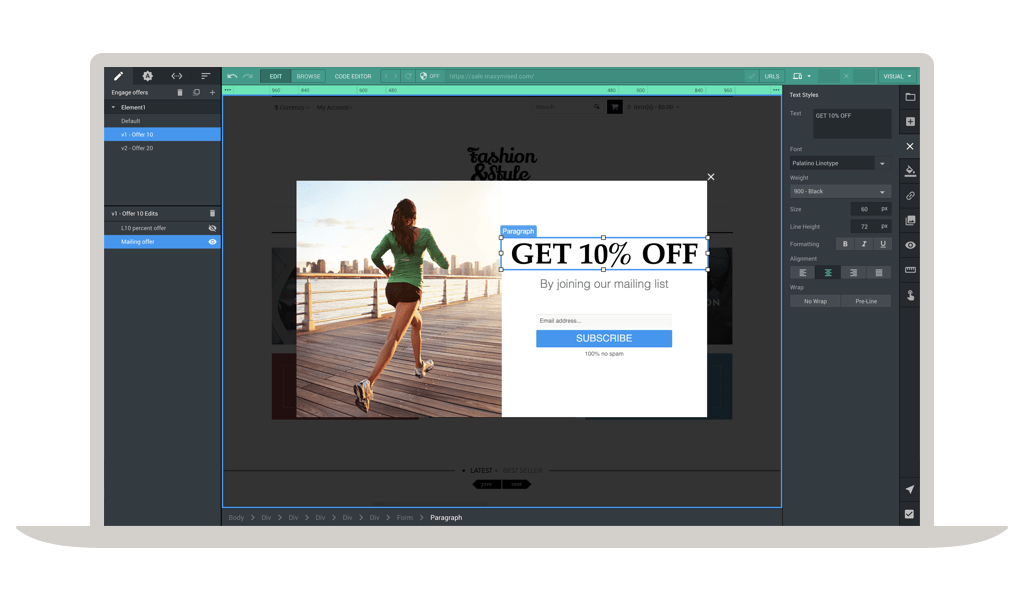
The Platform contains drag-and-drop editor options for creating variations, which ease the A/B tests process, as it does not require any coding or development resources.
Establishing it is so simple that even a non-technical person can do it perfectly.
It provides real-time results and analytics with robust dashboard access through which you can quickly analyze how different variations perform. With this, your team can easily make data-driven decisions Fastly.
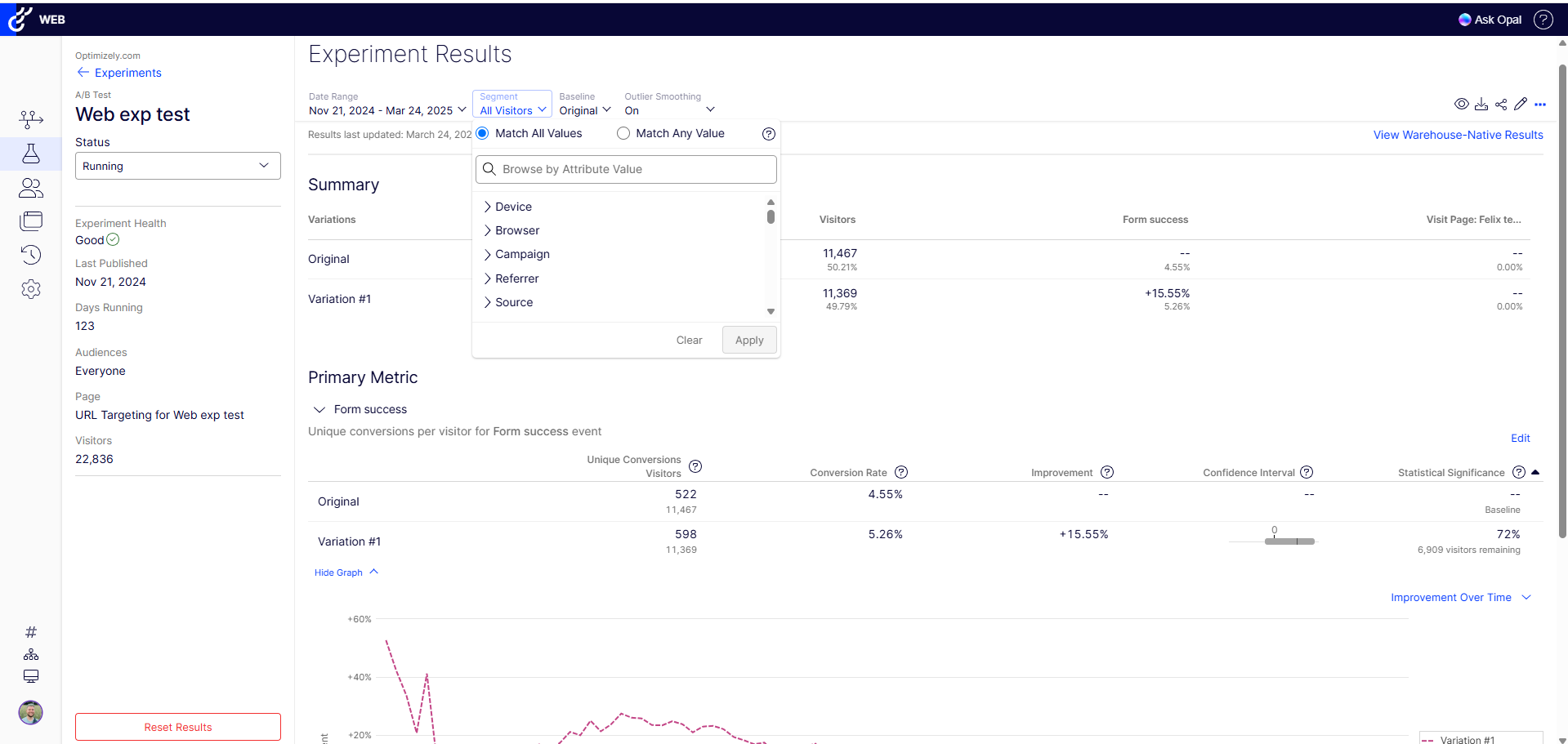
The results view is dense and difficult to package easily for leadership, and when filtering by segment it's hard to read comparative outcomes without clearing or swapping filters
The organization of experiments and statuses is a cluttered list and the search is limited in use - would love to see that improve with time
There are so many other MarTech products out there, would love to see more dedicated integrations so we don't have to invest in something like Zapier or Tray to build hacky automations
User Interface - The UI is a bit outdated and clunky, but gets the job done with some getting used to.
Training - There isn't much out there for training, unless you are willing to pay Oracle or a 3rd party.
Support - There is no dedicated support and you have to use their portal. It sometimes take awhile to get things looked at or fixed, but they eventually get to it.
Because it's an incredible and essential tool for my line of work as a conversion optimization specialist. Really couldn't do my job nearly as effectively without it. It's paid for itself many times over and I feel like I'm only beginning to unlock the tools potential.
We have been able to automate so many marketing processes with Eloqua over the past 5 years that the only direction would be to adopt the latest and greatest features Eloqua adds. The alternative would be to go back to the marketing stone-age and start over again. And we would rather move forward with increased automation and efficiency.
Optimizely Web Experimentation's visual editor is handy for non-technical or quick iterative testing. When it comes to content changes it's as easy as going into wordpress, clicking around, and then seeing your changes live--what you see is what you get. The preview and approval process for sharing built experiments is also handy for sharing experiments across teams for QA purposes or otherwise.
Personally, I find it quite easy to use. But for those members of our team who have little or no testing experience, it's been a bit more difficult. There's also training required for development teams in order to have your campaigns coded and set up in the most efficient way. Our developers have been able to do basic and intermediate tests with no difficulty, and they find the interface itself quite intuitive... it's just the extremely complex tests that require a bit more understanding.
I would rate Optimizely Web Experimentation's availability as a 10 out of 10. The software is reliable and does not experience any application errors or unplanned outages. Additionally, the customer service and technical support teams are always available to help with any issues or questions.
I would rate Optimizely Web Experimentation's performance as a 9 out of 10. Pages load quickly, reports are complete in a reasonable time frame, and the software does not slow down any other software or systems that it integrates with. Additionally, the customer service and technical support teams are always available to help with any issues or questions.
There are occasional complaints about slowness to refresh a screen or build a report. However, this is as much a factor of network access speeds as the system itself, since often the complaints occur when someone is accessing on a wireless network.
They always are quick to respond, and are so friendly and helpful. They always answer the phone right away. And [they are] always willing to not only help you with your problem, but if you need ideas they have suggestions as well.
I would actually rate day to day support a 1. We often knew more than the person on the phone.
I would however rate escalation support a 7. When we went to “red status”, support was very good. We were assigned a technical resource who performed a full audit. Unfortunately the integration to Salesforce.com still failed
They offer very basic classes which are required for master certification.
After having been through it, I would not consider anyone with a master certification any more qualified, unlike Salesforce.com certification which is a more difficult thing to acquire. For example, one of the classes towards certification was around social media. I would have expected examples of how to incorporate into campaigns in the product, with a demo and hands-on test. Instead, it was a powerpoint slideshow that went on way too long and covered really basic stuff like “what is Facebook, what is Twitter”
The tool itself is not very difficult to use so training was not very useful in my opinion. It did not also account for success events more complex than a click (which my company being ecommerce is looking to examine more than a mere click).
Ok, so, this sounds like it could be horrible because it was all remote, but we loved it... the Adobe training environment was easy to use, and the trainers were engaging. It was simple to switch back and forth between the meeting and the hands-on exercises in their training instances. We took the fundamentals training early in our implementation-- before the consultants came onsite-- and I know this made a big difference in our implementation, because we were able to ask informed questions throughout
The implementation through the tag management system took a bit of trial and error at first, mostly due to the asynchronous nature of the TMS. We had to manipulate the implementation to assure that the Optimizely code was written to the page at the right time to allow the experiment content load in the browser without showing any of the original content first. We also needed to make some adjustments to the TMS code to get the integration with Site Catalyst timed appropriately.
I give it a 10 because the only issue we had was a result of not following the guidance we were given. Maxymiser provided a customized implementation guide for each site where we were adding the code. On our site implementations when we followed that guide to the letter, it was extremely fast and easy and has worked very well.
The ability to do A/B testing in Optimizely along with the associated statistical modelling and audience segmentation means it is a much better solution than using something like Google Analytics were a lot more effort is required to identify and isolate the specific data you need to confidently make changes
It was quite complex to generate segments with Adobe analytics and I wasn’t personally satisfied with the overall performance of Adobe Analytics and wasn’t enough flexible in any way. So we decided to switch to something else better than Adobe Analytics and is available in the market at a cheap rate and we ended up doing our research for the most suitable tool at Oracle Infinity and we don’t regret our decision.
It's incredibly flexible and adapts well to organizations of all sizes, whether you’re running a single site or managing multiple departments and platforms. The ability to deploy experiments seamlessly across different environments is a huge plus, especially for growing businesses. While it’s highly scalable, the last point would depend on the right team leveraging its full potential.
Eloqua is definitely good for larger companies that have 100,000+ contacts and complex marketing workflows and data. Personalization is fairly robust with Eloqua for larger campaigns with smart content and features. Scaling across channels is also seamless - as the platform has great options for non-email channels like SMS, Direct Mail, Chat, etc.
Eloqua has had a very positive impact on our ROI and ability to build very complex programs. We have been nomitnated for the past 4 years as a Markie finalist and have won a Markie ourselves.
Eloqua has a great pulse on the marketing trends and future developments to help keep it's software competitive.