Oracle Enterprise Manager vs. IBM Turbonomic

Overview
ProductRatingMost Used ByProduct SummaryStarting Price
Oracle Enterprise Manager
Score 7.4 out of 10
N/A
Oracle’s Enterprise Manager is an on-premises monitoring and management tool. The console is designed primarily to manage other Oracle products, it but can integrate to manage non-Oracle components as well.N/A
IBM Turbonomic
Score 9.3 out of 10
Enterprise companies (1,001+ employees)
IBM Turbonomic is a performance and cost optimization platform for public, private, and hybrid clouds used by cloud, infrastructure operations, and architecture to assure application performance while eliminating inefficiencies by dynamically resourcing applications through automated actions. One of the key features of IBM Turbonomic is its ability to continuously adjust application resources in real time. By monitoring resource utilization and application performance,…N/A
Pricing
Oracle Enterprise ManagerIBM Turbonomic
Editions & Modules
No answers on this topic
IBM® Turbonomic On-Prem
Varies - Request a Quote
per month IBM Turbonomic On-prem optimizes data center resources in real time, ensuring app performance at the lowest cost by aligning infrastructure supply with dynamic application demand.
IBM® Turbonomic Cloud Standard
Varies - Request a Quote
per month For customers with more than USD 1.6 million in annual cloud spend or 50 Managed Virtual Servers (MVS) or greater
IBM® Turbonomic Hybrid Standard
Varies - Request a Quote
per month Advanced hybrid cloud optimization capabilities for customers with 200 managed virtual servers (MVS) or more
Offerings
Pricing Offerings
Oracle Enterprise ManagerIBM Turbonomic
Free Trial
NoYes
Free/Freemium Version
NoNo
Premium Consulting/Integration Services
NoNo
Entry-level Setup FeeNo setup feeOptional
Additional DetailsVolume discounting available.
More Pricing Information
Community Pulse
Oracle Enterprise ManagerIBM Turbonomic
Considered Both Products
Oracle Enterprise Manager
Chose Oracle Enterprise Manager
NA
Cannot Disclose
Chose Oracle Enterprise Manager
Datadog is good at collecting metrics, monitoring, and alerting; whereas, with Oracle Enterprise Manager, in addition to all that, we can manage the infrastructure as well as automate certain fixes.
Chose Oracle Enterprise Manager
Foglight is great, but expensive. It has great monitoring like OEM, but can negatively impact database performance. OEM is better than Foglight because it is a native application from OEM and has features that Foglight doesn't have.
Chose Oracle Enterprise Manager
They don't stack up against each other. They complement each other.
Chose Oracle Enterprise Manager
Oracle Enterprise Manager is better than Toad in that it allows you to do various server configurations that Toad doesn't allow.
Chose Oracle Enterprise Manager
Kibana from Elastic is another monitoring tool that claims to provide very similar information to OEM.
It seems to be an information tool rather than a tool that can actually make changes within a database.
I think Kibana is more robust for hardware versus database software so it …
Chose Oracle Enterprise Manager
Being an Oracle shop using Oracle Database and MySQL, management console from Oracle was a better choice than IBM or Microsoft even though we do use Microsoft Azure and storage/servers from IBM (on-prem).
Chose Oracle Enterprise Manager
Have not used any other products.
Chose Oracle Enterprise Manager
OEM is better at monitoring applications, while SolarWinds is better at monitoring the underlying infrastructure such as networks, switches, and routers.
Chose Oracle Enterprise Manager
I am using Nagios Enterprise monitoring tool also, but as compared to Nagios, Oracle Enterprise Manager is best for our company. Nagios is very weak in some aspects.
Chose Oracle Enterprise Manager
I used many other Oracle products (like Database, Middleware, Identity Management, etc.) but I have yet to review them.
Chose Oracle Enterprise Manager
Have not tried via Oracle Enterprise Manager, but CommVault is used by corporate for all backups of storage. However, it is just using Ansible to kick off RMAN jobs.
Chose Oracle Enterprise Manager
Toad for Oracle is more suited for individual users who have a strong focus on database development, and it is not as comprehensive as Oracle Enterprise Manager. While it is quite decent in logical database layer tasks, such as schema objects and SQL, it lacks visibility into …
Chose Oracle Enterprise Manager
OEM Cloud Control base version is free to use if you have licensed Enterprise Edition of one of the Oracle Product. It's sophisticated single point of control, we have used other monitoring products such as Veeam but none of the products have all the features packed together …
Chose Oracle Enterprise Manager
OEM is better and cheaper at managing Oracle databases.
Chose Oracle Enterprise Manager
Since OEM Cloud Control comes free with Enterprise Edition, we have mostly worked on OEM Cloud Control. I did have my fair share of experience with DBArtisan. It's good and lighter than OEM Cloud Control. It sort of removes your need to even go to SQLPLUS command line most of …
Chose Oracle Enterprise Manager
It is much simpler to install and configure as compared to Spotlight and Solarwinds.
Oracle Enterprise Manager measures performance diagnostics accurately and raises alerts and takes preventive actions. Other products can not take preventive actions even if they raise alerts. It …
Chose Oracle Enterprise Manager
I'm not aware of any OEM alternatives. At least, nothing with the kind of features you find in OEM, and nothing that is free.
Chose Oracle Enterprise Manager
Oracle Enterprise Manager suited our requirement as the clients were using multiple products of Oracle. They were using several instance of oracle implemented at different geographical locations each in Europe, UK, Canada, and USA. So Oracle Enterprise Manager was best fit for …
Chose Oracle Enterprise Manager
We have not used any other products to monitor and/or manage our oracle instances. We have always used Enterprise Manager, although we did use a previous version (11g Grid Control), right around the time I arrived at my position. I upgraded to 12c Cloud Control with the …
Chose Oracle Enterprise Manager
SQL Developer DBA module allows user, space management, SQL Tuning, ad-hoc queries, and schema management. Great free product supported and enhanced from Oracle.
Chose Oracle Enterprise Manager
Oracle Enterprise Manager is easy to install, use and extend the capability of. It supports many Oracle products, which is what it is used for in my company. We selected OEM for its ease of use, intuitiveness and robustness.
IBM Turbonomic
Chose IBM Turbonomic
Resource management with openshift and turbonomic forms an ideal set for observing problems and correctly dimensioning the environment

Chose IBM Turbonomic
Simpler. IBM Turbonomic is more efficient and simpler to use.
Chose IBM Turbonomic
I think IBM Turbonomic is much much better than Datadog. Both in terms of functionality and capabilities. AI driven resource allocation is the standout feature.
Chose IBM Turbonomic
We already had the Turbonomic license acquired.
Chose IBM Turbonomic
IBM Turbonomic supports multi cloud deployments and work well with other IBM cloud/web tools we use within our organization.
While there is an initial learning curve, over long period of time it pays off once the cost benefits are realized from the efficiency gains. Given the …
Chose IBM Turbonomic
I chose IBM Turbonomic because it is a good tool that integrates any CSP and on-premises solutions. It also helps with difficult tasks related to ARM issues.
Chose IBM Turbonomic
We found that that the support we had from IBM and 3rd party vender on IBM Turbonomic was superb , and was one of deciding factors of why we choose IBM Turbonomic. We like a lot of the automation features , and how it helps our engineers work smarter. Even though the VM ware …
Chose IBM Turbonomic
Turbonomic is class apart compared to the others. It helps you achieve what is not possible with the other solutions. Turbonomic can work in an auto-mode and keep delivering savings and business performance. No other product comes even close.
Chose IBM Turbonomic
I selected IBM Turbonomic because it is a comprehensive tool that can help me monitor and optimize the entire IT environment. The choice of IBM Turbonomic is often driven by its extensive feature set, scalability, and delivering tangible results. IBM Turbonomic stands out in …
Chose IBM Turbonomic
As the organization had experience of years in using IBM products, we had the confidence that they will provide us with great support. And we needed a reliable solution as a financial institute to ensure continuous operations. Even though the price was very high, we made the …
Chose IBM Turbonomic
Application awareness is the key success criteria of IBM Turbonomic when the comparison came on the table. To be aware of the application performance and nature when monitoring or analyzing the components and resources of the applications is the key differentiation of the IBM …
Chose IBM Turbonomic
IBM Turbonomic is still trying the pick the pace and against the other products in the market. It is equivalent to SolarWinds, LogicMonitor and some part of AppDynamics but far behind SPLUNK Enterpsie and ServiceNow Now Platform due to the fact that they offer open wide …
Chose IBM Turbonomic
IBM Turbonomic has grown to a respectable level now in the market and after associating with IBM its value has been increased in terms of trust and results. From technical point of view this is a potential solution and provide almost all similar features like its competitors. …
Chose IBM Turbonomic
Turbonomic blew the doors off the competition. When we did a comparison to our current application that was monitoring our environment, Turbonomic surpassed them with flying colors at the start during the POC. Then during the POC white we were kicking the tires around the …
Chose IBM Turbonomic
I like Turbonomic it helps us to ensure our applications get the resources they need to perform. With a complete understanding of the application and infrastructure stack, we are able to automate actions and prevent resource congestion across a hybrid cloud environment.
Chose IBM Turbonomic
Azure AI (Cortana), ADL Data Systems and Databricks Lakehouse Platform (Unified Analytics Platform)
Chose IBM Turbonomic
We tried the vRealize suite but found it complicated and not very intuitive for first-time users. Meaning we could log into Turbonomic and click around to figure out what we needed, whereas vRealize was not as user-friendly in its UI. Ultimately that was why we choose to go …
Chose IBM Turbonomic
We liked Turbonomic as it could work in the container space and the VM space. Other products were too one-dimensional. Additionally, the algorithm in Turbonomic is not typical. Turbonomic does not take the standard data elements and map them to consumption. Their use of a …
Chose IBM Turbonomic
Turbonomic was recommended by one of our vendors to help handle and manage costs. We have not used any other company.
Chose IBM Turbonomic
IBM Cloud Availability Monitoring is a very basic monitoring tool. As the name suggests, it only monitors the availability of your systems. While it is a good tool to get started with, it lacks many advanced features available with other solutions such as New Relic, which you …
Chose IBM Turbonomic
The only comparable alternative has been DRS and sDRS which are native to vCenter. These tools have had to suffice for managing resources and placement. Thusfar, they have been working for us well. Although there is some manual work and reliance on monitoring tools to ensure …
Features
Oracle Enterprise ManagerIBM Turbonomic
Cloud Management
Comparison of Cloud Management features of Product A and Product B
Oracle Enterprise Manager
-
Ratings
IBM Turbonomic
6.8
Ratings
24% below category average
Cloud Management Security00 Ratings6.30 Ratings
Automation and Orchestration00 Ratings6.30 Ratings
Cost Management00 Ratings7.80 Ratings
Cloud Management Performance Monitoring00 Ratings7.20 Ratings
Governance and Compliance00 Ratings6.80 Ratings
Resource Management00 Ratings7.30 Ratings
Systems Integration00 Ratings5.70 Ratings
Best Alternatives
Oracle Enterprise ManagerIBM Turbonomic
Small Businesses
DBeaver
DBeaver
Score 9.2 out of 10
VMware Cloud Director
Score 8.6 out of 10
Medium-sized Companies
DBeaver
DBeaver
Score 9.2 out of 10
Cohesity
Cohesity
Score 9.0 out of 10
Enterprises
DBeaver
DBeaver
Score 9.2 out of 10
vRealize Operations (discontinued)
Score 10.0 out of 10
All AlternativesView all alternativesView all alternatives
User Ratings
Oracle Enterprise ManagerIBM Turbonomic
Likelihood to Recommend
7.7
(0 ratings)
7.8
(0 ratings)
Likelihood to Renew
-
(0 ratings)
9.0
(0 ratings)
Usability
7.3
(0 ratings)
8.0
(0 ratings)
Availability
-
(0 ratings)
10.0
(0 ratings)
Performance
-
(0 ratings)
8.0
(0 ratings)
Support Rating
7.3
(0 ratings)
8.0
(0 ratings)
In-Person Training
-
(0 ratings)
8.2
(0 ratings)
Online Training
-
(0 ratings)
10.0
(0 ratings)
Implementation Rating
-
(0 ratings)
9.7
(0 ratings)
Configurability
-
(0 ratings)
10.0
(0 ratings)
Ease of integration
-
(0 ratings)
8.0
(0 ratings)
Product Scalability
-
(0 ratings)
10.0
(0 ratings)
Vendor post-sale
-
(0 ratings)
10.0
(0 ratings)
Vendor pre-sale
-
(0 ratings)
10.0
(0 ratings)
User Testimonials
Oracle Enterprise ManagerIBM Turbonomic
Likelihood to Recommend
I wish I had an option to give it a 9.5 :) OEM Cloud Control is very well suited if you have a system with multiple implementations of Oracle Database Enterprise Edition. If you are willing to pay for the huge license cost which is typical with Oracle, then you will love to use OEM Cloud Control to monitor your entire ERP solution including web servers, applications, network, storage, and physical servers. It is not worth the buck if your's is a small implementation. Your DBA's should be able to work without depending on OEM Cloud Control.
Read full review
Measure the usage of resources across different platforms, from Kubernetes to VMs on-premises or in the cloud, to obtain current capacity metrics and plan for future scenarios. Reduce IT infrastructure costs by taking automated actions based on resource underutilization, such as shutting down VMs or changing resource definitions.
Read full review
Pros
  • Oracle Enterprise Manager is a "one stop shop" for all of our management needs. This is helpful because it minimizes the management of the management software itself. There are less upgrades and connectivity issues to handle. And there are "plug-ins" for additional products we use like Blue Medora's one for PostgreSQL.
  • Managing administrative jobs can be burdensome in a shop with dozens of servers and databases. OEM Cloud Control makes it easy since you can view all the jobs for all servers in one place. It is easy to filter on jobs with problems or the like so that you can quickly look at the logs and fix the issues.
  • Tuning PL/SQL is much easier using OEM Cloud Control. Most DBAs are familiar with trace files and TKPROF, but not having to do those things at a command line smooths the process out. The graphical interface makes it easier to show developers exactly what the issues are. This makes for less finger-pointing and quicker resolution of performance problems.
  • Proactive management is easier using OEM Cloud Control. Before having the gui, I had a collection of scripts that I would have to install on each database server, then set up cron jobs to run them. When Oracle was upgraded, those scripts might have to be updated on each and every server. OEM Cloud Control has those things built in. You can choose exactly which metrics are important to you. And you can keep performance graphs up all day on a second monitor to let you instantly see when something might cause a problem.
Read full review
  • Presentation is nice. Its easy to understand what your looking at and the data that is being presented to you.
  • Properly identify resource utilization and recommendations for action on how VMs can be improved and resources can be better utilized.
  • It was also able to tell us the same information and analysis for cloud resources. I was not expecting that.
Read full review
Cons
  • We also use OEM to monitor SQL Server. However, OEM only provided limited features for SQL Server. It would be nice if we can schedule backup jobs for SQL Server in OEM.
  • The ability to run SQL queries. You can't run queries in OEM. I have to go to SQL Developer or SQL PLUS to run. queries.
Read full review
  • It would be nice if the UI included a break-down of features that are both licensed as well as un-licensed. That way, you could not only see what you have, but what you don't.
  • The right-sizing recommendations are great, but very little info is given about why the recommendation is being made. More info would not only increase understanding, but would also help drive decision-making.
Read full review
Likelihood to Renew
No answers on this topic
I have not found a better tool for capacity planning my VM environment than Turbonomic. If that is the use case, I would highly recommend. Similarly, if you are looking for automation and VM rightsizing automation I would also highly recommend. For troubleshooting scenarios where deep levels of infrastructure metrics are required, there are better tools available.
Read full review
Usability
It's great! It does everything and anything you would want it to do. It can monitor things which doesn't comes out of the box by adding plug ins to it, for example, you can even monitor Oracle GoldenGate Replication by adding a plug-in to OEM Cloud Control.
Read full review
Excellent approach to larger VM organizational management. They have an very clean integrated dashboard that allows us to see everything in our environment and what that is doing in real-time. It works on multiple hyper-visors really well and integrates capacity planning on my local site as well as my cloud locations.
Read full review
Reliability and Availability
No answers on this topic
VMTurbo has not caused any outages by not doing what we expect it to do.
Read full review
Performance
No answers on this topic
It allocates resources among applications by showing more on the cost breakdown by cloud service, with metrics on cloud provider information like Azure Management, Identity, Networking, Storage with costs per day, and total services costs. This then could facilitate and show the corresponding actions thereafter upon scaling.
Read full review
Support Rating
I still rate OEM as a must-have tool for central management of Oracle fleet. The pros and cons of the product is prominent. Meanwhile, I also acknowledge that OEM was design about a decade ago. At that time, it did not have the landscape we have today, such as cloud, DEVOPS, machine learning, etc. I hope in future releases, the design will incorporate those features.
Read full review
Just this week we had an issue where security permissions we had done wrong were causing problems in VMTurbo Operations Manager. Despite this being our fault the service request was handled very quickly. In addition we are routinely contacted proactively to see if there is anything we need or they could do for us.
Read full review
In-Person Training
No answers on this topic
Alex (from VMTurbo) has worked with the product for years and helped develop the product. He was very knowledgeable and was able to provide our support team with details knowledge on how to get our deployment configured correctly as well as help with another VMTurbo POC within another customers environment.
Read full review
Online Training
No answers on this topic
After buying VMTurbo Operations Manager, I was invited to an online user training event. I felt this training was effective and dug just deep enough to be informative yet still keep my attention. Additionally, the webinar was free.
Read full review
Implementation Rating
No answers on this topic
VMTurbo was easy to setup and implement. Probably helped by the remote telephone support we received. It was a simple process and and fairly painless. More complex configuration was achieved via a webex session and the support was greatly appreciated
Read full review
Alternatives Considered
Kibana from Elastic is another monitoring tool that claims to provide very similar information to OEM. It seems to be an information tool rather than a tool that can actually make changes within a database. I think Kibana is more robust for hardware versus database software so it is more suited to that purpose and does to compare to the Oracle Database monitoring attributes of OEM.
Read full review
As the organization had experience of years in using IBM products, we had the confidence that they will provide us with great support. And we needed a reliable solution as a financial institute to ensure continuous operations. Even though the price was very high, we made the correct decision to go ahead with IBM Turbonomic as the feedback from existing users in the region was very positive. We needed a solution which was capable of handling our automation requirements. All these were green in IBM Turbonomic.
Read full review
Scalability
No answers on this topic
It’s very scalable.
Read full review
Return on Investment
  • Positive: Alerting features. Without this we would have to be a 24x7 shop with someone always manning the helm. With the alerting feature we can define levels of alerts and only get the most pressing alerts sent out.
  • ROI: OEM is free, so the ROI is whatever you make of it.
Read full review
  • Application performance has been a big one. With Turbonomic keeping everything running at top performance, it can make changes when extra resources are need, quicker than somebody being notified and then making the necessary changes.
  • Turbonomic has been a great cost savings for us on multiple occasions. We use it every time we are improving servers.
  • With the planning feature we get the best performance form new hardware purchases
Read full review
ScreenShots

IBM Turbonomic Screenshots

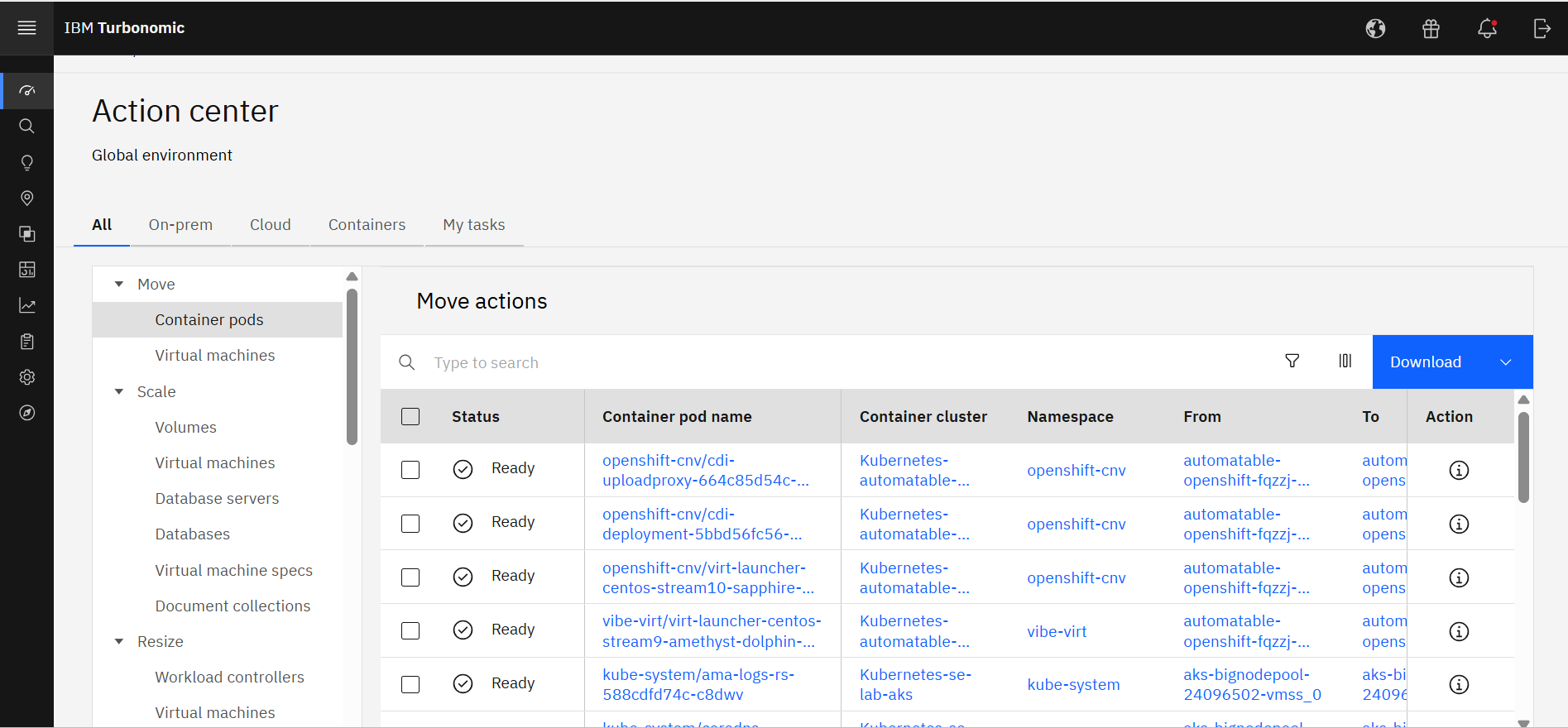
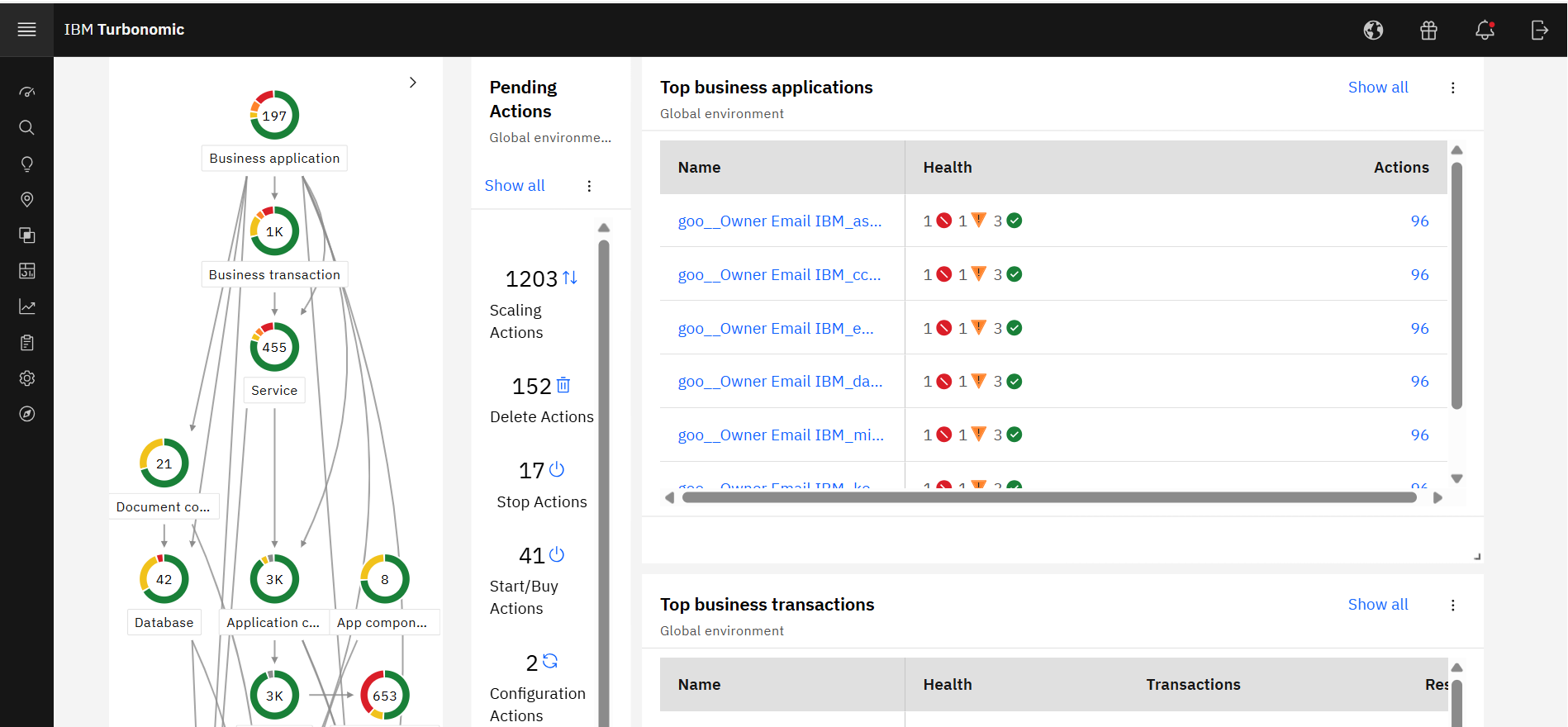
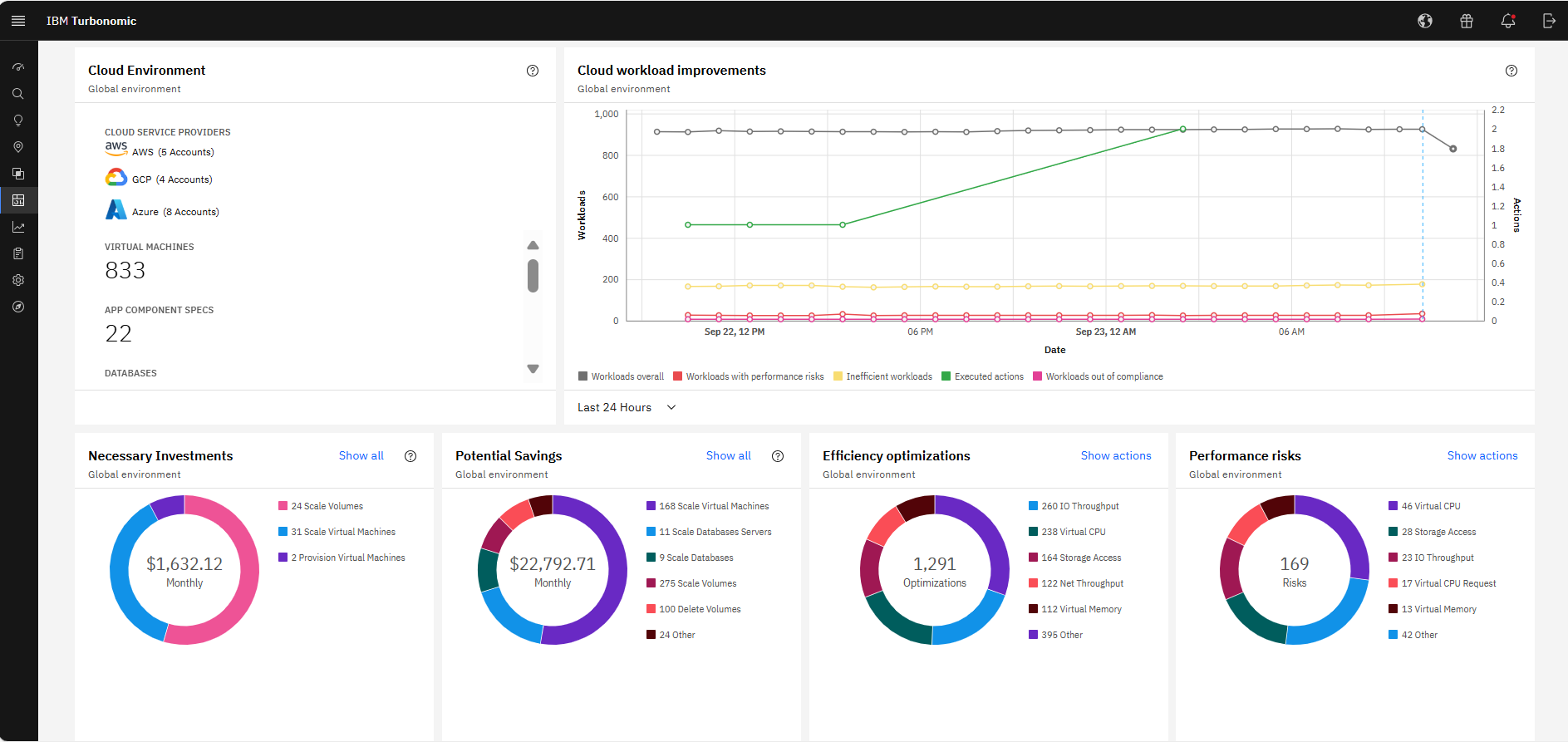
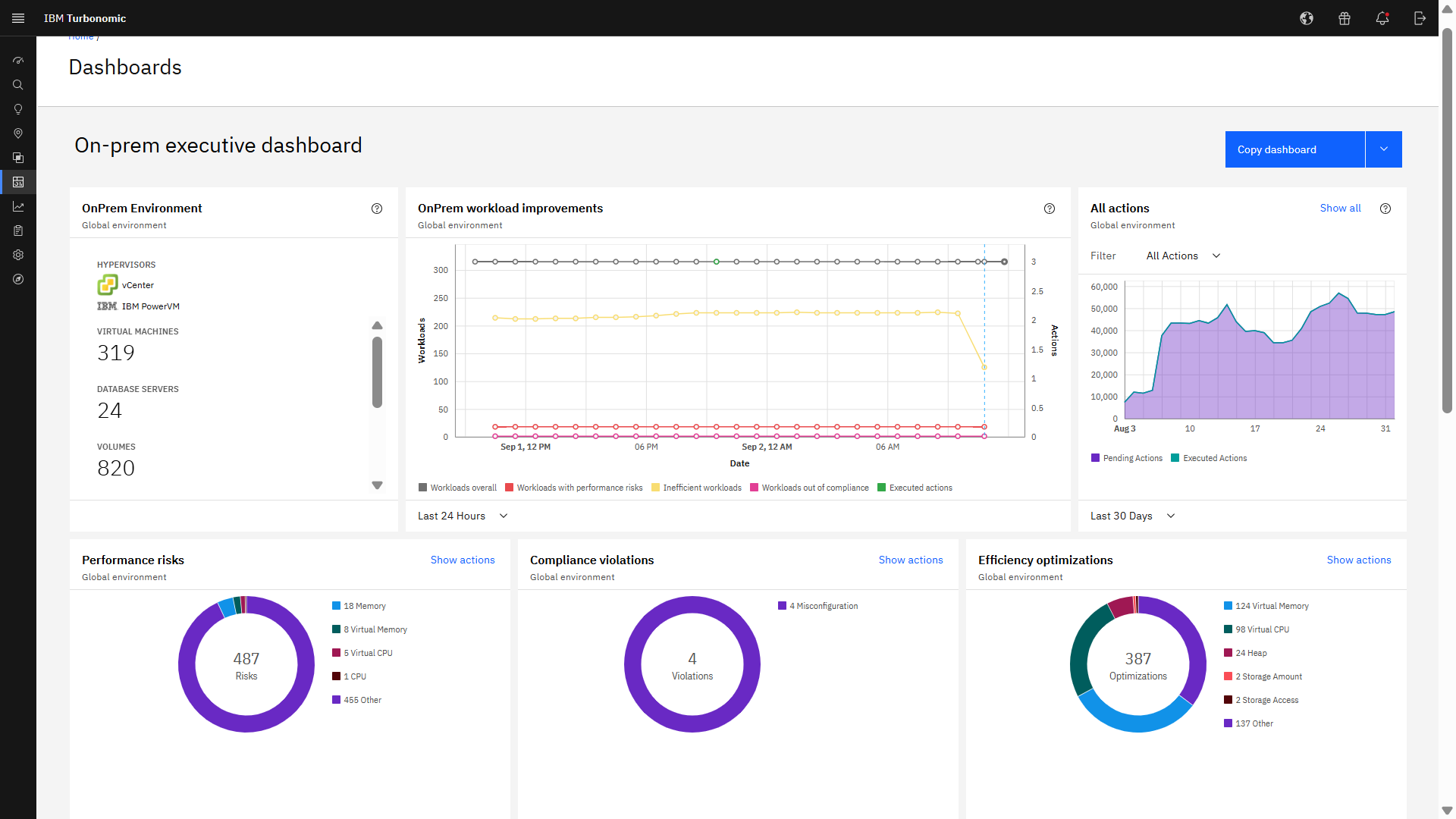
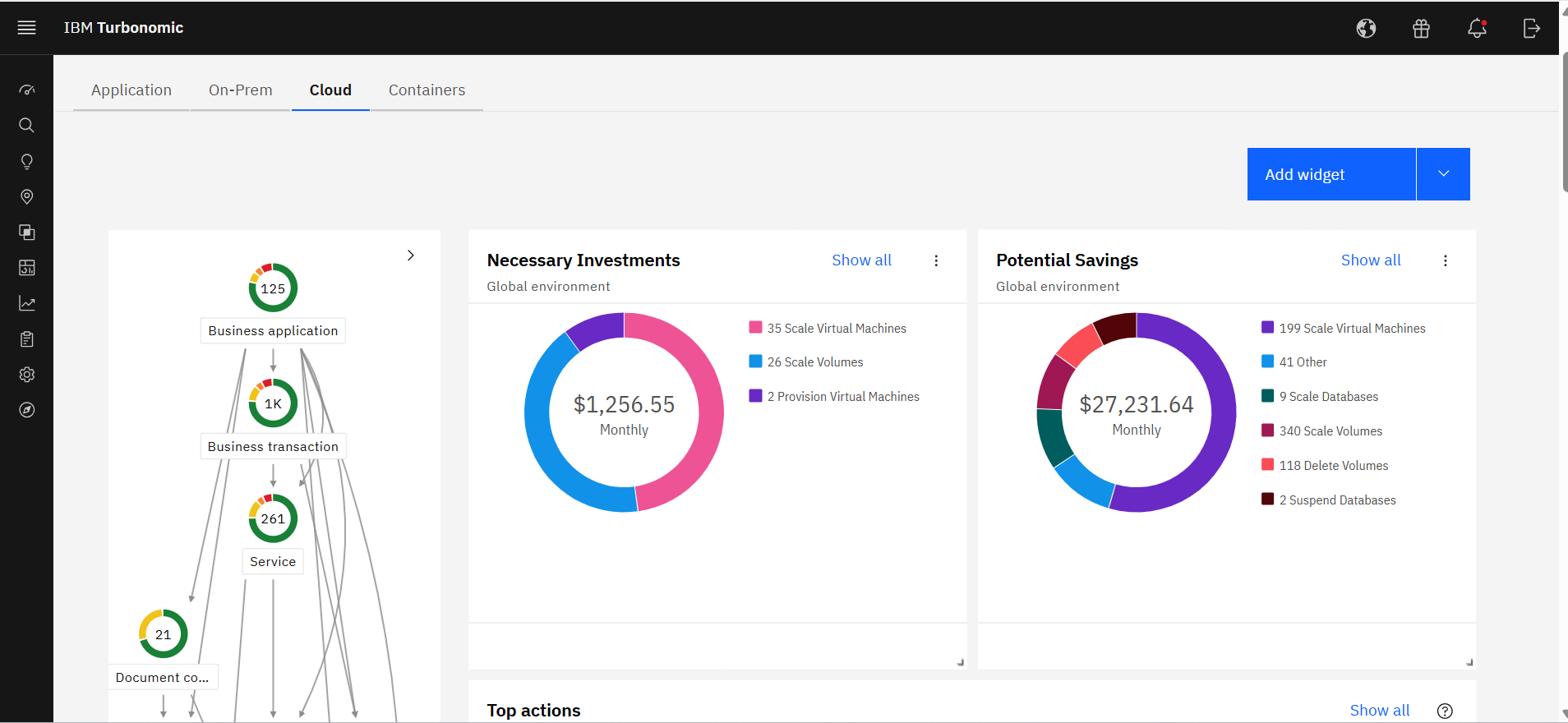
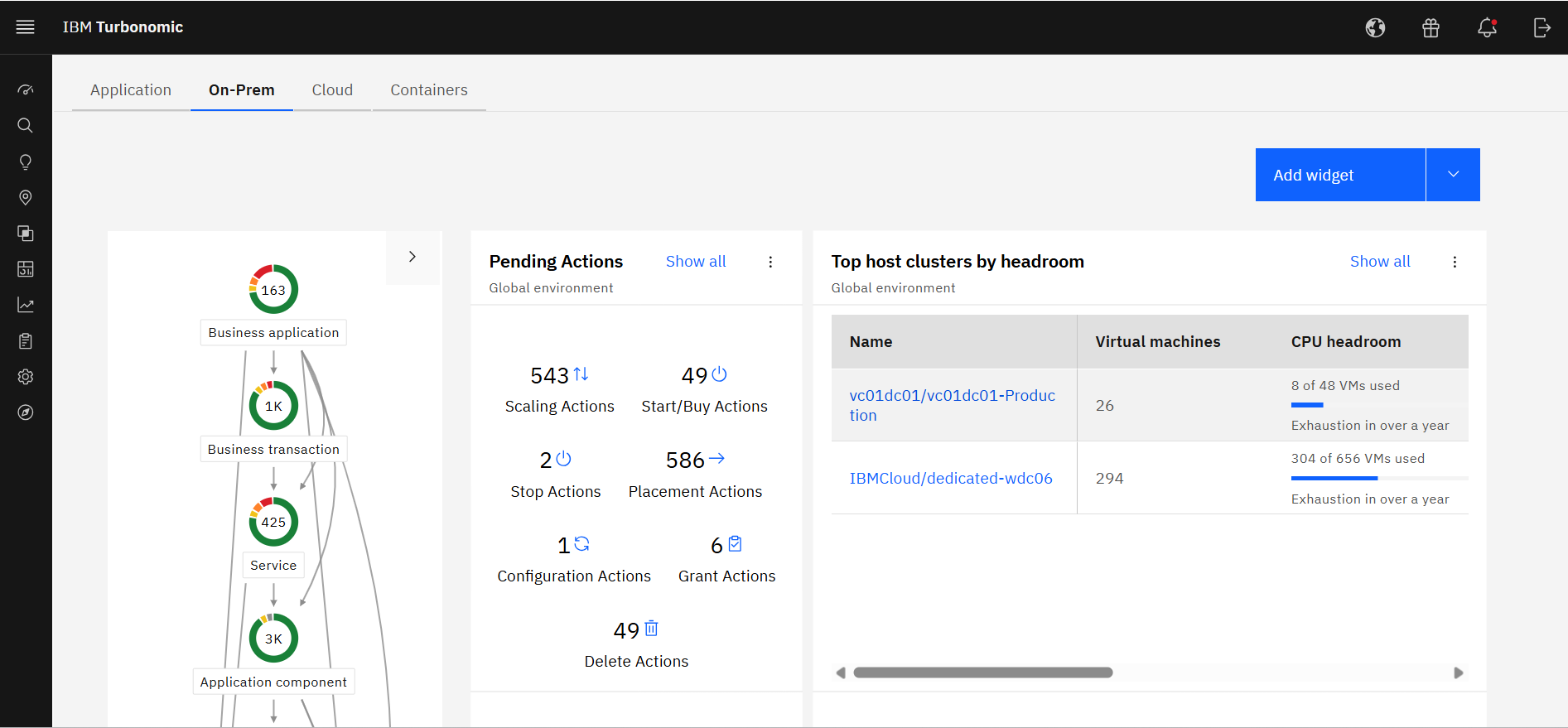
Screenshot of IBM Turbonomic Action Center, where it shows the list of optimization actions across the global environment—on-prem and cloud—that should be taken to minimize cost while assuring performance.Screenshot of IBM Turbonomic Application, a view that shows the global environment across private and public infrastructure from the context of individual application components. Users can optimize one application at a time by viewing each app's pending actions. The Supply Chain at left shows all of the entities across applications and their interdependencies.Screenshot of The IBM Turbonomic Cloud Executive Dashboard, an out of the box dashboard that allow users to rapidly communicate value to executives. This view shows the cloud cost savings opportunities realized and not yet realized over any time period.Screenshot of The IBM Turbonomic On-prem Executive Dashboard, an out of the box dashboard that allow users to rapidly communicate value to executives. This view shows the savings opportunities realized and not yet realized over any time period.Screenshot of an IBM Turbonomic Cloud view, where the public cloud environment(s) and all of the pending actions required to bring them into an efficient, performant state. The Supply Chain at left shows all of the entities in the public cloud(s) and their interdependencies.Screenshot of The IBM Turbonomic On-Prem view that shows the user's private data center environment(s) and all of the pending actions required to bring them into an efficient, performant state. The Supply Chain at left shows all of the entities in data center(s) and the interdependencies between them.