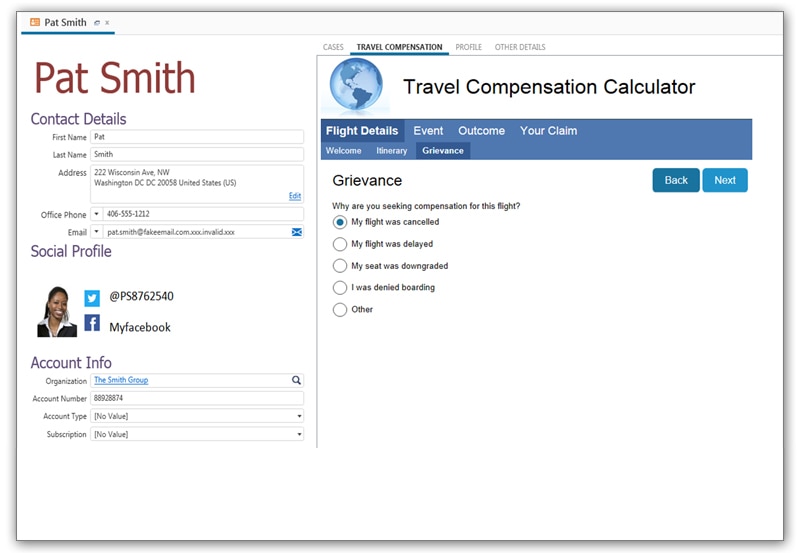
Oracle Service is the help desk and customer experience management platform from Oracle. The technology was developed and supported by RightNow Technologies as RightNow CX for cloud-based call center automation, until that company's acquisition by Oracle in 2011 for about $1.5 billion.
N/A
Parature (Discontinued)
Score 5.0 out of 10
N/A
Parature was a self-service customer support platform providing a self-service knowledge base to connect with customers across multiple channels. The company was acquired by Microsoft in January 2014 and reached EOL in 2017.
Oracle Service is a powerful service where the customers or clients can be evaluated in-depth. It provides a unified way where the customers can also raise complaints that can further be evaluated or resolved by the monitoring team to enhance the product. Also, it offers a lot …
Oracle Service is slightly on the expensive side in terms of pricing but it offers powerful features as well. As compared to Intercom, Oracle Service is suitable for large companies, and the support in the case of Intercom is available only by phone and email while in the case …
Oracle Service seems to have the advantage of providing many opportunities to companies if they have the right knowledge base. It opened our eyes to what possibilities were afforded to us by exploring the different options that existed. None of the options seemed to be more …
Oracle Service is the best fit for companies already using other Oracle products. Though Salesforce Service Cloud is equally good in most aspects, Oracle is once again an ecosystem of products like Oracle EBS where seamless integration is possible. Most of our clients were …
Mainly because of the name Oracle, it's a world leading company backed by a large user community in a broad range of different products. We needed the certainty of good support team behind the product and Oracle could deliver on this much better.
Oracle Service Cloud offers a wide range of communication channels that optimize and innovate the company's communication process and management with our customers.
I was not a part of the company when it was selected. Newer software has come out since but OSC had become so integrated with our ecosystem of software that it would be difficult to get rid of now. It has become more of a necessity than a desire to have. If possible down the …
I was not part of the team to make the selection. I worked as a user of both products, and from that point of view can say that Oracle Service Cloud offers a better GUI.
Before choosing Parature we reviewed many of the currently available solutions before building our short list of Parature, SugarCRM, Zendesk, Salesforce, and NetSuite. In the end, the licensing models for Salesforce and Netsuite eliminated them from consideration. The SugarCRM …
Parature comes in at just the right blend between ticketing solutions like Ceridian and Remedy. Ceridian is a little too cut-down/simple while Remedy can be mired by its complexity. Parature shares the same features as quite a few other ticketing solutions, but hits strongly in …
I'm currently using Solarwinds Web Help Desk and I think the 2 are very comparable. I didn't select either product but I'd rate Parature at the same level as WHD or better.
Salesforce is so much more intuitive and the layout is so much better. I never had any training nor did I need it with SF and with Parature it was a constant battle to understand its issues. I don't like to feel I have to resort to a manual every time I use the product.
Between SolarWinds and Altiris, I like the advantage that Parature gives. The auto reply is a huge assistance when dealing with people outside of my organization.
Oracle Right (Oracle Service Cloud) was an important evolution in the group's ombudsman channel management processes. We brought the Oracle Service Cloud to digitize the processes for capturing and managing the group's ombudsman channel, no longer operating manually (MS Excel).
Oracle Service Cloud (Right Now) brought about an important evolution in the management processes of the group's ombudsman channel, where activities that were performed manually, repetitively and with risk of errors, are now operated by the Right Now platform itself, whether by API, or by automation of the tool.
Parature earns a "7" on my rating scale because it fits the bill for a ticketing solution. While it is not the most powerful utility I have come across, it is fairly user friendly and gets the job done. There is quite a bit of room for customizing the interface, but it comes with a learning curve. A score of "7" reflects what I would tell anyone who is looking for feedback on this application; it's better than a majority of the market share, but still has room to grow!
Oracle Service cloud handles incident management extremely well. It can accept requests from multiple channels. That includes email, website, phone, chat, SMS & some social.
Oracle Service cloud provides a knowledge base that can be used by customers or by agents. It can move consumers to self service for most issues. It also has good feedback from customers and agents so that the knowledge can continue to be updated to push people to more self service.
Oracle has a good consumer portal that can be used as a website or typically is used in conjunction with a main website as a contact center or help center site. This allows the contact center to manage both the knowledge and the request and the interactions with the customers.
Oracle Service cloud is built to provide a turn key solution for CRM/Contact center with some minor configuration. But it also has the ability to be highly customized to meet any companies needs. Much of that work can be done via the configuration options already in the system. It also have a full set of SOAP and Rest APIs for integrating to other systems.
This is only an occasional, user problem; when searching for specific records, at times we receive an error that the maximum size has been exceeded and therefore does not yield any results. This is particularly frustrating when trying to search for a specific street address across several years.
I give this rating to RightNow because I believe that it's a strong CRM (I know RightNow doesn't like this term) product with virtually limitless possibilities. I like how flexible RightNow is, allowing businesses to fully customize it for their needs. I also like that it's cloud based and doesn't require additional local installation and management.
We left Parature for Salesforce Service Cloud. While Parature was functional, as our business matured we needed better support, more stability, and a lot more features. In addition, it integrated with our sales, marketing, and finance department, allowing us to all use a single solution and be able to share information across departments.
The learning curve is fairly steep; but for something that has this much capability, it's nearly impossible to make it "easy". The layout and organization are at least reasonably intuitive. The hardest part-- the "weakest link"-- is the portal development (where you can build help centers and other end-user pages.) The capabilities there are significant, but the learning curve for that part is especially steep and it takes a fair amount of expertise to be able to update it.
It was bulky, cumbersome, and didn't allow us to handle the volume of cases we received on a daily basis. Many of our issues were highly technical in nature and we would often need to work on 2 or 3 at once. The poor design choices prevented this, which was unfortunate.
They recently had one very extended outage. It was a data center issue - but they were not diversified enough so in the end the system was down for almost 8 hours. There are also periods of time where for no reason the system simply doesn't respond. This small outages are usually short (just a few minutes), and have in fact been occurring less often, so it appears some corrective actions have been taken.
We use a lot of tabs and fields on our incident workspace, which should slow the system down, but it's still quite fast, and we continue to optimize whatever is possible.
Technicians seem to be assessed based solely on how quickly they close the issues. I've had to reopen requests multiple times because they didn't actually solve my problem. Also, when the issue has even a moderate amount of complexity, the technicians often instruct me to "open another SR" to handle the other issue. I'm the customer, I shouldn't have to follow their processes, they should handle that for me. But even when I create the new SR, it seems like their right hand isn't talking to their left - they aren't reading back to the previous issue for context. So I get bounced around a lot, and I have to tell them how to do their job
Most of our training was given while doing user acceptance testing, and getting the system approved by the market. When ever we were in doubt, our implementer helped us along. Later on we started exploring by our selves.
Work with a RightNow expert during the implementation. Explain features that would you like to have. Often, somebody who really knows the system can show you what you need to do to achieve the desired results. Where a RightNow support engineer or a consultant might say "the system can't do that," a RightNow application engineer will listen to what you need, and often come up with an alternate path to achieve it
TCS' customers who also selected Oracle Service Cloud over Salesforce Service Cloud and GE's ServiceMax in the Mfg. vertical in which I work, did so because of the robust ability of Oracle Service Cloud and its APIs to integrate with other value-add solutions for manufacturers such as IoT applications, Big Data Analytics, and Field Service applications.
Before choosing Parature we reviewed many of the currently available solutions before building our short list of Parature, SugarCRM, Zendesk, Salesforce, and NetSuite. In the end, the licensing models for Salesforce and Netsuite eliminated them from consideration. The SugarCRM solution was our current solution, and didn't appear to be a key area of focus for Sugar (though we continue to use SugarCRM for everything except the Ticketing feature). Zendesk lacked the Download Module feature which is a critical element of our deployment. In the end, it was Parature that addressed all of the needs we identified and did so in a single, hosted solution. It was also one of the least expensive to deploy and maintain.
Positive: everything is housed in one place, we are paperless and we are efficient.
Negative: the bugs of this product make the above equally as frustrating. Also, some people don't use it correctly and going back and fixing their mistake is time-consuming. The reporting feature are also pretty flawed.