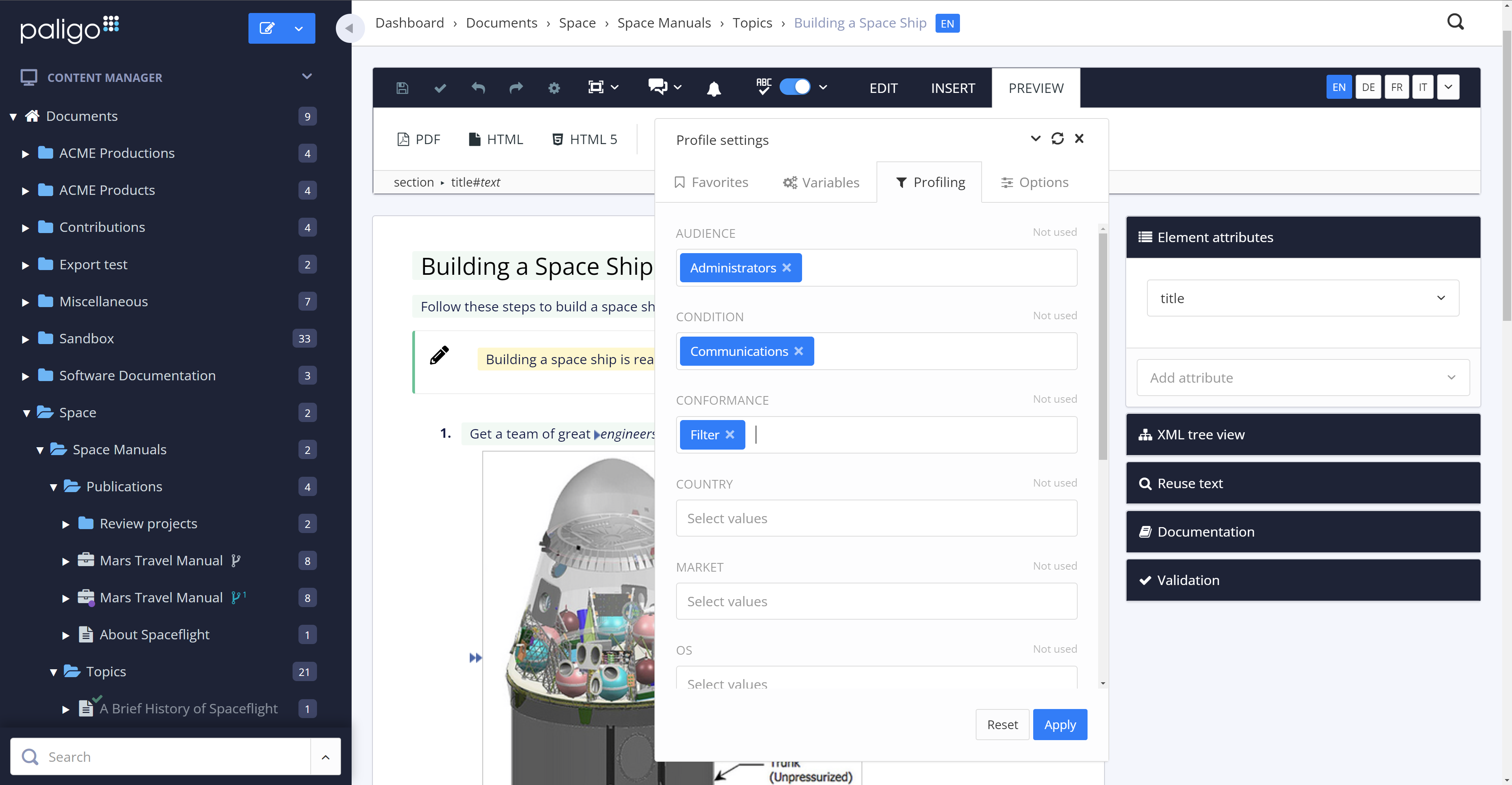
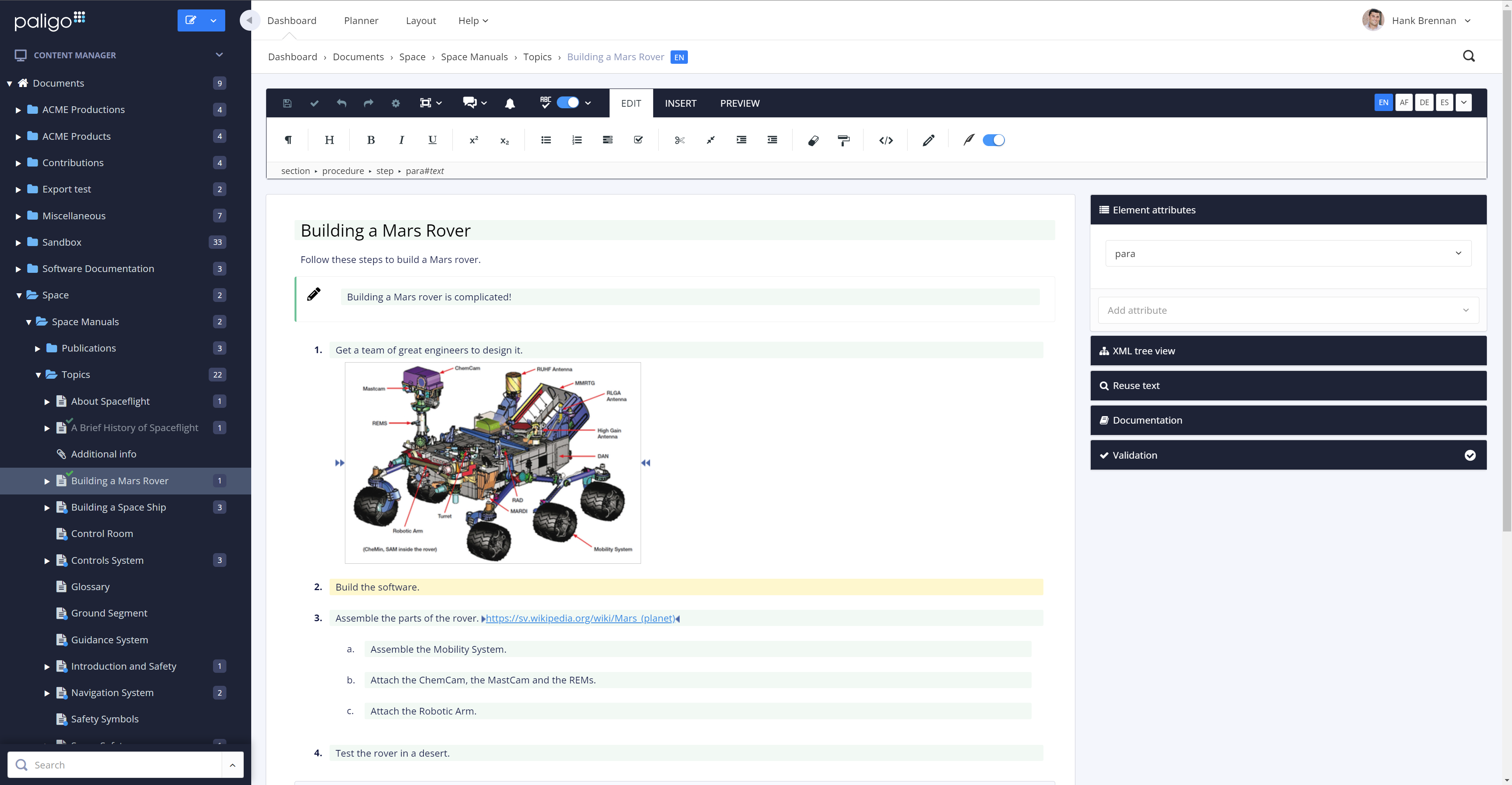
Paligo, headquartered in Stockholm, offers their component content management system (CCMS), supporting the creation and publishing of technical documentation and help systems.
$4,800
per year
Sitecore Digital Experience Platform
Score 8.6 out of 10
N/A
The Sitecore Experience Platform (Sitecore XP) is a digital experience platform used to build websites and create customer experiences online. The solution boasts fast content authoring, built-in personalization features, testing and other optimizations, as well as analytics and marketing features.
I was working with 10+ CMS:es (list here is not possible choose them from) “all my active work life” and Paligo GUI is unique: No or very few systems of this complexity have a rational GUI. Paligo stands out here and is very user friendly! When it comes to style sheets and …
Paligo gives you the benefits of a fully integrated XML content database, making the whole package much easier to setup and use than a system using Oxygen. It's much easier to set up and far less expensive than Adobe's XML offerings. The cost is comparable to MadCap, but all …
I was not part of the selection process / did not evaluate other tools. I had previously been authoring my content in Google Suite or directly in our Learning Management System. Both of those were hells of information duplication.
We were using our own, custom management scheme - relying on tools like Sharepoint to store and collaboratively edit. But we were lacking the reusability feature and content control features that Paligo provides.
Compared to Author-It, Paligo is a godsend. It's so much more performant, the output quality is much higher, and the user experience is unmatched. Before we switched to Paligo, I had to spend multiple working days just fixing the broken output that Author-It has given me, …
We moved from Flare to Paligo. One of the main reasons was the fact that Paligo is a cloud product. Collaboration with anyone outside of our team was more difficult with Flare. Also, maintaining a server for Flare content was going to become an issue, and overall I felt the …
They are both good documentation options, but the cloud-native capabilities and intuitive UI of Paligo, plus it's ability to produce excellent output for both PDF and HTML5 were the main reasons I chose Paligo. I am very satisfied with my choice.
We selected Paligo over the alternatives for a variety of reasons: It was cloud-based (usable on a Mac) It had the features we needed: Content reuse Variables Easy restructuring and maneuverability of content
Better Support than any of the others; Ability to migrate at cost (unlike AIT and Flare); Teamwork and centralized variables (unlike Word, Google Docs, FM); Diff and Revert (must-have feature); L10N features (better than all others).
I trialed a version of Oxygen XML editor, but the fact that Paligo is cloud-based and integrates directly to Zendesk sold me, even though Oxygen XML is essentially the de facto standard for most structured authoring.
Adobe Marketo Engage is a fantastic product for managing campaigns and audience segmentations syncing with Adobe Audience Manager. It also has OOTB connectivity to very popular CRM platforms. Adobe Analytics and Adobe Target are pretty similar to Sitecore CDP/Personalize. Any …
Other tools lack one or the other and fail to provide a comprehensive best experience for everyone - content authors, marketers and developers. Sitecore comes with out of the box authoring host, best content authoring and WYSIWYG editing experience and much more.
Really the only comparable product to Sitecore DXP is Adobe Experience Manager. Both are very well established and robust content management platforms. Products like Contentful and Contentstack are very lightweight and do not have as many built-in features like DXP, so it is …
Its is simply by far the most advanced system. Using other CMS you will soon be blocked with advanced customizations specially to their back office but Sitecore enables you to do whatever you want and hook into the pipelines and embed your own code/business logic.
I haven't used other DXPs in that great detail to provide a holistic comparison between it and Sitecore. Overall, I feel every product has its pros and cons. With Sitecore, I feel they are always innovating and coming up with new solutions to help the partners deliver the best …
We experienced issues with this CMS and thus switched from Sitecore Experience Platform to AEM and both of them have their own pro and cons. While Sitecore Experience Platform provides flexibility to copy properties from one page to other, AEM doesnot allow that.. we need to …
The main reason to use Sitecore Experience Manager is if you want to develop something completely custom. Sitecore is best suited for very robust, multi-page websites. If you need to build out a website that supports multiple product lines, Sitecore could be a good option.
All of these platforms have their pros and cons. Selecting the best fit is a matter aligning corporate need vs features provided. Have a .NET shop with an advanced marketing team looking to push UX forward and willing to pay a premium, then Sitecore may be the right fit. …
After evaluating OpenText, we found that Sitecore has stronger capabilities to utilize the content for personalization and contextual marketing. We also favored Sitecore's user permissions, roles, and content creation processes out of the box.
Sitecore was evaluated by our practice next to two other Content management systems 4 years ago. Sitecore scored the highest following a series of questions related to product stability, scalability, ease of use, and a host of other categories.
WordPress and Wix are great solutions for a small business or a solopreneur who's just looking to get a simple website up and running. For larger businesses with more robust content, I think Sitecore offers a bit more flexibility. Wix and Wordpress are both really simple to get …
Sitecore provides and enterprise grade CMS over Wordpress and allow us to do the customization we need for our unique environment. Optimizely might be better for AB testing.
Sitefinity is improving but at the time of decision making it had nothing that could compare with the A/B testing and personalisation features that Sitecore offers. This was a key differentiator and ultimately ensured Sitecore was purchased. Wordpress isn't really comparable …
The decision to select Sitecore was not ultimately mine, but the fact that we were able to leverage in-house Microsoft .Net (C#) experience on a platform that had a library of extensions, but also allowed us to customize and keep private our confidential IP has been a big help. …
Of all the competitors listed above, Sitecore owned, by far, the best combination of power, easy-of-use, and extensibility. It easily outperformed the other paid-for CMS systems. Its power is especially noticeable in its ability to handle very complex workflows, security …
I have used an in-house CMS and the Amaxus CMS. Sitecore is a great balance of these two. The in-house CMS was VERY user friendly, for the least technical client. It showed the actual page you were editing and allowed you to basically edit the text on the page, no HTML …
Every product has a cost window it fits in. Umbraco is perfect for small to mid-enterprise implementations. However Sitecore is more stable from a developement standpoint.
Director of Information Technology & Assistant Pastor
Chose Sitecore Digital Experience Platform
For us, Sitecore was all about the integration possibilities and a CMS that empowered our staff to get their information published online in a timely fashion. At the time SiteFinity was still early in its development. Sitecore was a more mature product with many more features.
Paligo is particularly well suited for developing similar document sets for multiple products or product lines. It is not a page layout application, so don't expect the same capabilities as popular applications for graphics-heavy documentation. With some up-front time developing good layouts, however, Paligo does manage to create very usable PDF output for customer-facing documents.
Having worked with other DXP platforms, I find Sitecore to be the most suitable for enterprise-level clients. The platform is highly flexible - both customizable and extendable - making it adaptable to any customer needs or requirements. The platform focuses on the success of both marketing and technical teams, which I don't see on other platforms.
The review mode is super convenient. Comparing a snapshot of the previous versions with the current one clearly outlines the respective changes and reduces the necessary content to review tremendously.
The option to reuse text fragments is another handy feature. Text fragments will be updated whenever the original text fragment is altered is also extremely helpful.
Managing a content's structure was never easier. An intuitive drag & drop functionality allows you to design your document's structure however you like.
You can also fork content, in addition to reuse text fragments. This is another helpful option that no longer requires you to create repetetive chapters over and over.
Customer Profiles - the ability to identify key features on the site and flag those interactions to tie customer visits back to specific persona types.
Lead Scoring - the ability to establish a funnel for leads and use this funnel to assign a score or qualification within the sales funnel.
Personalization - the ability to tailor experiences to unique customer segments based on their needs, identifiying and optimizing the experience in real-time.
The amount of CSS/JS required to customize a site's appearance can be cumbersome
Product documentation can be lacking, specifically with integrations; in some cases, support offered no real help when trying to solve a problem with an integrated service
Some features require extensive development experience to use, which can sometimes be an obstacle to less-experienced team members
Sitecore is complicated. Software developers need (costly) training to get the most value out of it and business users do not find it intuitive to use. Concepts like the content tree can be difficult for the business users to grasp.
Despite everything being possible in Sitecore, virtually nothing comes out of the box - you need to develop every component and do so within a defined process and framework, which can be a fairly big development overhead.
Sitecore has proven that it can deliver on its promise of a robust, reliable enterprise CMS solution with plenty of features. Also, they keep updating it with more and better features. Now that we are highly trained on it we have started on getting the most out of it and we plan to keep doing more of that in the future.
Generally, I'm very happy with Paligo and the productivity gains that I get from using it. There are a few arbitrary limitations on structure, and when applying conditional formatting, that I don't really understand. Unlinking / editing reused text uses this broadly inscrutible colour-coding that I just hate. It would be nice to double-click a component, make edits, then respond to a popup asking if I want to confirm the edit for all linked content, or unlink this instance. Likewise converting from an informal topic insertion to duplicates of its raw contents.
Once you learn how to use the platform and can put a solid strategy in place to manage it long-term, it becomes a lot easier to use. The tricky part is working with resources who are familiar with the platform to navigate some of the common implementation and configuration pitfalls. Although Sitecore has worked very hard to overcome some of these from their earlier product versions by creating wizards and improving their support documentation, at the end of the day it is still a very complex and powerful system that needs to be implemented carefully in order to foster the best possible user experience for authors. So it could be rated very usable or not usable at all based on how much planning took place and the quality of the implementation.
So far, support has been excellent. They reply very quickly and give in-depth replies. Solutions advisors and account managers have also been very responsive and clearly focused on creating the best experience for implementation. And that's only when the answers can't be found in excellent product documentation. The online training class and tutorials are also very good.
1. Customized software development & maintenance. 2. Technology Consulting - Consulting-based services for technology solutions data engineering or cloud solutions. 3. Used for tapping into multiple data sources such as CRM and marketing automation systems and, creating automated data extracts with a high-end visual representation of data. 4. Implemented for scheduling an existing report to automatically refresh and be delivered to specific users at a specific regular interval.
Sitecore captures and remembers every single interaction your customers and prospects have in any part of the system, allowing you to build comprehensive, ever-learning profiles of each individual. From email marketing, to social media, to online shopping, Sitecore remembers where each interaction left off so you can automatically continue the conversation. Sitecore helps you manage your content for each and every experience your customers enjoy. Customize what content you want and the system will take care of how it's displayed.
We implemented Sitecore on an Agile project team, which worked very well. We worked closely with the stakeholders for each feature and all features and user stories were prioritized outside of the development team. Anyone trying to implement a website of this magnitude should definitely attempt to do so in as much an Agile fashion as possible.
Paligo gives you the benefits of a fully integrated XML content database, making the whole package much easier to setup and use than a system using Oxygen. It's much easier to set up and far less expensive than Adobe's XML offerings. The cost is comparable to MadCap, but all our content was already in Docbook, so the transition to Paligo was nearly seamless.
Adobe Marketo Engage is a fantastic product for managing campaigns and audience segmentations syncing with Adobe Audience Manager. It also has OOTB connectivity to very popular CRM platforms. Adobe Analytics and Adobe Target are pretty similar to Sitecore CDP/Personalize. Any custom/extension implementation required in the Adobe space has the same complexity as Sitecore.
Positive - has allowed us to create templates for integration documentation. this has greatly sped up our process for creating articles for each of our integrations, which we haven't had up to this point.
Positive - has created greater alignment between the self-service content team and the marketing team.
Positive - has introduced a review and feedback workflow for our content creation that was not available in ZenDesk. The feedback directly in the app allows me to pinpoint comments about text and other elements so my writers can address them directly and become better writers in the long term.
Negative - long ramp up time due to a completely different approach to creating content. My team was training in early August and we have not yet published our new help center (though, to be fair, it is a lot of content that had to be completely rewritten)
Positive - any UI updates only require updating a single image, which has saved us dozens of hours of updating already.