Aha! Roadmaps is used to set strategy, prioritize features, and share visual plans. It includes Aha! Ideas Essentials for crowdsourcing feedback. For an integrated product development approach, Aha! Roadmaps and Aha! Develop can be used together. The software is available with a 30-day trial.
$59
per month per user
Roadmunk
Score 9.0 out of 10
N/A
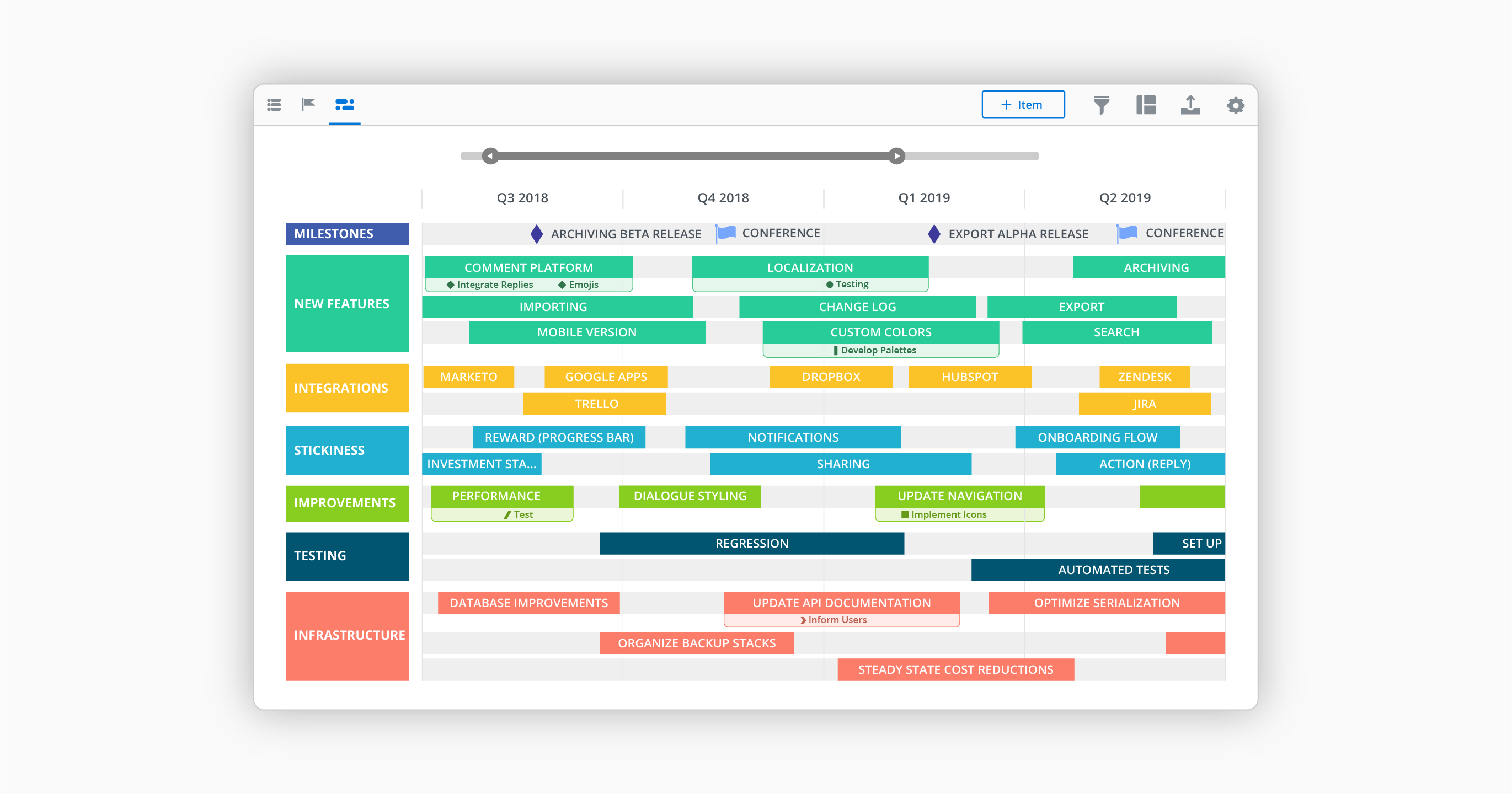
Roadmunk is a roadmap visualization platform that is designed to enable product managers and their teams to communicate the strategic roadmap throughout their organization. The vendor says product leaders can easily input milestones, roadmap data and create unlimited pivots in real time. The vendor says it has differentiated itself through intuitive user-centric design, seamless manipulation of roadmap views and enterprise data security. Since late 2021, Roadmunk is part of Tempo.
$19
per seat
Pricing
Aha! Roadmaps
Roadmunk
Editions & Modules
Premium
$59
per month per user
Enterprise
$99
per month workspace owner or contributor
Enterprise+
$149
per month workspace owner or contributor
Starter
$19
per seat
Business
$49
per seat
Professional
$99
per seat
Enterprise
Custom
per seat
Offerings
Pricing Offerings
Aha! Roadmaps
Roadmunk
Free Trial
Yes
Yes
Free/Freemium Version
No
No
Premium Consulting/Integration Services
No
No
Entry-level Setup Fee
Optional
No setup fee
Additional Details
Startup pack available for early stage companies.
Ready to roadmap? All our plans start with a free 14-day trial.
More Pricing Information
Community Pulse
Aha! Roadmaps
Roadmunk
Considered Both Products
Aha! Roadmaps
No answer on this topic
Roadmunk
Verified User
Anonymous
Chose Roadmunk
Roadmunk beats Aha! through visualization and Gantt connections between work items. We originally turned to Lucid (Spark and Chart) and Miro to get away from Aha's difficulties, but those platforms presented significant challenges in terms of relationships and dependencies.
Sr. Director, Emerging Products at Swagbucks, a Prodege Company
Chose Roadmunk
To be quite transparent, Roadmunk was the cheaper option. However, it also provided a ready-to-use solution for the team that required little to no training to get up and running. It provided the needed results almost from Day 1. Aha! had the more robust feature set and the …
In my opinon Roadmunk has the best UX and very friendly interface. The decision to purchase Roadmunk was based also on the great customer service and help provided by the team. Roadmunk team is open to suggestions and is constantly working on their product. It's great to see …
Aha! is the all around product management tool. You need something once you build out a product management role and grow beyond a small scrum team with one or two products. JIRA, Pivotal, and project management tools don't cut it for aligning [engineering] with product initiatives once the backlog starts to scale.
On the other hand, there are several unfinished features that my peers all admit to having to work around: Capacity Planning, Salesforce Integration, Roadmap Display Flexibility, User Feedback, etc. This year has been all about reporting in terms of feature releases. As Aha! grows, they will fill in these other areas, so stay tuned.
Roadmunk allows us to configure and share customized views of our roadmaps. As a platform, it has demonstrated progress in its scalability and performance, which has accommodated the growth our team has seen over the last two-plus years. Particular strengths include configurability and customization, along with options for views, exports, and sharing with internal and external audiences.
Collaboration – Roadmunk makes it very easy to work and edit within a team structure.
User Experience – The usability of the product made it quite easy for the entirety of the team to hit the ground running (i.e. very little training was required).
Rollups – Each product line and therefore each product owner could easily focus on their particular roadmap without having to sort through the master roadmap making it highly efficient, while at the same time making it quite easy to pull all updates into one high-level document.
Notes - There's not a great place to leave lots of notes or instructions, almost like a Confluence page. Although not required, it would be nice to have this built in.
Learning curve - As with most new tools, there's a bit of a learning curve to become proficient.
If you have the time and resources there really isn't anything you can't get Aha! to do for you in regards to managing workflow and releases. The Prioritization features are top of its class, the dashboards are getting better and better every day and the team all seem to really enjoy using it to manage their workloads.
Performance has improved meaningfully over the last 12 months or so, especially in our views that contain many roadmap items. Some challenges remain, however, particularly when changing the timeline and in scenarios of multiple users interacting with the roadmap simultaneously.
When we signed up for Aha!, we were assigned an Aha! team members to help us with training/questions. The meeting was set weekly, and it exponentially helped with our familiarity with Aha! Support is beneficial and has a lot of experience working with product teams.
The Roadmunk team has been great to work with...whether proactive communications about new features or the occasional outage, or when we reach out to them with feature requests, assistance/support, or even license management and renewals - they are top notch.
productboard was used in the organization when I arrived, but after assessing productboard, I felt it was too lightweight for our ambitious product goals. It's also critical, especially in a startup, that we focus our limited capacity on the work that matters most. Aha! far and away had superior capabilities in defining strategy directly in the product and associating all of our work to the strategy. Aha! is a serious product management tool and I found productboard to be more of a simple backlog management tool.
Roadmunk has an actual product management workflow design built into it vs trying to use eg generic e-post-it software like Trello. Trello is better at free-forming prioritization, which is actually much better than (again) the awkward item navigation in Roadmunk, but the other Roadmunk advantages post-prioritization win out in the end.
Roadmunk has reduced the number of meetings that product needs to attend with customers by 20-25%
Roadmunk has eliminated a whole set of churn in our workstream management tool (JIRA) by abstracting the planning step away from the steps where we monitor work progress