Salesforce Marketing Cloud Personalization (formerly Salesforce CMS) is a hybrid CMS allowing users to author content once and deliver it anywhere, in or out of Salesforce. Users create content, define content access, and define channels so they can share content and limit access to appropriate contributors. For an experience built with Salesforce, users can choose from two of the company's “what-you-see-is-what-you-get” (WYSIWYG) tools: Experience Builder and Commerce Page Designer. If the user…
N/A
WebWave
Score 9.5 out of 10
N/A
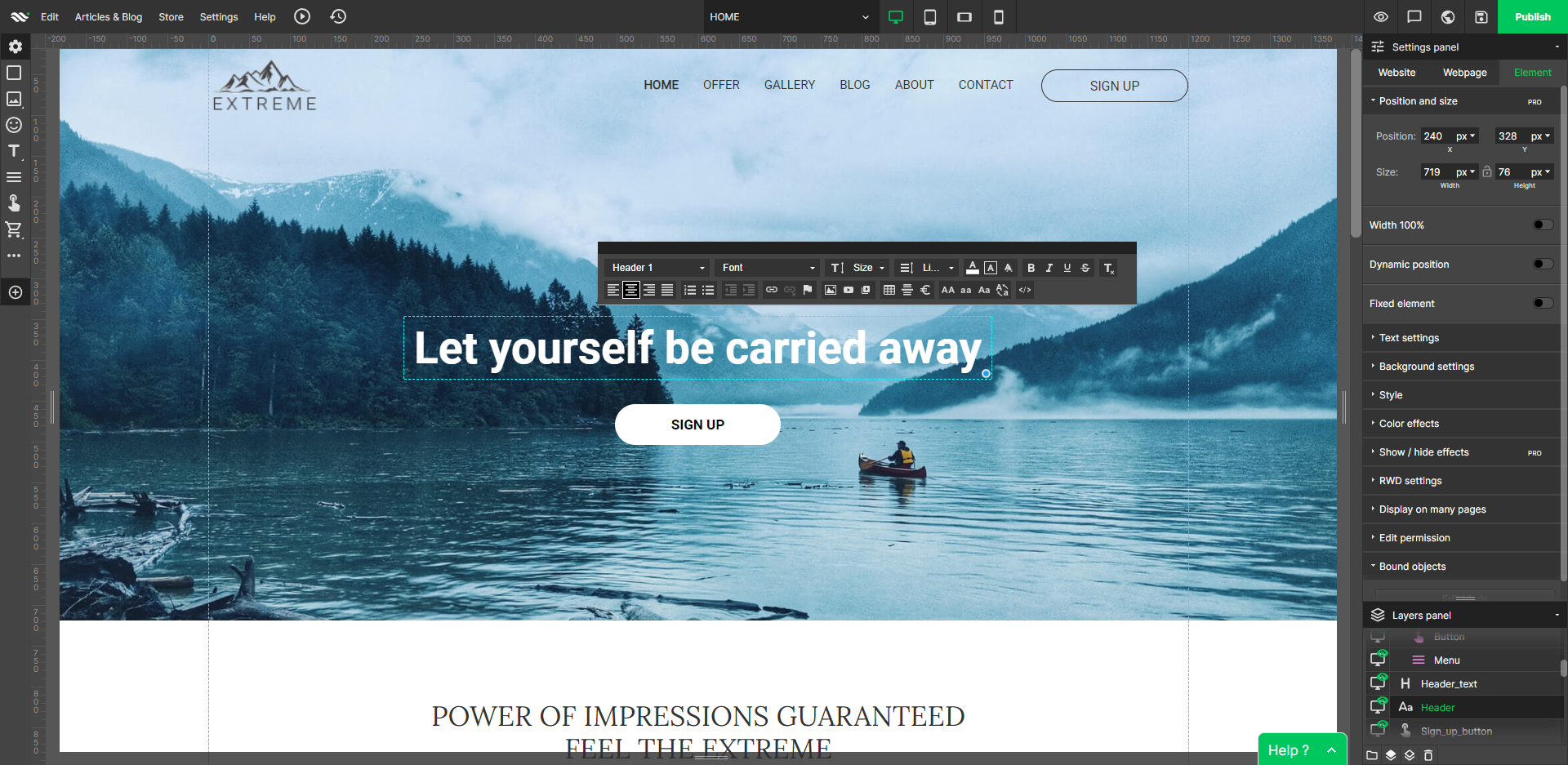
WebWave — an alternative for agencies and freelancers for creating custom websites for clients with the support of CMS. Using CMS with no sacrifices WebWave is a CMS platform that gives a designer precision up to 1 px in every single detail just like in more sophisticated graphic programs such as Photoshop while remaining a drag and drop software. This is to make creating websites much faster without loosing on details. Spend less time talking WebWave…
N/A
Pricing
Salesforce CMS
WebWave
Editions & Modules
No answers on this topic
No answers on this topic
Offerings
Pricing Offerings
Salesforce CMS
WebWave
Free Trial
No
Yes
Free/Freemium Version
No
Yes
Premium Consulting/Integration Services
No
No
Entry-level Setup Fee
No setup fee
$7 per month
Additional Details
—
—
More Pricing Information
Community Pulse
Salesforce CMS
WebWave
Considered Both Products
Salesforce CMS
Verified User
Anonymous
Chose Salesforce CMS
Salesforce CMS is by far more capable to be tailored towards the need and critical aspects based on how our org is structured and work.
Integrations are also great! Critical data is easily being synced with other tools in tech stack.
Salesforce is magnificently more robust and functions much better when managing complex sales cycles with multiple individuals and products. With simple sales cycles and few products, Excel is a strong contender.
Salesforce CMS stacks up as a Customer management system because it has a more user friendly snd intuitive interface. The UX is better and more modern. It can be customised and extended. There are always learning opportunities and updates for the system so it keeps on …
Salesforce CMS is way better with both optimization and reporting both of which Sonar Scheduling lacked. Our ability to skill technician or prioritize was lacking with Sonar. The API was very delayed with Sonar so changes on the Gantt had a delay that would throw off other team …
This fits into the mold with the other Salesforce services. Once you get used to the suite and the nuances of each platform, things become easy. Just read any documentation first, as jumping in will only get you so far, and the more connections with the other apps, the more …
Hubspot CSM is a bit easier to use, but not as strong for bigger markets like enterprise. Also, it's a bit annoying having to log into different platforms. Being able to do everything directly in Salesforce is pretty nice.
Salesforce more so compliments these products, rather than stacks against them. We don't have any products similar to Salesforce CMS, so in lieu of that, these are the products we were using that mesh the easiest with Salesforce CMS in terms of proceeding through the …
In my opinion, Salesforce CMS is the most complex of these offerings, and probably the most complex platform of its kind. It was selected by another stakeholder - I would likely have chosen something less expensive and more intuitive to use. The robust feature set is amazing, …
We used the Catalyst product of Totango. It was not great as it was hard to navigate, and it did not offer any reporting capabilities at all, nor did it speed up our day-to-day tasks.
As our business heavily relies on Sales Cloud, Service Cloud, and Marketing Cloud, we need a CMS that works natively with our existing Salesforce Data. Other platforms would require third-party connectors or custom API development, making integration more complex and expensive. …
I would say Zoho seemed very remedial when compares with the functionality of Salesforce CMS. Zoho might be better for those just starting out and don't need the full functionality of what Salesforce CMS is capable of. Used Zoho at a previous employment and I didn't think it …
I was uninvolved in my organization's CMS selection, but I used Freshdesk at another organization and generally prefer Salesforce CMS due to greater functionality and wider use cases. Unlike Freshdesk, Salesforce CMS is built for processes besides customer support ticketing, …
I have not researched other products. The last two companies I have worked for both used Salesforce CMS and had no intention of changing providers. I cannot think of a time where someone told me they did not like Salesforce CMS. When you have a solid solution like Salesforce …
Pulls data from Sales Cloud, Service Cloud, and Marketing Cloud to dynamically update content, we didn't want to use too many 3rd party tools that would expose our busines to threats
I used to use WebWave at my previous firm and felt like it was more for website creation rather than content sharing internally. I was also in a different role so I meant my needs at my last firm. My focus has changed and now Salesforce CMS is the best product for my team to …
Integration with this tool are immensely incredible it make us efficient whenever we need to see the data of our client. It helps us to make our lives easier in terms of sending rates, follow-ups, Outbound call and more importantly constant assurance that we have our process on …
Fast load times: WebWave's websites have fast load times, which is critical for ensuring a positive user experience and better SEO performance. Responsive design: WebWave's websites are optimized for mobile devices, ensuring that they look great and function well on any screen …
It is compatible with many WordPress plugins and offers many more possibilities than google sites, Wix, or similar builders. It is a WordPress as easy to use as Microsoft Word.
WebWave is easy, the sites are stunning, and I don't have to pay an arm and a leg for it. Usually, there is a drop in customizability using WordPress. But WebWave allows a great site and an incredible price. For that reason, I'm leaving a great platform in WordPress and jumping …
Due to WebWave's innovative and intuitive layer-based design system, it is infinitely more user-friendly than both Webflow and WordPress. Webflow's websites feel lighter and faster, but I'm sure WebWave will address this as they mature. Webflow's animation features are also …
Only the traditional ones like WordPress with Elementor or WPBakery page builder. It's not an easy comparison. WordPress is the big boss but you have to buy a bunch of services, plugins, other embedded SAAS and such tools to make it work. WebWave, on the other hand, is making …
In terms of flexibility and functionalities, WebWave falls behind Webflow. However, practically anyone with a basic understanding of web development or who can use a word processor will be able to teach themselves how to utilize WebWave. Webflow, on the other hand, is far more …
It's an easier, super complete option and cheaper Instead of paying everything separately like Wix, this option gives you all for a good price. And is the same with Elementor, you need to pay their license, the hosting, the domain, and connect everything manually, but this …
Most Wix and WebWave have the same features as well as their distinctions. They are pretty good on their own functionality. They have their own functionality. From the pricing perspective, WebWave is slightly ahead of Wix. The pricing of Wix is a bit more than WebWave. So, if I …
WordPress is a great product but I need to figure out hosting myself, also I need to make sure the theme I am using is mobile friendly. We WebWave, I don't need to worry about any of those and the drag and drop builder is very easy to get familiar with.
Wordpress is a more flexible and adaptive content management system than Webwave. In addition to the functionalities that are already built-in, I am unable to add any customizable plugins or add-ons. However, in the majority of cases, the inherent features of Webwave are …
WebWave is fairly easy to use. For novice users, it is easier to use than WordPress or Shopify. I think WebWave will be more SEO friendly than Wix. The price is affordable for small businesses/clients as well. The template system is much easier and takes less time than …
web starts, Convertri Pro, and other alternatives Webstarts has a lot of issues with mobile view. U have to rearrange almost everything again. WebWave on the other hand lets u group and save so that don't have this problem. Also, animations work as they should same with …
WebWave stacks up well with other website builders. Especially the all-in-one types. It does things well and things make sense when it comes to editing. There are a lot of options to help you get things the way you want. I like how it can grow with the users. I feel the …
If you have a large customer base and a large amount of data on each of your customers, it is really strong in creating personalized content that your salespeople can use in their pitch meetings—and then setting up workflows for automated for lifecycle journey creations to automatically go out to customers.
The WYSIWYG web builder marketspace is saturated, but there are not many solutions out there that eschew table-based design in favor of letting creators build sites where anything goes wherever you want. You’ll likely want to skip this product if you need a plug-and-play solution where everything is automatically responsively. However, if you have an eye for design, love creative control, and like to sweat the details until you have made the perfect website, WebWave is a must buy.
Easy to use, just like Salesforce's other products. Many users can sit down and figure it out in no time, and with a little training become power users.
Fast and secure - Salesforce is a leader in the cloud world so you get consistently fast results and security that is top notch in the industry.
Accessible from anywhere - if you use cloud CMS already this is a no-brainer, but for those that do in-house CMS still, this is a major difference. Mobile access from anywhere on the planet without a VPN is something you just can't do without the cloud.
WebWave's site builder is the platform's truly innovative feature. I've never come across another service that deploys a layer-based approach in web design, as most of them usually deploy a grid-based system. This is an incredible alteration that ensures WebWave behaves much like a traditional graphic design tool, thereby resulting in an experience that is a lot more intuitive and instinctive. I believe this has the potential to radically change the way people approach no-code web design.
WebWave provides automatic, daily backups and a free SSL certificate for every website. This results in excellent security.
WebWave's support team is first-class! I had some teething-issues in the beginning, but the support team quickly got me back on track.
WebWave's community/forum is an excellent place to vote and request new features. This proves the development team is committed to making WebWave better by listening to their users.
Organizations that are new to Salesforce need to be prepared for report building and other configurations. Customization is a great feature, but it can be overwhelming if not impossible for a brand new user.
Salesforce Trailhead is robust but can be confusing and overwhelming.
I'm currently comfortable with only using Salesforce CMS or any iteration on a desktop.
Some scope for improvement in UX (colors are not very appealing). It is simple to use but design is a little dated. Especially in the builder section, I'd like to see modern design for buttons and maybe gradients also: as this is where visual motivation is also important
Some edits take effect only after pressing OK. That should be eliminated as it's an unnecessary addition. It's also kind of annoying to do that again and again, which can add up to a lot as we do so many small tweaks while building the website.
Few things (maybe glitches) in design. The rectangle below the footer was uneditable for me. I spent quite some time trying to figure it out so I'm convinced it's a glitch.
It will be too difficult to change to a different software. We are fully integrated, and if things are not working well, it would be way worse to try to move to a different platform.
Strengths: - Intuitive for Salesforce Users – If you’re already working within the Salesforce ecosystem, the Salesforce CMS is easy to navigate, with a clean UI, drag-and-drop content management, and reusable assets for quick updates. - Seamless Integration – Since it connects natively with Experience Cloud, Marketing Cloud, and CRM, it allows for efficient multi-channel content distribution without needing extra third-party tools. - AI-Powered Personalization – The ability to deliver dynamic content based on user profiles and engagement data is a huge plus, making content delivery more relevant and impactful. Challenges: - Learning Curve for New Users – If you're not already familiar with Salesforce, the interface can feel overwhelming, requiring training to fully leverage all features. - Limited Customization & Workflow Automation – While it works well for structured content, advanced approval workflows and deep editorial customization are limited compared to enterprise CMS platforms like Adobe Experience Manager. - Media & Design Limitations – Salesforce CMS is not as robust for managing rich media-heavy content, which can be frustrating for teams needing more flexibility in multimedia presentation.
I've never really had to contact support. It's at the point where we have people in the organization that are our specific go-to inhouse support teams for Salesforce. Again, that goes back to what I said about there being a point where just too much is added to Salesforce that you have to hire someone to be the go-to person of Salesforce. There is only so much their support team can do for you. I wouldn't expect Salesforce Support to have any sort of understanding of the weird issues I deal with!
1. The support person does not seem to understand the issues, and seems like they go off to talk to somebody and revert back every 5 to 10 minutes. It takes up a lot of time. 2. There is a lack of reading material to address simple issues like changing the website name in the dashboard, pasting a code, etc.
Salesforce CMS is way better with both optimization and reporting both of which Sonar Scheduling lacked. Our ability to skill technician or prioritize was lacking with Sonar. The API was very delayed with Sonar so changes on the Gantt had a delay that would throw off other team members. Sonar was cheaper but Salesforce CMS is way more capable.
Fast load times: WebWave's websites have fast load times, which is critical for ensuring a positive user experience and better SEO performance. Responsive design: WebWave's websites are optimized for mobile devices, ensuring that they look great and function well on any screen size. Wix simply just doesn't have that and I was really struggling with this issue. Cost-effective: WebWave's pricing plans are affordable and provide excellent value for money, making it a cost-effective option for small businesses and entrepreneurs.