Salesforce Sales Cloud is a platform for sales with a community of Sellers, Sales Leaders, and Sales Operations, who use the solution to grow sales and increase productivity. The AI CRM for Sales features data built right in, so that companies can sell faster, sell smarter and sell efficiently. Salesforce Sales Cloud is used for, and supports: Buyer Engagement Sales Engagement Enablement Sales AI Sales Analytics Team…
$25
per month per user
Terminus ABM Platform
Score 8.0 out of 10
Mid-Size Companies (51-1,000 employees)
Supporting B2B strategies, the Terminus platform offers tactical playbooks that help teams meet accounts throughout their entire lifecycle. It is a platform rooted in first-party data that surrounds buyers with engaging digital experiences from account acquisition to expansion and renewal. The Terminus engine is built to drive ROI, minimize fraud, prioritize brand safety, and turn intent into relevant, actionable insight for GTM teams. Key benefits of Terminus: - Relevant…
N/A
Pricing
Salesforce Sales Cloud
Terminus ABM Platform
Editions & Modules
Starter
$25.00
per month per user
Professional
$80.00
per month per user
Enterprise
$165.00
per month per user
Unlimited
$330.00
per month per user
Agentforce 1 Sales
$550
per month per user
No answers on this topic
Offerings
Pricing Offerings
Salesforce Sales Cloud
Terminus ABM Platform
Free Trial
Yes
No
Free/Freemium Version
No
No
Premium Consulting/Integration Services
No
No
Entry-level Setup Fee
Optional
Required
Additional Details
—
—
More Pricing Information
Community Pulse
Salesforce Sales Cloud
Terminus ABM Platform
Considered Both Products
Salesforce Sales Cloud
Verified User
Anonymous
Chose Salesforce Sales Cloud
Salesforce Sales Cloud is by far the most powerful platform overall, because it can spearhead an entire organizations worth of data into one single source of truth, particular if connected well. But, in simple terms, it's just the most powerful sales enablement tool out there. …
Salesforce Sales Cloud is fully featured and is truly a platform solution vs Hubspot and Pipedrive that are very single use focused around CRM. NetSuite is legacy and has outdated user interfaces and experiences.
Allows deep customization through its Lightning Platform, enabling businesses to adapt the CRM to their unique processes. From custom objects and workflows to advanced AppExchange integrations, Salesforce Sales Cloud can accommodate even the most complex requirements.
Salesforce Sales Cloud has comparatively more customization capabilities, better report and dashboards, wide range of out of the box features and automation capabilities.
This platform is superior in many ways, being able to integrate other platforms at the same time to unify management. Also, the user experience is superior, the design is friendly and allows one to work without problems and find everything in a friendly way and save time, above …
Not as such platforms in my mind, but Every Sales CRM has thier own advantages and flaws for working Salesforce mainly addresses all issues but it is difficult to compare with others as the unique system of Salesforce while once I use Zoho, which also gives an edge to maintain …
It is easy to learn, handy and usable. The data is cleaned and then processed, which reduces the scope of error in client prediction. The automated workflow is also a key factor
The other tools that I have previously used such as Hubspot, Mailchimp (for email list management) and Insightly do not stack up to Salesforce Sales Cloud, as Salesforce Sales Cloud is highly focused on streamlining pipeline and customer management. The other tools are a good …
Keap, formerly Infusionsoft, has a lot of similar core functionality but is geared much more towards small businesses and cannot compare to the integration and partner community that Salesforce Sales Cloud has. We migrated to Salesforce Sales Cloud at our original period of …
Salesforce sales can do everything Front does regarding email integrations and communicating with your peers. Still, it provides even more insight for our salespeople and leadership team. Although Front is cheaper, we decided the added productivity and visibility provided to …
At our company, we use Salesforce and HubSpot. I personally like both for different reasons. Salesforce makes it easy to generate reports, keep track of dealer and customer information, tie customers to dealers, and is easy to use. However, I like HubSpot for the marketing …
We used Capsule CRM when the business started. It was a great tool for a small business, but as our customer base and sales team grew, we wanted to glean insights quicker, manage customers better and to do so without the use of spreadsheets. Salesforce Sales Cloud with its …
The previous product we used was pathetic. It was collaborative and could work as web based so could be used anyw. However, its reporting functionality was rudimentary at best. It was often difficult to get reports even on the simplest of metrics. There were no analytics so any …
Salesforce Sales cloud is well integrated with a lot of other marketing and sales technology SAAS products that we use within our business, which is a big part of why I enjoy using it. Compared to NetSuite, it is a lot more user friendly, a modern platform that provides better …
It was a no-brainer: Salesforce was the number 1 option. SF was by far the clear winner from the beginning, with the CEO having used it in a prior organization, his development knowledge, and knowing that it is the best product on the market, we only evaluated a second option …
Hubspot isn't a huge amount cheaper and the customisability is a lot more limited. As a bespoke manufacturer, who is keen on efficiency, having a CRM we can really tailor to our needs makes a big difference.
We also tried Prospectsofts CRM but this has very limited customisation …
Salesforce Sales Cloud is more flexible and can be customized based on business needs. Other CRMs typically do not provide ability to perform so much customizations. Also out of the box functionality of Salesforce Sales Cloud is extensive and can fulfill most needs of small …
Costly, larger time to market / value time, difficult and complex to set up and customize. But if you want highly customizable CRM and don´t care about user experience within a super large company Salesforce does the job well and the costs could be optimized as a larger …
In this case I listed two solutions (Clari and People.ai) complementary and one competitor. In my humble opinion Pipedrive is not competing for the same target market and SFDC is 100% consolidated in Enterprise segment as the only possible option for best in class companies …
I would say Terminus is easier to use and more cost effective. It is a better solution for beginners to get up and running with ABM marketing with enough runway to advance. Their customer service team is average, but there are learning tools to teach yourself. Lots of …
I was not involved in the evaluation process, however, I have heard that [the] Terminus ABM Platform is much more robust and the information [source] is much better.
It's a great all-around platform. With each of these ABM vendors, you have to pay for all the bells and whistles they offer. Terminus ABM Platform "base" packages include everything you need to get started and you can add on bits and pieces like chat, email or personalization …
Where Terminus ABM Platform was better than other options we evaluated: Much better quality and reach of [the] display network. More ability to tweak display network preferences and do things like contextual content targeting. Good control over ad budgets and pacing with …
Intent data & ad experiences were more robust & allowed for more customizations. Also - the interface was much more difficult to navigate to gain reporting insights that are valuable.
Terminus is competitive from not just a pricing perspective, but [its] ability to push more campaigns, through multiple channels, all through the Terminus platform.
I ran through a demo with the Triblio rep about a month ago. The platform seems to be very comparative to Terminus when it comes to the primary functionality. You can do display advertising to individuals based on company and other criteria. In talking with the Triblio rep, …
Sendoso and Terminus are alike in that they both work to add "personalization" into Marketing. However, they are not competitors per-say. Sendoso personalizes the physical interactions (direct mail) while Terminus works on the digital landscape. I would say Terminus more …
Terminus's professional services and support, along with its command-center approach, deliver a huge value to a ultra-lean fast moving business like Phononic. As a semiconductor startup that is rapidly growing, we need partners that can not only keep up with us, but also push …
Bizible is the only tool that I've done quite a bit of research on and it seems to be more advanced and further along than Terminus. They have an integration with SFDC as well as the ability to connect to a data warehouse.
We chose Terminus because of the campaign attribution models. Many companies do target account ad targeting, but none did that plus the revenue attribution from marketing.
Engagio: their analytics platform is slightly more refined, but Terminus is rapidly catching up. It is worth just using Terminus for the cost and would be another tool to complicate the Martech stack. Triblio: for a basic program, they have too many bells and whistles that are …
Sigstr is a solution for commercial teams. It allows the Customer Experience or Marketing team to manage the environment without getting IT involved. Other solutions we saw were basic IT managed solutions with no integrations or analytics.
Drift has banners available in their email tool, furthermore, we are able to mimic a Sigstr banner in Hubspot when we build emails by placing the banner image with a link in the bottom of an email, it's just a more manual process.
Terminus is a lot easier to use than other tools we have used or evaluated for our ABM campaigns. Updating what we want to see and working with their team has been a great experience. They listen and seem to understand our specific industry better. They aren't looking to …
Salesforce Sales Cloud is great for tracking your dealer (reseller) information, customer information, order information, and generating reports. You would want to use Salesforce as a smaller business because it is easy to use and keeps track of everything. You can also click on the reports tab and quickly generate different reports or save them as an Excel file to share with your team. You can set those reports with desired features and change them to fit your needs. I would say SF is not the best if you are going to send lots of marketing emails, etc, because it is not as visually friendly as HubSpot, for example.
I really love working with the team. If you are looking to get more targeted in your advertising approach, leverage intent data & have your sales team utilize this data for a more personalized experience - that is the best-case scenario. You do need to invest quite a bit into your advertising to be able to gather data & see [the] influence, so if your AOV would be impacted drastically by this cost, I would not recommend using the advertising experiences and chat experiences until you can invest more.
Logging notes: SF makes it easy to log notes in the timeline or static notes that live in an easy-to-see spot for longevity.
Logging activities: It's easy to post a call, text, email, etc.
API data: Once connected, SF is critical to automation, such as website activity, login activity, pages visited, etc., which saves the Customer Success side time in understanding account activity.
Custom fields: you can add custom fields to really personalize your experience. We use quite a few and it's brilliant.
Event Announcements. We use Sigstr to promote hosted and co-hosted events. Email recipients can click on the Sigstr to register for the event itself. By promoting events through Sigstr we have been able to increase event registration and attendance.
Content Sharing. New blog post, webinar, presentation, infographic... you name it, you can use Sigstr to promote it. Furthermore, you can personalize the content to target different audiences based of the sender group. Example: customer content Sigstr belongs to support, while marketing new business content belongs to sales.
Announcements. Product enhancements, Company news etc. You can use Sigstr to promote general announcements relevant to the audience.
They recently purchased some new solutions that are being integrated into the platform so once that is completed it will be a much more robust solution.
I think updating what is considered high value vs brand awareness on the spike report could be a little more seamless.
For Salesforce integration, Terminus information unfortunately doesn't pull in historically, it just shows what has happened since the integration started. I think it's unfortunate because that historical data tells us a lot.
There are days when I wish we hadn't switched, but I know that if we put in the time, we will get to where we want to be with the software and that it has many more capabilities than anything else we looked at. However, the amount of time and onboarding we need to do is also far greater than we realized/were told when we originally bought the product. They told us we should hire onboarding support, but at the end, after we had already reached our budget maximum for this, so it's been slower than we had hoped.
Terminus is a turn-key partner in the B2B Account-Based Marketing space. Their model is flexible and efficient which in turn provides effective results. Their sales staff is great and never tries to up-sell, but rather coach and educate our teams to be better at our jobs. It has been great to collaborate
Salesforce has been designed on the basis of "Clicks, not code". So anyone willing to learn the Salesforce user interface (which is quite good as far as management software platforms go) is able to become a Salesforce user or even a Salesforce administrator. You don't have to know coding language to work in the Salesforce environment. Also, Salesforce has one of the best software training resources (Trailhead) that I have ever encountered. It is free to all, easy to use, and most importantly it is interactive. No scrolling through endless text in a user manual. There are hands-on modules and related videos interlaced and through it all you earn points and badges to display your level of learning.
All Force.com apps run on world-class data centers with backup, failover, and disaster-recovery facilities. Force.com has had a proven 99.9 percent uptime record for years. Accordingly, I only recall our instance of Salesforce having one unscheduled, brief down time over 6 years. I can't remember for sure, but it may have been due to our Internet Service Provider (ISP) versus Salesforce itself. Also, Salesforce does it's best to keep customers in the loop:
Trust.salesforce.com is the salesforce.com community's home for real-time information on system performance and security. On this site you'll find:
Live and historical data on system performance Up-to-the minute information on planned maintenance Phishing, malicious software and social engineering threats Best security practices for your organization Information on how we safeguard your data
For a SaaS provider, I'd rate their performance to be one of the best. At times, reporting tends to slow down if the data set is very large, which is the case in any system. But, that's a very rare phenomenon
The overall support has been good. More and more features are being released quite frequently. Very small features are also making big difference in how the tool can be adapted and used better. If there is anything we need or are stuck, the support team sets up a call and helps in resolving the issue/provides workarounds.
I attended two training sessions. I would rate them a 4 as an advanced user. It was very basic – great for someone new – would give 8+ for new person.
I had 3 years of experience at the time. I skipped basic and went onto advanced and still not helpful. A lot of it was best practices that didn’t feel relevant for our business
I have gone through multiple. The content that’s delivered is quite basic – I wish they had more advanced training.
We are grandfathered into premium support plus training. We get unlimited access to instructor led and online training for free. We have taken advantage of this
Just from an organizational standpoint - we standardized our data prior to moving to Salesforce. But we essentially standardized it wrong. That's created a big disgusting mess for us know that I'll have to deal with as the Admin. Be sure you think through use cases prior to doing something like that - seek outside opinions on how the data will work best, especially depending on what else you're going to integrate with Salesforce.
Salesforce sales can do everything Front does regarding email integrations and communicating with your peers. Still, it provides even more insight for our salespeople and leadership team. Although Front is cheaper, we decided the added productivity and visibility provided to the team would be well worth the higher price tag.
It's a great all-around platform. With each of these ABM vendors, you have to pay for all the bells and whistles they offer. Terminus ABM Platform "base" packages include everything you need to get started and you can add on bits and pieces like chat, email or personalization as your organization continues to mature through their ABM journey.
Salesforce Sales Cloud is highly scalable and designed to accommodate the needs of businesses of all sizes, from small startups to large enterprises. It offers flexible subscription models and can easily scale up or down based on the organization's requirements. Whether a company is expanding its sales team, increasing its customer base, or adding new features and functionalities, Sales Cloud can adapt to support growth without sacrificing performance or reliability. Additionally, Salesforce's cloud-based architecture ensures that users have access to resources and capabilities as needed, making it a highly scalable solution for organizations looking to automate customer relationship management at scale.
The inbox feature allows me to see when the customer opens my email, and hence a timely follow-up could result in a higher response rate.
The mobile app allows users to gain access to leads and customer contacts on the go, which increases sales team productivity and enhances customer conversations.
The reports of the notes on the account level are not working, which is causing manual work in the weekly report to leadership.
It's EXTREMELY hard to assess total ROI with display advertising unless you're getting clicks on your ads. Even then you probably want additional tracking metrics such as Google Analytics, form fills, etc.
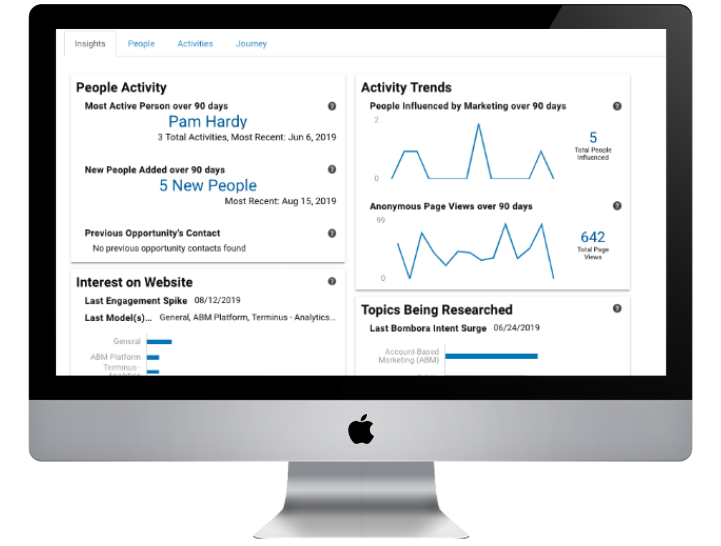
Our sales guys like the engagement spike reports, which can be useful for prompting them to reach out to their contacts.