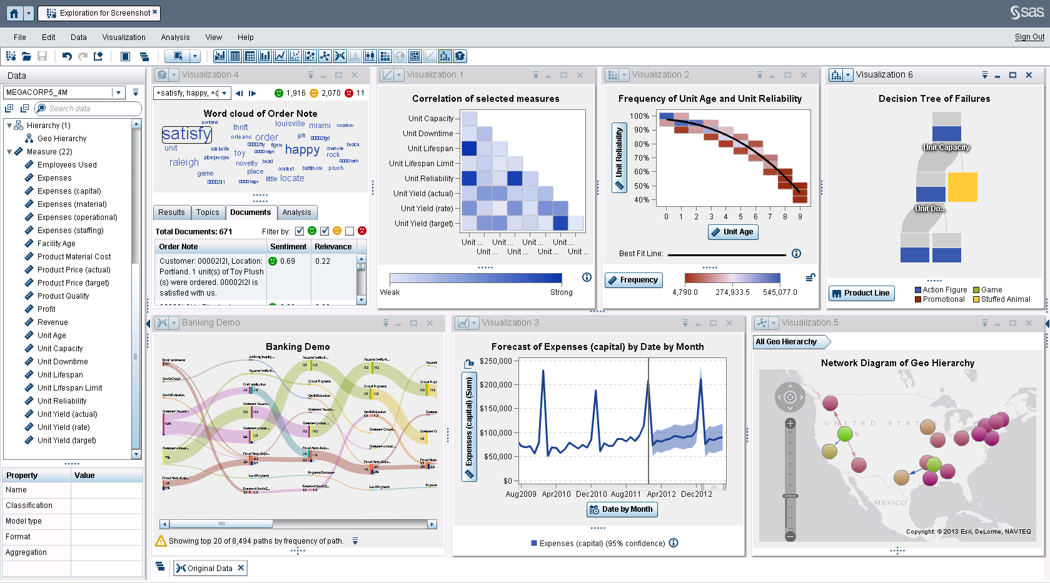
SAS Visual Analytics provides a complete platform for analytics visualization, enabling users to identify patterns and relationships in data that weren't initially evident. Interactive, self-service BI and reporting capabilities are combined with out-of-the-box advanced analytics so everyone can discover insights from any size and type of data, including text.
N/A
Mathematica
Score 8.2 out of 10
N/A
Wolfram's flagship product Mathematica is a modern technical computing application featuring a flexible symbolic coding language and a wide array of graphing and data visualization capabilities.
$1,520
per year
Pricing
SAS Visual Analytics
Wolfram Mathematica
Editions & Modules
SAS Visual Analytics for SAS Cloud
$0
Annual By Users: 5, 10, 20
Standard Cloud
$1,520
per year
Standard Desktop
$3,040
one-time fee
Standard Desktop & Cloud
$3,344
one-time fee
Mathematica Enterprise Edition
$8,150.00
one-time fee
Offerings
Pricing Offerings
SAS Visual Analytics
Mathematica
Free Trial
Yes
No
Free/Freemium Version
No
No
Premium Consulting/Integration Services
No
No
Entry-level Setup Fee
No setup fee
No setup fee
Additional Details
SAS Visual Statistics and SAS Office Analytics are also available as add-ons.
Discounts available for students and educational institutions. The Network Edition reduce per-user license costs through shared deployment across any number of machines on a local-area network.
More Pricing Information
Community Pulse
SAS Visual Analytics
Wolfram Mathematica
Considered Both Products
SAS Visual Analytics
Verified User
Anonymous
Chose SAS Visual Analytics
I have chosen SAS Visual Analytics because one of my colleagues suggests using the software for the same for our work. As earlier, we use to take a lot of time in analyzing the data but after using the SAS Visual Analytics software our work has improved and time has decreased. …
I have used Crystal Reports, Jaspersoft and SQL Server Reporting Services (SSRS). I would recommended Business Intelligence over SSRS and Crystal Reports. SSRS is very SQL-centric and Crystal Reports is more of an end-user tool. I would recommend Jaspersoft over Business …
We already have lot of SAS products in our organisation like Base SAS, SAS Grid, SAS EG, SAS Studio and Office Add-in. SAS VA works best for our situation.
I have used SAP Lumira as well. The reason for me to use both software is to see the user experience. With Lumira, it was easy for me to visualize data and data storytelling and with SAS it was easy for me to create an algorithm as I wanted them to be. SAS software allows me to …
Price and features we looked at seemed consistent. We chose this product because our staff already knew the product, plus users at the state had recommended it as it is what they use.
I have used Tableau desktop for which free access is provided for a limited time with limited features. Tableau is visually more appealing than SAS VA but SAS VA can handle data better. My use of Tableau with limited features may have effected my viewpoint.
We use both. But SAS is always the starting point to all analytics projects. It is a wider array of products and features. Gives robust results and reporting is easier. There is always this one or two things for which you turn to some other products to fill the holes.
Consultant SAS Business Intelligence Architect and Analyst
Chose SAS Visual Analytics
There is no contest. SAS is easier maintain and has much more in the way of analytics than MicroStrategy has. It can pull from more than one data source and when the underlying architecture changes, it is much easier to maintain. More savvy analysts can perform more with SAS …
Projektspezialist bei Steffen Jäschke EinzUnt Physik, Berechnungen
Chose Mathematica
There is no other alternative that Maple from Maplesoft all over. There are other systems for mCAx that do not offer the richness and coverage of mathematical features. For example Matlab that restricts inself to matrice calculation and only the the right set of addon library …
Well, Mathematica is free at my university. As a graduate student, you can download and install Mathematica in your device after log in through your university email. Second, it has very nice platform. You can use Mathematica for many data analysis such as plotting, integration …
Matlab is an excellent tool, but it can't handle analytic manipulations in algebra, calculus and differential equations. Matlab is superior when it comes to a less steep learning curve. In terms of using only one tool for analytic and numerical calculations, Mathematica wins. …
Mathematica is good solution in some cases but doesn't perform well in other regions. Mathematica is good in solving mathematical problems but not performs well in machine learning areas. I would suggest to use TensorFlow or Keras for machine learning. Also it performs good for …
The ability to manipulate algebraic expressions, nested lists, and data structures in Mathematica was unequalled when I first did the comparison. Since then, I've stuck with Mathematica mostly because it's "the tool I know."
We have evaluated and are using in some cases the Python language in concert with the Jupyter notebook interface. For UI, we using libraries like React to create visually stunning visualizations of such models.
Mathematica compares favorably to this alternative in terms of …
We selected Wolfram Mathematica as it offers lot of functionality that other products like MATLAB or sageMath do not have. And it also has advantages on the feature that it does share in common with other tools like sageMath, MATLAB etc. It is more powerful than MATLAB. It …
I think IBM Watson analytics is good alternative to Wolfram Mathematica. A few advantages of Mathematica over IBM Analytics is that Mathematica comes with a lot of inbuilt things like neural networks, predictive analysis geometry. And IBM analytics does not show the step by …
SAS Business Intelligence is more suited to organizations which are already using SAS as the primary software for their analytics needs. Learning curve is relatively shorter for teams already skilled in BASE SAS. For organizations already working with open source software like Julia and Python, it doesn't make much sense to use SAS BI.
We are the judgement that Wolfram Mathematica is despite many critics based on the paradigms selected a mark in the fields of the markets for computations of all kind. Wolfram Mathematica is even a choice in fields where other bolide systems reign most of the market. Wolfram Mathematica offers rich flexibility and internally standardizes the right methodologies for his user community. Wolfram Mathematica is not cheap and in need of a hard an long learner journey. That makes it weak in comparison with of-the-shelf-solution packages or even other programming languages. But for systematization of methods Wolfram Mathematica is far in front of almost all the other. Scientist and interested people are able to develop themself further and Wolfram Matheamatica users are a human variant for themself. The reach out for modern mathematics based science is deep and a unique unified framework makes the whole field of mathematics accessable comparable to the brain of Albert Einstein. The paradigms incorporated are the most efficients and consist in assembly on the market. The mathematics is covering and fullfills not just education requirements but the demands and needs of experts.
Mathematica is incompatible with other systems for mCAx and therefore the borders between the systems are hard to overcome. Wolfram Mathematica should be consider one of the more open systems because other code can be imported and run but on the export side it is rathe incompatible by design purposes. A better standard for all that might solve the crisis but there is none in sight. Selection of knowledge of what works will be in the future even more focussed and general system might be one the lossy side. Knowledge of esthetics of what will be in the highest demand in necessary and Wolfram is not a leader in this field of science. Mathematics leves from gathering problems from application fields and less from the glory of itself and the formalization of this.
SAS BI makes it very easy to create interactive dashboards even for someone who is not from an IT background. For some specific requirements, basic knowledge of SQL is good enough.
A lot of functions have been predefined which makes it very convenient to create dashboards and reports. One doesn't need to be from an IT or a programming background to understand and create dashboards.
It supports other programming languages like R and also has a seamless API integration with various data management platforms.
There is no other product that can match SAS. There are some products that can compare to ETL but lack the analytics that SAS has. Others can perform a limited set of analytical procedures but lack the data processing that comes with SAS. Using thin client allows users to access data whenever they have an internet connection.
SAS BI is good for creating reports and dashboards and then sharing it with the users. It also has ability to manage access to the reports and dashboards but somehow with most of the world moving to open source languages R, Python and Julia, SAS BI feels to be archaic in terms of feature set and integrations it allow[s]. Also, comparing it with other Business Intelligence tools like Tableau and Microsoft BI, the functionality of SAS BI is very limited and doesn't justify the pricing.
When you call tech support, you are immediately routed to a person who can answer your question. Often they can answer on the spot. However, if they cannot, you are given a track number and then followed up with. There have been times when I have had multiple track numbers open and they will actually TRACK YOU DOWN to ensure that your problem has been resolved. Issues do not fall into black holes with SAS. They are also willing to do a WebEx with you to diagnose the problem by seeing your environment, which is always helpful.
Wolfram Mathematica is a nice software package. It has very nice features and easy to install and use in your machine. Besides this, there is a nice support from Wolfram. They come to the university frequently to give seminars in Mathematica. I think this is the best thing they are doing. That is very helpful for graduate and undergraduate students who are using Mathematica in their research.
I have chosen SAS Visual Analytics because one of my colleagues suggests using the software for the same for our work. As earlier, we use to take a lot of time in analyzing the data but after using the SAS Visual Analytics software our work has improved and time has decreased. It's very helpful for us.
The ability to manipulate algebraic expressions, nested lists, and data structures in Mathematica was unequalled when I first did the comparison. Since then, I've stuck with Mathematica mostly because it's "the tool I know."
Mathematica is our "go to" environment for developing solutions for our clients, so I suppose you could say that it is solely responsible for our revenues. On occasion we do use other platforms but Mathematica is a core component of our offer to clients.