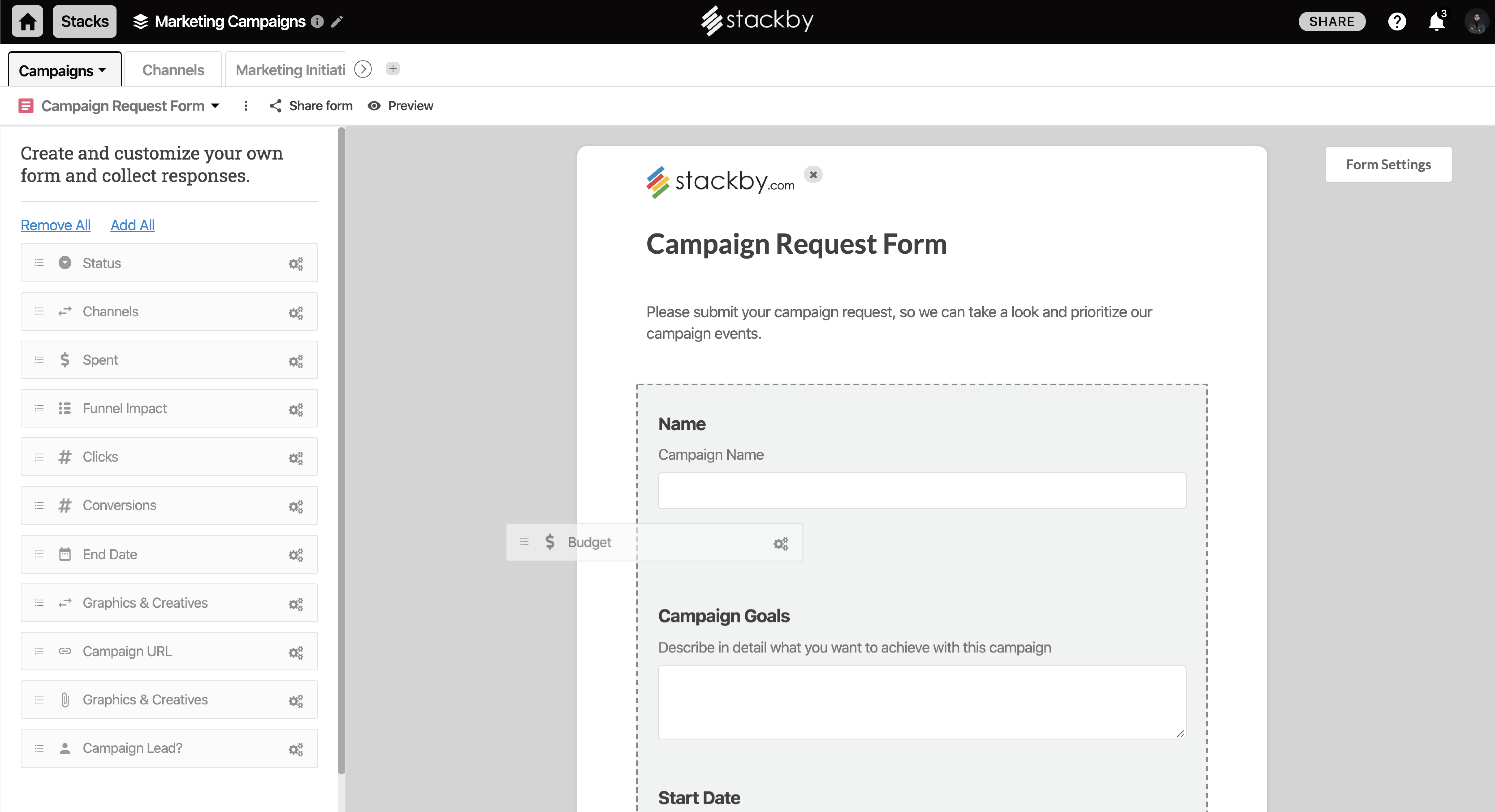
Stackby is designed to bring together the simplicity of spreadsheets, the functionality of databases and integrations with best business APIs to let anyone build their own tools, the way they want. No coding needed. Users can build a database from scratch, import data from pre-existing sources like spreadsheets or Google Sheets, or choose from over 100 pre-built templates across multiple categories. Stackby offers over 25 unique column types like text,…
$6
per month per user
Wrike
Score 8.3 out of 10
Mid-Size Companies (51-1,000 employees)
Wrike is a project management and collaboration software. This solution connects tasks, discussions, and emails to the user’s project plan. Wrike is optimized for agile workflows and aims to help resolve data silos, poor visibility into work status, and missed deadlines and project failures.
$0
per month per user
Pricing
Stackby
Wrike
Editions & Modules
Personal
$6
per month per user
Economy
$10
per month per user
Business
$20
per month per user
Business Plus
$35
per month per user
Enterprise
Custom
Wrike Free
$0
per month per user
Wrike Team
$10
per month (billed annually) per user (2-15 users)
Wrike Business
$25
per month (billed annually) per user (5-200 users)
Wrike Enterprise
Request a quote
per month per user
Pinnacle
Request a quote
per month per user
Offerings
Pricing Offerings
Stackby
Wrike
Free Trial
Yes
Yes
Free/Freemium Version
Yes
Yes
Premium Consulting/Integration Services
No
No
Entry-level Setup Fee
No setup fee
No setup fee
Additional Details
20% discount for annual pricing.
Every premium plan begins with a 14-day trial period.
Airtable is the "gold standard" when it comes to relational databases. SmartSuite is the "gold standard" when it comes to how nice a relational database can look. Stackby takes a cue from Airtable in how it delivers and interacts with data, and it offers a better cost …
As an Airtable user, I was glad to see an available alternative. Stackby has ticked the boxes and exceeded my expectations. They also continue to grow and improve the service, making it even more appealing and valuable. Support has also been responsive and consistent. I would …
The use case and feature set against airtable is equivalent if not better and the offer of LTD access as well as specific add-ons make Stackby the better choice every time.
We have been using Airtable so often but once your team grows it costs a lot of money, to be honest. Stackby could be a great fit for our team but of course, Airtable is a more mature tool. I'm really hoping that Stackby reaches the level of Airtable at some point one day. For …
This is a legitimate competitor to Airtable! They are well on their way to meeting the feature set offered by this much bigger and older company. Stackby has done some amazing things with this platform, and I hope they continue their great work to keep improving and already …
I am a paying user of both Stackby and Airtable. I use both both as there are some shortcomings of both.
Airtable is more developed and useful on both desktop and mobile, whereas Stackby is not. Airtable has useful internal automations, dashboards and a huge online community, …
We chose Stackby over Airtable primarily because Airtable does not currently have the option to pre-fill default data in a cell. This feature alone is a huge time saver and allows us to skip cells that contain necessary, but redundant data.
I think Wrike is comparable against these competitors - it reminds me of Trello the most in terms of interface. I did not personally select Wrike, I am a user, not the purchase decision maker.
I like Wrike best. I liked Asana, but I think it got too pricey for the features that we wanted out of it. Notion was fine, but I think its ability to integrate with the rest of our tech stack proved difficult. Trello was fine, it was early in my career and I remember its ease …
I'm in the process of evaluating ClickUp, and so far, it seems far more robust in the areas that matter (integrations, automation, speed, ease of use) where it could apply to small and medium orgs. I have another call with ClickUp and if their pricing holds, we may end up …
Jira is really geared towards IT organizations. It is far more complex to use so it has a steeper learning curve, but once you get the hang of it, it does have more customization capabilities and it offers more functionalities, such as extra fields, types of graphs, etc.... …
Wrike provides multiple use cases on managing workflow through the various range of functionalities provided. Trello more so provides a straight forward way to obtain a full scope view of projects, but Wrike is more comprehensive in managing all stages.
We use both Wrike and Smartsheet to satisfy our necessities. Smartsheet gives us a platform to input more information, while in Wrike we stablish contact with our customers for proofing before product development; information that goes directly into our Smartsheet once the …
ClickUp and Wrike look very different - when I think of Wrike, I think of larger tasks, but ClickUp I used for smaller lists & used the calendar view more.
Great for large project and/or complex projects. However there can be a learning curve. I would possibly choose a different platform if I am working with non-techy team members.
Wrike is better than both as it allows for greater visibility and is more similar to an excel based system, which i think has a much better initial understanding of all users.
Wrike has been a helpful benchmark of industry standard. Many people who have used other similar platforms have been able to easily transition to Wrike.
I have used inhouse project management tool in my previous company. It was very slow compared to Wrike, visualisation is better in Wrike, they did not have customised template increasing repetitive work, the tool used in previous company was very slow as it takes like a lot of …
Figma is similar in many regards from the ways I've used it. Wrike is far superior to Workamajig in terms of visual language and ease of use; however, Workamajig seems to be more robust for the expansive needs of an agency.
Wrike has a much deeper feature set than Trello, though does cost significantly more. Azure Devops is better suited to developer workflows out of the box but overall, I would be inclined to use Wrike due to the simpler UX/UI.
Wrike always works - it's always up-to-date, never down, and our one source of truth. I wish the mobile version of Wrike was more usable, but that's the only thing where Wrike may not be the front runner.
In my opinion, Wrike is very similar to Asana (Asana has Wrike beat when it comes to completing tasks. Who doesn't enjoy seeing a rainbow unicorn fly across the screen when marking a task complete). Jira is also very similar but a bit more robust as it integrates with Aha for …
Based on my experience, I can provide specific scenarios where Stackby is well suited and others where it may be less appropriate: Project Management: Stackby is an excellent choice for project management scenarios. Its ability to create custom databases, track tasks, assign responsibilities, and collaborate in real-time makes it highly effective for managing and monitoring project progress. CRM and Sales: Stackby is well suited for managing customer relationships and sales processes. Its customizable database structure allows for organizing customer information, tracking leads, managing deals, and generating reports. The ability to integrate with other tools further enhances its usefulness in CRM and sales workflows. Content Planning: Stackby is a great fit for content planning scenarios. Users can create databases to manage editorial calendars, track content ideas, assign tasks to team members, and monitor content performance. Collaboration features facilitate seamless content collaboration and ensure timely publishing.
Negotiations often involve long timelines and multiple rounds of discussion. Wrike allows us to assign clear ownership, track due dates, and monitor progress so that nothing stalls or gets lost. Redlines, proposals, and finalized agreements can be stored and shared within Wrike, reducing reliance on scattered email chains and ensuring everyone is working from the most current version.
different views to accommodate different users workflow
predecessors and successors to tie tasks together and adjust dates as a group
Being able to see other people's workloads so when I am planning my projects for the upcoming quarter, I can set a project delivery date that is better suited to workload and is more realistic
Implement the same views available on desktop into the mobile app
Internal automations (like Airtable)
Ability to implement and display info as a dashboard (like Airtable)
Polish up the formatting of formulas, inputting them causes user frustration due to the formula input cursor jumping around
Better intelligence and ease of inputting data in bulk i.e have the fields automatically identify what data is being input and format appropriately (like Airtable does)
For example, let's say we are onboarding a new client. There are certain tasks that need to be done. It would be great to be able to create a new project and have certain tasks preloaded.
Importing.
Importing may seem easy, but there is so much nuance to it. The fact that you need to make sure the parent task comes before child tasks is very difficult to do without the help of AI. Also, I am not sure it is possible if you have a thousand tasks to import, to make sure that you have a folder structure and parent/child tasks.
I also find that the documentation is lacking and the 2 import methods lacking as well.
Customize my inbox. When I log into Wrike, my Inbox is the first thing I see, but this doesn't show the full picture of what I want it.
I wish that Wrike had more drag and drop functionality that would be connected to assignee and also I wish that the finish date of a task would update to the date where you checked completed. It does not do that. Also finishing a task doesn't move the start date of the next task it "protects your time in that way", but our management team wants us to quickly see what we have down the pipeline rather than having to scroll down the list of upcoming tasks.
Stackby is overall pretty easy to use, especially if you're used to something like Airtable or SmartSuite. Some of the pages seem like near exact clones (though they put their own creative spin on things). I'd prefer a slighty fresher interface (like SmartSuite), but I'm willing to sacrifice that for the better price and great customer service.
I love the way task management is designed within Wrike. The full overview, followed by sequential updates, really works for us - this way, we don't need to go into individual people's work subtasks to find what's happening with a project. That's very useful from a project management perspective. The to-do feature also lets everyone access info in one place.
Over two years of (almost) daily usage without outages. Don't remember any errors. I give it 9 only because some Wrike plugins (for online document edit) are based on NPAPI architecture. These types of plugins are being phased out in new browsers, and NPAPI plugins are disabled by default in recent versions of Chrome so you have to do some browser adjustments when you switch browsers or move to another computer.
Wrike tasks loads fine, but I hate clicking files and wait for a bit of time since it is powerpoint or word, Wrike assumes I want to open those on Wrike. My suggestion is to link it to office 365 so we do not need Wrike based decoder for PPTX and DOCX
We've had so many questions during the establishment of Wrike for our team, and the Wrike support team has exceeded our expectations. Our team is naturally curious, and the Wrike support team has always been willing to hold conversations about how we can make an idea work, to show us hidden features that delight us, and to help us plan ways to build out projects efficiently. They meet our questions with multiple solutions and best practices
I love the Wrike training options. Wrike Discover has tons of courses, learning plans, certifications, etc. This is an area where Wrike definitely shines! I wish these resources were more in your face for new people, because it seems like a lot of coworkers didn't know all of this training was available to them.
There are a lot of bells and whistles in Wrike, and not all of it is easy or intuitive to understand once it's plopped in your lap. It's easier when there are a few choice people who understand Wrike as a platform and articulate it in such a way where it makes it easy to pass it along to others in the group
I have also tried Ora.Pm. Infinity has better graphical interface, but nowhere near as many features and the UI isn't as effective (i.e, moving around with keys). Grist has a much more technical interface and it comes from being more of a database/interactive spreadsheet vs Stackby. Grist has much more functionality in terms of formulas, but is much harder to learn to use and less other functionalities. Ora.PM is more of a test at a task management app, and doesn't compare - Stackby is much better.
Jira did not at all help us get our work done as content creators. I think that was because Jira wasn't quite right for our uses. Wrike fits our needs so much better. I can't tell you enough the relief I felt when we adopted Wrike and I never had to use Jira again.
Wrike has significantly enhanced our workflow and productivity, ensuring accuracy and efficiency meet high standards. Our work now reflects professionalism and top quality. Other departments have taken notice of how organized we are thanks to Wrike, and we take great pride in our work—all made possible by this platform
Wrike has improved our resource management significantly.
Wrike has improved the request intake process for us.
One negative impact of using Wrike is that we had to include Workato for some customised automations, which were not supported by Unito, but this can be on a need-to basis.