Adobe acquired Omniture in 2009 and re-branded the platform as SiteCatalyst. It is now part of Adobe Marketing Cloud along with other products such as social marketing, test and targeting, and tag management.
SiteCatalyst is one of the leading vendors in the web analytics category and is particularly strong in combining web analytics with other digital marketing capabilities like audience management and data management.
Adobe Analytics also includes predictive marketing capabilities that help…
N/A
Gainsight PX
Score 7.9 out of 10
N/A
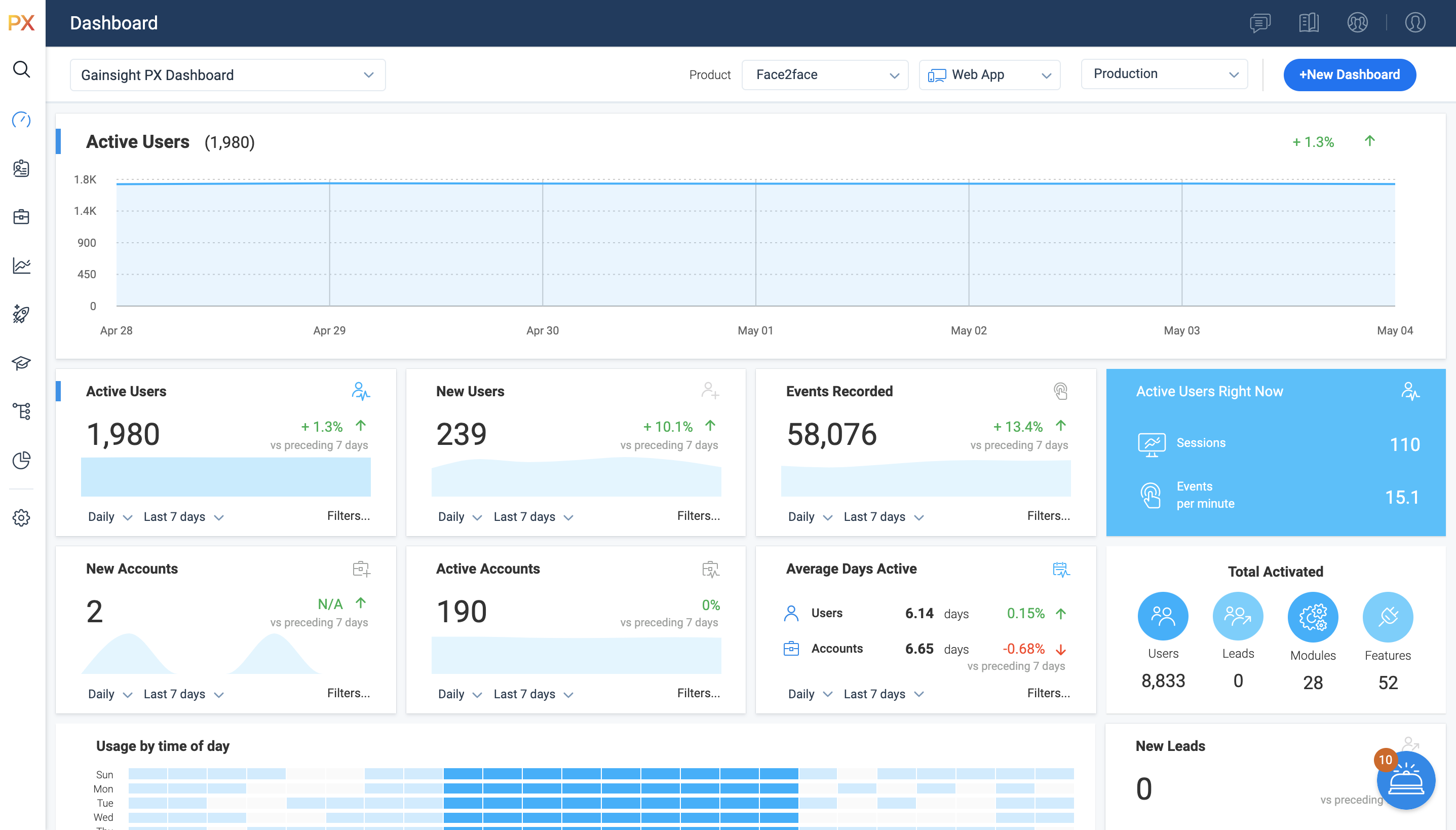
For SaaS products, Gainsight's product experience software enables companies to track every step of their user's journey and fully understand how they're interacting with a product over time.
Clients usually select Adobe Analytics because it suits them better than the alternatives and they want more customisation than GA4 offers. Also because they might be with Adobe Experience Cloud for a few other things like tag management, A/B testing, audience manager, campaign …
Historically I've looked at a lot of different products. More recently I'd say Mamo and Google Analytics. Those are probably the two big ones that I've seen around, so yeah.
It's more feature rich. It provides more dimensions, more breakdowns, and it also scales data better.
Many of our users come from a background of using Google Analytics. They like it, but Adobe Analytics gives them an ability for a more thorough analysis.
I used Google Analytics extensively but Adobe Analytics triumphs. It provides an overall overview which is extremely helpful. Google is a great tool for advertisement and I suggest you not go into that venture to keep your exclusivity. This makes Adobe Analytics amazing and …
Adobe is more sophisticated and customizable but Google UI is a lot cleaner and nice that it connects with Gmail data so you can see demo of people going to your site/app.
Adobe Analytics is a comprehensive tool that enables an entire tracking and analysis stack for our company. The other tools listed above more supplement our adobe analytics tool and do not serve as replacements, hence why we continue to use and choose Adobe for our company and …
I have used and evaluated a few similar products to Gainsight PX, including Appcues, WalkMe, and Pendo. I found that Gainsight PX was the most comprehensive and user-friendly platform, offering features such as customizable onboarding flows, product usage tracking, and …
We leaned towards Gainsight PX because of the tight integration with Gainsight. Implementations were somewhat similar but the ease of mapping for all features and modules was superior for PX.
It's been a couple years since I've used Pendo and admittedly we were not set up in the best way for Pendo to work like we have PX. Specifically I am referring to how our elements were tagged.
That being said, here is what I recall as main differences:
The feature on Gainsight PX are easy to understand and implement in the solution, the pricing is also very competitive and functionalities like Customer health score, Customer monitoring, playbooks, surveys etc helps us to provide great insight to the team.
Heap has a great value proposition and very nice user experience. But it lacks the clear funnel analysis that Gainsight PX provides. Plus Heap also does not have integration with a lot of CRMs and Customer data platforms. Also, Additionally if you go in the market to find Heap …
I did not select Gainsight and we recently switched some of our products to other software which give us better targeting options but are more difficult to implement.
Mixpanel was much less mature when we ditched it for Gainsight, and the Salesforce integration was very important to us, and Gainsight was the main service that offered it at the time. Mixpanel is probably better today if you look at the big picture, and don't need a specific …
Churnzero is similar in its NPS and walk-through abilities as is user IQ but neither fits in the exact same category. Px is unique to anything I've used for the data extraction it offers. It's not a CS tool like those I mentioned but it is easily the best in terms of tracking …
HelpHero is a very flexible and powerful walkthrough tool. We've used it alongside PX. We still use PX for most customer messages, CES surveys, and in-app badges.
I also evaluated Pendo, WalkMe, and a few other DAPs.
Between the products analyzed, Pendo and Gainsight PX were most complete/mature. At the time, Pendo's UI seemed more intuitive than Gainsight PX. Chameleon and Appcues seemed easiest to use, but were lacking some of the functionality we were looking for. Ultimately chose …
Working with both Gainsight PX and Mixpanel, my experience has been that the integration of Gainsight PX was much easier. Additionally controlling profiles and personas to make sure each group is getting the data they need, and only the data they should see, is easier with …
The main reason is that Gainsight PX offers a perfect combo - analytics and customer engagement. That allows us to make the engagement contextual, based on real-time analytics results.
WalkMe: while the in-app engagements were powerful, there was no email capability, and the analytics were an afterthought (rather than a core part of the solution). WhatFix: the concept was great; the in-app engagements could be made into documentation and videos. However, we …
Maybe for a small company with small products for their thing, Adobe may be bit of an implementation too much for them, but when it comes to companies like us, like a life sciences or large enterprises and even small enterprises, but with more products, more analysis that they need to make their marketing experience better, maybe Adobe product is the best suitable.
It’s a robust tool that allows you to easily map and track key features and actions within your products. It also allows for in app communications to help guide the user through the path you want them to follow. The ability to connect with Gainsight CS also allows you to leverage that data to drive actions for the account team, incorporate it in health scoring, and use it to trigger digital programs. You do need a well thought out strategy for management of the platform, the data and how you will use it.
eVars (love, wish there was more but I heard they are unlimited in AJA)
Projects. The transition from Reports to Projects was easier for me to navigate than I thought it was going to be.
Adobe Templates. Again with the love. Nothing helps me more than copying a template and then deconstructing it to see how it works and reconstruct to how I want it to be.
Mapping your product is easier with PX than with Google Analytics (mapping your product makes usage data appear as hits on mapped URLs, buttons, etc)
PX is good at showing simple messaging popups to customers.
PX Badge functionality—a persistent hover- and click-enabled popup launcher, positioned on select pages and attached to select elements—works well as a self-serve resource for users. It can be unobtrusive yet right there when needed.
PX modal content is fully editable HTML with plenty of flexibility.
Audience filters are really powerful. You can target users by many built-in and dev-configurable attributes, like device-type (which helped me work with mobile web users), browser, account, parts of the application visited/used in the last day, and many more.
Our site has about 250,000 definitions pages on dictionary.com. We've got about 150,000 synonym pages across the source.com. So very high volume of pages. As you can imagine, most of these are pretty low traffic. You've got maybe that top 5%, 10% are really driving a huge amount of traffic, but then you have all these really obscure things out there. There's still a lot of important information you can get there and oftentimes in our Adobe Analytics reporting suite, it'll kind of bundle things at low traffic at a pretty low threshold for us to get to. So that can be a limitation when we're trying to do some really detailed keyword analysis. The way we've gotten around that is we make use of the data feed and the export. So we make the data available to our analyst in more of that raw state. So when they really do need to truly get into that weeds data, we don't run into that low traffic limitation.
New pricing models are very expensive compared to old pricing model, even though it includes several additional tools, most of which seem to be beneficial
Horrible support experience despite working with escalation teams to try and resolve
Several bugs in recent releases which remain unresolved for many months at a time
Sometimes the processing times are very long. I have had reports or dashboards time out multiple times during presentations. It could be improved. It is understandable since there is a huge data set that the tool is processing before showing anything, however for a company that large they should invest in optimizing processing times.
It is a good product, but like with every product, there is room for improvement or even just things I, as a user, would prefer, such as the ability to click on a company and have it go to Salesforce instead of Insight. It can also be difficult to find certain reports.
I do not ever recall a time when Adobe Analytics was unavailable to me to use in the 8 or so years I have been an end user of the product. My most-used day-to-day analytics tool Parse.ly however, generally has a multiple hours planned offline maintenance every two to four weeks, and sometimes has issues collecting realtime analytics that last anywhere between 15 minutes to an hour, and happen anywhere between 1 to 5 times a month.
Overall, Adobe's servers seem responsive. Like any large-scale SAS provider, they can have occasional slowdowns where, I presume, a node is not available and other servers get bogged down with the user load. I have noticed this with both large and small data sets and reports.
On that note, Adobe Analytics can take a long time to run reports and pull various data points, depending on the period of time, number of metrics and segments applied. As you create reports, particularly in Workspace, the data are pulled in real-time while you're creating the report. This can often cause issues while trying to drag more metrics into the interface when certain elements of a table are grayed out because data is being pulled in.The more data points and segments involved, the longer it takes to update. When you look at larger windows of time, it takes even longer. If one were to compare to Google Analytics or one of the open source products like Piwik or Motomo, Adobe seems much slower. However, Adobe also supports far more variables than other web analytics products.
I barely see any communication from Adobe Analytics. The content on the web is also not that great or easy to read. I would recommend a better communication about the product and the new addons information to come to its user by a better mean.
I have not had to contact support frequently but when I have I used the chat and my questions were answered immediately. I've also used their knowledge center, help documentation and training videos which are all very thorough. The support we've received from our Customer Success Manager has been helpful as well.
It was a one-day training several years ago that cost the organization several thousand dollars. There were only about 10 people in the training class. Adobe tried to cram so much information into that one-day class that none of our users felt like they really learned anything helpful from the experience. Follow-up training is too expensive
The online training for Adobe SiteCatalyst consists of short product videos. These are ok, but only go so far. For a while Adobe charged a fee for this, but recently made these available for free. There are many great blog posts that help users learn how to apply the product as well.
It is a large effort to implement. Throwing a developer with zero experience with Adobe Analytics with no support is a REALLY BAD IDEA!!! Having experienced developers working as a team is crucial to a strong implementation. I say this because I have experienced both scenarios. I was the only developer on an implementation project and I had no experience with Adobe Analytics. As a result I made many architecturally bad decisions which lead to a rigid fragile implementation that eventually was scraped. It took some hard lessons to learn that Adobe Analytics was not as simple as their sales reps make it sound. Using the Adobe Dynamic Tag Manager made sequential implementations incredibly STRONG. Having a DTM to manage the code was a miracle and a life saver!!! If you plan on doing a big enterprise level implementation, please seriously consider using the Adobe Dynamic Tag Manager!!! it made code maintenance super slick and easy which is super important for a developer!!!
Historically I've looked at a lot of different products. More recently I'd say Mamo and Google Analytics. Those are probably the two big ones that I've seen around, so yeah. It's more feature rich. It provides more dimensions, more breakdowns, and it also scales data better
I have used and evaluated a few similar products to Gainsight PX, including Appcues, WalkMe, and Pendo. I found that Gainsight PX was the most comprehensive and user-friendly platform, offering features such as customizable onboarding flows, product usage tracking, and automated customer success workflows.
My organization uses Adobe Analytics across a multitude of brand portfolios. Each brand has multiple websites, mobile apps and some even have connected TV apps/channels on Roku and similar devices. Adobe can handle the multitude of properties that have simple, small(ish) websites and the larger brand properties that include web, mobile and connected TVs/OTT devices.
Each of those larger brands has multiple categories and channels to keep track of. We can see the data by channel/device or aggregate all the data together. This gives our executive teams the full picture and the departmental teams the view they need to see their own performance.
Adobe Analytics impacts nearly every aspect of a billion plus dollar revenue eCommerce business. From measuring the impact of new build features to marketing campaigns.
We are saving substantial money and resource effort by consolidating all of our properties to Adobe Analytics from alternative solutions, at which point we will finally be able to report on Total Digital, rather than disparate reports.
We support experimentation on every platform and the performance is only known through Adobe Analytics tagging.
Customer Sentiment. Customers have been excited when we can show them data around usage and where we can improve.
Deciding to remove features. We have used PX to identify features that have little to no usage which allows us to get rid of unnecessary process and maintenance.
Identifying areas of improvement. We are able to find areas of our product that we need to focus on improving where previously we would have missed or had a tough time justifying spending time and resources.