Adobe Marketing Cloud is a suite of products including analytics, social, advertising, targeting and web experience management. It comprises foremost the popular integrated web content management and digital asset management (WCMS / DAM) solution Adobe Experience Manager, Adobe Campaign's cross-channel campaign management and marketing resource management capabilities (based on technology acquired with Neolane in 2013), the Adobe Audience Manager data management platform, analytics, and other…
N/A
monday.com
Score 8.6 out of 10
Mid-Size Companies (51-1,000 employees)
monday.com Work OS is an open platform designed so that anyone can create the tools they need to run all aspects of their work. It includes ready-made templates or the ability to customize any work solution ranging from sales pipelines to marketing campaigns, CRMs, and project tracking.
$12
per month per user
Pricing
Adobe Marketing Cloud
monday.com
Editions & Modules
No answers on this topic
Basic
$12
per month per user
Standard
$14
per month per user
Pro
$24
per month per user
Enterprise
Contact Sales
Contact us
Offerings
Pricing Offerings
Adobe Marketing Cloud
monday.com
Free Trial
No
Yes
Free/Freemium Version
No
Yes
Premium Consulting/Integration Services
No
No
Entry-level Setup Fee
No setup fee
No setup fee
Additional Details
—
Yearly plan: Save 18%
Monthly plan also available
More Pricing Information
Community Pulse
Adobe Marketing Cloud
monday.com
Features
Adobe Marketing Cloud
monday.com
Project Management
Comparison of Project Management features of Product A and Product B
Adobe Marketing Cloud
-
Ratings
monday.com
8.9
Ratings
15% above category average
Task Management
00 Ratings
9.50 Ratings
Resource Management
00 Ratings
9.30 Ratings
Gantt Charts
00 Ratings
8.40 Ratings
Scheduling
00 Ratings
8.60 Ratings
Workflow Automation
00 Ratings
9.60 Ratings
Team Collaboration
00 Ratings
9.40 Ratings
Support for Agile Methodology
00 Ratings
8.80 Ratings
Support for Waterfall Methodology
00 Ratings
7.00 Ratings
Document Management
00 Ratings
8.50 Ratings
Email integration
00 Ratings
9.40 Ratings
Mobile Access
00 Ratings
8.60 Ratings
Timesheet Tracking
00 Ratings
9.10 Ratings
Change request and Case Management
00 Ratings
9.60 Ratings
Budget and Expense Management
00 Ratings
9.20 Ratings
Professional Services Automation
Comparison of Professional Services Automation features of Product A and Product B
This is definitely a tool for enterprises. You need to have a certain level of complexity before you pay for this tool. You should have multiple funnels, websites, or an insane amount of content. If you are involved in ecommerce, this is a worthwhile investment. However, if you have a smaller site, little content, only a single funnel, or don't sell anything online, this is a much less worthwhile tool for you.
Here, I will suggest that it is best to create employees, clients, or project reports. Easy to track with the dashboards. I did many integrations and developments. I can not list each of them here. I will say the best tool for management. I couldn't see criteria of unsuitable. But yes It will depend on the client's requirements. I will suggest it as very user-friendly tool for CEOs, CTOs, Managers, and company owners also for team.
Adobe Marketing Cloud provides strong capabilities and applications that help better run digital marketing campaigns, manage content and understand an insight.
Adobe Marketing Cloud also provides tools to A/B test, CMS, and manage digital campaigns.
It also provides strong capabilities to get an insight with Analytics to better understand the user journey.
Adobe Marketing Cloud is fairly expensive compared to some of the other tools out there. While it does provide an excellent tool for the price, it can be a little daunting to some.
The learning curve with Adobe Marketing Cloud is fairly steep. When we bring on new employees that will work directly with the tool, it can take weeks until they are up to speed.
Like it mentioned before, the initial implementation was a fairly lengthy and complicated process. Staying on top of new campaigns does require quite a bit of knowledge of the tool and our process in order to be properly launched.
Ensuring I have set up a Private board vs public board is not clear - it would be useful to have an additional alert when creating a board as I work with sensitive information. It will eventually be used in a team based environment but while I test the boards, they needs to be private.
Time tracking is clumsy, could be easier to record
Although a powerful tool, Google Analytics has been catching up in capabilities and is much simpler to use. As analytics move to the spotlight, more sections in a company want to have access to it. However, creating straightforward reports/dashboards and sharing them with different groups is not a strength of Adobe Marketing Cloud.
Teams involved in content creation, such as marketing or editorial teams, could use monday.com to manage the entire content lifecycle. Boards might track content ideas, assignments, drafts, reviews, approvals, and publication schedules, helping teams collaborate and keep content production on track.
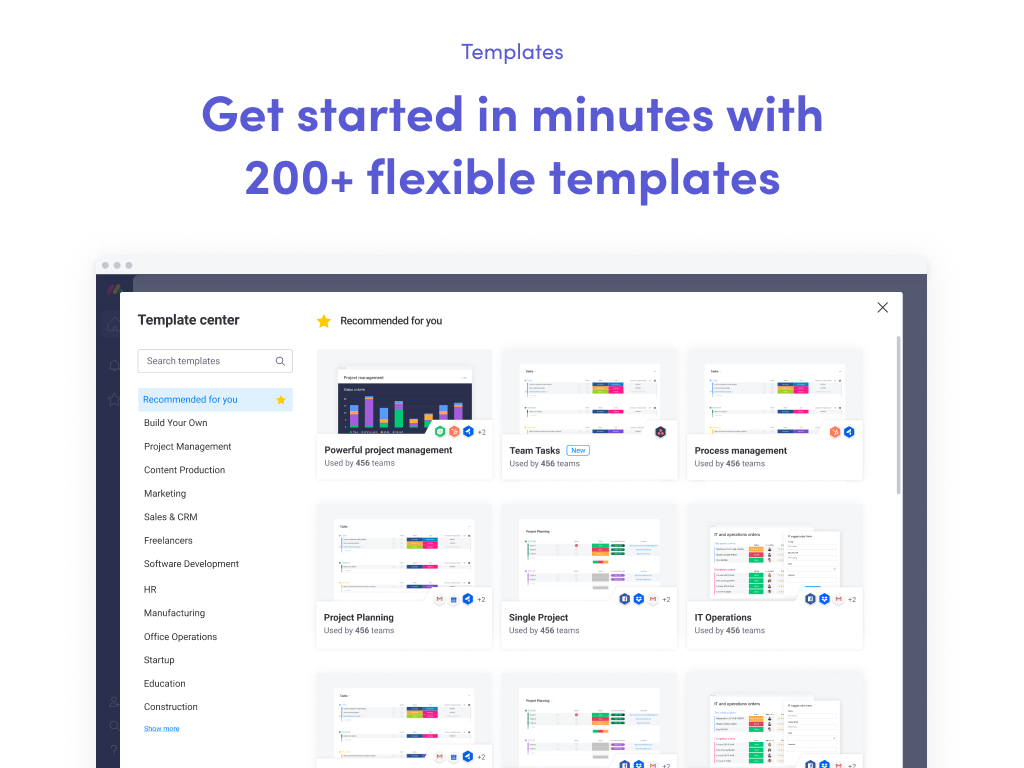
It's straightforward to use and simple to understand. They have tutorials on different elements of the system that you can learn. The workflow there is very intuitive, drag and drop, which doesn't require a learning curve for most people. Templates that also make things more accessible can be found.
Everything performs fairly well. Every now and then there are user errors where an employee will not click "ok" on a note they've created and simply exit out (I do wish that something was in place to prevent this, such as a pop "are you finished?")
monday.com only really care about accounts that have 20 seats or more. While this is great for monday.com, it pushes smaller organisations to evaluate alternatives. We rate monday.com highly in our organisation because key staff have already got good experience with the application and we know we will get to 20+ seats one day. But, till then the billing model and lack of permanent enterprise features is a dread.
To have someone walk you thru the features and capabilities of Monday.com is priceless. Someone also coming along later in the contract to see if you are maximizing the program to suit your company needs is beyond helpful. The staff that have provided this training are fun, creative and very patient.
We signed up for the accounts. Created the accounts. Ran the trial version and tested it live while we were running multiple projects and found that it was fitting our needs perfectly. When the trial ended and we were asked to purchase the full version, we did. We have found other ways to use it and it's a breeze.
Adobe marketing cloud was a strong fit for our agency, considering we already take advantage of Adobe Creative Suite for creative projects. Competitor marketing platforms have often been tempting to evaluate considering they are often far less expensive, but the extra costs of Adobe Marketing Cloud have been considerably offset when taking into account how much overhead and internal efficiency has been added to our process. That said, Moz and HubSpot, the two primary competitor platforms I have sampled, both had much better billing and estimating tools, a critical part of agency life. They also better handled the ever-changing social media landscape and were often quicker to adapt to emerging marketing trends.
We decided to go with monday.com because they offered a free tier for nonprofits and because they are easier to use and offered additional features that we could not find on the other choices. Hands down, there was no better choice for us than monday.com.
For it to work across multiple departments and sites, I would like to see improvements made with integrations and automation. For this question, I am acknowledging not only the addition of internal triggers/automation, but also an expansion on external ones.
Allowed us to increase the number of emails that went out the door without inundating our members with more email due to the levels of segmentation we could now activate.
We can add communication limits to make sure people only get a certain amount of messages from s in a given time period.
We decreased the time it took for a lead to make it to the sales team to a matter of seconds.
By using monday.com as an enablement tool for templated onboarding plans, we have been able to begin calculating the number of manager hours saved through our work (not defined yet).
monday.com's reporting tools also allow us to more easily report on the productivity and output of our team since we keep up with all projects and subitems in monday.com.