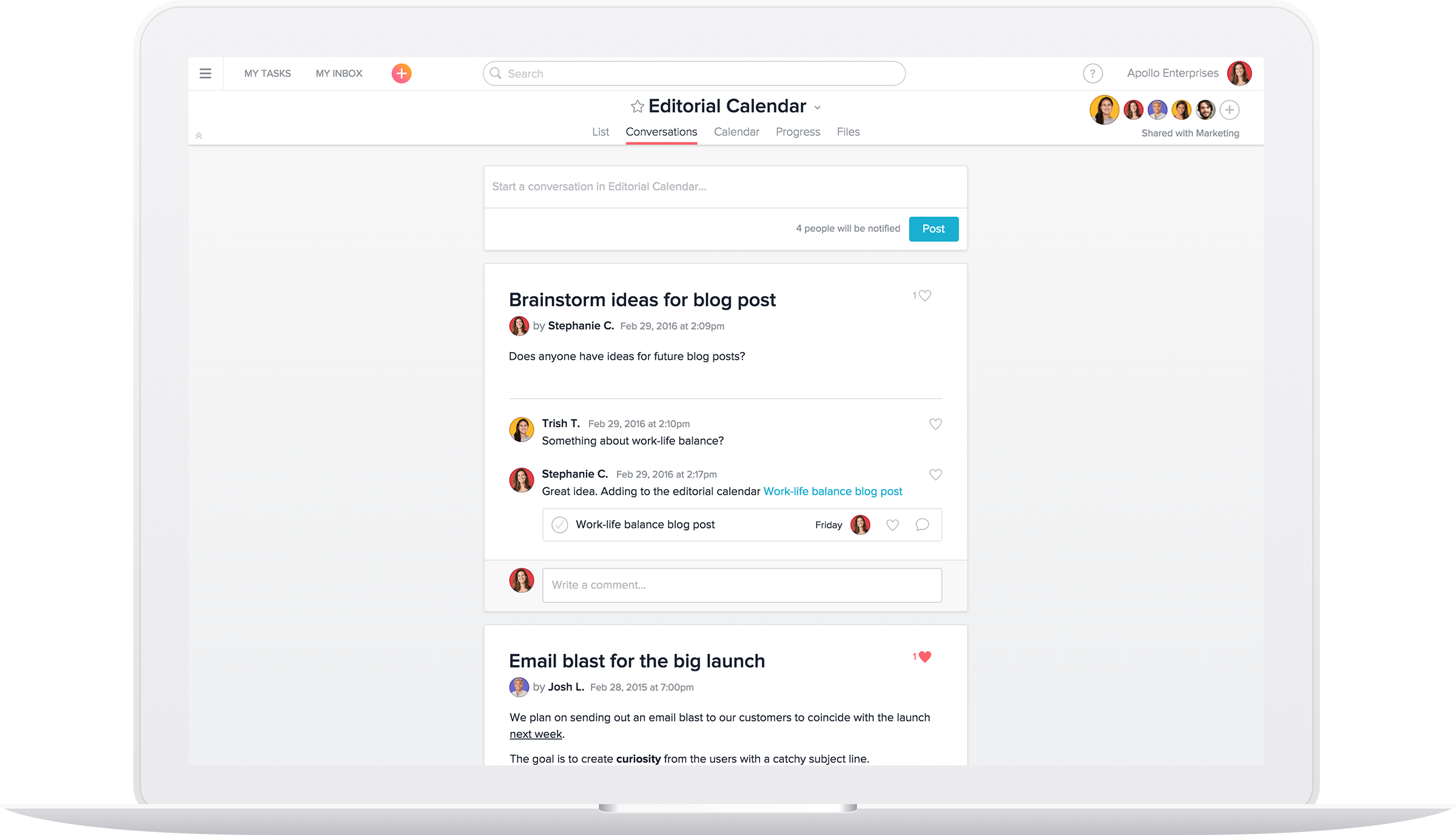
Asana is a web and mobile project management app. With tasks, projects, conversations, and dashboards, Asana lets an entire team know who's doing what by when, enabling workload balancing. Users can also add integrations for GANTT charts, time tracking and more.
$13.49
per month per user
OneNote
Score 8.4 out of 10
N/A
Microsoft's OneNote is a digital note-taking app, supporting photos, annotating, web page clipping, emailing, and synchronizing notes across devices.
N/A
Pricing
Asana
OneNote
Editions & Modules
Starter
$13.49
per month per user
Advanced
$30.49
per month per user
Enterprise
Contact Sales
Personal
Free
Microsoft OneNote
Free
Offerings
Pricing Offerings
Asana
OneNote
Free Trial
Yes
No
Free/Freemium Version
Yes
Yes
Premium Consulting/Integration Services
No
No
Entry-level Setup Fee
Optional
No setup fee
Additional Details
A discount is offered for annual billing.
—
More Pricing Information
Community Pulse
Asana
OneNote
Considered Both Products
Asana
Verified User
Anonymous
Chose Asana
Within our organization, most have fallen back to their old way of tracking tasks, which varies between paper and pen notes on sticky notes to OneNote to Microsoft To-Do, to Outlook Tasks, to Windows 10 Sticky Notes. These other tools have familiarity, ease of use, and …
For me, OneNote is way simpler and easier to use. Furthermore, the storage options was one of the key factors that I choose OneNote. Since it's a software for my PC, I can just store all the documents on my computer and I will never have the fear of running out of space and …
The usability of Asana is broad since it's available in a variety of platforms that are widely used nowadays. I think that it would be great for people who are constantly on the move and switching devices, since it has allowed me to work from my phone, too. I also think that Asana has proven itself to handle a large quantity of work
It is well suited for capturing weekly departmental task lists. For example, each week we create a new page in a shared departmental notebook. In this new page, each department member enters his/her top 3 accomplishments for the week and the top 3 things which the member will attempt to accomplish in the coming week. We then use this page during our Monday morning stand-up meeting and it helps provide an agenda, structure, and discussion points for the meeting.
OneNote synchronizes across platforms very quickly. I often find that notes entered, or updated, on my desktop are synchronized to my laptop and smartphone well before I ever open them up to access the information.
OneNote has apps for just every major platform available. This includes Windows, iOS, and Android. The web app has plenty of features so you won't feel let down if you have to access your notebooks through a browser.
The multimedia features of OneNote are wonderful. I can draw pictures, add sound bites, add videos, add files, and much more. This helps me capture the full context of a note, including any references that I might need, all within the note itself. I don't have to go outside of OneNote to find a video clip, logo, or soundbite.
OneNote could improve on its web clipping features. Evernote still beats it in terms of robustness, but OneNote is sufficient for most purposes.
OneNote could also improve on its tagging system. Its the other major way of categorizing notes, which Evernote uses to great effect, but OneNote de-emphasizes this in favor of a hierarchical ordering.
This is a silly point, but it drives me mad. OneNote's free-form editing on pages, meaning you can click anywhere and start editing makes for sloppier notes that aren't as well aligned. This could be an enjoyable feature for some, but for me, I like my pages orderly.
I just can't see us getting it off of Asana any time soon, despite the many headaches it has caused us. We have too much data in there, too much time & training invested into it, too much at stake to move. If we were just starting out today, fresh, I don't know for certain that I would absolutely go the same direction, but I *think* I still would. I just haven't seen anything better yet. Maybe if Podio's support staff hadn't treated me like a worthless nuisance to them, I might feel differently, but the fact is that their task management is simply inferior to Asana's. That can't be denied, and in fact Podio said it themselves: "Tasks are a simple function. They cannot be customized. Tasks in Podio can be used for quick to-do's for you and your team members." In our operation, however, prompt task completion is a big deal; one task can't be completed until another one is done first, and closing the gaps between those tasks is critical in meeting deadlines and servicing our customers. Asana gets us there, the others don't.
As this is not a compulsory tool in our organization, I would say all depends on the decision makers, however since this is a part of MS Office, I am sure we will have it for as long as we will possibly need it. However, I would not be so sure, if it was a separate product
It is very user-friendly. Takes a new employee an hour to start figuring out how the system works. That's an important factor. You don't want to encounter the issue where employees need a week to understand how the system works. For example, JIRA, I tried using it for a week and I still don't understand the complicated layout. Asana has a simple interface. Once you see it, you get it type of program.
It is easy to use day to day and has become a common use application like Outlook or Teams. There is little to no learning curve, and you can use it in the way that is most suitable for you. Features like moving sections of text around and creating new tabs is self-explanatory.
I find OneNote to perform very well. I experience quick load times and automatic updates which are two things that are very important to our organization. I personally do not integrate OneNote with other software or systems but I do like that it can generate a sharing link for other people to view.
I haven't had to use their support so I can't rate it. The fact that I haven't needed them reflects the ease of use of the product. I would recommend that any new users schedule a complete demo of the product to ensure that they are using it to it's fullest (there's a lot of useful features).
Since it is part of Microsoft Office and used across the globe there are a lot of support options available. It's quickest to just do a google search which will have plenty of articles to help you since there are so many OneNote users but as an Office customer you also have access to Microsoft support and I have had good experiences with their support (probably because I'm with a large company who is a large customer to them).
Asana is a top-tier project management software that helps us organize and track projects from start to finish. It allows us to apply tasks/to-dos to multiple projects without duplication, divide complex projects into smaller tasks, and track project progress. It also helps us organize work on Kanban boards or linear lists. It stands out from the crowd in a big way compared to the competition.
I’ll be honest, once I met OneNote, I knew my search was over. I found a software package that could do everything I needed and more. Pen and paper are helpful but not searchable, not private, not easily shared. Your notebook can be misplaced or stolen. You cannot use it to access websites with a click. I was a user of Lotus notes back in the day and though it had better function than pen and paper, I lost my entire notebook twice because of system issues and it didn’t have 1/10th of the function OneNote had
By giving employees this tool, each one can try to make the most out of it, and use it as they want. I know that many employees are utilizing features of OneNote every day, and it does help them to work more organized, and more efficiently.
I don't think there is any negative impact. Those who don't know how to use the tool are likely not to use it, so there is no risk for negative impact other than the cost of the license.