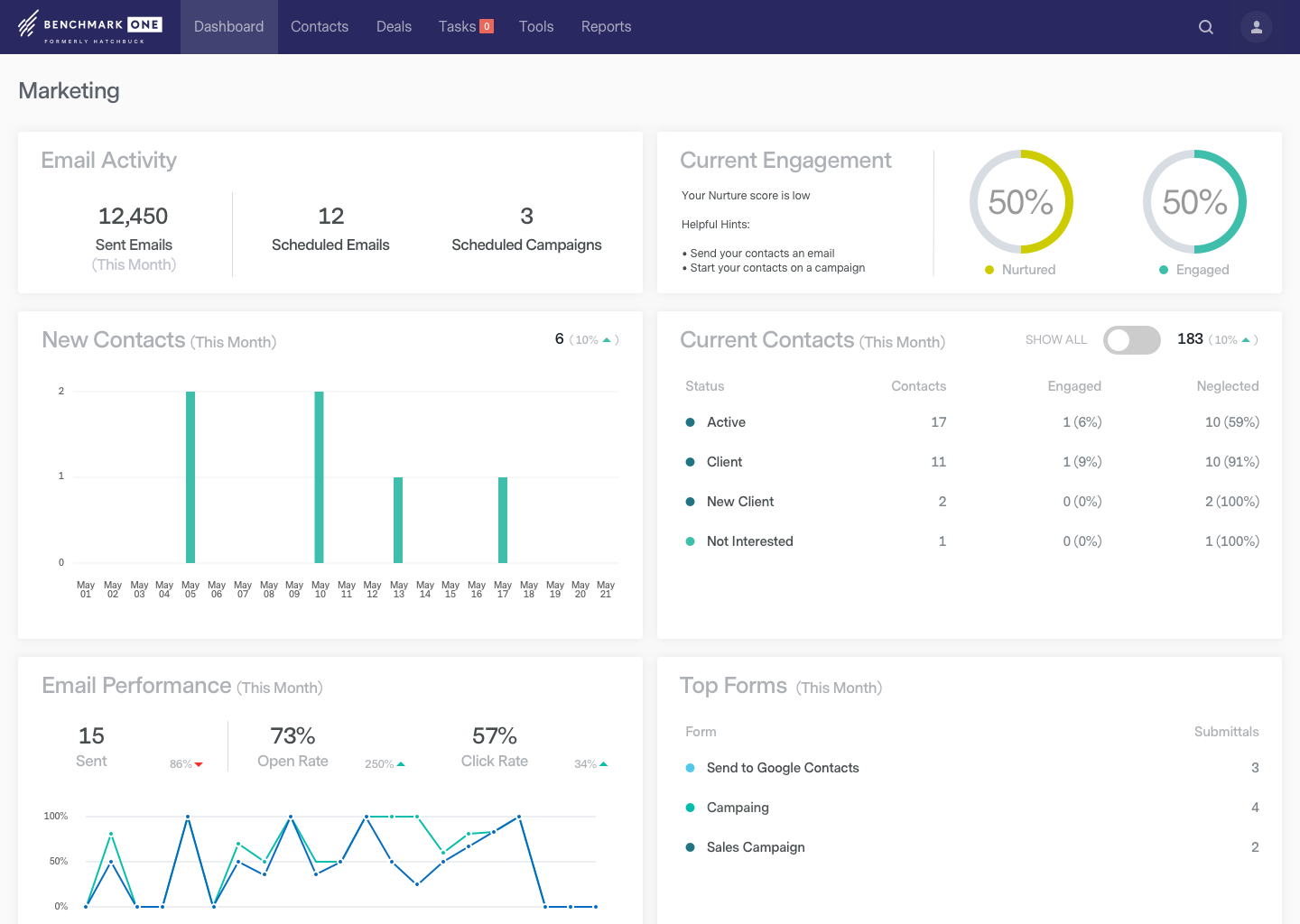
BenchmarkONE (formerly Hatchbuck) is an all-in-one sales and marketing software that includes CRM, marketing automation, and email marketing tools. Users can build online forms, manage and segment contacts, engage prospects with relevant follow-up, manage tasks, and track their pipeline.
$0
per month
Salesforce Marketing Cloud
Score 8.1 out of 10
N/A
Marketing Cloud is an AI-powered, cloud-based digital marketing platform within the Salesforce Customer 360 ecosystem. Marketers can segment their audience, deliver personalized messages, track campaign performance, engage leads and accounts, and optimize strategies based on real-time insights.
I have had more experience with Hatchbuck, and was introduced to it through someone who is quite familiar. My perspective is that for the money, Hatchbuck does all it needs to, and does it well. I'm sure there are comparable products, but this is the first one that I found …
Hatchbuck is my favorite. It's easy to use and it's budget-friendly. It's much more intuitive than SharpSpring or ActiveCampaign. Because of the price of the tool, it's definitely a serious competition to giants like Hubspot. This is a great choice for solopreneurs and smaller …
We really liked the unique mix of a CRM, an email marketing tool, and a sales funnel tool we found with Hatchbuck. Additionally, the software was easy enough to learn so that multiple team members were able to quickly get up and running using the system. Other tools we …
I use Hubspot sales concurrently with Hatchbuck as it offers capabilities not included with Hatchbuck: email tracking not from the system, integration with Facebook advertising, website popups.
Hatchbuck was selected as an entry-level tool focusing on automation and CRM. Though …
For very basic CRM, email and marketing automation, Hatchbuck is a clear winner on feature set, price and ease of use. Lots of bells and whistles are great if you use them. But many of our clients don't want to learn, maintain and pay for that much technology. However, more …
Hubspot and Infusionsoft are awesome, but, there is too much to understand and layers of tools which sometimes end up taking up more time than the typical small business owner has to invest.
I don't have much experience with similar products at this point in time. Very little experience with Constant Contact and Mail Chimp. What I can tell though is Hatchbuck's features are far more advanced.
Cost wise, Hatchbuck is more expensive than Constant Contact, which it replaced. Feature wise, Hatchbuck provides more functionality and features than Constant Contact.
Microsoft Dynamics CRM was way too complicated and more [robust] than the needs of the company. Hatchbuck makes it easy to automate, segment, and deliver content. Microsoft Dynamics was extremely customizable but that came at both a financial cost and a productivity cost. No …
Verified User
Anonymous
Chose BenchmarkONE
I used Constant Contact in the past. Hatchbuck has a much better CRM system and ways to track and segment customers.
I have tested three major competitors in the same field and Hatchbuck stands above them. I do not wish to mention them, but I can say that the visual appeal, intuitive nature, and ease of which I am learning their system is stellar. It takes a bit of time, but you can be up and …
I demo'd MailChimp. They seemed pretty simliar, but honestly I decided on Hatchbuck because the customer service and special attention they provided during the demo stage.
Hatchbuck has much better integration and segmentation features. It easily allows me to send an email to any segment of my list without having duplicate addresses across multiple lists. Any email creation tasks are also much easier.
We've used Salesforce and Streak. Hatchbuck is vastly more robust than Streak and not nearly as burdensomely complicated as Salesforce. It's the perfect solution for a small business.
We made the decision to purchase hatchbuck back in November and couldn't be happier with the product! We are able to manage all aspects of the customer experience and can do it from any computer in any country in the world. This is a great product for any small to medium size …
I probably reviewed seven or eight CRMs, most notably Salesforce and a host of others. Some didn't seem intuitive to use, some had poor customer service, and some had constraints that were a deal breaker. Salesforce, for example has a daily e-mail limit of 250 ... I send out as …
Salesforce Marketing Cloud
Verified User
Anonymous
Chose Salesforce Marketing Cloud
I have worked with all three providers across different businesses and seen the benefit of each one in different ways. It is good that Salesforce Marketing Cloud connects well with salesforce as a sales management CRM. Hubspot is a lot. more user friendly of an interface and …
I find the data stored in the database is very much cleansed and hence the overall decision making process improves. Also the customised emails, digital marketing features stacks the Salesforce Marketing Cloud way above others
We use Salesforce Marketing Cloud for lead management, generating reports, tracking customer and dealer information, inputting orders, and more. I prefer HubSpot for email marketing and automation because it is easier to use and the emails are designed much better. We …
I think that all of the marketing platforms I have evaluated and used in the past serve different markets and purposes. Salesforce Marketing Cloud was more palatable to our team because of our existing tech stack where we had Salesforce CRM already deployed and in use. Compared …
Hubspot is more user friendly, more intuitive, and has functionality built in from the start that allows you to get things off the ground faster than SFMC. I use SFMC because that is the current platform at my employer.
Mailchimp is great for simple email use. It's straightforward and great for beginners in the email space. It does not offer nearly as much in the way of complexity as Salesforce Marketing Cloud does, so is limited with what it can do. Salesforce Marketing Cloud is much more …
It has more features and a fuller capacity for all things marketing. Pardot was clunky and lacked a good email builder. It wasn't my choice to select this software, but I see its value, and the team has benefitted from it. We hope they continue to improve functionality and …
Salesforce Marketing Cloud is a more comprehensive product than HubSpot Marketing Cloud. It integrates better with multiple channels, is a powerful audience builder, and is an efficient AI. However, Salesforce Marketing Cloud is also more expensive and requires Salesforce.com …
Salesforce Marketing Cloud stands out for its comprehensive features, scalability, and seamless integration capabilities. Compared to other platforms, its unified suite of tools for email, social media, mobile, and advertising enables streamlined cross-channel campaign …
Not to sound like I am completely against Salesforce Marketing Cloud, I believe HubSpot has worked alot on their marketing platform to simplify the interface along with keeping the rich functions a marketing platform would want. Campaign monitor is a bit more basic, but perfect …
My previous organization used Pardot and also Mailchimp. Salesforce Marketing Cloud is more powerful than both of those tools and integrates more deeply with Salesforce CRM.
Overall, 80 percent of the features and boiler plate and standard across all these tools. Salesforce leads in integrations and global scalability. But lacks in User interface and ease of use.
Salesforce Marketing Cloud offers many opportunities for personalization and supports big data integration. It features powerful tools like SQL for data and AMPscript for email creation. If someone wants to master the platform, it might require some initial learning, which I …
We use these both in conjunction together now rather than rivals as the data that can be held in both does differ slightly and one platform email maker is slightly better so we do a lot of the creative in one platform and then have it link in and have all the data flow into the …
Salesforce Marketing Cloud is intuitive and does what it needs to do. The functions are easy to find, and the automation options work smoothly. You find an intuitive workspace in both HubSpot and Marketo Engage, and the options in these programs look similar to Salesforce Sales …
Pardot has a tighter integration with Salesforce CRM compared to Marketo. This allows for more seamless data transfer. MCAE has a slightly more user-friendly interface compared to Marketo, which can make it easier for non-technical users to navigate. From the cost perspective, …
Both products have a very similar approach on the Engagment part. At least at the time we used Hootsuite, it didn't had integration with Instagram, so that was a big win when we changed to Social Studio. Also, the automation tools of Social Studio were a great diferential in …
Salesforce Marketing Cloud stacks up well against Adobe Campaign and Sendinblue. I found it to be a more robust and feature-rich platform than Adobe Campaign and Sendinblue.
Salesforce is faster and has better and more logical visualisation. Salesforce is evolving and has more relevant products from one vendor. Salesforce proved its course to AI supported user activity. AI module exists in Salesforce Marketing Cloud Interaction Studio, sure will …
The breadth of the services and features Salesforce Marketing Cloud Interaction Studio offers stacks up against its competitors and makes it an ideal choice. The future scope of Salesforce Marketing Cloud Interaction Studio is more impressive than its alternatives and the past …
Both small and large companies alike can utilize it. The simplicity is great and automation is a real winner. It is most appropriate in scenarios where you already have a contact list or an established plan to get emails from contacts. A potential customer should simply talk about their current challenges and let Hatchbuck explain how their product would provide a solution.
At least for us, what we noticed is the best use case is that it replaces the use of cloud teams, which has a more complex platform to navigate; since we are already using Salesforce, it was just more straightforward to allow the teams to continue to do that as opposed to giving them a new system. This also works for us because they are both selling the same product in different ways. Any team collaboration is where this product shines.
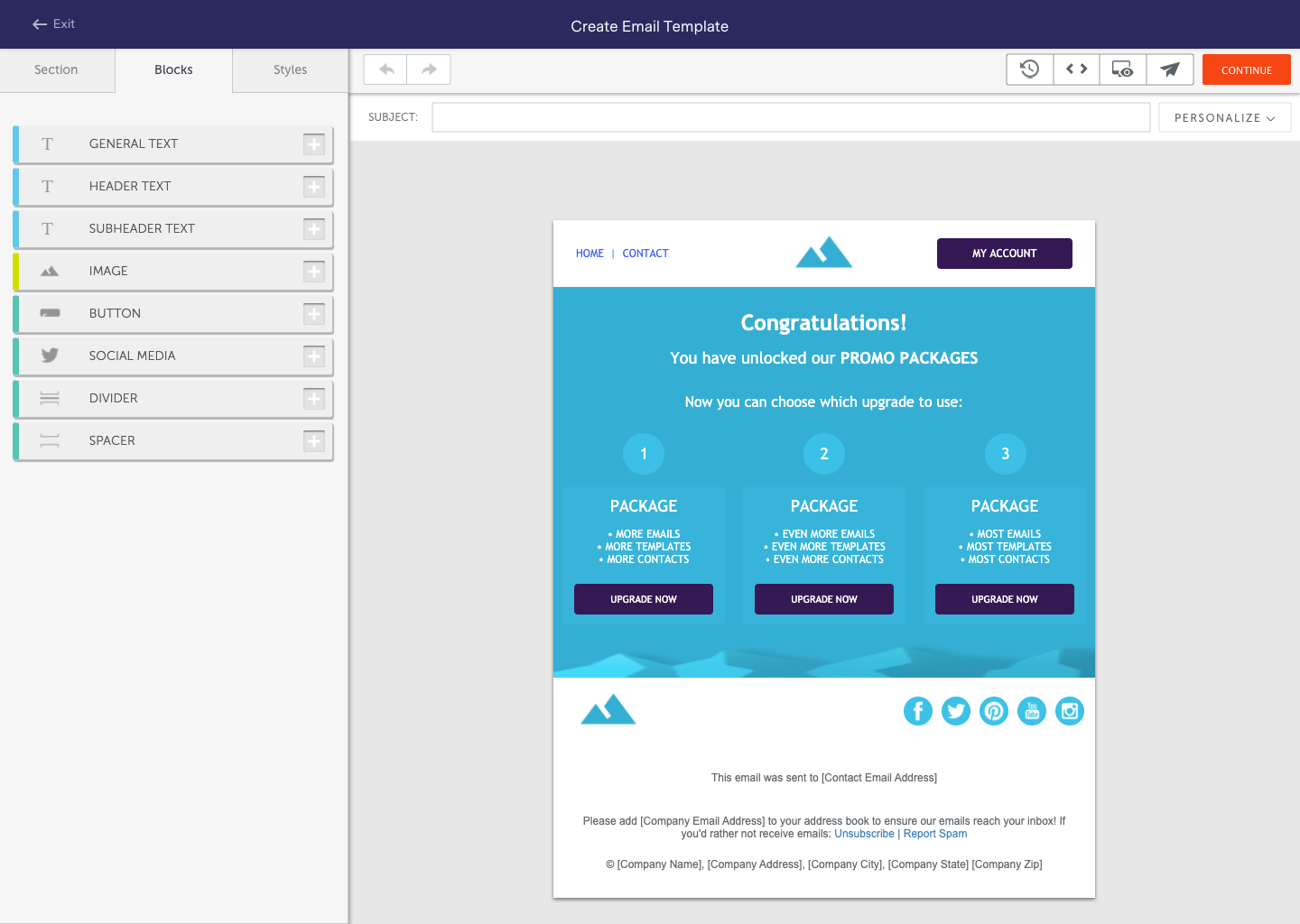
Email marketing. Their WYSIWYG email editor has a lot of options for customization, but also offers templates if you're not great with code or you're in a hurry.
Keeping contacts organized. There are tons of ways to categorize contacts - using tags, labels, and other data.
Automated contact "points." You can set up automations to add or subtract points from contacts based on their behavior (site visits, social media visits, clicks, etc.) to gauge how warm/cold your leads are.
Customer service. Their team is really stellar and they really care about their clients!
It'd be great if the tool had landing pages and calls to action. It would eliminate the need for multiple tools and streamline the efforts and results.
Form design could be better. Although there can be custom coded, the default options are pretty basic.
It has just about everything I want and then some. What I want but they don't have - calendar and e-mail integration, social media integration, and a mobile app, I believe are all in the works for a future release.
We are happy with Pardot. It has made our jobs easier and installed some reporting functions that have increased our ROI with the company. We have worked hard to set-up the functions in Pardot and it has taken time, but paid off.
Hatchbuck offers on-boarding, training, and has a suite of videos, which makes it super easy to get started. As with any software that is the key. Have a plan, stay focused, and get started. Once, you begin to play with Hatchbuck you will see that it is very user friendly.
You won't find another solution that has as many features as Salesforce Marketing Cloud Interaction Studio. We all know Salesforce, we all know how big they are and it's not for nothing... Their tools do most of the things you want, need and even imagine. Using it is complicated, but the usability is infinite.
There has never been any downtime for Hatchbuck, which is very reassuring for me as I market and recruit strenuously for the University at Albany's executive Weekend MBA Program. Hatchbuck team members have also been available when I have reached out to them with questions or issues. With one exception, where one of my e-mails became lost in the Internet "black hole," they have gotten back to me in very timely fashion!
Upgrades and timing of the upgrades were communicated well and planned during off hours for our work. If we did have a campaign scheduled during that time, it would kick-off after the system was back active. There were a few unplanned system down times, but it was a rare occurrence and those times were also short in duration.
Though the make up of MA apps is not built this way today, it would be nice to see them become more real-time. The integration between Salesforce and Pardot is not a true real-time integration. If I modify something in Salesforce, those changes are not automatically reflected in Pardot immediately. There is a delay of about 15 minutes before the systems sync. This delay, although not long, is less than ideal We would love the systems to be integrated real time such that changes are propagated from one system to the other immediately.
I always get a response within 24 hours, unless I ask on a weekend. The team seems to work together to resolve my issues, answer my questions, and update me on changes. In fact, they have even connected [with] me to ask how they can improve the Hatchbuck software and their service. This is why I love them so much.
They are really responsive and more than not solve the problem or give you insight to how you can manage the solution yourself. I do find however sometimes a long delay on the more complex issues when they need to loop in other departments. but overall a good experience with support
Training program is not very well established. There is very little documentations. More often than not it's in-person training. I wish there were more video tutorials so that somebody can learn the system quickly. Their documentation is very much like an RFP. Long and very technichal. They should definitly improve on this area.
Pardot's online training touches on all topics briefly and vaguely without much indepth exploration into how a final outcome could look, such as Nurturing Campaigns, Email templates, landing page templates, etc... The only true way to uncover Pardot's full capabilities is to have Front End design and coding experience. Without this key skill set, I would not recommend Pardot to another business.
From an IT perspective, once you set up the Javascript beacon and start collecting data there is a waiting game. During this time you can start labeling your site actions which can be labor intensive for a single person, but you don't really have the final end-users on the platform yet. We did a lot of training so users were experienced, but it wasn't until they had their first tasks to accomplish that they started using the system and had questions. I'd recommend setting up some immediate goals for an end-user to start segmenting for the purpose of displaying message campaigns so you can jump start end-user action.
We really liked the unique mix of a CRM, an email marketing tool, and a sales funnel tool we found with Hatchbuck. Additionally, the software was easy enough to learn so that multiple team members were able to quickly get up and running using the system. Other tools we evaluated either had too heavy of a sales focus, were too clunky, or were lacking some flexibility within their automation or email options that were important to us.
We use Salesforce Marketing Cloud for lead management, generating reports, tracking customer and dealer information, inputting orders, and more. I prefer HubSpot for email marketing and automation because it is easier to use and the emails are designed much better. We currently use Salesforce and HubSpot, and we are very happy to have both, as they have different pros/cons.
Salesforce Marketing Cloud does a great job at what it is designed to do. There are several SaaS products in the Marketing Automation arena and SFMC is one of the top providers. There are several things it does well, such as email marketing and automation, leads generation/segmentation/qualification, and reporting/analytics. There are a few areas of improvement when it comes to the product and they surround legacy systems and architecture, outdated UI/UX, as well as targeting data in the activity logs for reporting and segmentation.