Chatter was a collaboration platform with integration into the business process and the ability to conduct actions like approving expense reports and creating support cases from the activity feed itself. It was acquired by Salesforce and is currently discontinued.
N/A
HipChat (discontinued)
Score 9.7 out of 10
N/A
Hipchat was discontinued by Atlassian. Users are being migrated to Slack.
$0
per user
Pricing
Chatter (discontinued)
HipChat (discontinued)
Editions & Modules
No answers on this topic
HipChat Basic
$0
per user
HipChat Plus
$2
per user
Offerings
Pricing Offerings
Chatter (discontinued)
HipChat (discontinued)
Free Trial
No
Yes
Free/Freemium Version
No
Yes
Premium Consulting/Integration Services
No
No
Entry-level Setup Fee
No setup fee
No setup fee
Additional Details
—
For Server pricing info please visit https://www.hipchat.com/server (Only $1.20/user/month at the highest user tier!)
Slack, Hangouts, there are a ton of messaging/social apps out there. Overall, I like to use Slack and Hangouts more as a messaging tool. However, when there are certain things that HAVE to get done within Salesforce, I can totally understand why Chatter would be important. When …
We were using Skype for business before, but Skype was mostly good at team communication and sharing activities/updates only. Since we started using Salesforce, we got the best option by using Chatter's added advantages. By using it we don't miss any action items. It's a …
Because Chatter is tied into our CRM I feel it is easier to use. Teams is better for instant answers and chats. Chatter is better for a data storage of ideas and answers. While they both have there advantages It is hard to say which is more valuable on their own.
Chatter is a solid tool within Salesforce. Slack has become more commonplace within our organization, but the fastest way to find out what is going on within an account or opportunity is to check the Chatter feed. I think there are different uses for each of the tools, but …
Slack utterly dominates chatter. Slack is searchable, has the use of channels. When you can sync it with Salesforce (there are multiple ways to automate alerts or notifications to be sent from Salesforce to Slack), it renders Chatter useless. Slack makes me never want to use …
Chatter is simply the most accessible, user-friendly, and convenient on the go platform we enjoy utilizing daily to help our company grow and boost overall revenue. Without the many features, Salesforce offers daily. We would be unable to capitalize on many lead and application …
We are using Chatter just because it is integrated with SFDC, and we use SFDC as our CRM. We use other communication tools as well. You can find communication tools in many applications and platforms, I recommend using the very specific ones, like Chatter, for only the teams …
There's a variety of communication tools available for selection out in the market place but I like the easy to navigate system of Chatter. I think there's a whole bunch of more features available in Chatter that I currently do not utilize but I think it's a good robust option.
We also use Teams. Chatter is very helpful in that I can directly tag any object in our CRM. Instead of taking email requests for admin needs, I have added a Chatter process builder that helps me manage requests. If the case calls for a report to be made, I am able to tag the …
We have also tried to use Slack and Service Now. Service Now simply did not have the features we needed. Slack was useful but not nearly as good for the end users who simply want very simple. Slack confused the end user which caused them frustration, which also meant they did …
It is tough because there are several applications that allow for internal communication among teams. Chatter, however, is the only one that's native to Salesforce and allows for all communication to be attached to their respective artifacts. We use Slack in addition to Chatter …
I personally like Google Hangouts more due to the flow of conversations. I find it a much more efficient way to speak back and forth with work colleagues, other than face-to-face of course. But, as a manager I could see how Chatter would be useful to use when managing pipeline.
Chatter was within Salesforce already, so we simply went with it because it's attached and integrated well within Salesforce and Google Drive and Gmail.
Salesforce Administrator & Business Systems Analyst
Chose Chatter (discontinued)
Chatter is much more basic than other solutions, mainly, because it is not the core product for Salesforce. It is great for basic communication needs, but if you are looking for a much more robust solution then I would recommend using an application that is more focused on …
I've used slack and it's much better app in comparison with HipChat. Slack is much faster than HipChat. Slack has strong user community and lot of documentation around how to use it. Product functionality and performance is superb with slack compared to HipChat. Slack has more …
Compared to skype creating groups is easy and fast. Also , file sharing is easy and loads instantly . Emoji and gifs are much more better in HipChat compared to skype .My company's management chose to use HipChat for our organization as they got the license of HipChat for …
We selected HipChat because it was an enterprise solution to our organization. It allowed us to connect our enterprise ticketing software (which was used for everything) to communicate updates/patches and solutions to our clients. HipChat was a great tool because we were able …
HipChat really cannot compete with Slack so it doesn't surprise me that they've purchased the code base from Atlassian. As I mentioned earlier in the review it's screen sharing, video/audio quality and file transfers abilities are almost universally done better by the …
Slack and Google Hangouts have more features and offer meeting functionality. My choice would be Google Hangouts for ceremonies and Slack for messaging.
Slack is better developed then HipChat. It's better and faster for connecting with people. HipChat is also good but needs to be developed. The company has to update their software regularly to reach the level where Slack is now.
While Sametime or Jabber multi people chat requires that someone who's in the chat invite you, HipChat has this nice system of a room where anyone with the right permission can join at any time. Also, the history of a Sametime or Jabber chat tends to be lost in the …
At the time, our organization was using Jabber for communication, which wasn't suited well for teams. HipChat brought a ton of great features when moving from Jabber, such as the ability to make rooms for each of our projects.
Rocket Chat is an open-source Slack clone, which …
Slack is by far a better alternative, and HipChat was only developed as an alternative to Slack. It certainly falls short. The platform is not user-friendly, it is generally a bit buggy, and it doesn’t organize conversation threads in an efficient way like Slack does.
Aside from HipChat we used Slack and Cisco Spark. Cisco Spark doesn't look as outdated as Hipchat but still is very limited with integrations and requires a paid version to take full advantage of it. Mobile version of Cisco Spark is limited and doesn't have many settings. Slack …
HipChat offers a good advantage for organizations looking for a low cost communication tool. The integration is easy and widely supported by many forums. Though, the technical issues are less reliable. Due to technical failures, Slack and Skype take the cake. Slack offers many …
I used HipChat in a company which was pro "open source" and another one which is pro Atlassian. For the "open source" company I was not involved in the decision of selecting HipChat but I know that the integration with Jenkins and other internal tools were drivers for selecting …
We left HipChat because of ongoing support issues and it didn't seem to be exactly, cutting edge. We now use Slack which seems to be much more in line with our organization as a whole. The features we use on slack were not offered at the time on HipChat and I think they had …
We tried a lot of chat clients before choosing HipChat. The Skype for Business UI on the Mac side was 5 years old and terrible. Mac users hated the app including our CTO. Cisco Jabber was expensive to license and maintain; Skype was open to the public which took time away due …
HipChat stacks up really well against Slack. Many of the same features, look and feel and performance. Although we have about half of us on Mac and half on PC and several times we hear complaints of the desktop app not connecting soon after updates are released. Slack also …
I haven't evaluated any similar products. HipChat is really just perfect for the Atlassian user. Before my company used HipChat we were using Google Hangouts.
I only used Cisco Jabber for a few days before the company I work at made the decision to switch to HipChat, so I didn't really have a chance to use that application enough to compare it effectively. With Yahoo Messenger, I used to use it quite a bit, but haven't since Facebook …
Technical Lead Datastore, Site Reliability Engineer
Chose HipChat (discontinued)
Hipchat behaves equally good among several other platforms used at my company (OSX, Windows, Linux). It brings us the possibility to integrate with most of our used tools, and the cost is lower than other options. Chat history and encryption makes it easier to find previous …
HipChat works best in the work environment. It can integrate with other applications that are used on the job and show notifications from them. Others are better suited for personal messaging.
I have used Google Hangouts before. Hipchat is better in that it has a lot more integrations and special features, whereas Hangouts is pretty much purely chat. The downside is not everyone has a HipChat account and therefore Hangouts is easy to start up with your friends …
[Chatter] is the tool that makes our relations stronger. It provides advanced ways of communication. I have trained my many team members because of the easy features and functions of this tool, It is very user-friendly. Give it a try if you want to improve your relations with your customers. It will surely enhance the productivity of your organization.
HipChat was discontinued by Atlassian because it wasn't as versatile as Slack and couldn't handle Video/Audio calls as well as Zoom. It lacked the screen sharing capabilities of Skype and ScreenHero (now owned by Slack). It wasn't great at any particular area and its competitors were obviously better in those areas. This lack of versatility negatively impacted it's adoption at GLG, and I'd imagine the rest of world as well. HipChat excels at instant messaging communication (which is the one thing they got right) and although you could make specific rooms to chat about certain topics, Slack was already doing this way better. Overall it's impossible to recommend this software today. If I recall it was very expensive compared to better and more feature rich competitors. If you're seeking a bare bones method of communication you may consider the free version of it, but outside of that scenario, you are almost certainly better off going with a different product.
HipChat is very stable and reliable. I have never had issues with not being able to connect or being able to communicate with others on HipChat.
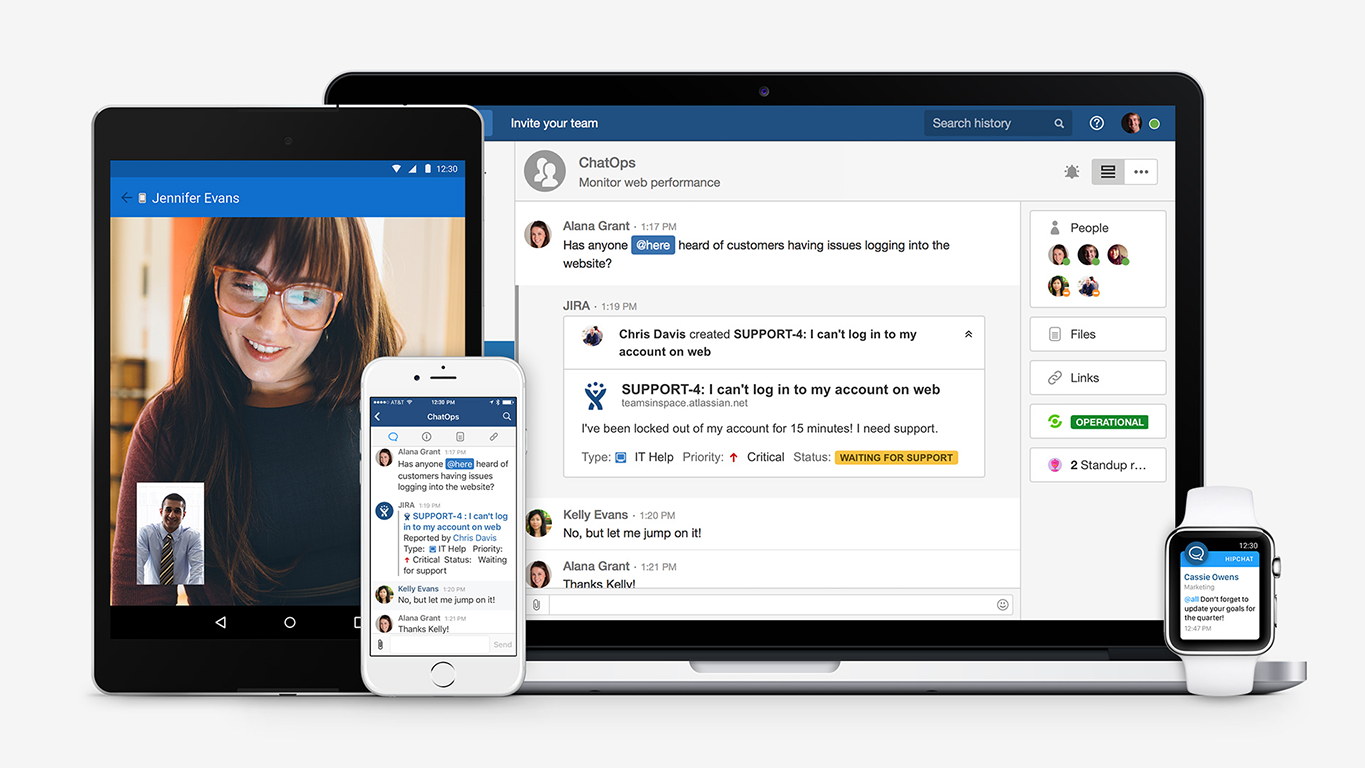
HipChat integrates quite well with other applications, such as Jira and Stash. This is a main selling point for my team. It provides a convenient feed of actions on a JIRA story or Stash pull request.
HipCat does a good job of allowing 1-1 and group chats. It is simple to start a new conversation and it is easy to hold a group conversation and keep track of who is in the room.
I like how HipChat has away/here/on mobile statuses. This makes it easy to see if a person is available to be contacted.
Mobile app is not very responsive on iOS. Sometimes connection to Hipchat servers is taking too long even on good networks.
Both mobile and desktop versions have no alphabetical or recent sorting for groups and chat rooms.
Video and audio calls are pretty useless, they're slow and not always work.
The whole user interface is simple but very outdated - apparently Atlassian didn't focus too much on Hipchat even though they tried in the last 2 years.
Chatter can fulfill at least 85-90% of our business requirements in an easy-to-use platform. Usability is a key requirement and we have had our share of bad usability experiences. In our experience, even the most novice users were able to pick up Chatter in a relatively short amount of time with little/no assistance.
It is easy to use but the impact of it feels like it is a bit antiquated. It does not feel collaborative and real time. Chatter is more akin to email versus Slack or Hangouts where it feels like problems are being solved as you are communicating.
i like how its easy to login , create rooms or start private conversations . The best feature i like describing usability is searching history of conversation in either a room or private conversation just by typing single word .Easy file uploading and downloading .Mention feature is very easy to use which shows all the names starting with given letter .
I haven't had to use support often, but when I have Salesforce was very responsive. Like with all things Salesforce, it is easy to use and doesn't have too many issues, so I don't think that people will have to use support often, but if so, they are easy to work with and helpful within the product.
HipChat support was one of the best I've encountered. When we faced difficult tasks in terms of updates to infrastructure (where HipChat sits on top) or updates to the application itself, HipChat support was very responsive to our questions, concerns, and comments. HipChat also had some really good online documentation. We were able to find step-by-step guidelines and documentation when implementing new features or installing new updates/patches.
Because Chatter is tied into our CRM I feel it is easier to use. Teams is better for instant answers and chats. Chatter is better for a data storage of ideas and answers. While they both have there advantages It is hard to say which is more valuable on their own
I've used Slack and it's much better app in comparison with HipChat. Slack is much faster than HipChat. Slack has strong user community and lot of documentation around how to use it. Product functionality and performance is superb with Slack compared to HipChat. Slack has more emojis and icons which brings them closer to how people use their cell phones in text conversations.
Actually I never shared of HipChat using with more than 25 persons in team simultaneously, but I believe it can be scaled for much largest collaboration teams. At least it works flawlessly for us, with transparent integration with Jira, and I am not see any reasons for some troubles for work at big scale.
This has had a very positive impact when it comes to verifying if proper communication has been had among teams. This helps us know when and what people have been informed of, which gives us the opportunity to regularly review our communication styles.
This has had a very positive impact when trying to find particular individuals in a very large company, and without any barriers.
This also provides a 'get networking' tool for new and existing individuals to the company, helping people gain influence and awareness among their stakeholders.
HipChat has increased the effiency with which I am able to communicate with my coworkers, particularly those who work out of other offices. Having a light, portable messaging solution has been beneficial for checking in on small things without the need to send emails or schedule phone calls.