Elasticsearch is an enterprise search tool from Elastic in Mountain View, California.
$16
per month
Yext
Score 8.9 out of 10
N/A
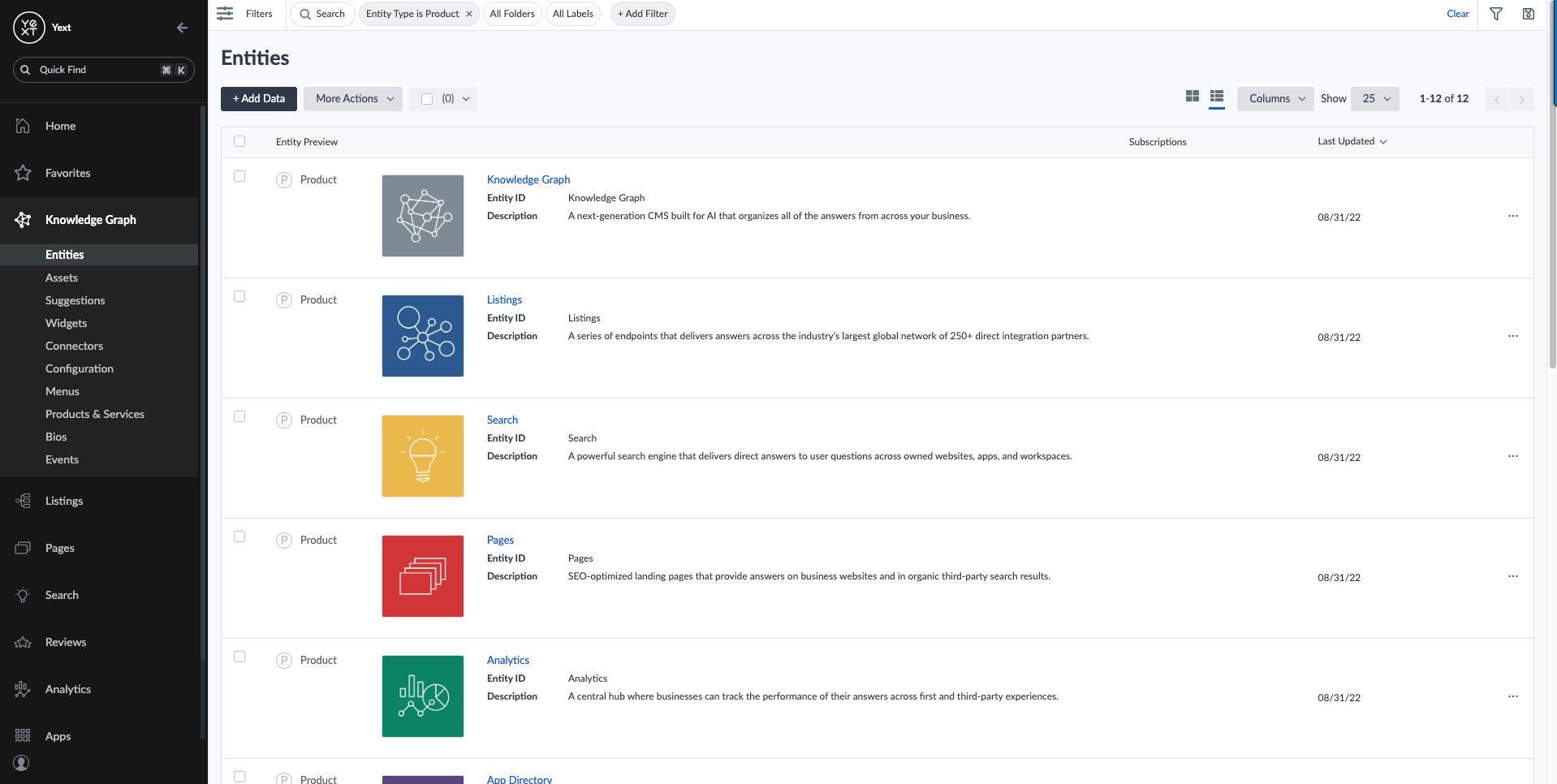
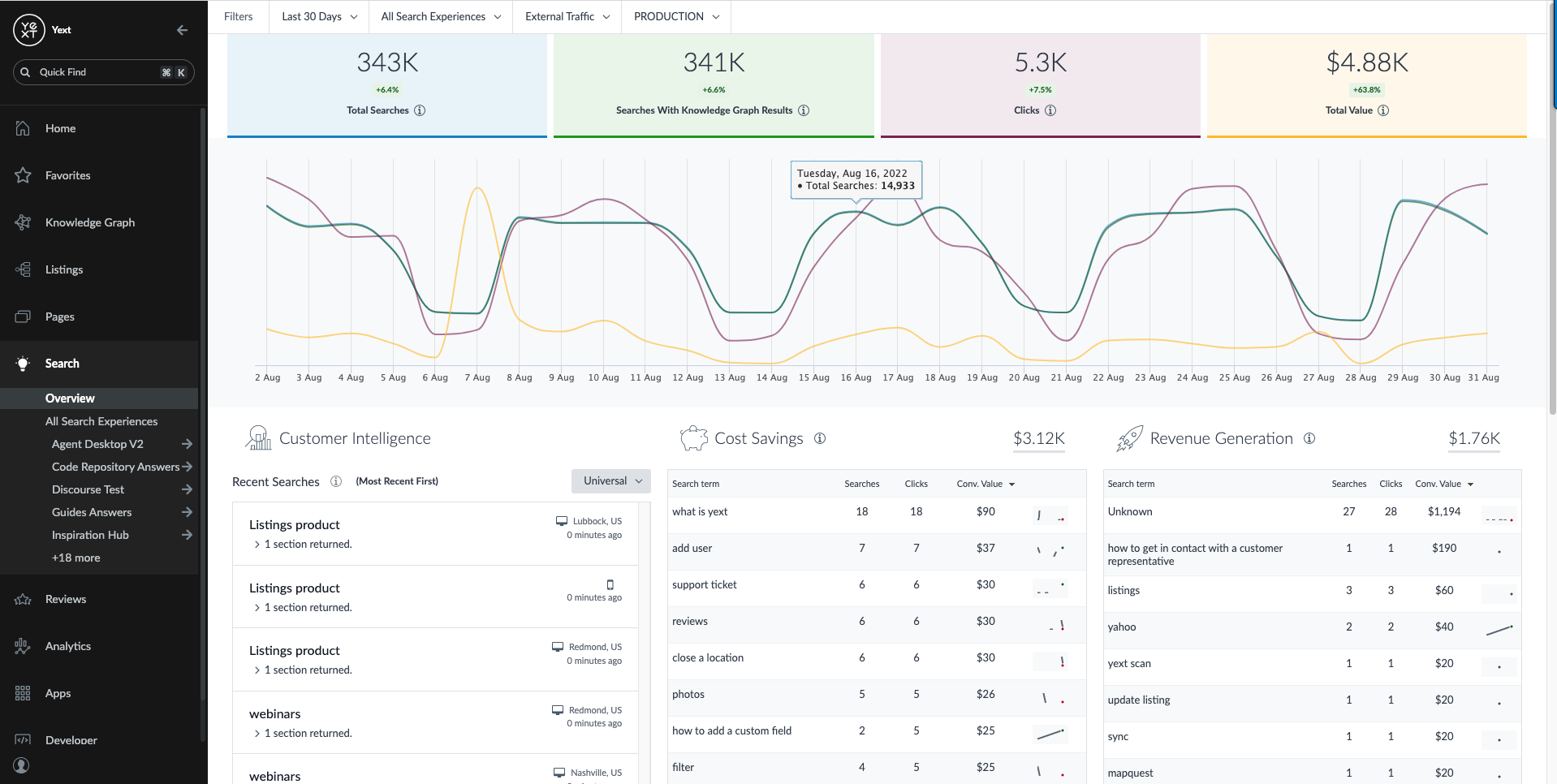
Yext is a digital experience software provider headquartered in New York, New York.
N/A
Pricing
Elasticsearch
Yext
Editions & Modules
Standard
$16.00
per month
Gold
$19.00
per month
Platinum
$22.00
per month
Enterprise
Contact Sales
No answers on this topic
Offerings
Pricing Offerings
Elasticsearch
Yext
Free Trial
No
Yes
Free/Freemium Version
No
No
Premium Consulting/Integration Services
No
No
Entry-level Setup Fee
No setup fee
Optional
Additional Details
—
The cost of Yext varies depending on a number of factors such as package type, business size, entity count, and more. To create a solution that fits your business goals, please contact us or request a demo.
More Pricing Information
Community Pulse
Elasticsearch
Yext
Considered Both Products
Elasticsearch
Verified User
Anonymous
Chose Elasticsearch
Elasticsearch has a steep learning curve, but it is the best in terms of customization and use cases it can cover most of the business needs. The other tools might be easier to integrate with and start seeing results, but you will end up having issues when you need customized …
Elasticsearch is relatedly cheaper the splunk. Opensearch is good and we migrated some data into it but the critical data stays in elasticsearch as it has formal support.
They all have their specific pros and cons. Elastic was actually initially brought in to provide less expensive functionality to Splunk, and Splunk use cases. Grafana was brought in to provide less expensive visualizations compared to Splunk and Elastic...I would recommend …
Elasticsearch is the most well-known and supported free data platform that we identified. We are taking advantage of community knowledge and practices. In terms of flexibility and breadth of use cases no other competitor came close to Elasticsearch. We've tried Solr in the past …
Elasticsearch brings the capacity to grow data ingest and provides 24/7 visibility into critical services across IT and Business teams. With Elasticsarch, specialized support teams can easily view all the relevant information by using real-time dashboards, and can immediately …
Elasticsearch and Solr are both based on Lucene, but the user community for Elasticsearch is much stronger, and setting up a cluster is easier. Splunk is very well suited for Log indexing and searching but is not nearly as flexible as Elasticsearch. Couchbase is a great NoSQL …
Search and analytics capabilities of Elasticsearch are superior to its competitors. Being open source, it is a cheaper and faster solution than other competitors. Installation is straightforward and it can be potentially deployed anywhere and everywhere! There is no need for …
Faster, better, more efficient. There was no comparison in Elasticsearch vs LEM. AlienVault was decent but too expensive for what it does compared to Elastic. The only competitor I'd consider as in the same ballpark in the SIEM world is Splunk. Save yourself the money and get a …
I think Elasticseach works less great compared to Splunk. Mainly the way the Splunk search head works is vastly superior to the way the Elasticsearch query language works. Furthermore, the Splunk architecture is in my opinion easier to roll out and scale-up. Splunk also has a …
Elasticsearch is very well packed in a broad set of features, ranging from customization capabilities to security and add-ons, and also comes with a great visualization tool named Kibana. Most of the competitors are strong in some of these areas, but I know of no other that's …
Almost no one uses Solr anymore--most have migrated to Elasticsearch. I've never tried it myself but I heard Solr is much more difficult to configure and because it doesn't use a REST API, it locks you into Java and XML. XML--ick! Lucene: Elasticsearch is built using Lucene …
From my perspective, there is nothing currently on the marker better than Datadog, but unfortunately, that's a pricey product, Elasticsearch deliver us part of Datadog functionalities being cheaper. Fluentd as a service (provided by the company behind Fluentd) looks like a …
Previously, we used Microsoft SQL Server's full-text search. Elasticsearch is faster and that includes searching and indexing and re-indexing the catalog of products.
With Elasticsearch you can integrate a lot of data sources. It can act as a small DataLake where you can put different kinds of data and extract important insights. With Splunk, additional to elevated costs of licensing and hardware, you need to have expert engineers to address …
All database systems have things they are good at, and things they aren't as good at. Riak/SOLR is great as a K/V store, but SOLR cannot handle requests as fast as ElasticSearch. In fact, SOLR is the reason we had to migrate to ElasticSearch. Redis is great at SET operations …
ES does not compete with the above packages but compliments them. By automating and mining logs, you are able to get a sense of the business process, marketing data or whatever else you need to capture and mine. The potential energy stored within Elasticsearch makes it a great …
Elasticsearch is the most powerful and easy to use platform in this market. It's open source which makes enhancements very possible and also makes customization something that is commonplace. We're able to create custom modules to pull data from both log and config files, which …
As far as we are concerned, Elasticsearch is the gold standard and we have barely evaluated any alternatives. You could consider it an alternative to a relational or NoSQL database, so in cases where those suffice, you don't need Elasticsearch. But if you want powerful …
When we first evaluated Elasticsearch, we compared it with alternatives like traditional RDBMS products (Postgres, MySQL) as well as other noSQL solutions like Cassandra & MongoDB. For our use case, Elasticsearch delivered on two fronts. First, we got a world-class search …
Before Yext, I used Moz Local to manage our business listings. Moz Local had fewer listing platforms included with their service. For example, Moz Local did not include Yahoo, and we had issues with inconsistent Yahoo listings. We ultimately switched to Yext and it's been a …
We initially chose Yext because it provided the greatest control for our multiple listings. Plus, it had access to the most publishers. However, when evaluating Synup we were very impressed. You would not go wrong to choose either!
We use Yext and all the other products mentioned here. Yext overlaps a bit with Brightlocal, but Brightlocal acknowledges Yext and thus makes it easy to avoid duplicated work. Each service provides a unique service that we use with our clients. We have been with Yext since …
Moz Local does not have as good of listings coverage as Yext and their platform does not work as well for at scale changes. Moz Local also does not have the same powered listings partnerships that Yext has for instantaneous changes. For smaller enterprises where there are fewer …
Fazoli's is using Yext for response, generation, publishing, analytics, and the knowledge assistant. We implemented a review response strategy out to all our field users and have seen tremendous success from that program. The proposal from Rio Seo only included review …
I looked at a few other competitors and they were significantly cheaper. But they offered fewer directories and fewer additional services. Yext is always expanding their offerings and the other guys seem to be just focused on the SEO benefits, where I see the logistical, …
We didn't know about BirdEye until after working with Yext. Definitely excited to work with them and see how their solution stacks up. It seems to be Yext but much more robust and hopefully actually functional. The bedside manner at Yext was the most unprofessional I have ever …
We ended up with Yext after 3 years with a smaller organization because we selected Broadly for our overall SEO management software, and Yext was part of the package. Very happy with this additional service.
Moz Local is a primary alternative to this platform. And while it's not nearly as powerful, customizable, or wide-reaching as Yext, its price point is probably more appropriate for smaller businesses/agencies.
Unlike Yext, which is a subscription model, Whitespark allows you to pay once to disseminate your information throughout their network and offers a very reasonable price to send any updates through the network if your NAP data has changed. Yext offers annual agreements and a …
Yext allows us to update information across all platforms and keep visitors up to date with what is happening at our client's hotels. SEMRush and Ahrefs do not have this feature in their software making it necessary to have Yext. The customer service at Yext is also incredibly …
My company initially used Moz Local to manage our online listings and after we had 10 clinics open, we made a change and switched to Yext. Yext is a lot more user friendly and cost effective. You also have the added benefit of working directly with an Account Manager who can …
Yext Knowledge Manager ranks above all other listing management platforms such as MozLocal, Rio SEO, BrightLocal etc with regards to the service they provide. They offer much faster updates, accurate data sync, allow scheduled updates, powerful templates, featured message sync.
Elasticsearch is really well suited for searching text (Natural Language Processing) and you can fine tune the searches and scoring very well. I like the ability to find Significant Terms in the Index, where you can find aggregations that are really relevant to a specific search. It also allows for queries to lead to new queries via aggregations which is great for navigating your data. It is less suited to doing more complex aggregations where slices of data are required to be processing using guassian normalizations. And doing searches which join different documents is very very hard, and requires serious thought on how to denormalize data.
Yext is great for bigger clients. If your client has a franchise of any kind, or even multiple locations, that's an ideal use case. For smaller clients, with one location that doesn't change a lot, Yext isn't as viable, and the effort to update maybe ten or fifteen listings would be worth it.
Setting Java memory thresholds can be a pain for those not accustomed to things like Eden Space & Old Generation which can lead to over allocation, or more likely, under allocation. Apache Solr had a similar issue. It would be nice if the program would take an extra step and dogfood it's own advice by analyzing the system & processes to return a solid recommendation for that configuration. The proper configuration information is outlined in the documentation, it would be nice if that was automated.
The only health check that ElasticSearch reports back is a "red" status without any real solid information about what is going on, though its usually memory thresholds or disk I/O. I am currently on ElasticSearch 1.5 so that may have changed for newer versions. When the status goes "red", I as the administrator of the software, feel like I lose control of whats going on which should rarely happen. Something more verbose would eliminate that.
This is more of a critique of the ElasticStack in general. The whole top to bottom stack is starting to get feature creep with things that are better suited in other software and increasing the barrier for entry for people to get started with setting up a robust logging infrastructure. ElasticSearch as a storage search engine, is pretty streamlined, but I can see that the tools that comprise the ELK Stack are going to require a certification with constant study at some point. During major release for Logstash a while back, it literally took a month to learn a new language because Elastic completely changed the syntax. For a medium sized organization of only a couple of admins, that is a pretty high bar where time is money. They really should work on refining/automating the tools & search engine they have, instead of shoehorning/changing things on to an already rock solid foundation.
Cost. This platform offers a lot of powerful features, but it has an expensive barrier to entry.
Annual contracts limit flexibility for smaller companies
The biggest drawback is that you need to keep your subscription active or listings/citation data will revert back to what it was pre-Yext implementation
To get started with Elasticsearch, you don't have to get very involved in configuring what really is an incredibly complex system under the hood. You simply install the package, run the service, and you're immediately able to begin using it. You don't need to learn any sort of query language to add data to Elasticsearch or perform some basic searching. If you're used to any sort of RESTful API, getting started with Elasticsearch is a breeze. If you've never interacted with a RESTful API directly, the journey may be a little more bumpy. Overall, though, it's incredibly simple to use for what it's doing under the covers.
Yext is pretty easy and straightforward to utilize out of the box. While I work for a digital marketing agency, and this is second nature to me at this point, I do believe the average SMB owner with zero digital marketing experience could be a proficient Yext user within 1 hour or so of usage. It's easy
We've only used it as an opensource tooling. We did not purchase any additional support to roll out the elasticsearch software. When rolling out the application on our platform we've used the documentation which was available online. During our test phases we did not experience any bugs or issues so we did not rely on support at all.
We are a larger company with 26 locations, so we may receive additional attention. But they are always quick to answer our calls or emails. I rarely need support as the software delivers as promised. I will say their staff thus far has been very knowledgable about Yext and some lesser-known features. For us, they really understand our needs and why I'd be asking for certain solutions.
Elasticsearch is the most well-known and supported free data platform that we identified. We are taking advantage of community knowledge and practices. In terms of flexibility and breadth of use cases no other competitor came close to Elasticsearch. We've tried Solr in the past be we encountered issues which were deal-breaking for us. MongoDB - it just did not pass our evaluation parameters as a main data platform. We still use it for smaller purposes, though.
Before Yext, I used Moz Local to manage our business listings. Moz Local had fewer listing platforms included with their service. For example, Moz Local did not include Yahoo, and we had issues with inconsistent Yahoo listings. We ultimately switched to Yext and it's been a good fit for us.
I am not in finance and I suspect even if I was this would be hard to measure. But for sure, Elasticsearch has enabled us to have the most flexible data model in the industry for our customer's data, and in doing so we have attracted many many technical customers and got much of their $$$.
One problem with Elasticsearch is that because it runs on the JVM, there can be some stop-the-world JVM garbage collections happening that can take down nodes and reduce indexing speed. The solution for that tends to be "let's just upgrade the CPU on that machine". And before you know it you are paying $$$ because this'll happen with 40+ machines.
On the other hand, I do think that ES is more efficient than other systems and so it requires fewer nodes to keep it highly tolerant and available, so we probably saved some money that way.
Yext has absolutely strengthened our SEO performance and has driven leads that perform extremely well.
Yext has improved our consultation show rate because all of the clinic information for each of our locations is accurate no matter which website our clients are using to search for the clinic info.
Yext has allowed our organization to ensure the correct phone numbers are listed across the web, which increased the number of inbound leads that come into our Call Center.