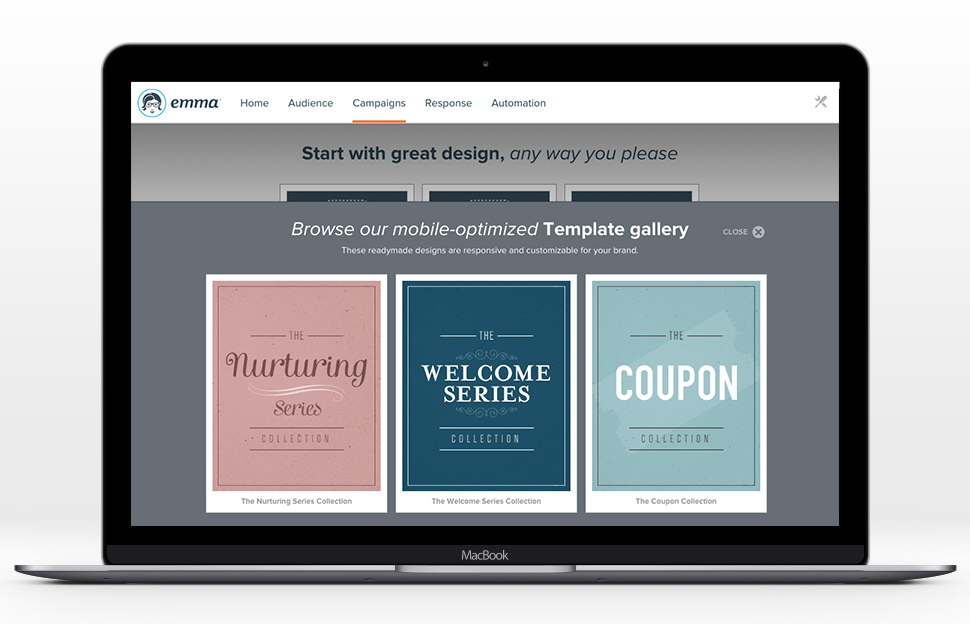
Emma by Marigold is an email marketing solution. Its key features include mobile-ready design templates, email automation, audience segmentation, and dynamic content. The software includes integration with third-party CRM solutions, ecommerce platforms, and social networks.
$500
per year per user
iContact
Score 6.8 out of 10
N/A
iContact is an email marketing solution that was acquired by Vocus in 2012. The product is integrated with Facebook and Twitter and is aimed at SMBs with unlimited sending as a key feature.
Emma is a step up from Constant Contact and two steps up from Mailchimp. Emma is affordable and easy to use for all types of companies, but especially for smaller firms and startups. It’s in compliance with SPAM laws, but has an advanced platform to keep your emails from going …
I like Emma much better than MailChimp because of the flexibility and ease of the user interface. I used MailChimp for a previous position and I felt like the home page was definitely more cluttered and it had a clumsier navigation portal. I also think Emma's email design …
Emma had a more robust multi-level account structure which empowered individual locations to participate at the ground-level. Additionally corporate was able to maintain oversight, template creation, marketing automation, and data reporting. The goal is to provide the locations …
I use MailChimp a lot, and while I like it, at the end of the day Emma simply is the most cost-effective. There's not a HUGE learning curve, compared to MailChimp, which is nice, since our non-designers can take a proverbial 'whack' at an email and we can trust that it will get …
Compared to Act-On, Emma is miles above regarding the ease of use and simplification of complex features. Drip campaigns really are a breeze with Emma's intuitive data. You will experience WYSIWYG glitches due to the nature of the program but Emma offers better templates to …
Emma is a good alternative, but I think mailchimp may be a better and more affordable alternative. Especially since mailchimp is continuously releasing new features and improving their product.
MailChimp seems to offer more customizable options than Emma, but Emma is far less buggy. I used Constant Contact while working with another nonprofit organization and did not anything about it.
We moved away from Constant Contact because of the reputation it was starting to get with not auditing its domain and not providing us with the best possible brand reputation and also because we just didn't get the analytics we wanted to improve our process. With Emma, we can …
Emma is the easiest to use platform I've tried so far. It was easy to setup and send the first enewsletter. The functionality is very user friendly and it "makes sense" as you go through to add content and users. It's made being a marketing team of one very efficient.
Mail Chimp: the price was better, but the platform was not predictable. You did not get the same support with mailchimp. Constant Contact: This is an outdated system that does not make it easy to design modern, clean emails and I consider it a dinosaur.
Emma was the perfect solution for what we were looking for due to its easy to use interface, relatively low cost and basic functionality. We were not looking for expensive, complex tools to send out multiple campaigns with various controls and tests. We also were impressed with …
At the time we made the decision to move to Emma, my organization was using both MailChimp and Constant Contact. Emma's drag-and-drop template editor surpassed both, and even editing the pre-made template HTML in Emma was easier. List management was much smoother than the …
We moved from Emma to SendGrid. The deliverability of Emma is lower than Sendgrid and the overall functionality of Sendgrid feels more fit for a digital marketing agency. The number and design of the Emma templates far surpasses that of Sendgrid though. Emma is much more suited …
None of those platform were good for an agency and their clients. Managing multiple email clients in one system isn't something you find everywhere. It's also not easy to pay for the other platforms since they are built for the enterprise and not SMB.
Our internal competitors are the individual email platforms our stores have signed up for. In general, they need to take our HTML and upload it themselves, making Constant Contact and MailChimp very cumbersome. Emma, on the other hand, allows us to take charge of that. Users …
We chose Emma in addition to Sendgrid to protect the integrity of our transactional email deliverability. Emma's delivery rates were good. We later found Mailchimp a bit cheaper and easier to work with in our specific use case but I still think it's worth testing Emma if you're …
MUCH more straightforward and usable, PeopleVine requires someone with a lot more coding knowledge to do simple things like change a font color or hyperlink text and is better used by an agency with extensive access to those experts whereas Emma can be taught to just about …
Emma is night and day difference from Constant Contact in terms of customer support, feature set, and usability. It is so much better and more affordable. Emma is a step down in feature set and functionality from Pardot, Marketo, or Hubspot, but if you are a company that is not …
PosterMyWall is used for the design of social media, flyers, websites, and printing purposes. We previously used PosterMyWall for email campaigns, but it was standard and time-consuming. This is why we made the switch to iContact, for more effection and a way to reach potential …
ClickDimensions was more comprehensive but buggy and not stable. We lost a lot of data which negated the benefits. iContact doesn't do as much but is stable and reliable. ClickDimensions support was awful. iContact support has been fine for us. ClickDimensions assigned us …
Sendinblue, Mailchimp, Sumo. We're moving to Sendinblue because it was better priced with better features. Sumo is more bit more geared towards building email lists -- although it fails miserably because it cannot accurately report #contact or visits to your site. Mailchimp …
In my opinion, MailChimp is the top contender to iContact and really gives them a run for their money. MailChimp offers users more features, and costs less. Of course, they both have their advantages and disadvantages. Overall, it is a tough decision to make between the two, …
iContact is more fancier in that you can add pictures, change font types & sizes, etc. Infinite Campus is more for just sending emails to all your students. I still use Infinite Campus but like iContact more.
iContact and Constant Contact are very similar products, however I prefer the iContact interface. Mailchimp may have more features but is harder to train users who are not familiar with email campaigns.
I haven't used other products for the same features that iContact offers, but I have used products like Mailchimp which sends out massive emails or postcards and such. Personally, I prefer iContact because you're able to personalize it and have the ability to send the emails …
We selected iContact because it was available at the time, and in our price range. I inherited it at the school. If it had been the program it is now back then, I would not have chosen it. At the moment, we are too busy to fully vet another program, so we are stuck with this …
I didn't actually choose iContact, it was already implemented when I started working for the company. I haven't looked too deeply into switching because it works for our needs right now. I would love to find another service with more customization and surveys included, but …
iContact was the solution in use when I entered the organization. I have heard very good things about MailChimp and Constant Contact, the other two big names in this field. We have chosen to remain with iContact since then, but would be open to moving. However, it is fulfilling …
I have personally used MailChimp and Constant Contact. Plus, a back-end WordPress plug-in that I've since forgotten the name of as well as Active.com's email platform.
IContact offered more flexibility, the ability to designate more users in different departments, and better-looking templates. The ability to ask for support and customized templates is also a key, and their account manager is available to respond to issues, offer advice, etc. …
Robly has the ability to send at the time when they expect that there is a user going to open. However, iContact is much more professional in their support and having a dedicated account manager who has a grasp on the latest in e-mail marketing was a primary reason we select …
We didn't select iContact initially, our team was handed it as an existing tool. Our other tool is Pardot which is connected to our Salesforce instance. We don't have iContact connected to the database because we use it for entirely different messaging. Since we didn't choose …
We previously used another product, Vertical Response, but ultimately chose iContact because we felt the newsletter editor was more easily adaptable (from a brand perspective we were able to customize the template to fit our brand). Additionally, from a pricing standpoint, …
iContact far outperformed emailbrain in getting my emails to our subscribers (delivery rate) but with emailbrain I could easily send hyperlinks that opened pdf. documents, see how my email was going to look in a couple dozen different variations (gmail, yahoo, desktop, mobile), …
We are no longer using iContact, but if you were comparing them to Constant contact, Mail Chimp, etc. then go with one of those, their software is more current and they have better analytics, but will still be in the cheaper price bracket. Currently, we are using our ESP, …
It offered the best cost to feature ratio and was easy to use. The other systems were great as well, but the potential integration with our CRM (Salesforce), was one of the key deciding factors. Also, icontact was included with the Vocus marketing suite which offered other …
Features
Emma by Marigold
iContact
Email & Online Marketing
Comparison of Email & Online Marketing features of Product A and Product B
Emma by Marigold
9.1
Ratings
14% above category average
iContact
6.6
Ratings
19% below category average
WYSIWYG email editor
8.00 Ratings
7.00 Ratings
Dynamic content
9.00 Ratings
7.00 Ratings
Ability to test dynamic content
9.00 Ratings
5.00 Ratings
A/B testing
9.00 Ratings
5.00 Ratings
Mobile optimization
9.00 Ratings
7.00 Ratings
Email deliverability reporting
10.00 Ratings
7.00 Ratings
List management
10.00 Ratings
8.00 Ratings
Triggered drip sequences
9.00 Ratings
6.00 Ratings
Landing pages
00 Ratings
7.00 Ratings
Reporting & Analytics
Comparison of Reporting & Analytics features of Product A and Product B
Emma by Marigold
10.0
Ratings
26% above category average
iContact
8.0
Ratings
4% above category average
Dashboards
10.00 Ratings
8.00 Ratings
Standard reports
9.90 Ratings
8.00 Ratings
Custom reports
10.00 Ratings
8.00 Ratings
Pre-Send Testing
Comparison of Pre-Send Testing features of Product A and Product B
Using Emma for weekly templated email use with minimal changes is awesome. If you want you can create a master and make minor graphic edits quickly and easily from your smartphone. Any edit is possible as long as the artwork is on the online server. Only time I hit a bump in the road is when I was asked to change the style sheet and did not know that the pricing plan I was on did not include this feature. Client had to wait to send new format until Emma performed the requested changes.
iContact is a great option for small businesses. It doesn't have enough features to create the demands of a large corporation. Of course the price goes up exponentially with more subscribers, which would also make it beneficial for small businesses. If you have too many lists to add people to it can get a little crazy too.
Drag and Drop Interface - I love the drag-and-drop interface used to design campaigns. It makes it easy for creative types to get the look they want, and it helps less technically and aesthetically adept users to create campaigns that still look great. After using both Constant Contact and Mailchimp, I think Emma comes out on top in terms of ease of template design.
Master Admin Account - Having a master admin account controlled by one person allows us to deploy brand assets to each sub-account, and we're also able to push out templates for users who aren't ready or don't have the time to design their own.
Dynamic Content - Dynamic content has proven so useful to us, especially in our Admissions Office. Making it possible for regular users to easily create emails using dynamic content is a VERY strong feature that, in my experience, is unique to Emma.
Great Tutorials - Emma does a great job taking care of its users. The support folks are always kind and helpful, but Emma publishes an array of tutorials and resources to help with just about anything its users encounter, from how to use custom merge fields to advice on creating the best campaigns.
Customer service is wonderful! They are always helpful, guiding and available for any odd question, even if those questions are training for a newbie to the email world.
Building forms for data collection and the code generator the for the site is very easy.
Ensuring double opt-in is extremely straightforward.
Including unsubscribe on every message automatically means we never have to worry about CAN-SPAM.
Setup of users - We used to be able to setup a user and send them our own welcome email. Emma has since set up the ability to add users where they send the welcome email. It's a great new feature, but it doesn't always work. We've had some users who never receive these emails and then we need to reach out to support anyway.
The code to set up a configurable email is cumbersome. It's great that it is so customizable, but there is a learning curve.
Every time you edit or sometimes open an email it brings it to the top of the list. I would prefer my email to go to the top only after I send it out to my subscribers.
When I add a new contact I sometimes copy and paste the email. This is not allowed sometimes and I have to manually type the email in.
LinkedIn will not allow you to add pictures anymore when sending emails out.
Easy to use and gets the job done without too many "extras" (ex. we didn't need a full marketing automation platform so Emma had what we needed to send email marketing communications without having to pay for the stuff we didn't need)
After 4 years of using iContact we finally cut the cord. It was hard to justify staying with them when it seemed like they had some of the most outdated software in the industry, some of the worst deliverability, and were in general extremely lacking in customization. They are a decent ESP for a great price point, so if that is your main concern it may be worth it, but if you want to have your emails you are paying for hit inboxes (not spam folders) then look into someone else that guarantees great deliverability.
While every WYSIWYG software will experience glitches, Emma handles them well. Keep in mind they rarely happen, but they do, it can be of annoyance. Regardless, Emma allows my organization to create seamless email campaigns using fresh data. Emma makes coming up with strategic decisions very easy. The list segmentation that Emma feature allows us to easily manage a large list without issues. Overall, Emma is extremely usable with nearly no learning curve!
I rate iContact as an easy to use program due to its user friendly dashboard and user interface. Most companies of small to medium size do not have a dedicated marketer, therefore it is someone multitasking who may or may not have this kind of experience. iContact makes it relatively simple and can actually expand one's knowledge in the area of business promotion.
iContact is regularly up and running. Only once has it been unavailable for maintenance, which is to be expected and even desired for optimal performance when needed.
I hate that to get support I have to submit a question to a public forum and wait for a response. I just want the ability for a quick live chat to answer my simple help questions quickly or at the very least submit a ticket via email and get a status update.
They have always been responsive to any issues or concerns that have arisen with our account. Our customer account manager participates in our monthly county-wide communicators meetings via telephone to ensure that we are getting the most from the service. He also analyzes our lists to help us weed out inactive contacts.
Emma had a more robust multi-level account structure which empowered individual locations to participate at the ground-level. Additionally corporate was able to maintain oversight, template creation, marketing automation, and data reporting. The goal is to provide the locations with the ability to send their own marketing messages, saving corporate marketing time, and providing more genuine, locally-focused email campaigns. Emma was very effective at making that happen.
We selected iContact because it was available at the time, and in our price range. I inherited it at the school. If it had been the program it is now back then, I would not have chosen it. At the moment, we are too busy to fully vet another program, so we are stuck with this one. It does get the job done. It is great for a small business with small needs, but once you start expanding and having more intricate needs, it does not compete with others like MailChimp
iContact stays the same with the number of users added or taken away. It certainly remains reliable despite increased usage, and so, can be considered scaleable in that aspect.
Increased Employee Efficiency - once a template is created, it is very easy to edit the content within the template with minimal or no assistance from developers.
Domain Reputation - if you aren't careful, it is very easy to hurt your domain reputation when using iContact. Make sure the person in charge of email marketing knows the risks of email marketing or is willing to closely work with iContact's customer service to follow best practices.
Increased Lead Conversion - through the use of automated email functionality, you can stay in the forefront of your customer's minds. This increases conversions by reminding customers that you are there to provide the goods or services that they may need periodically or in the future.