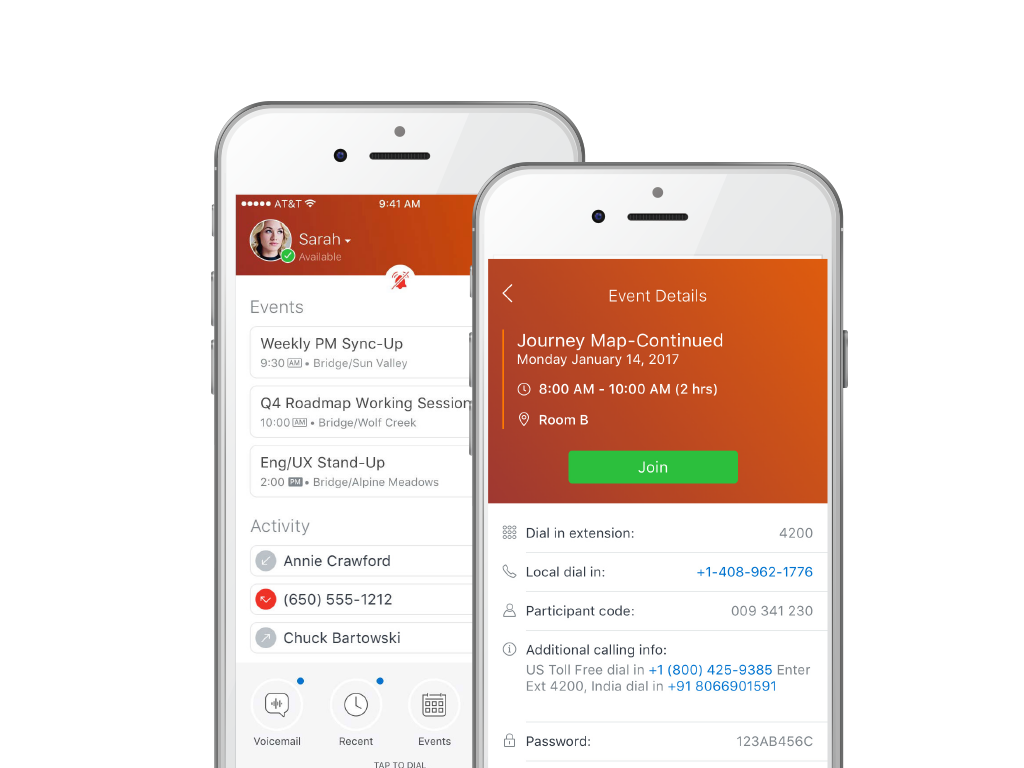
Fuze is a cloud-based unified communications platform that includes IP PBX voice service, video conferencing, and collaboration tools such as content sharing and instant messaging capabilities. It also integrates with a wide range of popular CTI, CRM, and click-to-call solutions.
$0.02
Per Minute
MiCloud Connect
Score 7.8 out of 10
N/A
MiCloud Connect is a business communications solution for contact centers that includes features like IP PBX telephony service, desk phones, softphone, and collaboration tools. It is integrable with other business communication technology, including Microsoft Outlook and CRM software.
Our company has used three different phone systems during my time. It began with an on-premises system from Interactive Intelligence, Inc. (I3), which is primarily a higher-end call-center product. Due to a business relationship, we were able to utilize what would have been …
Our use of ShoreTel at the time was extremely limited. We basically only used them for calling, so any VoIP system that at least did calling right worked for our needs. Fuze really looked and sounded exciting.
Fuze was a cost effective solution that best met our requirements. Compared to 8x8 in particular, Fuze's built in queue logic allowed us to migrate our call flow more seamlessly. To our customers, it didn't sound like we changed a thing even though everything did. That …
Although Avaya offers some cloud-based solutions, they didn't have the features we were looking for in the price-range we were willing to pay. ShoreTel has great features and great pricing, but we would be heavily reliant on hardware at each location or a higher level of …
Fuze won on reporting flexibility and disaster recovery and business continuity features. For reporting, they provide granularity that I haven't seen on other platforms and data for us to create our own. Their base reports are highly visual and boardroom ready. For disaster …
Fuze has way more capability than we need for our small office so it might be best suited for large installations, call centers, and complex environments. Our office is small and our needs [are] minimal, so when we need support we are challenged to understand the support person due to our lack of technical sophistication. We sometimes feel like we should switch to a solution more geared for consumers or SOHO. Nevertheless, Fuze provides reliable service at [a] reasonable cost that meets our needs, and because support is rarely needed we are happy with them most of the time, i.e. when support isn't needed.
If your company has relied only on an on-premises system in the past, Mitel is a fantastic alternative. Mitel provides an excellent hosted option for businesses looking for scalability as they expand as well as ease of deployment for use by branch offices and remote employees. However, I would recommend caution if the company plans to utilize Mitel as its only communications platform because its conferencing solutions are not ready for prime time.
Availability to use your work number anytime anywhere. Our recruiters make themselves available as much as they can. Being able to answer calls from their worklines while not in the office and make calls from their work numbers is a big deal.
Setting up new phones and numbers is very easy with their hub. I don't always have to go directly to their support team to setup new users. As long as I have the mac address of the phone and we have free numbers I can set a new user up in minutes.
Their support team is great as well. If I do need to get help with an issue their support team is quick to respond and very knowledgeable about their systems. Their team is also able to fix most support cases within the same day.
With separate systems and two locations we used to have to fake the system into 4 digit dialing by forwarding all remote extensions to DIDs. Now with Shortel extended to the remote location we have true 4 digit dialing.
The Shortel desktop application makes managing calls and call routing a breeze for even our most novice users.
The Shoretel Mobility app for iPhone does not work very well and is not very intuitive in my experience.
We have had many intermittent instances of employees reporting that call quality is bad, sounds like the caller is garbled and underwater.
I deployed Shoretel Sky to eleven branches in four states over a 6 month period and experiences were not very consistent. Had issues with not enough power bricks being sent with the phones, some phones not having the the face sticker showing messages, directories, etc., user guides (quick start guides) not getting shipped with the phones at some branches, and phones being programmed incorrectly. This made it very difficult to plan my trips to train employees and install these at the various locations.
Cost and support and the primary driving factors. The management team has been extremely responsive and assisting even with the obstacles and hurdles we experienced during implementation. We are still learning how best to manage the solution and comfort and pleasure with the solution will increase as our knowledge and skillsets improve.
Although the price is higher than some of the other Hosted systems out there, the value is definitely worth a renewal. Everything is relative: there are some companies out there who need phones, but don't necessarily care how they work, the functionality/features available/durability etc., they just care that they have phones that make and receive calls. There are other companies that are completely reliant on phones and certain functionality that is provided by the system. There are even some companies who are straight up dependent on the phone system and are losing tons of money anytime they are down, ShoreTel is the perfect fit for theSMB client who sees value in a solid,robust, reliable and high functioning phone system
For most user, Fuze is very user friendly and easy to get use to. When it comes to the admin portal, it can be a little more challenging. There are also a lot of feature you unable to do as an admin that would normally be accessible. This cause the admin to have to rely on Fuze support, which could delay the resolution of a problem
I have not used a wide array of communication software, but this far ShoreTel/MiCloud has been the simplest and easiest to get into. My work employs several temps at certain points throughout the year, and they use this piece of software frequently, and new hires seem to have little to no issue using this software. Additionally, this is our primary telephone communication infrastructure, and I have yet to encounter any issues when signed in and regularly using it handling external calls to our department.
We've had a few outages over the past year. More than other vendors I've used. They usually have outages fixed within an hour. The downside is they do not provide root cause of outages. If they do at takes them at least a month to get it to you
The system has gone down on us MULTIPLE times. We asked them to move us to a different cluster. Shoretel declined. Basically we had problems or outages every month of the year from June 2012 to date. Our old phone system was just that: OLD, no bells or whistles. But it was up every day and I never had to think about it much until it was time for an upgrade. That's how I want Shoretel to be. I want it so reliable that I never have to think about it.
Since Fuze runs across multiple devices and platforms they really strived to make a lightweight interface that is optimized for phone calls, chat, and collaboration. The web client loads fast, the chat is always up-to-date, phone calls arrive on-time. The desktop client is the most feature rich and basically it just adds desktop sharing functionality as well as VoIP for calling, and the mobile client doesn't consume a lot of battery, and it stays running to get phone calls, chats, and can do meetings over Wifi, Cellular Data, or Cellular voice.
Even though the system uses a lower bandwidth connection we have experienced a higher call quality than our previous system which required a T1 line and back up broadband connection.
Our experience with Fuze support has been overall very positive. Their technicians seem to be well trained and able to handle a variety of requests and issues without unnecessary delays or extensive troubleshooting. Fuze allows enough customer access to avoid the need to call support for every little issue but is ready to assist when issues are beyond our capabilities to resolve.
ShoreTel Sky's support is amazing. The only reason why I didn't give it a 10 is that we still need to contact them for stuff that we should be able to do, for ourselves, within the management portal. I know their portal is being worked on, so hopefully they will get the "little things" included for self-management.
At many of our sites with more than 50 users, Fuze sent someone onsite to train. This worked surprisingly well, as the trainer allowed the users to set the pace and answered TONS of questions. Fuze has a very streamlined training process, their staff is very professional, very knowledgeable and very engaging.
I attended the first ShoreTel installer class in Austin,TX. It was a week of intensive study with a live lab and having hands on experience made the class worthwhile. I have taken all of the sales courses and remaining technical courses either online or self study to keep costs down. I send my techs to the first installer course in Austin as I feel it gives them a solid foundation and most of teh other courses they have taken have been online.
Fuze has vast amounts of training videos and guides on how to use its products and services. There are literally endless-hours of training and I often point end-users to a particular video which addresses the specific needs of the user, for example: how to check voicemail. Or, how to share your desktop, etc.
The training identified some things M5 (ShoreTel's cloud division) could provide, however it was only using it every day and asking the Shoretel support several questions that I got the hang of it. The training was able to highlight functions but I did not learn how to use the phone from the training.
Personally, I didn't have any trouble getting started with Fuze. It was installed on my computer on my first day and I was good to go! Little to no hiccups. I was not with the company when they first adapted Fuze so I can not speak to the implementation as a whole.
I feel that the current features that ShoreTel provides are pretty solid, but in future I would love to see it expand into more features to assist inter team communication if possible. Considering that there was not a single issue with ShoreTel in my whole work period of 6months I think it is safe to say that the implementation is pretty standardized.
We have had several vendors try to get our phone business, and I have always given my opinion to management why we need to stay with Fuze. Customer service is wonderful and the support staff puts up with me and they are very helpful. We use another company to do our dialing campaigns. Not sure why, but I think the reason was Fuze didn't offer that service. Fuze from the beginning appealed to our business due to the fact that it seemed so easy to use and manage.
Costs are lower with Mitel's offering than was the case with SureTel's offering. Switching from SureTel to MiTel was simple and painless. A software update was pushed by IT, and users migrated with relative ease. The vast majority of users did not need any involvement from IT during and after the switch over
Fuze does have scalability limits but most of that is how many end-points they can put on a virtual PBX, or VCX as they call them, I THINK its limit is somewhere between 2,000 and 5,000, but we've not had issues with that because we have put users into various VCXs some by location, some by department or function. Either way, we have 7,000 currently deployed, and are going to end up with over 15,000 when we are done, Fuze is VERY scalable.
Shoretel has been very scalable for our organization. We first installed Shoretel in 2003 to standardize three sites on one phone system. As our needs have changed, our Shoretel system has adapted with our growing needs and added locations. Initially, we were using analog phones and have been rolling out VoIP as our budgeting has allowed.
We've definitely seen a business impact on our company in a positive manner. We've been able to provide the best possible service that suits our needs, while not being gouged by ISP's or Telco providers.
We can better serve our customer service reps and tech support people by managing our own system, creating our own ring groups and control use.