Chose Gainsight PX
Unfortunately, I haven't used any other product like Gainsight PX so will move to the next question.

| Product | Rating | Most Used By | Product Summary | Starting Price |
|---|---|---|---|---|
 Gainsight PX | N/A | For SaaS products, Gainsight's product experience software enables companies to track every step of their user's journey and fully understand how they're interacting with a product over time. | $0 100 or less MAUs (Monthly Active Users) | |
 Google Analytics | N/A | Google Analytics is perhaps the best-known web analytics product and, as a free product, it has massive adoption. Although it lacks some enterprise-level features compared to its competitors in the space, the launch of the paid Google Analytics Premium edition seems likely to close the gap. | $150,000 per year |
| Gainsight PX | Google Analytics | |||||||||||||||
|---|---|---|---|---|---|---|---|---|---|---|---|---|---|---|---|---|
| Editions & Modules |
|
| ||||||||||||||
| Offerings |
| |||||||||||||||
| Entry-level Setup Fee | No setup fee | No setup fee | ||||||||||||||
| Additional Details | — | — | ||||||||||||||
| More Pricing Information | ||||||||||||||||
| Gainsight PX | Google Analytics | |
|---|---|---|
| Considered Both Products |  Gainsight PX  Bob Osborn Director of Product Management Chose Gainsight PX We leaned towards Gainsight PX because of the tight integration with Gainsight. Implementations were somewhat similar but the ease of mapping for all features and modules was superior for PX.  David Jensen Operations Manager, Customer Success Chose Gainsight PX Churnzero is similar in its NPS and walk-through abilities as is user IQ but neither fits in the exact same category. Px is unique to anything I've used for the data extraction it offers. It's not a CS tool like those I mentioned but it is easily the best in terms of tracking …  Michael Wohlwend Senior Information Developer, User Assistance Chose Gainsight PX HelpHero is a very flexible and powerful walkthrough tool. We've used it alongside PX. We still use PX for most customer messages, CES surveys, and in-app badges. I also evaluated Pendo, WalkMe, and a few other DAPs.  Justin Miller Director of Customer Success Chose Gainsight PX We chose Gainsight PX over Pendo because of the connector with Gainsight CS for the Customer Success Team.  Helene Tapper Customer Success Manager Chose Gainsight PX I have not used a different product as hands-on as Gainsight PC.  Igor Kranjčec Product Marketing Manager for Growth Chose Gainsight PX The main reason is that Gainsight PX offers a perfect combo - analytics and customer engagement. That allows us to make the engagement contextual, based on real-time analytics results.  Julie Pinto Support Manager Chose Gainsight PX WalkMe: while the in-app engagements were powerful, there was no email capability, and the analytics were an afterthought (rather than a core part of the solution). WhatFix: the concept was great; the in-app engagements could be made into documentation and videos. However, we … |  Google Analytics  Maria Sergeeva UX and Content Designer Chose Google Analytics Wix and other website platforms have a built-in analytic tool, but it is not as sufficient as Google Analytics, so I always use GA as the main source of information about sales. Most of the analytic tools on web platforms can't visualize user flows, which is very important when …  Hash Moody CEO (Chief Executive Officer) Chose Google Analytics Microsoft Clarity is speedy, extremely tidy, and straight to the point, and it contains everything a SME would need to maintain a healthy SEO without the need for technical understanding; its UI is far superior to GA, and it also provides additional capabilities like as …  Alex Nejako Marketing Automation Manager Chose Google Analytics Webtrends as a platform is older than Google Analytics and still quite good. If you have a company that is used to using Webtrends, it's likely still a good fit for you. Google Analytics has a lower entry cost and more accessible training to new Users, so that's why I would …  sandro merkvilishvili Head of e-commerce deparment Chose Google Analytics Ease of use: Google Analytics is known for its user-friendly interface and straightforward setup process, making it accessible for beginners. Adobe Analytics has a steeper learning curve and requires more technical expertise. Features: Adobe Analytics offers a more comprehensive …  Martha McNeil Data Management Analyst Chose Google Analytics Built-in reports are beneficial but you can create custom reports if you need more details with different dimensions and metrics it also provides insights which is just little data about your site traffic in sentence format its the best way to know which strategy you are on …  Thomas (TC) Riley Senior Director, Information Services Chose Google Analytics Adobe Analytics and Google Analytics 360 are both paid/premium options for website tracking. Though there are certain use cases when these might make sense (you operate entirely in the Adobe suite, you're a massive company/site that doesn’t mind the price tag on Google …  Ellen Moon Senior Manager Chose Google Analytics Google Analytics provides everything you need in terms of straight forward analytics needs. The tool is not very flexible compared to other software such as adobe, and if you want to upgrade to premium or add in a bunch of custom situations, that can be become very [tedious] …  Rafael Grandizoli Gerente de Operações Chose Google Analytics Google Analytics had the best price (it's free for major of our clients), and it was easy to find professionals that had experience on using it.  Víctor Garnica Professional Services Lead Chose Google Analytics Adobe Analytics has been in the market for a long time; some people still know it as Omniture or SiteCatalyst. It seems that some great ideas from Google Analytics, such as Enhanced Ecommerce and the new way of measuring events with GA4, are adapted from the traditional Adobe …  Daniel Berry Digital Marketing Manager Chose Google Analytics GA will always have an advantage with data, because it's the source, but other companies do a better job of specializing in certain areas or providing better UX/UI. HubSpot is the king of the latter and SEMrush is ideal for making organic improvements based on data. Ahrefs are … |
| Gainsight PX | Google Analytics | |||||||||||||||||||||||||||
|---|---|---|---|---|---|---|---|---|---|---|---|---|---|---|---|---|---|---|---|---|---|---|---|---|---|---|---|---|
| Web Analytics |
|
| Gainsight PX | Google Analytics | |
|---|---|---|
| Small Businesses |  Fullstory Score 9.1 out of 10 |  StatCounter Score 9.0 out of 10 |
| Medium-sized Companies |  Whatfix Score 8.2 out of 10 |  Siteimprove Score 10.0 out of 10 |
| Enterprises | Whatfix Score 8.2 out of 10 |  Optimal Score 9.0 out of 10 |
| All Alternatives | View all alternatives | View all alternatives |
| Gainsight PX | Google Analytics | |
|---|---|---|
| Likelihood to Recommend | 8.0 (0 ratings) | 8.2 (0 ratings) |
| Likelihood to Renew | 8.2 (0 ratings) | 9.0 (0 ratings) |
| Usability | 8.0 (0 ratings) | 7.5 (0 ratings) |
| Availability | - (0 ratings) | 10.0 (0 ratings) |
| Performance | - (0 ratings) | 10.0 (0 ratings) |
| Support Rating | 7.3 (0 ratings) | 7.0 (0 ratings) |
| Online Training | - (0 ratings) | 10.0 (0 ratings) |
| Implementation Rating | - (0 ratings) | 9.0 (0 ratings) |
| Configurability | - (0 ratings) | 6.0 (0 ratings) |
| Ease of integration | 7.7 (0 ratings) | 10.0 (0 ratings) |
| Product Scalability | - (0 ratings) | 10.0 (0 ratings) |
| Vendor post-sale | - (0 ratings) | 10.0 (0 ratings) |
| Vendor pre-sale | - (0 ratings) | 9.0 (0 ratings) |
| Gainsight PX | Google Analytics | |
|---|---|---|
| Likelihood to Recommend |
|
Thomas (TC) Riley Senior Director, Information Services |
| Pros |
Michael Wohlwend Senior Information Developer, User Assistance |
|
| Cons |
 Oded Wilder Head of Client Success |
 Heide Rembold Director of Marketing & Analytics |
| Likelihood to Renew |
Helene Tapper Customer Success Manager |
 Joshua Van Horsen Marketing Manager |
| Usability |
|
 Victor Campos Web Developer |
| Reliability and Availability | No answers on this topic |
|
| Performance | No answers on this topic |
|
| Support Rating |
Bob Osborn Director of Product Management |
 Sarah Hoffman Media Director |
| Online Training | No answers on this topic |
 Roy Morejon President |
| Implementation Rating | No answers on this topic |
 Sid Haas Vice President of Business Development |
| Alternatives Considered |
|
|
| Scalability | No answers on this topic |
|
| Return on Investment |
|
|
| ScreenShots | Gainsight PX Screenshots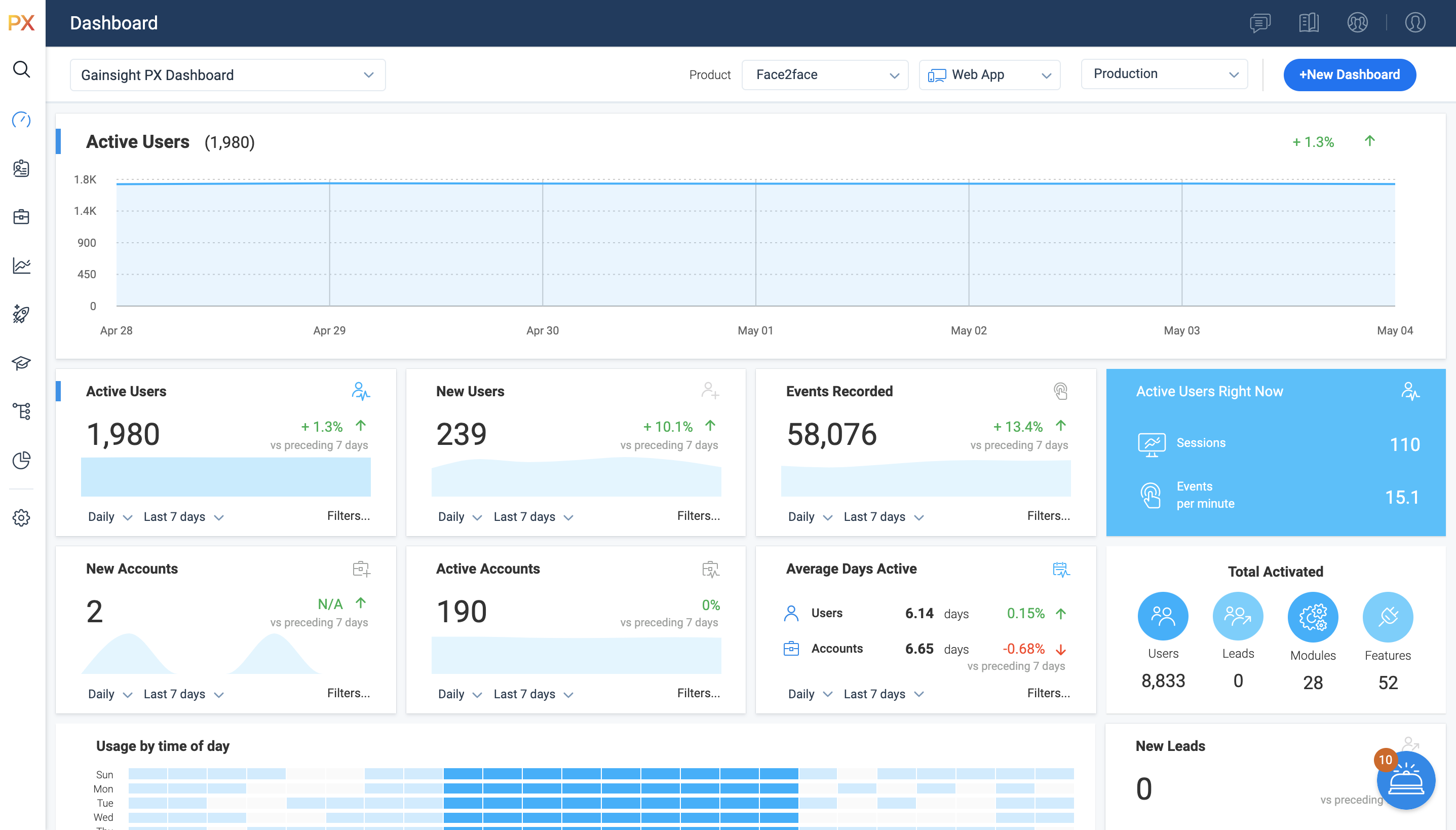      |